
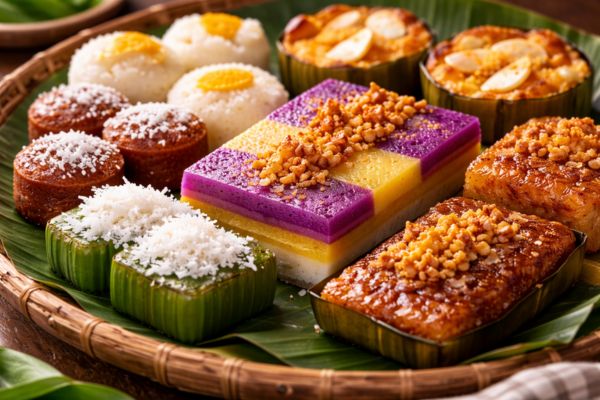
What Is Kakanin? Filipino Rice Cakes, History & Meaning
Studio Tributes / Filipino Food / What Is Kakanin?
Quick Answer - What Is Kakanin?
🍚What it is: The Filipino umbrella term for native rice cakes and sticky sweets — made primarily from glutinous rice, coconut milk, and sugar, prepared in dozens of forms across the Philippines.
📖Name meaning: From the Tagalog kain (to eat) and kanin (rice). Documented as offerings to Filipino gods as early as 1695 in a Spanish-Tagalog dictionary.
🕰️How old is it: Pre-colonial — Antonio Pigafetta described Philippine rice cakes on Magellan's 1521 expedition. Filipino ancestors offered them to gods long before that.
🥥Key ingredients: Glutinous rice (malagkit) or rice flour (galapong), coconut milk, sugar, and banana leaves for wrapping and steaming.
🎄The Christmas connection: Bibingka and puto bumbong are so tied to Simbang Gabi that eating them outside of December feels wrong. They are the official tastes of the Philippine Christmas season.
✨When it's served: Merienda, fiestas, Christmas, wakes, birthdays, harvests, and any time someone wants to say: this moment deserves something sweet and made by hand.
Before the Spanish arrived. Before the Americans. Before the Japanese. Before any of the colonial powers that came and went and left their marks on Philippine food — there was rice. And from that rice, there was kakanin.
Kakanin is not a dish. It is a universe of dishes — a category so broad and so deeply embedded in Philippine life that it appears at breakfast, merienda, fiesta, Christmas, wake, harvest, and homecoming. It is the steam rising from bamboo tubes outside a church at four in the morning. It is the bilao your lola carried to every family gathering. It is the purple puto bumbong that you only ever seem to eat in December and which, somehow, tastes like the whole Christmas season distilled into something you can hold in both hands.
The word itself — kakanin — comes from two Tagalog roots:kain, to eat, andkanin, cooked rice. Combined, they describe a category of rice-based sweets that predate every foreign influence on Philippine cuisine and have survived every attempt by history to replace them with something else. Friar Domingo de los Santos documented the term in his 1695 Spanish-Tagalog dictionary, defining kakanin and calamay as offerings made to Filipino ancestors. By the time the Spanish were writing it down, kakanin had already been a fixture of Filipino life for longer than anyone could count.
At Studio Tributes, we celebrate Filipino food because it carries more than flavor — it carries the whole story of a people. Today we are going deep on kakanin: what it is, how it began, why the same three ingredients can produce such wildly different results, what the bibingka and puto bumbong seasons mean, and why the bilao at the center of the fiesta table is one of the most important objects in Filipino cultural life.
🍚 What Is Kakanin?
Kakanin is the Filipino term for native rice cakes — sticky, sweet, chewy confections made primarily from glutinous rice (malagkit), coconut milk, and sugar. It is not a single dish but a vast family of sweets, each made from slight variations of the same core ingredients, transformed by different techniques, different cooking vessels, different wrapping materials, and different regional traditions into something completely its own.
According to Pepper.ph's history of kakanin, the name is derived from two Tagalog words:kain(to eat) andkanin(rice). It is an umbrella term for sweets made of glutinous rice and coconut milk — two ingredients that tropical countries like the Philippines have in extraordinary abundance.
The base ingredients are usually used in one of two forms:
🌾Galapong— rice flour made by soaking rice overnight, then grinding and straining it through cheesecloth. Gives a smoother, more delicate texture. The basis for puto, bibingka, sapin-sapin, maja blanca, and palitaw.
🌾Malagkit— whole or ground glutinous rice grains, left stickier and more substantial. The basis for biko, suman, puto bumbong, and espasol.
From these two forms, and with coconut milk, sugar, banana leaves, bamboo tubes, clay pots, bilao trays, and steam — Filipino cooks have produced dozens of distinct rice cakes, each with its own texture, flavor, color, occasion, and regional personality.
As Panlasang Pinoy's kakanin guide puts it perfectly: stir over heat, you get biko. Boil and roll, you get palitaw. Wrap and steam, you get suman. The technique changes everything, even when the ingredients stay nearly the same.
📜 The History: From Pre-Colonial Offerings to Simbang Gabi Vendors
The history of kakanin is the history of rice in the Philippines — and rice in the Philippines has been sacred for as long as Filipinos have existed.
According to Felice Sta. Maria, as cited in research by food scholars Amy Besa and Romy Dorotan in their 2006 book Memories of Philippine Kitchens, pre-colonial Filipinos held an ancient belief that there was a soul in every grain of rice. That belief evolved into a tradition of offering rice cakes to the gods and to honored guests — to ensure good harvests, good health, and the blessing of the natural world. Kakanin, in its earliest form, was sacred food.
The first recorded description of Philippine kakanin comes from Antonio Pigafetta, the Italian scholar who accompanied Ferdinand Magellan on his 1521 expedition to the Philippines. Pigafetta described suman — the rice cake wrapped in leaves — as rice cakes "wrapped in leaves and made in somewhat longish pieces." He was documenting something that was already, by 1521, an ancient tradition.
By 1695, Friar Domingo de los Santos was writing his Spanish-Tagalog dictionary and specifically defining kakanin and calamay as offerings made to Filipino ancestors. This documentation confirmed what the pre-colonial tradition already knew: these were not just snacks. They were ceremonial foods. They were the things you brought when you needed to mark something important.
Through the Spanish colonial period, kakanin absorbed new influences without losing its essential character. Spanish ingredients — eggs, cheese, sugar in refined form — found their way into some varieties. The bibingkahan, the traditional clay stove used to cook bibingka, became a fixture of the colonial landscape. The panciteria created by Chinese traders had its kakanin parallel in the vendors who set up outside churches to feed the faithful after mass.
That church-outside-vendor tradition became one of the most enduring images in all of Philippine food culture: the Simbang Gabi vendor. During the nine-day dawn mass series leading to Christmas, vendors set up alongside churches in the dark hours of the early morning to sell bibingka and puto bumbong to mass-goers as they emerged from worship. The steam from the bibingkahan and the bamboo tubes of the puto bumbong seller — visible in the cold December air — became as much a part of the Philippine Christmas as the parol lanterns hanging in every window.
Through American occupation, through the Second World War, through every political and economic upheaval of the 20th century, kakanin remained. It adapted. It regionalized further. It absorbed new flavors — ube, macapuno, pandan — without abandoning its core identity. And today, in the 21st century, in every city abroad where Filipinos have built communities, kakanin still appears at the fiesta table, still comes out of lola's kitchen at Christmas, and still means exactly what it has always meant: this moment is worth the effort of making something by hand.
🍮 A Guide to the Most Beloved Kakanin Varieties
👅 What Does Kakanin Taste Like?
Kakanin tastes like the gentlest possible sweetness — mild, chewy, and faintly rich from the coconut milk, without ever being overwhelming. If you have never had it before, the experience might surprise you. Looking at a slice of sapin-sapin, with its dramatic purple, yellow, and white layers, you might expect something light and fruit-forward, like a lemon bar. Looking at biko, with its dark caramel glaze and sticky surface, you might expect something intensely sweet, like fudge.
What you get, instead, is more nuanced than either.
As Tasting Table's kakanin guide describes: you get a chewy consistency with a mild sweetness that serves as a delicious backdrop to different garnishes — coconut caramel, grated cheese, toasted coconut flakes, toasted coconut milk curds, or salted egg. The sweetness is never the main event. It is the frame. The garnish and the texture are where the real character of each kakanin lives.
Biko is the richest — thick with coconut milk and brown sugar, the latik on top adding a toasted, slightly bitter contrast to the sweetness below. Palitaw is the most delicate — plain until you add the sesame seeds, sugar, and coconut, at which point the whole thing snaps into focus. Puto is mild and springy, almost bread-like in its lightness. Kutsinta has a jelly-bounce that catches people off guard the first time. And bibingka — especially fresh from the bibingkahan on a cold December morning, buttered and topped with salted egg — tastes like the specific joy of having completed something hard (the early morning mass) and being rewarded with something warm.
If I had to describe kakanin in one sentence: it tastes like care made edible. The labor of soaking, grinding, wrapping, steaming, and layering is in every bite — not as effort, but as tenderness.
🎄 Kakanin and the Filipino Calendar
One of the most important things to understand about kakanin is that it does not appear randomly. It follows a calendar — sometimes the Filipino liturgical calendar, sometimes the agricultural one, sometimes simply the rhythm of the family's year. Different kakanin belong to different moments, and a Filipino who grew up in the Philippines understands these associations without needing them explained.
Merienda — every day. The Filipino tradition of mid-morning and mid-afternoon snacking is kakanin's most natural home. A few pieces of puto with coffee. A slice of biko between meals. Palitaw with sesame seeds and sugar on a quiet afternoon. Panlasang Pinoy's kakanin guide notes that merienda is where kakanin lives most comfortably — between meals, at a comfortable hour, eaten slowly.
Fiesta — the bilao moment. No barrio fiesta is complete without a spread of kakanin. Sapin-sapin, biko, puto, kutsinta, and maja blanca all appear on the same table, and guests are expected to try every single one. The bilao — the large woven tray — is kakanin's natural presentation vessel. A bilao of sapin-sapin at the center of a fiesta table is one of the most immediately recognizable images in all of Filipino food culture.
Simbang Gabi — bibingka and puto bumbong. These two kakanin are so inseparable from the nine-day dawn mass tradition before Christmas that they constitute their own cultural category. As Inquirer Lifestyle has documented, eating bibingka and puto bumbong after early morning mass is a ritual that Filipinos observe across generations and across continents. The steam from the bamboo tubes. The clay pot over the coals. The dark street outside the church, still cold, the mass-goers in their coats, the vendor's lamp the brightest light on the block. Kakanin as Christmas. Kakanin as homecoming.
Pasalubong — the gift of kakanin. Espasol from Laguna. Suman from your aunt's province. Puto Calasiao from Pangasinan. Kakanin is one of the Philippines' great pasalubong foods — the gift you bring from a specific place, evidence that you were somewhere and thought of the people waiting at home. Each regional variety carries the identity of its place of origin, and receiving it is receiving a piece of somewhere.
Christmas Eve / Noche Buena. Maja blanca, bibingka, and various suman varieties appear on the Noche Buena table alongside the lechon and the pancit. Kakanin has a formal role at the Christmas feast — it is not just a snack but a participant in the most important meal of the Filipino year.
🗣️ Learn the Tagalog
The vocabulary around kakanin reflects how central these foods are to Filipino life — not just as sweets but as cultural markers, occasions, and memories.
The category and its language:
🍚Kakanin(ka-ka-nin) — rice cakes; the whole family of Filipino glutinous rice sweets
🌾Malagkit(ma-lag-kit) — glutinous/sticky rice; the primary ingredient
🌾Galapong(ga-la-pong) — rice flour made from soaked, ground, and strained rice; smoother and more delicate
🥥Latik(la-tik) — toasted coconut curd; the caramel-flavored coconut solids used as topping
🍌Dahon ng saging(da-hon nang sa-ging) — banana leaf; wrapping material for suman and many other kakanin
🪵Bilao(bi-la-o) — the large woven tray on which kakanin are displayed and served at fiestas
🎋Bumbong(bum-bong) — bamboo tube; the vessel for steaming puto bumbong
The occasions:
☀️Merienda(me-rien-da) — the Filipino mid-morning and mid-afternoon snack; kakanin's most frequent appearance
🎉Handaan(han-da-an) — a celebration feast; kakanin is always present
⛪Simbang Gabi(sim-bang ga-bi) — the nine-day Filipino Catholic dawn mass series before Christmas; the occasion of bibingka and puto bumbong
🎁Pasalubong(pa-sa-lu-bong) — a gift brought from a place of travel; kakanin is one of the Philippines' most beloved pasalubong foods
🌙Noche Buena(no-che bwe-na) — Christmas Eve feast; kakanin appears at the most important table of the year
At the table:
😋Ang sarap!(ang sa-rap) — so delicious!
🥥May gata ba?(mai ga-ta ba) — is there coconut milk in this? — the question that almost always has the answer yes
🍫Lagyan ng latik(lag-yan nang la-tik) — top it with latik; the instruction for maximum kakanin experience
🎋Puto bumbong na!(pu-to bum-bong na) — the puto bumbong is ready! — one of the most joyful phrases in December Philippines
🤩 Fun Facts About Kakanin
1. Kakanin was documented in 1521 — by Magellan's expedition journalist. Antonio Pigafetta, the Italian scholar on Ferdinand Magellan's voyage, described Philippine rice cakes as "wrapped in leaves and made in somewhat longish pieces." He was describing suman, which was already, by that account, a fully formed and traditional food. Kakanin predates every foreign documentation of Philippine cuisine.
2. Filipino ancestors believed there was a soul in every grain of rice. According to Felice Sta. Maria and Atlas Obscura, this ancient belief meant that rice — and by extension, kakanin — was not simply food. It was sacred. Offering rice cakes to the gods and to ancestors was a ritual that ensured good health, good harvests, and the continued blessing of the natural world. Kakanin began as a ceremonial food before it became a fiesta food.
3. The word kakanin was documented in a 1695 Spanish-Tagalog dictionary as an offering. Friar Domingo de los Santos specifically defined kakanin and calamay as offerings made to Filipino ancestors. By the time the Spanish were writing this down, the tradition was already old enough to require explanation to outsiders.
4. Puto bumbong's purple color does not come from ube. The violet color of puto bumbong comes from pirurutong — an heirloom variety of purple glutinous rice that is almost impossible to find outside of specialist Philippine markets. When modern recipes substitute ube flavoring, they are technically producing a different product. The original puto bumbong is a specific shade of violet that belongs entirely to that specific rice variety.
5. Biko's name may come from Hokkien Chinese. As Tasting Table's kakanin history notes, the first syllable of biko is believed to be the Hokkien word for uncooked rice. This connects biko — one of the most quintessentially Filipino kakanin — to the same Chinese trading history that brought pancit to the Philippines. Philippine food absorbs influences and makes them its own. Kakanin is no exception.
6. Kutsinta is derived from a Hokkien Chinese dessert. Kutsinta is derived from kueh tsin tao — the Hokkien name for a type of bite-sized snack or dessert introduced by Chinese traders to the pre-colonial Philippines. The jelly-like, annatto-colored rice cake that Filipino families eat for merienda alongside puto has a Chinese ancestor that most people eating it have never heard of.
7. The bibingkahan — the clay stove used to cook bibingka — is itself a cultural artifact. The traditional terra cotta pot with coals above and below, lined with banana leaves, creates the characteristic scorched edges and smoky flavor that distinguishes bibingka from anything baked in a modern oven. The bibingkahan is not just a cooking method. It is an experience — the smell of the coal, the sound of the batter setting, the sight of the vendor tending the fire in the cold December dark.
8. Bayanihan — communal labor — is built into kakanin making. The labor of making kakanin has historically been shared labor. Soaking, grinding, wrapping, steaming — these are tasks that communities did together. Out of Town Blog's kakanin guide notes that the preparation of kakanin involves communal cooperation, locally called bayanihan, which creates not just food but social bonds. The bilao of kakanin on the fiesta table is the result of many hands working together, which is why it tastes the way it does.
9. Pichi-pichi is technically not a rice cake — but it is absolutely kakanin. Made from cassava rather than rice, pichi-pichi violates the strict definition of kakanin as a rice-based sweet. And yet it appears on every kakanin list, every fiesta bilao, and in every Filipino memory of the category. This is because kakanin is, at its core, about a spirit of preparation — soaked, ground, wrapped, steamed, handmade — as much as it is about any specific ingredient.
10. Completing Simbang Gabi earns you a wish — and bibingka and puto bumbong either way. The nine-day Filipino Catholic dawn mass tradition holds that completing all nine masses earns you a wish granted by God. Those who complete it get their wish. Those who do not still get bibingka and puto bumbong outside the church — which, some argue, is the better reward. Either way, kakanin is the prize.
🌍 How Kakanin Connects Filipinos Everywhere
Kakanin travels differently than most Filipino foods — not because it is easy to replicate abroad, but because the longing for it is so specific that it drives Filipinos to extraordinary lengths to recreate it.
Bibingka requires a clay pot and charcoal. Puto bumbong requires pirurutong rice and bamboo tubes. Sapin-sapin requires the patience to set three separate layers and the skill to press them together while still warm. None of these are things that can be assembled from a standard foreign grocery store. And yet, in Los Angeles, Toronto, London, Dubai, and Sydney — wherever Filipinos have built communities — kakanin appears at Christmas, at fiestas, and at the kitchens of the people who refuse to let their children grow up without knowing what it tastes like.
The Filipino diaspora's relationship with kakanin is, in many ways, the story of how Filipino identity travels. It is not the easy foods that mark who you are in a foreign country. It is the labor-intensive ones — the ones that require you to source specific ingredients, learn specific techniques, and give hours of your Saturday to making something that your grandmother made without thinking twice. Those are the foods that prove something. That prove the culture is not just remembered but practiced. That prove the tradition is not just inherited but chosen.
The bilao of kakanin at the overseas Filipino party is never just dessert. It is a declaration. It says: we know where we came from. We know what our grandmothers made. We know that a grain of rice has a soul. And we are passing that knowledge on — one palitaw, one biko, one puto bumbong at a time.
❓ FAQ — Everything You Need to Know About Kakanin
What is kakanin?
Kakanin is the Filipino umbrella term for native rice cakes and sticky sweets made primarily from glutinous rice (malagkit) and coconut milk. The word comes from the Tagalogkain(to eat) andkanin(cooked rice). These pre-colonial sweets have been served at celebrations, merienda, and religious occasions in the Philippines for thousands of years, documented as offerings to Filipino gods as early as 1695.
What is the most popular kakanin?
Biko, puto, palitaw, and suman are among the most widely eaten year-round. Bibingka and puto bumbong hold a special status as the Christmas season kakanin — tied to Simbang Gabi and largely unavailable at other times of year, which makes them among the most emotionally resonant of all Filipino foods.
What does kakanin taste like?
Kakanin tastes mildly sweet with a characteristic chewiness from the glutinous rice. The coconut milk adds a gentle richness. The sweetness is never the main event — it is the frame. The garnish (latik, sesame seeds, grated coconut, salted egg) and the texture are where the real character of each variety lives. As Tasting Table describes, biting into kakanin for the first time often surprises — it is chewier, milder, and more nuanced than its appearance suggests.
Why is puto bumbong only available at Christmas?
Puto bumbong is so tied to Simbang Gabi — the nine-day Filipino Catholic dawn mass series before Christmas — that it is rarely made or sold outside of December. Vendors set up outside churches during the early morning masses to sell it hot from the bamboo tubes. Its seasonal scarcity is part of what makes it feel precious when it finally arrives.
What is suman?
Suman is glutinous rice cooked in coconut milk, wrapped tightly in banana or palm leaves, and steamed. It is one of the oldest documented kakanin — described by Antonio Pigafetta on Magellan's 1521 expedition as rice cakes "wrapped in leaves and made in somewhat longish pieces." It is eaten with sugar, latik, or ripe mango, and is called budbod in Visayan languages.
What is the difference between kakanin varieties?
The main differences are in technique. The same basic ingredients — glutinous rice, coconut milk, sugar — produce dramatically different results: stirred over heat becomes biko, boiled and floating becomes palitaw, steamed in bamboo becomes puto bumbong, wrapped in banana leaves becomes suman, and pressed into layers becomes sapin-sapin. As Panlasang Pinoy notes, the technique changes everything, even when the ingredients stay nearly the same.
Is kakanin the same as mochi?
They share a glutinous rice base and a characteristic chewiness, but they are distinct culinary traditions. Japanese mochi is typically pounded into a smooth, uniform dough and filled or shaped in ways that emphasize elasticity. Filipino kakanin is more varied in technique — steamed, baked, boiled, layered — and is typically sweetened with coconut milk and brown sugar rather than the bean pastes and subtle flavors common in mochi. They are cousins, not siblings.
Can kakanin be made at home?
Yes, though some varieties are more accessible than others. Palitaw, biko, and kutsinta are relatively straightforward to make at home with glutinous rice flour and coconut milk. Bibingka and puto bumbong require more specialized equipment (clay pots, bamboo tubes, specific rice varieties) that can be difficult to source outside the Philippines. Filipino grocery stores and Asian supermarkets abroad typically carry the core ingredients for most varieties.
💛 Closing
Kakanin did not survive five centuries of colonial history, two world wars, mass migration, and the full force of global fast food culture because it was convenient. It survived because it was irreplaceable.
No other food category in the Philippines carries quite the same emotional freight. The bilao of sapin-sapin at the fiesta table. The bibingka eaten in the dark outside a church on a cold December morning. The suman your lola made without a recipe, following a process she learned from her lola, who learned it from hers, stretching back to the time before anyone was writing any of this down. The palitaw that appeared at merienda on ordinary afternoons and somehow tasted like Sunday. The puto bumbong that you only ever eat in December and which, by the time you eat it, already feels like a memory.
Kakanin is rice and coconut milk and sugar and labor and time. But it is also the oldest continuously maintained food tradition in the Philippine archipelago. It is the thing that Filipino ancestors offered to their gods — which means it is the thing they believed was precious enough for that purpose. Five hundred years later, the rest of the world is just beginning to discover that they were right.
At Studio Tributes, we celebrate Filipino food because it carries more than flavor — it carries the whole story of a people. Kakanin carries that story in every bilao, every bamboo tube, every banana leaf, and in every kitchen where someone still takes the time to make it by hand because that is the only way it has ever truly been made.
Keep exploring Filipino food and culture with us:
👉 Get your FREE Filipino coloring pages here.
🎨 Get our Filipino Food Activity Book on Amazon
📚 Read more Filipino food stories on our blog
💭 A Memory to Hold Onto
Did kakanin bring back a tray, a gathering, or a merienda table for you?
Maybe a banana-leaf-lined bilao with little squares and rounds arranged side by side.
Maybe a holiday morning with bibingka and puto bumbong nearby.
Maybe a favorite rice cake you always looked for first.
Which kind of kakanin did your family always have?
Did you love the chewy ones, the soft steamed ones, or the baked ones most?
What memory comes back when you picture those trays of rice cakes?
If a memory came to mind, share your kakanin story on Facebook or Instagram and tag @StudioTributes so we can celebrate it with you. And if you’d like more warm Filipino food stories, cultural memories, and creative inspiration, come spend time with us on social media.
Read Next
• What Is Pandesal?
• What Is Pansit?
• What Is Lechon?
• What Is Halo-Halo?
Together, these foods tell the story of Filipino life — from everyday breakfast to fiesta celebration.
📚 References & Further Reading
Pepper.ph — "Kakanin: The History Behind 7 Filipino Sticky Rice Snacks"— Source for etymology, galapong/malagkit distinction, and biko name origins.
Tasting Table — "Kakanin: The Rich History of the Popular Filipino Rice Snacks, Explained"— Source for pre-colonial rice soul belief, kutsinta Hokkien origins, puto name etymology, and bibingka-Goa connection.
Out of Town Blog — "Kakanin: A Guide to Authentic Filipino Native Delicacies"— Source for bayanihan in kakanin making and community significance.
Panlasang Pinoy — "Kakanin Guide: Traditional Filipino Rice Cakes & Delicacies" (2025)— Source for technique distinctions and occasion-kakanin pairings.
IFEX Connect — "Reverence for Suman"— Source for Pigafetta's 1521 suman description, Friar de los Santos 1695 dictionary documentation, and Amy Besa/Romy Dorotan research.
Juan's Kakanin — "Suman: Origin and Benefits"— Source for suman's pre-colonial and harvest festival origins.
Inquirer Lifestyle — "Beyond Bibingka and Puto Bumbong: 12 Kakanin of Christmas"— Source for Simbang Gabi kakanin tradition and Christmas season varieties.
Tatler Asia — "Are You a Fan of Kakanin? 11 Popular Filipino Rice Cakes You Need to Try" (2024)— Source for puto bumbong pirurutong details and kutsinta classification nuance.
HICAPS — "The Only Kakanin List You'll Ever Need" (2024)— Source for espasol regional identity and puto bumbong seasonal context.
Encyclopaedia Britannica — Philippine Cuisine— Supporting cultural context for Filipino culinary history.
This article blends Studio Tributes storytelling with cultural and culinary research to create a warm, family-friendly learning experience.