
What Is Kwek-Kwek? Filipino Street Food Explained
Studio Tributes / Filipino Food / What Is Kwek-Kwek?
What is Kwek Kwek?
Some foods belong to the formal table. Others belong to sidewalks, school breaks, quick cravings, and the kind of everyday hunger that makes something small feel unforgettable.
Kwek-kwek belongs to that second kind.
It is playful on sight — bright orange, bite-sized, easy to hold, and almost impossible not to notice. If you grew up around Filipino street food, kwek-kwek may live in the same memory lane as fish balls, kikiam, squid balls, and sweet-spicy sauce cups balanced in one hand. It is the kind of food that feels casual, but also beloved enough to inspire real loyalty. Everybody seems to have an opinion about the batter, the dip, or whether the vinegar should be spicy.
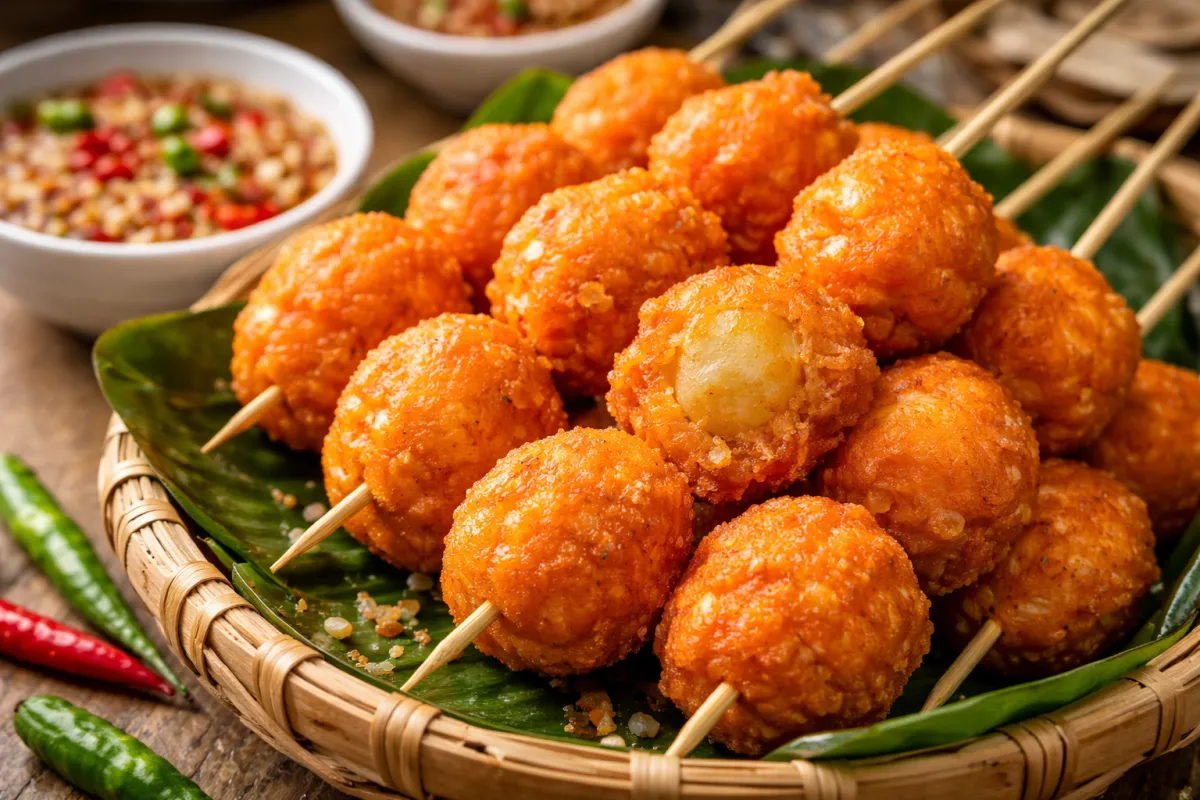
Kawaling Pinoy describes kwek-kwek as a popular Filipino street food made of quail eggs coated with orange batter and deep-fried to golden perfection. Panlasang Pinoy similarly describes it as deep-fried boiled quail eggs in orange batter.
At Studio Tributes, we love foods like kwek-kwek because they carry more than flavor. They carry sidewalk memory, merienda culture, and the joy of food that does not need to be fancy to be loved. Today, we’re looking at what kwek-kwek is, what makes it different from tokneneng, what it tastes like, and why it continues to hold such a cheerful place in Filipino street-food culture. Wikipedia’s Filipino cuisine overview lists kwek-kwek among popular Filipino street foods, alongside tokneneng, fish balls, and other familiar snacks.
🥚 What Is It?
Kwek-kwek is a Filipino street snack made by coating hard-boiled quail eggs in an orange batter and deep-frying them until crisp. The batter is commonly made from flour, cornstarch, water, and annatto, which gives the snack its signature vivid orange color. Panlasang Pinoy’s recipe specifically lists flour, cornstarch, water, and annatto powder as the base batter ingredients, while Kawaling Pinoy also highlights the orange batter as one of the dish’s defining features.
A classic kwek-kwek often includes:
🥚 Quail eggs — the defining ingredient and the reason the snack is so bite-sized
🟠 Orange batter — usually colored with annatto
🌽 Cornstarch and flour — often used together for a crisp coating
🔥 Hot oil — for frying until golden and crisp
🥣 Dipping sauce — usually vinegar, spicy vinegar, or a sweet-savory sauce
One of the most useful distinctions to know is that kwek-kwek is traditionally made with quail eggs, while tokneneng is the larger version made with chicken or duck eggs. Wikipedia’s tokneneng entry says exactly that: kwek-kwek is a popular variant of tokneneng made with quail eggs, and the two are often wrongly used interchangeably.
That size difference changes the whole experience. Kwek-kwek feels snackier, poppable, quicker. It is ideal for skewering, dipping, and eating in a few bites while standing at a street stall. Tokneneng, by contrast, feels more substantial. So even though they belong to the same street-food family, kwek-kwek has its own personality: smaller, cuter, quicker, and somehow even more playful.
📜 The Story Behind It
Kwek-kwek’s story is closely tied to the larger story of Filipino street food.
It lives in the world of quick-cooked snacks sold from carts, neighborhood stalls, and sidewalk setups — foods meant to be eaten hot, dipped generously, and shared casually. Wikipedia’s Filipino cuisine overview lists kwek-kwek among street foods that are commonly sold with other well-known Filipino snacks such as fish balls, squid balls, and kikiam.
That context matters because kwek-kwek is not usually talked about as a formal heritage dish in the same way as adobo or kare-kare. Its cultural power is different. It belongs to everyday movement: outside schools, in neighborhoods, near markets, around merienda time, and in the small, affordable pleasures that shape food memory just as strongly as holiday tables do.
It is also part of a broader Filipino affection for egg-based snacks. The Filipino cuisine overview groups it alongside tokneneng, balut, and penoy, all of which show how eggs occupy a fascinating place in Filipino street-snack culture. But kwek-kwek is probably the most cheerful of the bunch. It is bright, approachable, and easy even for first-timers to understand.
And then there is the name.
Unlike formal dish names that can sound culinary or historical, “kwek-kwek” feels playful — almost onomatopoeic. It sounds like something you would want to say with a smile. That playful quality suits the snack well. It is one of those foods that feels immediately friendly.
That may be why it stays so loved. Kwek-kwek is not trying to impress with complexity. It wins through familiarity, texture, color, and the tiny ritual of dipping and eating while the batter is still hot.
👅 What Does It Taste Like?
Kwek-kwek tastes savory, lightly eggy, crisp, and satisfying.
The first thing you notice is usually the coating. A good kwek-kwek has a light, crisp batter that gives way to the smooth firmness of the quail egg inside. Kawaling Pinoy describes the snack as deep-fried to golden perfection, while recipe versions from Panlasang Pinoy and Foxy Folksy emphasize a crisp orange batter around the egg.
On its own, the flavor is mild and savory. The quail egg brings a slightly richer egg flavor than the batter itself, which is why the dip matters so much.
And this is where kwek-kwek becomes especially fun.
With spicy vinegar, it tastes sharper, brighter, and more snacky.
With a sweet-savory sauce, it feels warmer, saltier, and more indulgent.
With both, it becomes a little choose-your-own-experience street food.
If I had to describe it simply, I’d say this:
Kwek-kwek tastes like crunch with a surprise inside.
It is not overly complicated. That is part of its charm. It is snack food that depends on contrast — crisp shell, smooth egg, bold dip — and in that simple structure, it becomes extremely craveable.
🗣️ Learn the Tagalog
One of the nicest ways to understand kwek-kwek is through the language that lives around it.
Because this is street food, the vocabulary around it often feels casual, immediate, and snack-oriented. People do not usually talk about kwek-kwek in the language of ceremony. They talk about it in the language of craving: Is there vinegar? Is it still hot? Are we getting some? Which sauce do you want?
Here are some useful Tagalog words and phrases connected to kwek-kwek:
Kwek-kwek (kwek-kwek) — The snack itself
Itlog (eet-log) — Egg
Itlog pugo (eet-log poo-go) — Quail egg
Harina (hah-ree-nah) — Flour
Asuete / Atsuete (ah-soo-eh-teh / aht-soo-eh-teh) — Annatto
Malutong (mah-loo-tong) — Crisp / crunchy
Mainit (mah-ee-neet) — Hot / warm
Suka (soo-kah) — Vinegar
Maanghang (mah-ang-hang) — Spicy
Merienda (meh-ree-en-dah) — Snack / light meal
Tuhog (too-hog) — Skewer / to skewer
Masarap (mah-sah-rahp) — Delicious
And here are a few phrases that feel especially at home with this snack:
May kwek-kwek pa ba? (mai kwek-kwek pah bah) — Is there any kwek-kwek left?
Masarap ang kwek-kwek! (mah-sah-rahp ang kwek-kwek) — Kwek-kwek is delicious!
Lagyan mo ng suka. (lahg-yan moh nang soo-kah) — Add vinegar to it.
Mainit pa ang kwek-kwek. (mah-ee-neet pah ang kwek-kwek) — The kwek-kwek is still hot.
What I love about these words is that they fit the life of the snack so naturally. Malutong matters because crispness is one of the best parts. Suka matters because vinegar is one of its classic dipping partners. Mainit matters because kwek-kwek is especially good when it has just come out of the oil. And merienda matters because this is exactly the kind of snack that fills that in-between-meals space so well.
🎨 Color It!
Bring kwek-kwek to life in a whole new way — through art.
This is one of those foods that may look simple at first, but becomes surprisingly fun on the page. Kwek-kwek gives you bright orange batter, little rounded shapes, dipping sauce bowls, skewers or picks, and the contrast of a smooth egg inside a crisp fried shell. It has that same playful visual energy that makes street food feel lively and easy to love.
Our Filipino Food Coloring Book on Amazon invites you to slow down and notice those details in a new way. As you color, you begin to see what makes kwek-kwek so memorable: the cheerful color, the snackable size, the warm just-fried feeling, and the simple delight of food meant to be dipped and eaten right away.
That makes it especially meaningful for:
🌼 families looking for a calm activity to enjoy together
🌼 parents introducing Filipino culture to children in a creative way
🌼 adults and seniors who enjoy nostalgic, mindful coloring
🌼 teachers, homeschoolers, and community groups exploring multicultural learning
And because kwek-kwek is so tied to street-food memory, the page can open fun conversations too: Did you always dip it in vinegar? Did you eat it after school? Was it part of your favorite merienda stop?
When you finish your kwek-kwek page, we’d love to see it. Share your completed coloring on Facebook or Instagram and tag @StudioTributes so we can celebrate your creativity with you.
If you’d like to explore Filipino food through art, family connection, and cultural memory, our Filipino Food Coloring Book is waiting for you.
👉 Get your copy on Amazon here
🤩 Fun Facts About Kwek-Kwek
1. Kwek-kwek is made with quail eggs.
That is one of the clearest things that distinguishes it from tokneneng.
2. Tokneneng is the bigger cousin.
Tokneneng uses larger chicken or duck eggs, while kwek-kwek uses quail eggs.
3. The orange color usually comes from annatto.
Recipe sources commonly use annatto powder or annatto-colored liquid in the batter.
4. It is a classic Filipino street food.
Kawaling Pinoy directly describes it that way, and broader Filipino cuisine references place it firmly in the street-snack category.
5. The dip matters almost as much as the batter.
Vinegar and sweet-spicy sauces are both common serving styles.
6. It is one of the most cheerful-looking Filipino snacks.
That bright orange coating makes it instantly recognizable.
7. It fits perfectly into merienda culture.
It is quick, hot, snackable, and easy to eat on the go.
🛒 What You’ll Notice at a Filipino Street Stall
Kwek-kwek rarely stands alone.
At a Filipino street-food stall, it often appears beside fish balls, squid balls, kikiam, and other familiar fried snacks. Wikipedia’s Filipino cuisine overview specifically mentions kwek-kwek in this broader street-food environment.
That setting matters because it shapes how the food feels. You are not just choosing a snack. You are choosing from a small ecosystem of merienda options, each with its own sauce, texture, and fan base. Kwek-kwek fits beautifully into that world because it is easy to skewer, easy to dip, and easy to crave again after the first bite.
It is one of those foods that feels instantly social.
❓ FAQ
What is kwek-kwek?
Kwek-kwek is a Filipino street food made of hard-boiled quail eggs coated in orange batter and deep-fried until crisp.
What does kwek-kwek taste like?
It tastes savory, crisp, lightly eggy, and especially satisfying when dipped in vinegar or sweet-spicy sauce.
Is kwek-kwek the same as tokneneng?
Not exactly. Kwek-kwek is made with quail eggs, while tokneneng usually uses larger chicken or duck eggs.
Why is kwek-kwek orange?
The batter is commonly colored with annatto.
Is kwek-kwek spicy?
Usually not by itself. The spice usually comes from the dipping sauce.
What sauce goes with kwek-kwek?
It is often served with vinegar, spicy vinegar, or a thick sweet-savory sauce.
Is kwek-kwek a snack or a meal?
It is most commonly eaten as a snack or merienda.
Is kwek-kwek street food?
Yes. It is widely recognized as a classic Filipino street food.
💛 Closing CTA
Kwek-kwek is more than a fried quail egg snack. It is one of those foods that carries the bright, easygoing side of memory — quick merienda stops, sidewalk stalls, little paper cups of sauce, and the kind of snack that feels fun before you even take the first bite.
At Studio Tributes, we love celebrating Filipino culture through food, art, and storytelling. Whether you are discovering kwek-kwek for the first time or remembering it from your own street-food favorites, we hope this gave you a warmer, deeper way to connect with one of the Philippines’ most cheerful snacks.
Keep exploring Filipino food and culture with us:
🎨 Get our Filipino Food Activity Book on Amazon
📚 Read more Filipino food stories on our blog
💭 A Memory to Hold Onto
Did kwek-kwek bring back an after-school stop or a quick merienda craving?
Maybe a paper cup of sauce in one hand and a skewer in the other.
Maybe a favorite street-food stall where the orange batter always looked extra bright.
Maybe that little pause before biting in, just to make sure it was not too hot.
Did you always dip it in vinegar or sweet sauce?
Was kwek-kwek part of your usual merienda order?
What memory comes back when you picture that bright orange crunch?
If a memory came to mind, share your kwek-kwek story on Facebook or Instagram and tag @StudioTributes so we can celebrate it with you. And if you’d like more warm Filipino food stories, cultural memories, and creative inspiration, come spend time with us on social media.
Read Next
• What Is Pandesal?
• What Is Lechon?
• What Is Halo-Halo?
• What Is Pansit?
If This Story Feels Familiar
If kwek-kwek reminds you of after-school afternoons, neighborhood vendors, or shared coins between friends — you’re not alone.
Filipino Fast Food Chain and Comfort Food Favorites was created to preserve those everyday memories.
Because culture isn’t only found in grand celebrations.
Sometimes, it’s found on a stick, dipped in vinegar, eaten under the sun.
Explore the full collection and continue the story.
This article blends Studio Tributes storytelling with cultural and culinary research to create a warm, family-friendly learning experience.