
Pansit Palabok: A Filipino Birthday Tradition Loved by Families in the U.S.
Studio Tributes / Filipino Food / What Is Pansit Palabok?
What Is Pansit Palabok?
Some dishes feel festive because they are rich. Others feel festive because they are colorful, layered, and made to be shared.
Pansit Palabok is both.
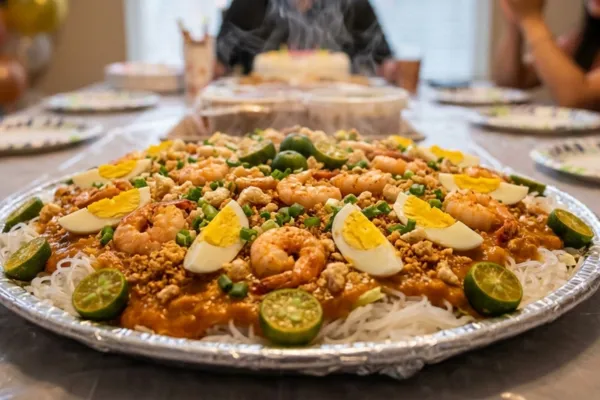
It is the kind of dish that does not quietly blend into the table. It arrives with color — that unmistakable orange sauce, those bright toppings, the shrimp, the egg, the crushed chicharon, the green onions, the squeeze of calamansi waiting on the side. Even before the first bite, Pansit Palabok feels like a dish with personality.
For many Filipino families, palabok belongs to the world of handaan, birthdays, merienda tables, and celebrations where food is meant to feel generous. It is a noodle dish, yes, but not one that relies on noodles alone. Palabok is built on contrast: soft noodles under a savory sauce, crunchy toppings over the top, and enough visual detail to make every plate feel abundant. Recipe sources consistently describe it as a noodle dish crowned with shrimp gravy or shrimp-based sauce and multiple toppings, which helps explain why it feels more dressed-up than many simpler pancit dishes.
At Studio Tributes, we love dishes like Pansit Palabok because they carry more than flavor. They carry occasion, layering, and memory. Today, we’re exploring what Pansit Palabok is, where it comes from, what it tastes like, and why it continues to be one of the most recognizable noodle dishes in Filipino cuisine.
🍜 What Is It?
Pansit Palabok is a Filipino noodle dish usually made with rice noodles or cornstarch sticks, then topped with a thick, savory sauce flavored by shrimp, annatto, pork, smoked fish, or a combination of these. Panlasang Pinoy describes it as a dish that uses cornstarch sticks, also known as palabok noodles, with an orange sauce made from minced pork, tinapa flakes, and annatto water, then finished with toppings like shrimp, hard-boiled egg, crushed chicharon, and scallions. Kawaling Pinoy similarly describes it as a noodle dish topped with shrimp gravy, shrimp, smoked fish flakes, pork cracklings, and eggs.
A classic Pansit Palabok often includes:
🍜 Palabok noodles — commonly rice or cornstarch-based noodles, depending on the version
🦐 Shrimp-forward sauce — often thickened and colored with annatto for its signature orange hue
🐟 Tinapa flakes — smoked fish, often used for extra depth in the sauce or topping
🥚 Hard-boiled egg — one of the most familiar toppings
🥓 Chicharon — crushed pork cracklings for crunch
🧄 Fried garlic and green onions — for aroma and brightness
🍋 Calamansi — often squeezed on top before eating
What makes palabok special is that it feels composed. Unlike a stir-fried noodle dish where everything is tossed together, Palabok is often assembled more deliberately: noodles first, sauce next, toppings last. That gives it a layered look and feel that immediately reads as extra special. It is still pancit, but it also feels like a dressed-up pancit.
And because so much of its identity lives in toppings and sauce, Palabok is also one of those dishes that feels highly recognizable from a distance. Even before you taste it, you know what it wants to be: savory, textured, rich, and celebratory.
📜 The Story Behind It
Palabok belongs to the wider family of pancit, and that already tells us something important about its story.
Pancit in the Philippines reflects long Chinese influence in the archipelago, and several Filipino food references connect the term itself to a Hokkien phrase associated with quickly or conveniently cooked food. Over time, pancit became not one dish but an entire family of dishes adapted to local tastes, ingredients, and occasions.
Palabok stands out within that family because of its sauce.
Kitchen Confidante notes that palabok’s mix of ingredients reflects multiple influences in Philippine cuisine: noodles associated with Chinese culinary influence, annatto introduced through colonial exchange, and seafood elements rooted deeply in local cooking. That layered background fits the dish itself. Palabok feels like a bowl where influences meet and settle into something unmistakably Filipino.
There is also a close relationship between Palabok, Luglug, and Malabon in Filipino noodle culture, with home cooks and food writers often discussing overlaps and distinctions among them. Panlasang Pinoy’s related palabok content points readers toward these nearby noodle cousins, which reflects how palabok sits inside a larger conversation of sauced Filipino pancit dishes rather than standing completely alone.
But for everyday eaters, what matters most is not taxonomy. It is the role the dish plays.
Palabok is often the pancit that feels extra. Extra toppings. Extra color. Extra care. It is the kind of noodle dish that looks at home on a celebration table because it feels intentionally assembled. Even when served as merienda or as a lighter meal, it still carries that sense of occasion.
That is part of why it lasts in memory so strongly. Palabok is not only a noodle dish you eat. It is a noodle dish you notice.
👅 What Does It Taste Like?
Pansit Palabok tastes savory, briny, smoky, and full of texture.
The sauce is usually the first thing people notice. It is rich and deeply flavored, often carrying shrimp at the center, with annatto adding color and a gentle earthiness rather than sharp spice. Depending on the version, smoked fish flakes and pork contribute even more depth. Panlasang Pinoy and Kawaling Pinoy both describe the dish as one where shrimp, smoked fish, pork, and annatto create the main character of the sauce.
Then come the toppings, and this is where palabok becomes especially satisfying.
Each bite can give you:
soft noodles
thick sauce
juicy shrimp
firm egg
crunchy chicharon
fried garlic
scallions
bright calamansi
That mix of textures matters just as much as the flavor. Palabok does not taste flat or one-note. It feels layered, and that layered feeling is central to the pleasure of eating it.
If I had to describe it simply, I’d say this:
Pansit Palabok tastes like celebration layered by hand.
It is savory, but not plain. Rich, but not dull. Brightened by calamansi, deepened by shrimp and smoked fish, and made memorable by the way crunch and softness meet in the same forkful.
🗣️ Learn the Tagalog
One of the nicest ways to understand Pansit Palabok is through the language that surrounds it.
Because palabok is such a topping-driven dish, the words around it often feel wonderfully specific. People talk about the noodles, yes, but they also talk about the sauce, the shrimp, the smoked fish, the chicharon, the garnish, and whether the calamansi has already been squeezed. In other words, the language of palabok feels very much like the language of assembly and abundance.
Here are some useful Tagalog words and phrases connected to Pansit Palabok:
Pansit / Pancit (pahn-seet) — Noodles / noodle dish
Palabok (pah-lah-bok) — Palabok-style noodle dish
Hipon (hee-pon) — Shrimp
Tinapa (tee-nah-pah) — Smoked fish
Chicharon (chee-chah-ron) — Pork cracklings
Itlog (eet-log) — Egg
Bawang (bah-wahng) — Garlic
Sibuyas dahon (see-boo-yas dah-hon) — Green onion / scallion
Kalamansi (kah-lah-man-see) — Philippine citrus
Sarsa (sar-sah) — Sauce
Malinamnam (mah-lee-nam-nam) — Rich / flavorful
Handaan (hahn-dah-an) — Celebration spread
And here are a few phrases that feel especially at home with this dish:
May palabok ba sa handaan? (mai pah-lah-bok bah sah hahn-dah-an) — Is there palabok at the celebration?
Masarap ang palabok mo! (mah-sah-rahp ang pah-lah-bok moh) — Your palabok is delicious!
Lagyan mo ng kalamansi. (lahg-yan moh nang kah-lah-man-see) — Add calamansi to it.
Kain tayo ng palabok! (kah-in tah-yo nang pah-lah-bok) — Let’s eat palabok!
What I love about these words is that they match the way the dish is enjoyed. Sarsa matters because the sauce defines the dish. Hipon and tinapa matter because they build the flavor identity. Kalamansi matters because many people do not want to eat palabok without it. And handaan matters because this is exactly the kind of pancit people expect to see at a gathering.
🎨 Color It!
Bring Pansit Palabok to life in a whole new way — through art.
This is one of those dishes that feels especially exciting on the page because it is already so visually layered. The warm orange sauce, the pink shrimp, the bright egg yolk, the green onions, the golden fried garlic, the crumbled chicharon — Palabok has the kind of built-in color and texture that makes it feel festive even before the first bite.
Our Filipino Food Coloring Book on Amazon invites you to slow down and notice those details in a new way. As you color, you begin to see what makes palabok feel special: not only the noodles, but the arrangement of toppings, the contrast of colors, and the way the whole dish seems assembled to feel abundant and joyful.
That makes it especially meaningful for:
🌼 families looking for a calm activity to enjoy together
🌼 parents introducing Filipino culture to children in a creative way
🌼 adults and seniors who enjoy nostalgic, mindful coloring
🌼 teachers, homeschoolers, and community groups exploring multicultural learning
And because palabok is so tied to gatherings, the page can open beautiful conversations too: Was this the pancit your family served at birthdays? Did your version have more shrimp, more tinapa, or extra chicharon? Did someone always remind everyone to squeeze the calamansi first?
When you finish your Pansit Palabok page, we’d love to see it. Share your completed coloring on Facebook or Instagram and tag @StudioTributes so we can celebrate your creativity with you.
If you’d like to explore Filipino food through art, family connection, and cultural memory, our Filipino Food Coloring Book is waiting for you.
👉 Get your copy on Amazon here
🤩 Fun Facts About Pansit Palabok
1. Palabok is known for its orange sauce.
Annatto is commonly used to give the dish its signature color.
2. The sauce is often shrimp-forward.
That seafood note is one of the most recognizable parts of the dish.
3. Tinapa flakes are a classic flavor booster.
Smoked fish adds depth and makes the sauce feel even more layered.
4. Palabok is as much about toppings as it is about noodles.
Shrimp, eggs, chicharon, fried garlic, and scallions all matter.
5. Calamansi can completely change the bite.
That squeeze of citrus brightens the rich sauce beautifully.
6. It feels more assembled than many other pancit dishes.
That layered presentation is part of what makes it feel festive.
7. Palabok often shares the stage with related noodle cousins.
Luglug and Malabon are frequently mentioned in the same family of sauced pancit dishes.
🎉 Why It Belongs at Celebrations
Some noodle dishes are comforting. Palabok feels celebratory by design.
Part of that comes from how it looks: vivid sauce, generous toppings, bright garnish, and the sense that every plate is meant to feel a little dressed up. But part of it also comes from practicality. Like other pancit dishes, palabok can be made for groups and served on a shared platter, which gives it an easy place at birthdays, family gatherings, and handaan.
And because it is so layered, it feels like a dish that rewards effort. It does not look accidental. It looks prepared.
That may be why it stays so memorable on celebration tables. It carries the same generous spirit as many beloved Filipino dishes: enough for everyone, and enough detail that people talk about it while they eat.
❓ FAQ
What is Pansit Palabok?
Pansit Palabok is a Filipino noodle dish made with rice or cornstarch noodles topped with a rich orange shrimp-based sauce and multiple savory toppings.
What does Pansit Palabok taste like?
It tastes savory, briny, smoky, rich, and layered, with brightness from calamansi and texture from toppings like chicharon and egg.
Is Pansit Palabok the same as Pansit Canton?
No. Pansit Palabok is a sauced noodle dish with shrimp-based gravy and toppings, while Pansit Canton is usually a stir-fried noodle dish.
What noodles are used in Pansit Palabok?
Recipe sources describe using cornstarch sticks or rice noodles, depending on the version.
Why is the sauce orange?
Annatto is commonly used to color the sauce.
What toppings go on Pansit Palabok?
Common toppings include shrimp, smoked fish flakes, hard-boiled eggs, crushed chicharon, fried garlic, scallions, and calamansi.
Is Pansit Palabok served at parties?
Very often, yes. Its layered look and shareable format make it a natural celebration dish.
Is calamansi important for palabok?
Many people consider it an essential finishing touch because it brightens the rich sauce.
💛 Closing CTA
Pansit Palabok is more than a noodle dish. It is one of those foods that carries the feeling of a table made ready — the platter in the center, the toppings scattered generously, the bright calamansi on the side, and the sense that this meal is meant to be shared with more than one person.
At Studio Tributes, we love celebrating Filipino culture through food, art, and storytelling. Whether you are discovering Pansit Palabok for the first time or remembering it from your own family’s gatherings, we hope this gave you a warmer, deeper way to connect with one of the Philippines’ most beloved noodle classics.
Keep exploring Filipino food and culture with us:
🎨 Get our Filipino Food Activity Book on Amazon
📚 Read more Filipino food stories on our blog
💭 A Memory to Hold Onto
Did Pansit Palabok bring back a celebration for you?
Maybe a birthday table where the noodles came piled high.
Maybe a family gathering where someone always made sure there was extra chicharon on top.
Maybe a platter passed around with calamansi waiting at the side and everyone building the bite they liked best.
Did your family serve palabok at birthdays or gatherings?
What toppings did your version always have?
What memory comes back when you picture that bright orange sauce and all those layered toppings?
If a memory came to mind, share your Pansit Palabok story on Facebook or Instagram and tag @StudioTributes so we can celebrate it with you. And if you’d like more warm Filipino food stories, cultural memories, and creative inspiration, come spend time with us on social media.
We invite you to explore our collection.
👉 Explore on StudioTributes.com
👉 Order for Libraries & Retailers
👉 Learn More About Studio Tributes
Read Next
This article blends Studio Tributes storytelling with cultural and culinary research to create a warm, family-friendly learning experience.