
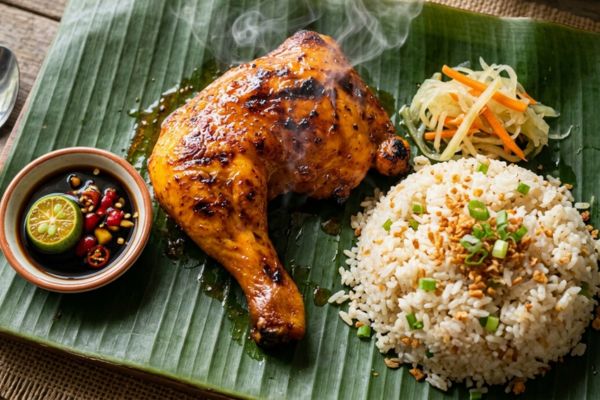
Chicken Inasal: Bacolod's Grill That Just Ranked #3 Worldwide
Studio Tributes / Filipino Food / What Is Chicken Inasal?
Table of Contents
🟠 The Annatto Oil — The Heart of the Dish
👅 What Does Chicken Inasal Taste Like?
🗣️ Learn the Tagalog and Hiligaynon
🤩 Fun Facts About Chicken Inasal
What Is Chicken Inasal?
The Grilled Chicken from Bacolod That Just Became the Best in Southeast Asia — and the Third Best in the World
There is a street in Bacolod City called Manokan Country.
Manokan — from the Hiligaynon word for chicken. Country — because there is simply no other word big enough for what this place is. Open-air stalls stretching down the block, each one with a grill over hot coals, the fat dripping and sizzling, the smoke rising in thick, lemongrass-scented columns, and the orange glow of annatto-basted chicken turning slowly over the heat.
You smell Manokan Country before you see it.
That smell — lemongrass, vinegar, calamansi, caramelized chicken fat — is the smell of Bacolod. It is the smell of a city that has been grilling chicken this way since the 1970s, when the first vendors set up along a stretch called Cuadra Street and a beloved Bacolod food tradition quietly became one of the great Filipino dishes.
That dish is chicken inasal. And in April 2026, TasteAtlas — the world's most respected traditional food ranking platform — named it the best chicken dish in all of Southeast Asia and the third best chicken dish in the entire world.
Not the Philippines. The world.
For Filipinos who grew up eating inasal — at Manokan Country, at Mang Inasal, at a neighborhood grill, or at someone's house with the charcoal set up in the backyard — this recognition felt like something that was always obvious finally being said out loud.
At Studio Tributes, we celebrate Filipino food because it carries more than flavor — it carries place, memory, identity, and pride. Chicken inasal carries all of those things, plus the specific smell of a Bacolod evening and the sound of chicken fat hitting hot coals. Today we are going all in — where this dish comes from, what makes it unlike any other grilled chicken in the world, what it actually tastes like, and why it matters to Filipinos everywhere.
🍗 What Is Chicken Inasal?
Chicken inasal (ee-nah-sahl), sometimes simply called inasal, is a Visayan-style grilled chicken dish originating from Bacolod City in Western Visayas. According to Wikipedia's entry on the dish, it is a variant of the Filipino lechon manok — but it is entirely its own thing, defined by a marinade and basting technique that produces a flavor unlike any other Filipino grilled chicken.
The word inasal comes from the Hiligaynon language. It is a native Ilonggo adaptation of the Spanish word asar, meaning "to roast." The name is purely about the method — and the method is everything.
What makes chicken inasal immediately different from regular Filipino barbecue or grilled chicken is one critical distinction: there is no soy sauce in the marinade. While most Filipino chicken barbecue relies on soy sauce for its savory backbone, inasal is built entirely on acidic, aromatic foundations. The result is something cleaner, brighter, more fragrant — and unmistakably Visayan.
A classic chicken inasal typically uses:
🍗 Manok — chicken, most often thighs and drumsticks (paa/hita) or breast with wing (pecho)
🍋 Kalamansi — Philippine lime juice, the citrus acid foundation
🍶 Suka — vinegar, preferably coconut vinegar or sinamak (spiced palm vinegar)
🌿 Tanglad — lemongrass, pounded into a paste for the fragrant, floral note
🧄 Bawang — garlic, crushed generously
🫚 Luya — ginger, which adds warmth and depth
🟠 Atsuete oil — annatto-infused oil, the defining visual and flavor element
🌶️ Paminta — black pepper
🍚 Kanin — garlic rice infused with chicken drippings, the only acceptable accompaniment
And then there is the sinamak — a spiced vinegar from Iloilo, infused with garlic, chili, and langkawas (galangal). Served on the side for dipping, it is not a garnish. It is the finishing move.
📜 The Story Behind It
The story of chicken inasal is the story of Bacolod — the City of Smiles — and of a food tradition that grew from street-side charcoal grills into a dish the whole world is now discovering.
One of the earliest written references to grilled chicken in the Visayas appears in Felix Laureano's 1895 photo book Recuerdos de Filipinas, which depicted daily life and culture in Iloilo and Panay. In the book, Laureano describes inihao nga manuc — a Visayan term for grilled or roasted chicken, equivalent to the Spanish pollo asado — served in local calenderias as part of everyday Visayan culinary life. The technique of charcoal-grilling marinated chicken in the Visayas is older than any document that currently exists to record it.
The dish as it is known today — with its specific marinade of coconut vinegar, calamansi, lemongrass, ginger, garlic, and annatto — became widely popular in Bacolod in the 1970s. As early as that decade, Bacolod City already had Chicken Alley — a street lined with food stalls serving freshly charcoal-grilled chicken, which became the predecessor to the renowned Manokan Country. Farmers and roadside vendors during a period of economic shifts in Negros Occidental adapted and popularized the dish, turning it into a staple of the city's street food culture.
Over the following decades, Manokan Country became one of the most famous food destinations in all of the Philippines. The aroma became Bacolod's calling card. The technique — marinate overnight, skewer on bamboo, grill slowly over charcoal, baste constantly with annatto oil — became the standard against which all other inasal was measured.
Two distinct versions developed, and they are both beloved:
Bacolod inasal — slightly sour, vinegar-forward, more sharply aromatic, served with sinamak
Iloilo inasal — slightly sweeter, gentler acidity, its own distinct character
In 2022, Bacolod City's Sangguniang Panlungsod passed an ordinance declaring chicken inasal an Important Cultural Property of Bacolod — the first Filipino dish in the city's history to receive this designation. In May 2024, the National Commission for Culture and Arts officially confirmed the recognition, cementing inasal's place not just as a beloved food but as a protected, formal piece of Philippine cultural heritage.
Then came the global stage. In November 2025, TasteAtlas ranked chicken inasal as the best chicken dish in Southeast Asia and 10th best in the world. In April 2026, it climbed to third worldwide — behind only South Korea's fried chicken and Peru's pollo a la brasa, and ahead of every other chicken dish from every other cuisine on the planet.
The City of Smiles has always known. Now the world does too.
🟠 The Annatto Oil — The Heart of the Dish
If sinigang belongs to its souring agent and adobo belongs to its vinegar-soy balance, chicken inasal belongs to its annatto oil.
Annatto — known in Filipino as atsuete or achuete — is a natural orange-red dye derived from the seeds of the annatto tree, native to tropical regions including the Philippines. In chicken inasal, annatto seeds are slowly simmered in oil — traditionally chicken fat rendered from the skin — until they release their deep, warm color. The result is a bright orange oil that is used both in the marinade and constantly during grilling as a basting sauce.
The annatto oil does three things simultaneously:
1. It colors the chicken. That signature golden-orange-red glow — the visual that makes inasal instantly recognizable — comes entirely from the annatto oil. Without it, inasal is just grilled chicken. With it, inasal looks the way it feels: warm, bright, alive.
2. It keeps the chicken moist. Constant basting with annatto oil during grilling prevents the acidic marinade from drying out the meat. It creates a lacquered, shining surface that keeps every bite juicy even from the hottest part of the grill.
3. It adds flavor. Annatto has a mild, earthy, slightly peppery quality — subtle enough not to overpower the lemongrass and calamansi, present enough to give inasal its distinct finish that no other grilled chicken has.
In Bacolod restaurants, the accompanying garlic rice is usually mixed with annatto oil or chicken drippings, then topped with fried garlic bits. The rice becomes as important as the chicken. You drizzle more annatto oil over everything at the table.
This is not a garnish. This is the point.
👅 What Does Chicken Inasal Taste Like?
This is the question everyone who has never had chicken inasal deserves a real answer to.
Forget everything you know about grilled chicken. Forget the soy-based marinades, the sweet barbecue glazes, the smokehouse traditions of other countries. Chicken inasal does not taste like any of them.
The first thing you notice is the brightness. Where most grilled chicken is rich and savory from the start, inasal opens with a tangy, citrusy hit — the calamansi and vinegar have done their work, and the acid is present but not sharp. It is refreshing, actually, in the way that sinigang's tamarind is refreshing: sour as a relief, not sour as an attack.
Then the lemongrass arrives. Not as a dominant note but as a warm, floral fragrance in the background — the kind of scent that makes you stop and breathe before you take another bite.
Underneath all of that is the chicken itself, which — if marinated overnight and grilled slowly over charcoal with constant basting — is extraordinarily tender. The acid of the marinade has worked into the meat, keeping it juicy from the inside. The annatto oil has created a caramelized, slightly charred exterior that gives you contrast with every bite: the crunch of the grill marks against the yielding softness of the meat inside.
And the sinamak on the side — the spiced vinegar with garlic and chili — does not overpower any of it. It sharpens. It finishes. It gives you a reason to take one more bite.
Eat it with garlic rice soaked in chicken drippings and annatto oil. Eat it with your hands. That is not a suggestion — that is the instruction.
If I had to describe it simply:
Chicken inasal tastes like a sunny afternoon in Bacolod tasted like. Bright. Smoky. Warm. Something you would travel for.
🗣️ Learn the Tagalog and Hiligaynon
Chicken inasal is a Visayan dish, which means it carries both Tagalog and Hiligaynon words — the language of Bacolod and Iloilo, the mother tongue of the dish.
The dish and its parts:
Inasal (ee-nah-sahl) — the dish; literally "char-grilled" or "roasted" in Hiligaynon
Pecho (peh-cho) — breast with wing; the prized cut for many inasal lovers
Paa / Hita (pah-ah / hee-tah) — drumstick / thigh; the juicier, more forgiving cut
Manok (mah-nok) — chicken
Inihaw (ee-nee-hahw) — grilled; the broader Tagalog term for grilled meats
The key elements:
Atsuete / Achuete (at-sweh-teh) — annatto seeds; the source of the orange color
Tanglad (tahng-lahd) — lemongrass; the floral backbone of the marinade
Sinamak (see-nah-mak) — Iloilo spiced vinegar; the essential dipping partner
Sawsawan (sahw-sah-wahn) — dipping sauce; the generic term for all Filipino dips
Sinangag (see-nah-ngahg) — garlic fried rice; the rice of choice alongside inasal
Suka (soo-kah) — vinegar; always present in the marinade
Kalamansi (kah-lah-man-see) — Philippine lime; the citrus foundation
Phrases at the table:
Pecho o paa? (peh-cho oh pah-ah) — Breast or drumstick? (the eternal question every inasal order begins with)
Dagdagan ng kanin! (dahg-dah-gahn nahng kah-nin) — More rice! (the correct response to inasal)
Mas masarap may sinamak. (mahs mah-sah-rahp mai see-nah-mak) — It's better with sinamak.
Dito ka lang sa Manokan Country. (dee-toh kah lahng sah mah-noh-kahn kahn-tree) — You stay right here at Manokan Country.
Sobrang sarap! (sob-rahng sah-rahp) — Absolutely delicious!
The phrase "Pecho o paa?" is worth its own moment. It is the first thing every inasal server asks you. It is a small, specific ritual that anchors the meal — a question that signals you are about to eat something that has cuts, preferences, regulars, and tradition attached to it. Not just grilled chicken. Inasal.
🤩 Fun Facts About Chicken Inasal
1. It just became the #3 chicken dish in the world. In April 2026, TasteAtlas ranked chicken inasal third in its global list of the world's best chicken dishes — with a 4.4 rating — behind only South Korea's fried chicken and Peru's pollo a la brasa. It was simultaneously named the best chicken dish in all of Southeast Asia.
2. Bacolod declared it an official cultural property in 2022. On November 16, 2022, the Sangguniang Panlungsod of Bacolod City formally declared chicken inasal an Important Cultural Property — the first dish in the city's history to receive this designation. In 2024, the National Commission for Culture and Arts confirmed the recognition under the Philippine Registry of Cultural Property.
3. The earliest written reference to inasal-style grilled chicken dates to 1895. Felix Laureano's photo book Recuerdos de Filipinas, published in Barcelona in 1895, describes inihao nga manuc — Visayan grilled chicken — as part of everyday culinary life in Iloilo and Panay. The tradition of charcoal-grilling marinated chicken in the Visayas is older than modern documentation.
4. There is no soy sauce in the traditional marinade. Unlike most Filipino chicken barbecue, authentic chicken inasal uses no soy sauce. The marinade is built entirely on vinegar, calamansi, lemongrass, ginger, garlic, and annatto — producing a cleaner, brighter flavor profile that is immediately distinct from every other Filipino grilled dish.
5. Manokan Country has been Bacolod's food soul since the 1970s. What began as Chicken Alley on Cuadra Street in the 1970s became Manokan Country — a strip of open-air inasal stalls that has been one of the Philippines' most iconic street food destinations for over fifty years. The sign reads Manokan Country — literally "Chicken Country" in Hiligaynon — which is exactly what it is.
6. Mang Inasal turned the dish into a national chain — then Jollibee bought it. In 2003, Edgar Sia founded Mang Inasal in Iloilo City. By 2010, the chain had grown so fast that Jollibee Foods Corporation acquired a majority stake. Today, Mang Inasal operates hundreds of branches across the Philippines, making inasal accessible to Filipinos nationwide — and making the unlimited rice concept almost as famous as the chicken itself.
7. The unlimited rice tradition started with inasal. Mang Inasal popularized the unli-rice concept in the Philippines — unlimited steamed garlic rice with any inasal order. It became one of the most beloved restaurant features in Filipino dining culture and has since been adopted by other chains. The idea makes sense: inasal rice, soaked in annatto oil and chicken drippings, is not just a side dish. It is an event.
8. Iloilo City listed inasal as one of its offerings when recognized as a UNESCO Creative City of Gastronomy. On October 31, 2023, Iloilo City was recognized as a UNESCO Creative City of Gastronomy — and chicken inasal was listed as one of the city's signature food offerings. This confirms the dish's significance not just to Bacolod but to the entire Western Visayas region as a defining element of its culinary identity.
🌍 How Chicken Inasal Connects Filipinos Everywhere
Ask a Filipino from Bacolod or Iloilo living abroad what they miss most about home, and the answer usually comes quickly and specifically: inasal from Manokan Country. Not just the flavor — the specific ritual of it. The ordering. The pecho o paa? The sinamak. The garlic rice already glistening with drippings. The smoke.
For diaspora Filipinos from Western Visayas, chicken inasal is not just a dish — it is the taste of a place. Bacolod is the City of Smiles, known for its warmth, its MassKara Festival, its sugar heritage, and its inasal. The dish carries the personality of its city: bright, generous, unfussy, and deeply satisfying.
But chicken inasal's reach has expanded far beyond the Western Visayas. Mang Inasal branches brought it to Metro Manila. Filipino restaurants in Los Angeles, New York, Toronto, London, Dubai, and Sydney have put it on menus. And now TasteAtlas has introduced it to food lovers worldwide who had never heard of Bacolod — who had no idea this dish existed — and made them want to find it.
That moment — when a dish leaves its city of origin and begins feeding people who did not grow up with it — is the same moment Filipino cuisine becomes something the whole world shares. And for Filipinos everywhere, watching chicken inasal climb to third in the world is not just a food ranking. It is a confirmation of something they always felt: that the food they grew up with belongs on any table, anywhere.
❓ FAQ — Chicken Inasal
What is chicken inasal? Chicken inasal is a Visayan-style Filipino grilled chicken dish originating from Bacolod City in Western Visayas. The chicken is marinated in a mixture of vinegar, calamansi, lemongrass, garlic, and ginger — without soy sauce — then grilled over charcoal and basted continuously with annatto-infused oil, which gives it its signature golden-orange color. In April 2026, TasteAtlas named it the best chicken dish in Southeast Asia and third best in the world.
What does "inasal" mean? The word inasal comes from the Hiligaynon language of Western Visayas and is a native Ilonggo adaptation of the Spanish word asar, meaning "to roast." It describes the cooking method — charcoal-grilling — that defines the dish.
What is annatto oil and why is it important? Annatto oil is made by simmering annatto seeds (atsuete) in oil — traditionally chicken fat — until they release their deep orange-red color. It is brushed constantly onto the chicken during grilling, giving inasal its vivid golden-orange appearance, keeping the meat moist, and adding a mild, earthy, slightly peppery flavor. Annatto oil is the visual and textural signature of the dish — without it, inasal is not inasal.
What is the difference between Bacolod and Iloilo inasal? According to Wikipedia's entry on chicken inasal, there are two popular versions. Bacolod's inasal has a slightly sour base flavor — more vinegar-forward, typically served with sinamak spiced vinegar. Iloilo's version has a sweeter profile. Both use the same core ingredients — calamansi, vinegar, lemongrass, garlic, ginger — but the balance differs between them.
What is sinamak? Sinamak is a spiced vinegar originating from Iloilo, made with coconut or palm vinegar infused with garlic, chili peppers, and langkawas (galangal). It is the traditional dipping sauce served alongside chicken inasal and is considered essential to the authentic eating experience. Bottled sinamak is available in many Filipino grocery stores worldwide.
What does chicken inasal taste like? Bright, tangy, and smoky with a fragrant lemongrass-and-calamansi character unlike any other grilled chicken. The absence of soy sauce gives it a cleaner, more acidic flavor profile than standard Filipino barbecue. The annatto-basted exterior is caramelized and slightly charred, while the interior remains juicy from the overnight marinade.
Can I make chicken inasal at home? Yes — marinate chicken thighs or drumsticks overnight in a mixture of coconut vinegar, calamansi juice, lemongrass, garlic, ginger, and black pepper. Make an annatto oil by simmering annatto seeds in neutral oil or chicken fat. Grill over charcoal (preferred) or cook in an oven with a broil finish, basting frequently with the annatto oil throughout cooking. Serve with garlic rice, sinamak, and calamansi halves.
Is Mang Inasal the original chicken inasal? Mang Inasal, founded in 2003 in Iloilo City, is one of the most widely recognized inasal chains and played a major role in popularizing the dish nationally after Jollibee Foods Corporation acquired a majority stake in 2010. However, chicken inasal as a tradition originated decades earlier in Bacolod's Chicken Alley in the 1970s, and the stalls of Manokan Country remain the benchmark for authentic inasal.
💛 Closing
There is a reason chicken inasal did not need a marketing campaign to become third best in the world.
It just needed people to taste it.
A dish made with charcoal and patience and vinegar and lemongrass and an orange oil that has been simmering in chicken fat since long before anyone was keeping score. A dish from a city called the City of Smiles that has been feeding people this way for fifty years in the open air, on bamboo skewers, over hot coals, with unlimited rice.
Bacolod built something extraordinary without intending to build anything at all. Just a way of grilling chicken that tasted better than any other way, passed from stall to stall and generation to generation along a street that became a landmark.
That is what Filipino food does. It starts in a specific place — a kitchen, a street, a city — and slowly, quietly becomes something the whole world wants.
At Studio Tributes, we celebrate Filipino culture through food, art, and the stories that travel with both. Whether you are eating chicken inasal in Bacolod, making it at home in Toronto, or discovering it for the first time through a TasteAtlas list, we hope this gave you something deeper to bring to the table.
If you’d like to explore Filipino food through art, and family connection, download our FREE Filipino Food Coloring pages—they are waiting for you.
👉 What Filipino Food Are You? Take the quiz →
👉 Get your FREE Filipino Coloring pages here.
Explore more Filipino food, art, and memory with us:
🎨 Get our Filipino Food Activity Book on Amazon
📚 Read more Filipino food stories on our blog
💭 A Memory to Hold Onto
Did chicken inasal bring somewhere to mind?
Maybe Manokan Country on a warm Bacolod evening, the smoke rising and the stalls full. Maybe Mang Inasal on a weeknight, ordering paa and extra rice. Maybe someone's backyard grill, the orange glow of annatto on the chicken, the sinamak in a small bowl. Maybe just the smell — lemongrass and charcoal and calamansi — coming from somewhere, unexpectedly, far from the Philippines.
Pecho o paa? What did you always order? Where did you have the best inasal of your life? Who was there with you?
If a memory came back — share it with us.
Tag @StudioTributes on Facebook or Instagram with your inasal story, or share a photo of your colored page using #StudioTributes and #FilipinoFoodMemories.
We read every single one.
Read Next
📚 References & Further Reading
Wikipedia — Chicken Inasal — Comprehensive entry covering inasal's Visayan origins, Bacolod and Iloilo versions, Manokan Country, and the cultural property declaration.
TasteAtlas — 100 Best Chicken Dishes in the World — April 2026 — Source of the #3 global ranking and #1 Southeast Asia ranking for chicken inasal.
Manila Bulletin — Bacolod declares chicken inasal as cultural property — Coverage of the November 2022 Sangguniang Panlungsod ordinance.
Rappler — NCCA recognizes chicken inasal as 'cultural property' of Bacolod — Confirmation of NCCA recognition in May 2024.
Grokipedia — Chicken Inasal — Detailed historical documentation including the 1895 Laureano reference to inihao nga manuc.
Positively Filipino — The Happy Home Cook: Chicken Inasal — Cultural and culinary context for the dish from a Filipino diaspora perspective.
Encyclopaedia Britannica — Adobo | Description, History, Variations & Uses — Referenced for broader context on the indigenous Filipino culinary tradition of vinegar-based cooking that underlies both adobo and inasal.
This article blends Studio Tributes storytelling with cultural and culinary research to create a warm, family-friendly learning experience.