
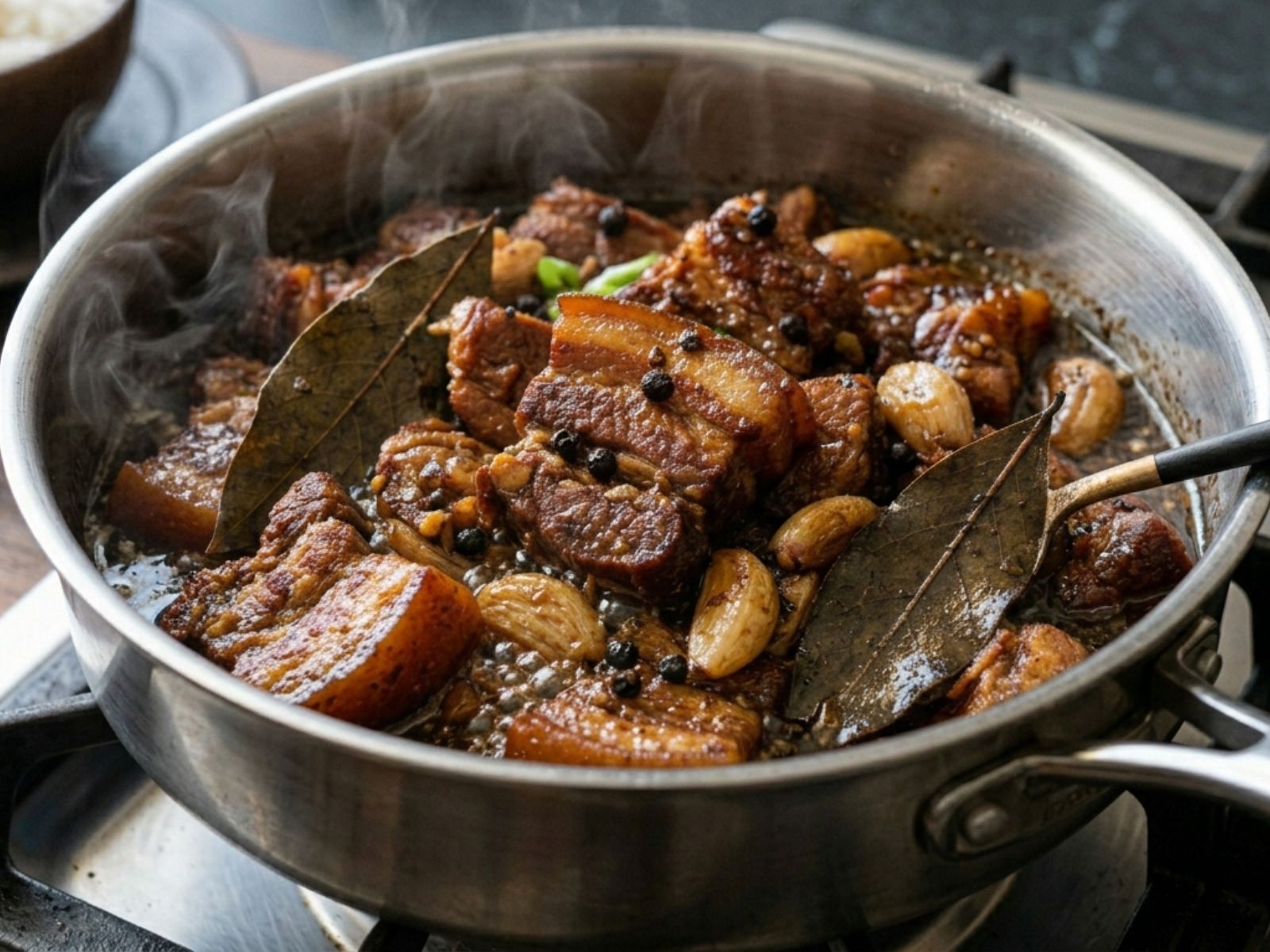
What Is Filipino Pork Adobo? The Dish That Tastes Like Every Filipino Kitchen That Ever Mattered
Studio Tributes / Filipino Food / What Is Filipino Pork Adobo?
If you grew up Filipino, you already know the answer before you finish reading the question.
Pork adobo — adobong baboy — is the smell that hits you before the front door is even fully open. It is the sound of a pot simmering on a stove on a Sunday afternoon when there was nowhere to be and no reason to hurry. It is the dish that somehow tasted even better the next morning, cold or reheated, over garlic rice with a fried egg beside it, eaten standing at the kitchen counter before anyone else was awake.
For many Filipinos living abroad, pork adobo is one of the first things they cook when the homesickness gets specific. Not just a general ache, but a specific craving — for that particular balance of vinegar and soy and garlic, for the way the sauce darkens as it reduces, for the feeling of eating something that knows exactly where you came from.
That is part of what makes adobong baboy so enduring. It travels. It keeps. It adapts. And no matter how far you are from the Philippines, you can almost always find the ingredients to make it — because vinegar, soy sauce, garlic, bay leaves, and pork are not hard to find anywhere in the world.
At Studio Tributes, we love Filipino food because it carries more than flavor. It carries family, routine, identity, and the kind of memory that lives in your body before it lives in your mind. Today we are going all in on adobong baboy — where it comes from, what makes it different from every other adobo in the world, what it actually tastes like if you have never had it, and why it has stayed at the center of Filipino food culture for centuries.
🍲 What Is Adobong Baboy?
Filipino style pork adobo, known in Tagalog as adobong baboy (ah-doh-bong bah-boy), is a braised pork dish cooked in a combination of vinegar, soy sauce, garlic, bay leaves, and black peppercorns. It is one of the two most recognized versions of Filipino adobo — the other being adobong manok, or chicken adobo — and it is widely considered one of the most iconic dishes in the entire Filipino culinary tradition. According to Encyclopaedia Britannica, adobo is widely considered the unofficial national dish of the Philippines, and the term refers both to the finished dish and to a specific indigenous method of cooking — a distinction that matters, because adobo is less a rigid recipe than a culinary language.
The word adobo itself comes from the Spanish term adobar, meaning to marinate or season. But here is the thing that matters: Filipino adobo is not Spanish. The cooking method is entirely indigenous to the Philippines. The name was applied by Spanish colonizers to a preservation technique that Filipinos had already been practicing for generations — using vinegar, salt, and aromatics to extend the shelf life of food in a tropical climate before refrigeration existed.
In other words, Filipino adobo already existed. It just did not have a Spanish name yet.
At its core, a classic pork adobo typically includes:
🥩 Baboy — pork, most commonly pork belly or pork shoulder
🧄 Bawang — garlic, crushed or sliced, often a generous amount
🍶 Suka — vinegar, the defining backbone of the dish
🥣 Toyo — soy sauce, which gives the sauce its depth and color
🌿 Laurel — dried bay leaves
⚫ Paminta — whole black peppercorns
🍚 Kanin — because pork adobo and rice are inseparable
What makes adobong baboy different from a generic braised pork dish is the specific balance of acid and salt — and the fact that no two families make it exactly the same way. Some households simmer it down until the sauce is thick, dark, and glossy. Others prefer it saucier, with more liquid to spoon over rice. Some add a touch of sugar. Some use coconut vinegar. Some marinate the pork overnight. Some fry the pork first to brown it before braising.
All of them are right. That is the nature of adobo. It belongs to the household as much as it belongs to the country.
📜 The Story Behind It
Filipino pork adobo is one of those dishes that becomes more interesting the deeper you look.
The first written record of Filipino adobo dates back to 1613. As Encyclopaedia Britannica documents, the term first appeared in a Tagalog-Spanish dictionary compiled by Franciscan missionary Pedro de San Buenaventura, who recorded the dish as adobo de los naturales — the adobo of the native people. He named it for its similarities to a Spanish marinade used in braising, but the dish's original Tagalog name was likely never recorded. What Britannica makes clear is that the cooking method itself had already existed long before the Spanish arrived — the colonizers gave the dish a name, not an origin. Pre-colonial Filipino communities had already developed their own vinegar-based preservation methods using locally fermented cane vinegar, coconut vinegar, and palm vinegar. Garlic, peppercorns, and bay leaves were part of the indigenous spice vocabulary.
Soy sauce came later, introduced through Chinese trade, primarily through Chinese merchants who had been trading with Filipino communities long before Spanish colonization. As soy sauce entered Filipino kitchens — especially in Luzon — it became part of the adobo formula that most families use today. The older version, made without soy sauce and relying on vinegar and salt alone, is still made today and is known as adobong puti — white adobo.
This is part of what makes Filipino pork adobo such a rich dish culturally: it is a living record of the people and influences that have shaped the Philippines over centuries. Indigenous preservation. Chinese trade. Spanish naming. And through it all, the Filipino cook's instinct to adapt, absorb, and make something entirely their own.
Regional variations developed across the archipelago's thousands of islands, each one reflecting the local ingredients and tastes of its community:
Adobo sa gata — with coconut milk, most common in Bicol
Adobong dilaw — with turmeric, which gives the sauce a golden color, found in parts of Batangas and Quezon
Adobong puti — the older version using no soy sauce, relying on vinegar and salt
Adobo sa atsuete — with annatto seeds, more common in the Visayas, giving it a warm reddish hue
Dry adobo — simmered until the liquid is almost completely gone and the pork is nearly fried in its own fat
Each version is a different answer to the same question: How does your family do it?
👅 What Does Filipino Pork Adobo Taste Like?
If you have never had pork adobo, here is the most honest description possible:
It tastes like something that has been thought about for a long time.
The first thing you notice is the tang — a bright, forward acidity from the vinegar that lifts the whole dish and keeps it from feeling heavy. Then the soy sauce arrives: savory, a little salty, darkening the sauce and giving it depth. Then the garlic — which you smelled long before you tasted — rounds everything out with its warmth and sweetness, softened by the long cook time.
The bay leaves and peppercorns work quietly in the background. You may not pick them out individually, but you would notice if they were gone. They are the bass notes of the dish — present, supporting, essential.
In texture, pork belly adobo becomes extraordinarily tender when braised properly. The fat renders into the sauce and makes it rich and glossy. Pork shoulder gives you a slightly leaner result but still falls apart with ease after a long simmer.
And then there is the sauce itself — the sarsa — which many people consider the best part. Thick enough to cling to the pork, dark and complex, with that perfect balance of sour and savory. When it hits the rice and the rice absorbs it completely, something happens that is difficult to describe but deeply satisfying. It is comfort without being heavy. It is bold without being overwhelming.
If I had to put it simply:
Filipino pork adobo tastes like exactly where you come from, made with exactly what you had, by someone who loved you.
🗣️ Learn the Tagalog
One of the most meaningful ways to connect with a dish is through the language that lives around it.
With adobong baboy, that language is practical and personal very quickly. These are the words of a kitchen where someone is always cooking, always adjusting, always tasting from a wooden spoon:
The dish and the cooking:
Adobo (ah-doh-boh) — the dish and the cooking method
Adobong baboy (ah-doh-bong bah-boy) — pork adobo specifically
Mag-adobo (mag-ah-doh-boh) — to cook adobo
Nagluluto ng adobo (nag-loo-loo-toh nang ah-doh-boh) — cooking adobo right now
The ingredients:
Baboy (bah-boy) — pork
Suka (soo-kah) — vinegar
Toyo (toh-yoh) — soy sauce
Bawang (bah-wahng) — garlic
Laurel (lah-oo-rel) — bay leaf
Paminta (pah-min-tah) — black pepper / peppercorns
Sarsa (sar-sah) — sauce
Ulam (oo-lam) — the main dish, the protein
Phrases at the table:
Kain tayo ng adobo! (kah-in tah-yoh nang ah-doh-boh) — Let's eat adobo!
Ang sarap ng adobo mo! (ang sah-rahp nang ah-doh-boh moh) — Your adobo is delicious!
Mas gusto ko ang maasim. (mahs goos-toh koh ang mah-ah-seem) — I prefer it more sour.
May natira pa ba? (mai nah-tee-rah pah bah) — Are there any leftovers?
Mas masarap bukas. (mahs mah-sah-rahp boo-kahs) — It'll taste even better tomorrow.
That last one is especially true. Filipino cooks have known for generations that adobo is at its best the day after cooking, when the flavors have had time to deepen and the meat has absorbed the sauce completely. It is one of those rare dishes where patience is genuinely rewarded.
🎨 Color It!
Bring Filipino food to life in a whole new way — through art.
Pork adobo may not be the most colorful dish on the table — it lives in a world of deep browns and warm golds and dark mahogany — but that is exactly what makes it so satisfying to color. It is a study in richness. The dark glaze on each piece of pork. The golden rendered fat. The deep amber of a well-reduced sauce. The white rice alongside it catching the light. The subtle green of a bay leaf. The tiny black peppercorns scattered through the sauce.
When you sit with an adobo coloring page long enough to actually render all of that, something happens. You start noticing the dish in a different way. You remember the specific color of your family's adobo — how dark it was, how much sauce there was, whether it was glossy or brothy. You start thinking about who made it. What their kitchen smelled like. What time of day it usually appeared on the table.
Coloring slows you down in exactly the right way.
Our Filipino Food Coloring Book on Amazon was built from that idea. Every page is a dish with a story. Every dish is an invitation to remember. Adobong baboy is one of the most beloved pages in the book — and for good reason. It is one of those images that makes people go quiet for a moment before they say, this reminds me of home.
That makes it especially meaningful for:
🌼 Families who want a calm, shared activity that starts a real conversation
🌼 Filipino parents and grandparents introducing heritage to the next generation
🌼 Adults and seniors who find nostalgic, mindful creativity deeply satisfying
🌼 Anyone in the Filipino diaspora who needs a way to hold onto home from far away
🌼 Teachers, homeschoolers, and community groups exploring multicultural learning through art
Each page can open a question worth asking: Who made pork adobo in your family? Did they use pork belly or shoulder? Was the sauce thin or thick? Did they add anything unexpected — potato, hard-boiled eggs, a bit of sugar?
Those are the kinds of questions that make creativity feel like connection.
And once you have finished your adobong baboy page, we would love to see it. Share your completed coloring on Facebook or Instagram and tag @StudioTributes so we can celebrate your version with the whole community.
If you would like to explore Filipino food through art, memory, and family connection, download our FREE Filipino Food Coloring pages — they are waiting for you.
👉 What Filipino Food Are You? Take the quiz →
👉 Get your FREE Filipino Coloring pages here.
🤩 Fun Facts About Adobo
1. The first written record of Filipino adobo dates to 1613. According to Encyclopaedia Britannica, the term was first documented in a Tagalog-Spanish dictionary by Franciscan missionary Pedro de San Buenaventura, who recorded the dish as adobo de los naturales — the adobo of the native people. Britannica is clear that the cooking method is indigenous to the Philippines and predates the Spanish name entirely.
2. Filipino pork adobo and Mexican adobo are completely different dishes. They share a Spanish-derived name, but the ingredients, techniques, and flavor profiles are entirely distinct. Mexican adobo typically centers around dried chiles. Filipino adobo is built on vinegar, soy sauce, garlic, and indigenous aromatics.
3. Pork belly is the most beloved cut — because the fat becomes part of the sauce. As pork belly braises, the fat renders slowly into the liquid, making the sauce richer and glossier. Many Filipino cooks say pork belly adobo is the most forgiving version because that rendered fat compensates for almost any other variable.
4. Older versions of adobo — adobong puti — use no soy sauce at all. White adobo relies entirely on vinegar and salt, closer to the pre-colonial original. It is lighter in color, more sharply acidic, and a completely different eating experience from the soy-sauce version most people know today.
5. Vinegar was chosen originally for preservation, not just flavor. In a tropical climate without refrigeration, vinegar was one of the most practical tools Filipino cooks had. Its acidity naturally extended the shelf life of meat. Filipino vinegar traditions — cane vinegar, coconut vinegar, palm vinegar — are among the richest and most varied in the world.
6. Adobo tastes better the next day. This is not a myth. As the dish rests overnight, the meat continues to absorb the sauce, the fat redistributes, and the flavors meld more completely. Most experienced Filipino cooks make adobo intentionally ahead of time for this reason.
7. There is no single, official pork adobo recipe. In 2021, the Philippine Bureau of Standards announced plans to standardize adobo for international promotion purposes — and the announcement was met with immediate, good-natured nationwide debate. The conversation itself is part of what makes adobo Filipino: it belongs to everyone and no one at the same time.
8. Pork adobo has made it to space — sort of. Filipino astronaut food programs have explored freeze-dried versions of adobo for long-duration space missions, cementing its place not just as a national dish but as a dish resilient enough to travel anywhere.
🌍 How Pork Adobo Connects Filipinos Everywhere
There is a specific kind of longing that Filipinos living abroad describe — not a general homesickness, but a dish homesickness. A craving so specific it comes with a smell attached to it.
For many, that craving is pork adobo.
Part of what makes adobong baboy such a powerful diaspora dish is its accessibility. Unlike some Filipino dishes that require specialty ingredients or regional produce, pork adobo can be made almost anywhere in the world. Pork, vinegar, soy sauce, garlic, bay leaves, and peppercorns are available in most grocery stores from Los Angeles to London, from Toronto to Dubai, from Sydney to Riyadh. You do not need a Filipino market. You do not need a specific brand. You need the method, the memory, and a pot.
That portability has made pork adobo one of the most commonly cooked Filipino dishes abroad — and one of the most commonly taught. It is often one of the first Filipino recipes passed from parent to child in diaspora households, partly because it is forgiving to make and partly because it tastes so unmistakably, specifically Filipino that it does the cultural work of ten other conversations.
There is also something quietly profound about the fact that a dish rooted in preservation — in the practical challenge of keeping food safe in a humid tropical climate — has become the dish that preserves cultural identity for millions of Filipinos living far from home. Adobo was always about making something last. It still is.
❓ FAQ — Filipino Style Pork Adobo
What is Filipino pork adobo? Filipino pork adobo, or adobong baboy, is a braised pork dish cooked in a vinegar and soy sauce base with garlic, bay leaves, and black peppercorns. Encyclopaedia Britannica describes it as both a dish and a cooking method, and notes it is widely considered the unofficial national dish of the Philippines. It is one of the most recognized and beloved dishes in Filipino cuisine.
What cut of pork is best for adobo? Pork belly is the most traditional and popular cut because the fat renders into the sauce during braising, making it richer and more flavorful. Pork shoulder is a good alternative with slightly less fat. Both work well — the choice often comes down to household preference.
Does Filipino pork adobo taste spicy? No. Filipino pork adobo is tangy, savory, and garlicky, but not spicy in the chili-heat sense. The peppercorns contribute a mild, background warmth rather than pronounced heat.
Why does pork adobo taste better the next day? As the dish rests, the meat continues to absorb the sauce, and the flavors deepen and meld. The fat redistributes through the liquid, making the sauce richer. Most Filipino cooks consider day-two adobo superior to the freshly cooked version.
What vinegar should I use for pork adobo? Traditional Filipino adobo uses cane vinegar (such as the Datu Puti brand) or coconut vinegar. White vinegar works as a substitute and gives a clean, sharp result. Apple cider vinegar produces a slightly rounder, fruitier version. The vinegar you use will significantly shape the flavor of the final dish.
Is Filipino pork adobo the same as Mexican adobo? No. Despite sharing a Spanish-derived name, they are entirely different culinary traditions. Mexican adobo is typically a chili-based sauce or marinade. Filipino adobo is a braising method built around vinegar, soy sauce, and indigenous aromatics.
What do you serve with pork adobo? Steamed white rice is the standard pairing, and the rice should absorb the sauce fully. Garlic fried rice (sinangag) is a popular alternative, especially for leftover adobo served the next morning. Atchara — pickled green papaya — is a classic condiment alongside it, providing a bright, sweet contrast to the savory richness of the dish.
How long does pork adobo last in the refrigerator? Because of the vinegar content, pork adobo keeps exceptionally well. Stored properly in an airtight container, it will last three to four days in the refrigerator and up to two months in the freezer.
Can I make pork adobo without soy sauce? Yes. The version without soy sauce is called adobong puti, or white adobo. It uses vinegar and salt as the primary seasoning agents. The result is lighter in color and more sharply acidic — closer to the pre-colonial original and equally delicious in its own way.
💛 Closing
Pork adobo is not the flashiest dish in Filipino cooking. It does not have the visual drama of lechon or the sweetness of leche flan or the celebratory weight of kare-kare on a holiday table. But ask most Filipinos which dish they would want if they could only have one, and pork adobo is almost always somewhere near the top of the answer.
Because it is honest food. It is practical food. It is food that was made with what was available and turned into something that has lasted for centuries and traveled to every corner of the world where Filipinos have gone. It is the dish that waits for you when you come home. The one that is somehow always better the next day. The one that smells, from the very first minute of cooking, like exactly where you belong.
At Studio Tributes, we celebrate Filipino culture through food, art, and the stories that travel with both. Whether you are tasting adobong baboy for the first time or cooking it from memory in a kitchen far from the Philippines, we hope this gave you something deeper to bring to the table.
Keep exploring Filipino food and culture with us:
🎨 Get our Filipino Food Activity Book on Amazon
📚 Read more Filipino food stories on our blog
💭 A Memory to Hold Onto
Did adobong baboy bring someone to mind?
Maybe a parent or a lolo who never measured anything and still got it exactly right every time. Maybe a lola whose kitchen always smelled like garlic and vinegar on Sunday mornings. Maybe a school lunchbox, or a pot you walked in on after a long day, or leftover adobo eaten cold at midnight that somehow tasted like the best thing you had ever had.
Whose pork adobo do you still think about? Did your family make it saucier or drier? More sour or more savory? Did they add potatoes, hard-boiled eggs, or something else entirely?
If a memory came back while you were reading this — we would love to hear it.
Share your adobo story on Facebook or Instagram and tag @StudioTributes. And if you would like more warm Filipino food stories, cultural memories, and creative inspiration, come spend time with us on social media.
Read Next
This article blends Studio Tributes storytelling with cultural and culinary research to create a warm, family-friendly learning experience.
📚 References & Further Reading
Encyclopaedia Britannica — Adobo | Description, History, Variations & Uses — The authoritative reference on adobo's history, indigenous origins, and cultural significance in the Philippines.
Panlasang Pinoy — Pork Adobo Recipe — One of the most widely used Filipino home cooking references for classic adobong baboy.
Kawaling Pinoy — Filipino Pork Adobo — Detailed recipe and cultural context for adobong baboy.
Ang Sarap — Precolonial Adobo — A deep dive into the pre-Spanish, pre-soy sauce origins of Filipino adobo.
Wikipedia — Philippine Adobo — Comprehensive overview of regional variations, historical documentation, and cultural significance.