
What Is Kwek-Kwek? Filipino Street Food Explained
Studio Tributes / Filipino Food / What Is Kwek-Kwek?
What Is Kwek-Kwek?
The Philippines' Most Cheerful Street Food — Bright Orange, Bite-Sized, and Impossible to Walk Past
Some foods belong to the formal table. Others belong to sidewalks, school gates, afternoon cravings, and the kind of hunger that makes something small feel completely unforgettable. Kwek-kwek belongs to that second kind — and it has never once pretended otherwise.
If you grew up anywhere near Filipino street food, kwek-kwek already has a place in your memory. It is the snack you spotted first because of its color — that vivid, unmistakable orange that announces itself from across a busy street before you even know what it is. It is the thing sold alongside fish balls, squid balls, and kikiam on a cart with a bubbling vat of oil. It is the food you ate after school with a skewer in one hand and a plastic cup of spiced vinegar in the other, standing up, no table, no ceremony, no problem.
For many Filipino Americans and Filipinos living in London, Toronto, Dubai, New York, or Sydney, kwek-kwek is one of those taste memories that lives in a very specific part of the brain — right next to the sound of a cart wheel rolling across pavement and the smell of something frying nearby. It is not a holiday food. It is not a dish you plan for. It is the food that was just there, reliably, every afternoon, for less than the price of a bus ride, and somehow that is exactly why it matters so much.
According to Wikipedia's entry on tokneneng — the dish's larger sibling — kwek-kwek is a tempura-like Filipino street food made by deep-frying hard-boiled quail eggs covered in orange batter, with the batter's signature color coming from annatto powder or annatto seeds soaked in water. TasteAtlas includes kwek-kwek among the best-rated street foods in the Philippines, noting it as a smaller, quail-egg variety of tokneneng, distinguished by its deep orange batter and served with a spiced vinegar-based dipping sauce.
At Studio Tributes, we love foods like kwek-kwek because they carry more than flavor. They carry sidewalk memory, merienda culture, the particular joy of food that costs almost nothing and yet stays in the mind forever. Today we are going deep — what kwek-kwek is, where it came from, how its name happened, what makes it different from tokneneng, and why it continues to hold such a bright, cheerful place in Filipino street-food culture everywhere in the world.
🍢 What Is Kwek-Kwek?
Kwek-kwek is one of the most immediately recognizable Filipino street foods — not because of its flavor first, but because of its color.
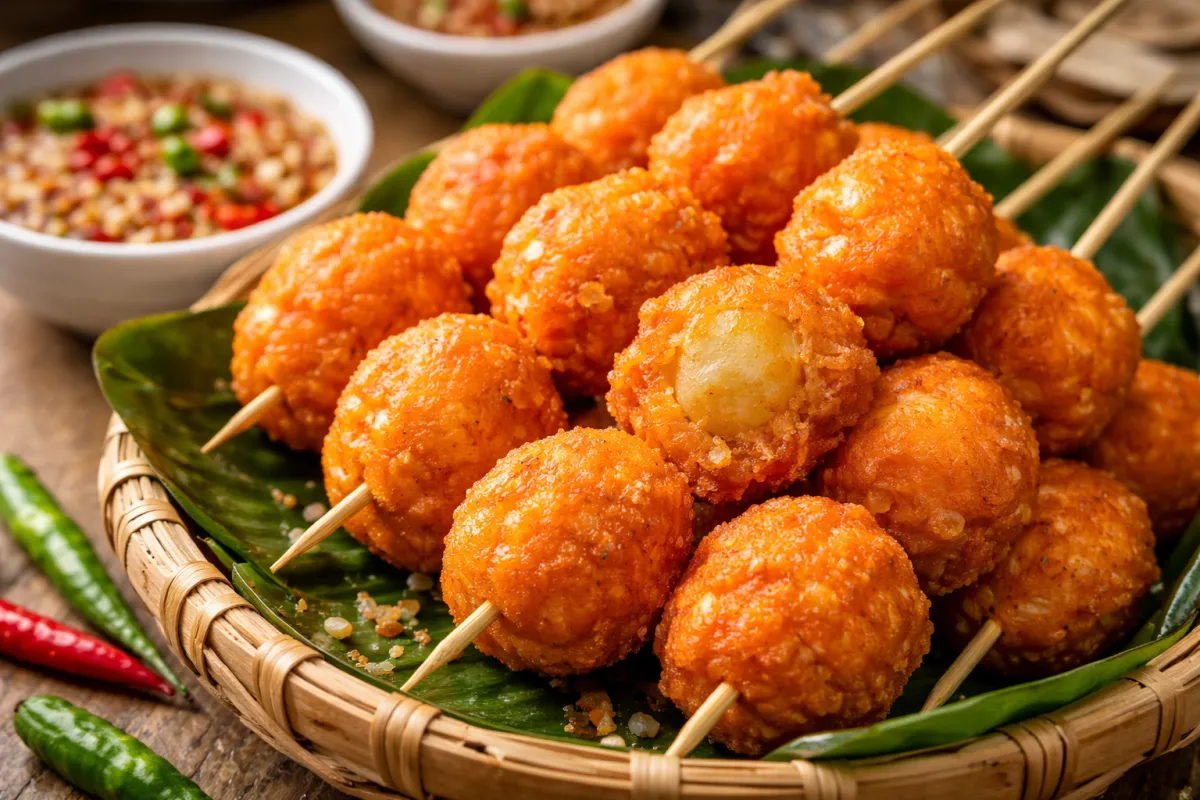
At its core, kwek-kwek is a hard-boiled quail egg coated in a thick orange batter and deep-fried until crispy. The batter is built from flour, cornstarch, water, and — most importantly — annatto powder (also called achuete), a natural dye made from the seeds of the achiote tree that gives kwek-kwek its signature vivid orange color. The eggs are peeled, rolled in the batter until fully coated, fried until the exterior is crunchy and golden-orange, and served either on bamboo skewers or in small plastic cups — always with dipping sauce on the side.
According to TasteAtlas, the thick batter is made with flour, cornstarch, and water, with the addition of annatto powder — a unique ingredient which gives the dish its remarkable orange color. Hard-boiled quail eggs are thoroughly coated in batter and fried until crispy.
A classic kwek-kwek setup typically includes:
🥚 Itlog ng pugo — hard-boiled quail eggs, the star of the dish; small, round, and perfectly bite-sized
🟠 Achuete/annatto batter — the orange coating made from flour, cornstarch, water, and annatto powder
🍶 Sukang may sili — spiced vinegar with chilies and onion, the classic dip
🥣 Sarsa — sweet-savory sauce made of flour, soy sauce, garlic, onion, and sugar; the alternative dip for those who prefer sweet over sour
🍢 Tuhog — bamboo skewer; the proper way to hold and eat it
🧅 Sibuyas at sili — chopped onions and chili peppers, usually floating in the communal vinegar cup
What makes kwek-kwek especially beloved is its accessibility. It is affordable, portable, quick to make, quick to eat, and available near every school, market, and busy street corner in the Philippines. It is food designed for people who are moving, hungry, and need something satisfying without ceremony.
📜 The Story Behind It
Kwek-kwek's origin story is exactly the kind of accidental, resourceful beginning that perfectly matches the food itself.
The most widely told origin story traces kwek-kwek to a balut vendor in Cubao, Quezon City. According to Wikipedia's entry on tokneneng — the parent dish — an early version of both tokneneng and kwek-kwek was created when a balut vendor accidentally dropped the eggs they were selling. Not wanting to waste them, they peeled off the shells, coated the eggs in batter, and fried them. What started as an act of resourcefulness became a street food beloved by millions.
Whether or not that specific story is entirely accurate — and most food historians acknowledge it is more legend than documented fact — it captures something true about how kwek-kwek fits into Filipino street food culture: it was born from practicality, improvised on the fly, and immediately recognized as something worth repeating.
The name itself adds another layer of color to the story. According to Esquire Philippines, "kwek-kwek" supposedly refers to the sound birds make — a kind of chirping or quacking onomatopoeia, fitting for a dish made from eggs. One source also notes that the snack was originally known as toknanay before the current name took hold. Unlike the word tokneneng, which has a traceable origin in a 1978 Filipino komiks series (more on that below), the exact etymology of kwek-kwek remains genuinely unclear — and somehow, that openness suits a snack that was never meant to be formal.
The annatto that gives kwek-kwek its orange color has its own history in the Philippines. According to VERA Files' cultural research on annatto in Philippine food, achuete was introduced to the Philippines by the Spanish — its name coming from the Nahuatl word achiotl — and has been used as both a natural dye and a flavoring in Philippine cooking for centuries. It colors kare-kare, chicken inasal, palabok, and empanadas — and it colors kwek-kwek. That orange is not arbitrary. It is one of the most recurring colors in Filipino food culture, and annatto is why.
Kwek-kwek grew in popularity throughout the latter half of the twentieth century, becoming a fixture outside schools and markets across Metro Manila and eventually spreading across the entire archipelago. Today it appears alongside tokneneng, fish balls, squid balls, and kikiam on virtually every street food cart — a permanent member of the Filipino sidewalk table.
🍳 Kwek-Kwek vs. Tokneneng — The Difference That Matters
One of the most common questions about kwek-kwek is also one of the most misunderstood things about it: how is it different from tokneneng?
The answer is simple, and it matters more than most people realize.
Kwek-kwek is made from quail eggs — small, delicate, and perfectly bite-sized. Each piece is roughly the size of a large marble and can be eaten in one or two bites.
Tokneneng is made from chicken or duck eggs — larger, more substantial, and typically served as a more filling snack. Wikipedia notes that tokneneng is the parent dish, and kwek-kwek is formally described as a popular variation of tokneneng.
Both are coated in the same orange annatto batter and fried the same way. Both are served with the same dipping sauces. The size difference is the defining characteristic — and yet, according to Wikipedia, kwek-kwek and tokneneng are often falsely used interchangeably, with vendors and customers calling one by the other's name depending on where in the Philippines they are.
The name tokneneng itself has a specific, traceable origin: it comes from the 1978 Pinoy komiks series Batute, illustrated by Vic Geronimo and created by Rene Villaroman. In the language invented for the comic's protagonist, Batute, the word tukneneng simply meant "egg." That word entered street food vocabulary and stuck.
In some parts of the Philippines, the distinction is reversed: some vendors use kwek-kwek to mean the chicken egg version and tokneneng for quail. In Taytay, according to Wikipedia, the snack is called epalog — a portmanteau of hepa (hepatitis) and itlog (egg), a darkly humorous local nickname referring to the yellowish skin color associated with jaundice.
All of this is to say: kwek-kwek is technically quail eggs. Tokneneng is technically chicken or duck eggs. In practice, most Filipinos know exactly what you mean when you point at a cart and say either name — because both are orange, both are delicious, and both are right.
🗺️ How It Is Sold Across the Philippines
Kwek-kwek is not a restaurant dish. It is a street dish — and the way it is sold is as much a part of the experience as the food itself.
The cart is part of the identity. A classic kwek-kwek cart is compact, efficient, and almost always orange in some way — the color of the food itself seems to bleed into the entire setup.
👅 What Does Kwek-Kwek Taste Like?
Kwek-kwek tastes like crunch, warmth, and vinegar in a single bite.
The first thing you get is the exterior — the batter, crispy and slightly dense, with a faint savory depth from the salt and a very mild, earthy warmth from the annatto. It does not have a strong flavor on its own. It is a canvas. The quail egg inside is soft and rich — smaller and slightly more intense in flavor than a chicken egg yolk — and the two together create a satisfying contrast between the crunch of the coating and the softness of the egg.
Then comes the dip. And this is where kwek-kwek becomes something else entirely.
The spiced vinegar — sukang may sili — is sharp, sour, and bright, with the heat of chili and the crunch of raw onion floating inside the cup. It cuts through the richness of the fried batter in a way that makes the next piece immediately necessary. The sweet-savory sauce, when it is offered, goes in the opposite direction: thick, slightly sticky, with soy sauce, garlic, and sugar creating a dark, umami-forward dip that turns the same crispy egg into something completely different.
Kwek-kwek is not a complex flavor. It is not meant to be. What it does exceptionally well is deliver crunch, salt, warmth, and acidity in a sequence that is deeply satisfying in a quick, uncomplicated way. It is street food logic at its purest: simple, affordable, and perfectly calibrated for the exact hunger it is meant to satisfy.
🗣️ Learn the Tagalog
One of the most meaningful ways to connect with kwek-kwek is through the words that surround it on the sidewalk.
Filipino street food vocabulary is alive in the moment — in the quick exchange between vendor and buyer, in the shorthand of pointing and nodding, and in the very specific language of how you like your sauce.
The food and the action:
Kwek-kwek (kwek-kwek) — the dish; also an informal onomatopoeia for bird sounds
Tokneneng (tok-neh-neng) — the larger sibling using chicken or duck eggs
Itlog ng pugo (it-log nang poo-go) — quail egg, the primary ingredient
Pritong itlog (pree-tong it-log) — fried egg; what it technically is
Batter (bat-ter) — batter; the word is used as-is in Filipino street food context
Achuete / annatto (ah-chweh-teh) — annatto; the orange dye that defines the color
The dips and sauces:
Suka (soo-kah) — vinegar; the backbone of the dip
Siling labuyo (see-ling lah-boo-yoh) — bird's eye chili; what makes it spicy
Sarsa (sar-sah) — sauce; the sweet-savory alternative
Maanghang (mah-ang-hang) — spicy; a key preference to state at the cart
Matamis (mah-tah-mees) — sweet; for those who prefer the other dip
At the cart:
Pabili nga ng kwek-kwek! (pah-bee-lee ngah nang kwek-kwek) — I'd like to buy kwek-kwek!
Ilan? Sampung piraso. (ee-lan? sahm-poong pee-rah-soh) — How many? Ten pieces.
Maanghang o matamis ang sauce? (mah-ang-hang oh mah-tah-mees ang sauce) — Spicy or sweet sauce?
Dagdag pa ng suka! (dag-dag pah nang soo-kah) — More vinegar please!
Ang sarap! Pabili pa! (ang sah-rahp! pah-bee-lee pah) — So good! I'll buy more!
These words do not exist in cookbooks. They live on sidewalks, at cart counters, and in the particular rhythm of a transaction that takes less than thirty seconds but somehow creates a memory that lasts for years.
🎨 Color It!
Bring Filipino street food to life in a whole new way — through art.
Our Filipino Food Coloring Book on Amazon was built from exactly that idea. Every page is a dish with a story. Every coloring session is an invitation to remember.
That makes it especially meaningful for:
🌼 Families who want a calm, shared activity that naturally opens a real conversation
🌼 Parents and grandparents introducing Filipino heritage to the next generation
🌼 Adults and seniors who find nostalgic, mindful creativity deeply satisfying
🌼 Anyone in the Filipino diaspora who needs a simple, colorful way to hold onto home
🌼 Teachers, homeschoolers, and community groups exploring multicultural learning through art
Each page can open a question worth asking: Where did you first eat kwek-kwek? Was it outside school, near a market, or from a specific vendor whose cart you still remember? Did you like it better with vinegar or sarsa? Did you always eat too many?
Those are the kinds of questions that make creativity feel like connection.
If you would like to explore Filipino food through art, memory, and family connection, download our FREE Filipino Food Coloring pages — they are waiting for you now.
👉 What Filipino Food Are You? Take the quiz →
👉 Get your FREE Filipino coloring pages here.
🤩 Fun Facts About Kwek-Kwek
1. The orange color comes from an ancient natural dye — not food coloring. The vivid orange batter is traditionally made with annatto, known in the Philippines as achuete. According to VERA Files' cultural research, achuete was introduced to the Philippines by the Spanish, with its name originating from the Nahuatl word achiotl. It has been used in Philippine cooking for centuries — appearing in kare-kare, chicken inasal, palabok, and empanadas. Kwek-kwek's orange is not artificial. It is one of the oldest colors in Filipino food culture.
2. The name "kwek-kwek" is likely onomatopoeic — and refers to ducks, not quails. According to Eat My Bananas' research on Filipino street food vocabulary, "kwek-kwek" is said to come from the sound ducks make — even though the eggs used are from quails, not ducks. The quacking sound became the dish's name, and nobody has ever thought to correct it.
3. "Tokneneng" has one of the most specific name origins in all of Filipino food. Unlike kwek-kwek, whose name is pleasantly vague, tokneneng has a traceable source: the 1978 Pinoy komiks series Batute, illustrated by Vic Geronimo and created by Rene Villaroman. In the fictional language invented for the comic's main character, tukneneng meant "egg." That invented word outlasted the comic and became the name of a beloved national street food.
4. Most Filipinos use kwek-kwek and tokneneng interchangeably — and technically, that is wrong. Wikipedia's entry is clear: kwek-kwek uses quail eggs, tokneneng uses chicken or duck eggs. But in everyday use across the Philippines, the names are swapped, reversed, and merged constantly. In some cities, the opposite convention is followed. The distinction is real — and also, somehow, not enforced anywhere.
5. In Taytay, it has a third name entirely. Wikipedia notes that in Taytay, the snack is called epalog — a portmanteau of hepa (hepatitis) and itlog (egg), a dark local joke about its yellowish appearance. Filipino food humor in four syllables.
6. The origin story involves a dropped balut in Cubao — and probably never happened exactly that way. According to Wikipedia, a popular origin story traces both tokneneng and kwek-kwek to a balut vendor who accidentally dropped eggs, peeled them, battered them, and fried them rather than waste them. Food historians note this is more legend than documented fact — but the story is still told because it captures something true about Filipino street food ingenuity: it was born from not wasting anything.
7. Annatto — the orange spice — was once used as lipstick. According to VERA Files, the achiote tree's nickname is "lipstick tree," because its seeds were historically used as cosmetic dye. The same plant that gives kwek-kwek its orange batter has been used as body paint across tropical cultures for centuries. That fact alone makes every kwek-kwek slightly more interesting.
8. Kwek-kwek is officially part of the Philippines' growing culinary tourism profile. A May 2026 press release on Philippine culinary tourism cited by PR Newswire specifically named balut and kwek-kwek as emblematic of Manila's vibrant street food culture — alongside Cebu's pungko-pungko and Davao's exotic fruit snacks — as part of a broader international push to highlight Filipino street food as a cultural tourism draw.
9. It is one of the most affordable sources of protein on any Filipino street. Quail eggs are small but nutritionally dense — high in protein, B vitamins, and iron. For generations of Filipino students and workers, kwek-kwek was not just a snack. It was an affordable, fast, filling meal that cost less than almost anything else available near where they were standing.
10. You can now find premium kwek-kwek in Filipino restaurants abroad — and it surprises non-Filipino diners every time. From Los Angeles to London, kwek-kwek appears on Filipino restaurant menus as an appetizer, often served with house-made sweet chili or garlic vinegar dips. For many non-Filipino diners, it is the first time they see quail eggs used this way — and the combination of vivid color, crisp texture, and tangy dip creates an immediate impression that is very hard to forget.
🌍 How Kwek-Kwek Connects Filipinos Everywhere
Kwek-kwek travels differently from a dish like adobo or halo-halo.
Adobo can be made almost anywhere — its ingredients are globally available and its method is timeless. Halo-halo requires effort and specific Filipino pantry items but can be assembled abroad with patience. Kwek-kwek, by contrast, is most powerful as a memory rather than a recipe — because what makes it special is not the food alone but the entire experience of how it is sold and eaten.
The vendor. The cart. The bubbling oil. The orange-stained bamboo skewer. The communal cup of vinegar with chilies already floating inside it. The act of standing up and eating on a sidewalk without sitting down, without plates, without any formality at all. That is kwek-kwek. And you cannot recreate that experience in a diaspora kitchen in the same way you can recreate adobo.
For many Filipinos abroad — in New York, London, Toronto, Dubai, Melbourne — kwek-kwek is one of those foods that triggers a very specific longing. Not just for the taste, but for the context around it. The school you were walking out of. The afternoon you were walking through. The specific vendor who knew your order. Food memory at its most sensory.
Filipino restaurants abroad have recognized this longing and responded to it. Kwek-kwek now appears regularly on Filipino menus internationally — sometimes as a nostalgic nod to diaspora customers who need that taste, and sometimes as a showpiece dish for non-Filipino diners discovering the full range of what Filipino street food can be. In both cases, it does something that few fried snacks can claim: it makes people ask a question before they eat it. That orange is unusual enough to invite curiosity, and the story behind it is interesting enough to hold attention.
A May 2026 report on Philippine culinary tourism highlighted kwek-kwek alongside balut and fish balls as central to Manila's street food identity — a confirmation that what began as an improvised snack from a dropped balut cart in Cubao has become one of the most recognized faces of Filipino food culture to the rest of the world.
The cart was always right there, on the corner, every afternoon. For Filipinos everywhere, that corner never entirely disappears.
❓ FAQ — Everything You Need to Know About Kwek-Kwek
What is kwek-kwek? Kwek-kwek is a popular Filipino street food made from hard-boiled quail eggs coated in a thick orange batter — made with flour, cornstarch, water, and annatto powder — and deep-fried until crispy. According to Wikipedia's entry on tokneneng, it is a tempura-like snack commonly sold alongside fish balls, squid balls, and kikiam at street food stalls across the Philippines. It is served with a spiced vinegar dip or a sweet-savory sauce.
What is the difference between kwek-kwek and tokneneng? The key difference is the egg. Kwek-kwek uses quail eggs — small and bite-sized. Tokneneng uses chicken or duck eggs — larger and more substantial. Both use the same orange annatto batter and are prepared the same way. According to Wikipedia, the two are often falsely used interchangeably, with conventions varying by region across the Philippines.
What does kwek-kwek mean? The name is widely believed to be onomatopoeic — mimicking the sound birds make. According to Eat My Bananas, "kwek-kwek" specifically refers to the sound ducks make, even though the eggs used are from quails. One source notes the snack was also once called toknanay before the current name became standard. Unlike tokneneng, whose name has a specific documented origin, kwek-kwek's etymology is informal and somewhat open.
What gives kwek-kwek its orange color? The orange comes from annatto powder — called achuete in Tagalog — a natural dye made from the seeds of the achiote tree. According to VERA Files' research on annatto in Philippine food culture, achuete has been used in Filipino cooking for centuries and appears in numerous dishes including kare-kare, palabok, and chicken inasal. It is a natural coloring, not an artificial food dye.
What sauce do you eat kwek-kwek with? Two dipping sauces are traditional. The first is spiced vinegar (sukang may sili) — sharp, sour, and bright, with chopped chili and onion. The second is a sweet-savory thick sauce made from flour, soy sauce, garlic, onion, and sugar. According to Wikipedia, both are standard accompaniments at street food stalls. Most vendors offer both; which one you prefer tends to be a matter of personal loyalty.
Is kwek-kwek the same as tokneneng? No, though they are closely related. Kwek-kwek uses quail eggs; tokneneng uses chicken or duck eggs. They share the same orange batter, the same preparation method, and the same dipping sauces. The distinction is technical but real — and according to Wikipedia, the names are frequently used interchangeably in everyday Filipino life despite the difference.
Where did kwek-kwek come from? The most commonly told origin story traces both kwek-kwek and its sibling tokneneng to a balut vendor in Cubao, Quezon City, who accidentally dropped eggs, peeled and battered them rather than waste them, and created a new snack. Wikipedia acknowledges this story while noting it is likely more legend than documented history. It entered street food culture in the latter half of the twentieth century and has been a staple ever since.
Is kwek-kwek healthy? Kwek-kwek is a fried street snack, so it is not a health food in the conventional sense. However, quail eggs are nutritionally dense — high in protein, B vitamins, and iron. For many Filipinos, kwek-kwek has historically served as an affordable protein source rather than just a treat. Air-fried home versions using less oil have become increasingly common for those who want a lighter preparation.
Can you make kwek-kwek at home? Yes. Kwek-kwek is straightforward to make at home. The main ingredients — quail eggs, flour, cornstarch, and annatto powder — are available at most Asian grocery stores. The batter is mixed, the boiled and peeled eggs are coated, and they are deep-fried in hot oil for about two minutes. The most common challenge is maintaining oil temperature for even crispiness. Home versions are a popular way for the Filipino diaspora to recreate the street food experience in their own kitchens.
What do you serve kwek-kwek with? Kwek-kwek is classically eaten on its own with dipping sauce as a snack or merienda. On the street, it is typically served alongside other fried snacks — fish balls, squid balls, kikiam — so a cart full of different options is the standard setup. At Filipino restaurants, it appears as an appetizer, often with upgraded house dipping sauces. It is rarely served as part of a larger meal with rice in the traditional ulam sense — it is snack food, and that is the whole point.💛 Closing CTA
Kwek-kwek is more than a fried quail egg snack. It is one of those foods that carries the bright, easygoing side of memory — quick merienda stops, sidewalk stalls, little paper cups of sauce, and the kind of snack that feels fun before you even take the first bite.
At Studio Tributes, we love celebrating Filipino culture through food, art, and storytelling. Whether you are discovering kwek-kwek for the first time or remembering it from your own street-food favorites, we hope this gave you a warmer, deeper way to connect with one of the Philippines’ most cheerful snacks.
Keep exploring Filipino food and culture with us:
🎨 Get our Filipino Food Activity Book on Amazon
📚 Read more Filipino food stories on our blog
💭 A Memory to Hold Onto
Did kwek-kwek bring someone to mind?
Maybe the cart outside your school that you stopped at every afternoon without fail. Maybe the vendor who always added extra sauce without being asked, or the one whose vinegar was spicier than everyone else's. Maybe eating it standing up on a crowded sidewalk, skewer in hand, not thinking about anything except how good the next piece was going to be. Maybe the first time you tried to explain it to someone who had never seen a quail egg before.
Where was your kwek-kwek cart? Was it the vinegar or the sweet sauce — and did you ever switch sides? What memory comes back when you picture that orange color?
If a memory came to mind, share your kwek-kwek story on Facebook or Instagram and tag @StudioTributes — we would love to celebrate it with you. And if you would like more warm Filipino food stories, cultural memories, and creative inspiration, come spend time with us on social media.
Read Next
• What Is Pandesal?
• What Is Lechon?
• What Is Halo-Halo?
• What Is Pansit?
If This Story Feels Familiar
If kwek-kwek reminds you of after-school afternoons, neighborhood vendors, or shared coins between friends — you’re not alone.
Filipino Fast Food Chain and Comfort Food Favorites was created to preserve those everyday memories.
Because culture isn’t only found in grand celebrations.
Sometimes, it’s found on a stick, dipped in vinegar, eaten under the sun.
Explore the full collection and continue the story.
📚 References & Further Reading
Wikipedia — Tokneneng — Primary reference for kwek-kwek vs. tokneneng distinction, origin story, egg types, batter ingredients, dipping sauces, the Batute komiks etymology of tokneneng, and the Taytay epalog nickname. Cited throughout this article.
TasteAtlas — 9 Best Street Food in the Philippines — Global culinary database that includes kwek-kwek among the Philippines' best-rated street foods, with description of batter ingredients and dipping sauce tradition.
VERA Files — An Orange-Red Sheen: Annatto in Philippine Food — Authoritative cultural and historical research on achuete/annatto in Philippine cuisine, including its Spanish introduction, Nahuatl etymology, and use across Filipino dishes. Key source for the annatto section and Fun Fact #1 and #7.
Esquire Philippines — History of Street Food in the Philippines — Illustrated food history article covering the origin stories of kwek-kwek and tokneneng, including the Cubao balut vendor legend and the kwek-kwek onomatopoeia explanation.
Eat My Bananas — Tokneneng 101: What You Should Know — Filipino food blog with clear explanation of the name origins of both kwek-kwek (duck sound) and tokneneng (Batute komiks), and the regional confusion between the two names.
Kawaling Pinoy — Kwek-Kwek with Sweet and Spicy Sauce — Widely cited Filipino home cooking reference for traditional batter ingredients, preparation method, and serving guidance.
PR Newswire — The Orange Crunch: Philippine Culinary Tourism 2026 — May 2026 press release specifically naming kwek-kwek and balut as emblematic of Manila's street food identity within the growing international profile of Philippine culinary tourism.
Kusina Secrets — Filipino Kwek-Kwek Recipe — Home cooking reference with detailed batter preparation, sauce variations, and cultural context for kwek-kwek as merienda.
This article blends Studio Tributes storytelling with cultural and culinary research to create a warm, family-friendly learning experience.