
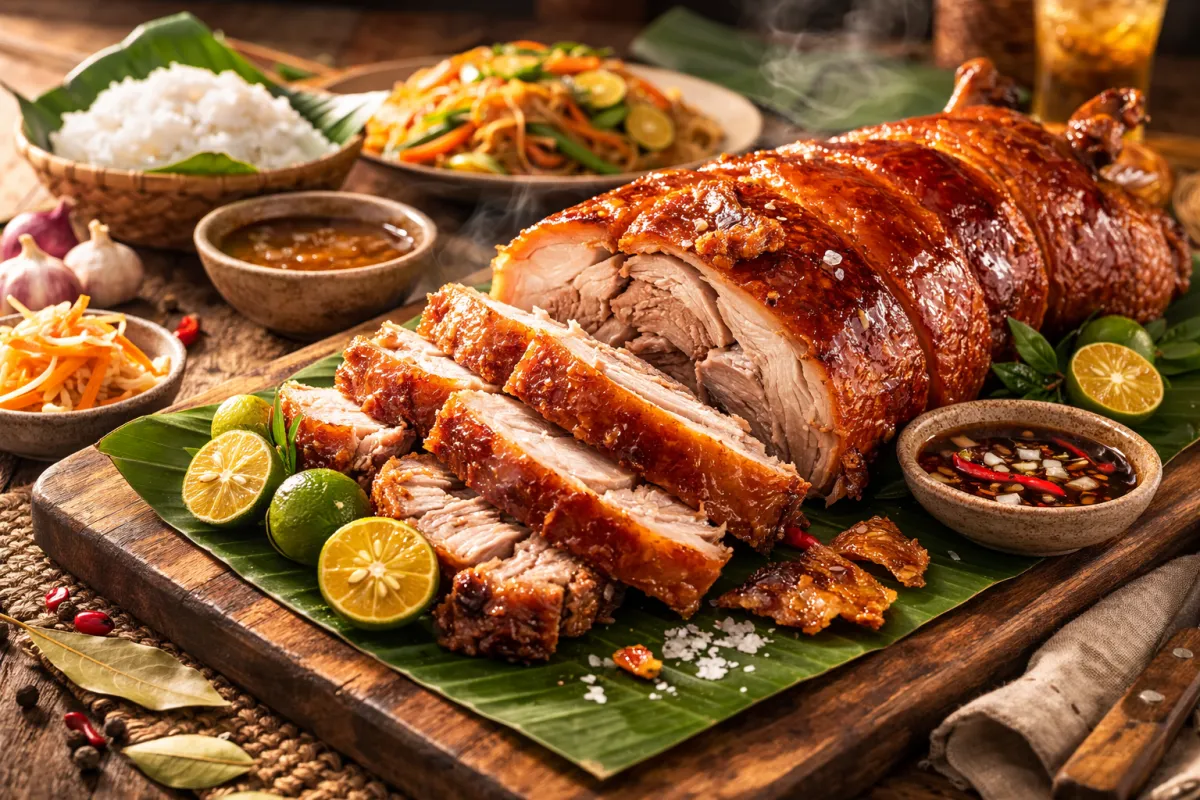
Lechon: The Whole Roasted Pig That Runs the Filipino Fiesta
The Whole Roasted Pig That Is Not Just a Dish — It Is the Announcement That Something Important Is Happening
When you walk into a Filipino celebration and lechon is on the table, you already know.
Not just that the food will be good. Not just that there will be enough. You know that someone cared enough to do the most. That this occasion was worth the hours of preparation, the charcoal, the bamboo spit, the careful rotation by hand. That today is not a regular day. Today — a wedding, a baptism, a fiesta, a milestone birthday, a homecoming — today, someone said yes to the whole pig.
Lechon is the dish that makes the announcement before anyone says a word.
It sits at the center of the table, golden and glistening, the skin crackling and caramelized from hours over hot coals. Everything else on the table — the pancit, the kare-kare, the rice, the fruit, the leche flan — is arranged around it. Because lechon does not share the center. It occupies it.
For Filipinos around the world, lechon is not simply a roasted pig. It is the smell of celebrations that stretched into the night. It is the sound of the skin being scored before it is carried out. It is the image of cousins fighting over the last piece of crackling. It is every occasion worth marking — remembered not just by what happened, but by what was on the table when it did.
At Studio Tributes, we celebrate Filipino food because it carries more than flavor. It carries meaning, occasion, memory, and the particular Filipino generosity that says I prepared the best thing I could prepare for you, and I hope it shows. Today we are going all in on lechon — where it comes from, what makes each regional version extraordinary, what Anthony Bourdain said about it in Cebu, and why this dish has been at the center of Filipino life since long before anyone called it by its current name.
🐖 What Is Lechon?
Lechon (leh-chon) is a whole spit-roasted pig — the centerpiece of Filipino feasts, fiestas, and every celebration large enough to justify the undertaking. The word comes from the Spanish lechón, meaning a suckling pig that is still nursing from its mother. Over time in the Philippines, the term expanded to describe any whole pig slow-roasted over charcoal on a bamboo spit, regardless of size or age.
Wikipedia describes lechon as a pork dish originating from Iberian cuisine, consisting of a suckling or young pig that is spit-roasted over an open fire — and notes that in the Philippines, the dish has become an iconic symbol of celebration, hospitality, and cultural pride.
A whole lechon is prepared this way:
🐷 Baboy — a whole pig, cleaned and gutted, the cavity washed and dried
🌿 Tanglad — lemongrass stalks, stuffed inside the cavity (especially in Cebu)
🧅 Sibuyas at bawang — onions and garlic, generous amounts
🌿 Laurel — dried bay leaves, tucked throughout the cavity
⚫ Paminta — whole black peppercorns
🧂 Asin — salt, rubbed across the skin
🎋 Kawayan — a long bamboo spit that runs through the entire pig from mouth to tail
🔥 Uling — charcoal, arranged beneath the pig in a long pit
The bamboo spit is turned by hand — continuously, patiently, for four to six hours or more depending on the size of the pig. The slow rotation ensures even heat distribution. The fat renders slowly into the meat, keeping it moist. The skin dries and tightens and eventually achieves the singular crackle that Filipinos everywhere describe as the best part.
The skin. Always the skin.
📜 The Story Behind It
Lechon's story in the Philippines goes further back than the Spanish name.
Archaeological work done by the National Museum of the Philippines conclusively proves that Filipinos ate pork as far back as 7,000 years ago. And the practice of roasting pigs over fire was already well established in the Philippine islands long before any outside influence arrived. When Italian chronicler Antonio Pigafetta accompanied Ferdinand Magellan's ill-fated expedition to the Philippines in 1521, he documented eating roast pork and fish during his time there — providing one of the earliest written accounts confirming that roasting pig was already a Filipino practice before the Spanish colonial period even properly began.
As Filipino food historian Felice Prudente Sta. Maria notes, pre-Hispanic Filipinos clearly had their own tradition of roasting pig — and yet we will likely never know the original Tagalog or Visayan name for the dish, because the Spanish colonizers named it before anyone thought to ask. The cooking method existed. The name lechon is what the Spanish called it when they arrived and recognized something familiar.
The word itself comes from leche — the Spanish word for milk — because the original lechón referred specifically to a young suckling pig still nursing from its mother. The practice of roasting whole animals was part of Spanish culinary and colonial tradition, and during the Spanish colonial period in the Philippines, which began in 1565, the Spanish promoted pork consumption actively as part of spreading their culture and religion across the archipelago.
But what Filipinos did with the technique is the real story. Over the following centuries, Filipinos did not simply adopt a Spanish dish. They transformed it. They stuffed the pig with their own local aromatics — lemongrass, star anise, bay leaves, garlic, spring onions. They developed their own dipping sauces rooted in Filipino flavors. They embedded the dish in the specific occasions of Filipino life — not the Spanish lechon de leche of elegant dining rooms, but the lechon of town fiestas and three-day weddings and backyard birthdays that spilled into the street.
Spain wrote the first chapter. The Philippines wrote the rest of the book.
👅 The Regional Versions — One Pig, Divided by Island
Lechon is made everywhere in the Philippines, and it tastes differently in every region. The differences are not subtle. They are deep enough that Filipinos from different provinces will have heated, affectionate, completely irresolvable arguments about whose region's version is best.
Manila / Luzon Lechon: The Metro Manila version is the one most widely available commercially and the one most often served at large catered events. The pig is typically prepared with a simpler cavity — salt, pepper, and some aromatics — with the primary flavoring coming from the outside rather than inside. Manila lechon is traditionally served with lechon sauce — a thick, sweet, savory, liver-based dipping sauce. The most famous commercial version is Mang Tomas All-Purpose Sarsa, the brown bottle that appears on virtually every Filipino celebration table outside of the Visayas. The skin is glossy and dark, the sauce is the companion, and the combination is deeply satisfying.
Cebu Lechon — The One Anthony Bourdain Called the Best Pig He Ever Ate: Cebu is the undisputed lechon capital of the Philippines — and by many accounts, the lechon capital of the world. Cebu lechon is stuffed with a generous bundle of fresh lemongrass, garlic, spring onions, native herbs, bay leaves, and black peppercorns — packed tightly enough that the aromatics slowly perfume the meat from the inside out during the hours of roasting. The result is a pig that does not need any sauce. Not because the skin lacks flavor, but because the meat itself is so deeply, herbaceously seasoned that adding anything on top would be a distraction.
In 2009, the late Anthony Bourdain visited Cebu for his CNN show No Reservations and tasted lechon prepared by Joel Binamira — known online as Market Man, and later the founder of Zubuchon restaurant. Bourdain's verdict, delivered on global television, was straightforward: "The best pig, ever." Cebuanos responded with the quiet pride of people who had always known and were simply glad someone finally said it out loud.
La Loma, Quezon City: La Loma is often called the lechon capital of Metro Manila — a specific neighborhood with a concentration of lechon restaurants that have been roasting pigs for generations. La Loma lechon tends to sit between the Manila and Cebu styles, with its own loyal following and its own particular preparation traditions.
Ilocos Region: Ilocano lechon has its own distinct character, often made with native Ilocano pigs and cooked with local aromatics and vinegar traditions that reflect the region's strong paksiw and vinegar culture.
Modern Variations: Beyond the whole pig, the lechon family has expanded significantly. Lechon belly — a deboned pork belly roll stuffed with aromatics and roasted — has become enormously popular for smaller gatherings where a whole pig is impractical. Lechon manok (roasted chicken) brings the lechon spirit to a smaller bird. Lechon kawali (crispy deep-fried pork belly) captures the essential crackle without the spit. And lechon de leche — a roasted suckling pig, younger and smaller than the standard lechon — is considered by many to be the most delicate and celebrated version of all.
🍽️ The Day After: Lechon Paksiw
One of the most beautiful things about lechon is what happens the next day.
A whole roasted pig feeds many people — but almost never everyone at once, and almost never completely. There are always leftovers. And Filipino cooking has always known that the best thing to do with leftover lechon is not to reheat it but to transform it.
Lechon paksiw is a Filipino pork stew made from leftover lechon. The word paksiw refers to a broad category of Filipino dishes cooked in vinegar — and lechon paksiw simmers the leftover chopped pork in vinegar, garlic, bay leaves, peppercorns, and lechon sauce or liver sauce until the meat is fall-apart tender and the sauce is rich, tangy, and deeply savory.
It is one of the great transformations in Filipino cooking. The day-before dish was a spectacle — golden, crispy, the center of attention. The day-after dish is quiet comfort — saucy, soft, eaten over rice at a kitchen table when the guests have gone and the house is back to normal. Both versions of the same pig are extraordinary. They are just extraordinary in completely different ways.
Mang Tomas — the bottled lechon sauce — is the standard companion for both the feast version and the leftover version across most of the Philippines outside Cebu, where the pig's own stuffing makes additional sauce unnecessary.
👅 What Does Lechon Taste Like?
There is no single answer to this because lechon's flavor depends enormously on the version, the region, and the specific pig. But there are constants.
The skin is the defining element. When done correctly — slow-roasted over charcoal for the right number of hours, basted at the right intervals, turned with care — lechon skin achieves something close to perfection. It is simultaneously paper-thin and substantial. It shatters when you bite into it, like the best potato chip you have ever had, but with the richness of rendered pork fat underneath. The color is a deep caramel-mahogany. The smell, from ten meters away, is what triggers the memory.
The meat beneath the skin is where the pig's preparation tells its full story. Manila lechon meat is clean and savory — the aromatics gentle, the flavor primarily pork and smoke. Cebu lechon meat is aromatic and herbaceous — the lemongrass and garlic have worked their way through every inch of the flesh during the hours of roasting. You taste the pig, but you also taste the particular herbal landscape of the Visayas. It is remarkable.
Eaten with lechon sauce (Manila style): rich, sweet-savory, the liver in the sauce adding depth and a slight edge. Eaten without sauce (Cebu style): pure, aromatic, self-sufficient.
If I had to describe it simply:
Lechon tastes like the reason everyone showed up.
🗣️ Learn the Tagalog
The language around lechon is the language of occasion, celebration, and the specific rituals that only happen when something important is happening.
The dish:
Lechon (leh-chon) — the whole roasted pig; the word and the event
Litson (lit-son) — the older, more colloquial Tagalog spelling; you will see this in provinces
Lechon baboy (leh-chon bah-boy) — pork lechon specifically; clarifies it is pig, not chicken
Lechon manok (leh-chon mah-nok) — roasted chicken in the lechon style
Lechon kawali (leh-chon kah-wah-lee) — deep-fried crispy pork belly
Lechon de leche (leh-chon deh leh-cheh) — suckling pig lechon; the most tender version
The preparation:
Uling (oo-ling) — charcoal; the fuel that defines the flavor
Kawayan (kah-wah-yan) — bamboo; the spit that holds the pig
Tanglad (tahng-lahd) — lemongrass; the aromatic heart of Cebu lechon
Balat (bah-laht) — skin; what everyone fights over
Karne (kar-neh) — meat; the second prize after the skin
The sauce:
Sarsa (sar-sah) — sauce; the generic word
Lechon sauce — the liver-based dipping sauce served with Manila lechon
Mang Tomas — the most iconic brand of bottled lechon sauce in the Philippines
Paksiw (pahk-seew) — the day-after dish; leftover lechon stewed in vinegar and sauce
At the table:
May lechon! (mai leh-chon) — There's lechon! (the announcement that changes everything)
Gusto ko ng balat! (goos-toh ko nang bah-laht) — I want the skin!
Saan ang lechon ng Cebu? (sah-ahn ang leh-chon nang seh-boo) — Where is the Cebu lechon?
Mag-paksiw tayo bukas. (mahg-pahk-seew tah-yoh boo-kahs) — We'll make paksiw tomorrow.
That last phrase carries something important in it. It means the celebration was large enough to leave leftovers. It means there is a tomorrow after the today. It means the occasion was worth it.
🎨 Color It!
Bring Filipino food to life in a whole new way — through art.
Lechon is one of the most visually spectacular Filipino dishes to color — and one of the most emotionally loaded. The canvas is extraordinary: the deep golden-mahogany of the caramelized skin, the darker grill-and-smoke marks along the belly, the pale ivory of the bamboo spit running through the full length. The garnishes that always appear alongside — fresh banana leaves, calamansi halves, tomatoes, and the small ramekin of Mang Tomas beside it.
When you sit with a lechon coloring page and choose your colors — how dark to go with the skin, where the char marks fall, how golden versus how amber the roasting created — something happens. You start thinking about the occasions. The specific celebration where you first remember lechon appearing. Who ordered it. How far in advance. The sound it made when it arrived on the table.
You think about what the occasion was. Whether it was a wedding or a birthday or a Christmas or a reunion. Whether it rained. Whether everyone came. Whether the skin was everything you hoped.
Our Filipino Food Coloring Book on Amazon was built from exactly that belief — that coloring a dish is a way of sitting with a memory long enough to really see it. Lechon — with its dramatic visual presence, its deep cultural weight, and its specific place at the center of every Filipino occasion that mattered — is one of the most powerful pages in the book to color.
This makes it especially meaningful for:
🌼 Filipino families who want to talk about the celebrations that shaped them
🌼 Parents and grandparents sharing the traditions of Filipino fiestas with the next generation
🌼 Anyone in the Filipino diaspora who has attended a celebration with lechon and wants to remember it differently
🌼 Non-Filipino partners and friends who want to understand what lechon means beyond the food
🌼 Teachers, homeschoolers, and cultural groups exploring Filipino heritage through art
Each page can open a question worth asking: What was the occasion the first time you remember eating lechon? Did your family fight over the skin? Cebu or Manila style — and does it matter to you?
Those questions are how a coloring book becomes a family archive.
Share your completed lechon page on Facebook or Instagram and tag @StudioTributes — we would love to celebrate your version with the whole community.
If you would like to explore Filipino food through art, memory, and family connection, download your FREE Filipino Food Coloring pages — they are waiting for you.
👉 What Filipino Food Are You? Take the quiz →
👉 Get your FREE Filipino coloring pages here.
🤩 Fun Facts About Lechon
1. Filipinos have been eating roasted pork for at least 7,000 years. Archaeological work done by the National Museum of the Philippines proves that Filipinos ate pork approximately 7,000 years ago. And Antonio Pigafetta's 1521 chronicle of Magellan's Philippine expedition documents eating roast pork during his visit — confirming the practice predates Spanish colonization.
2. The original Filipino name for the dish has been lost to history. Pre-Hispanic Filipinos never told Spanish colonizers their own word for lechon. The Spanish gave it a Spanish name and that is the one that survived. As food historian Felice Prudente Sta. Maria has noted, we may never recover the original Tagalog or Visayan term. It is one of the quiet casualties of colonization.
3. Anthony Bourdain called Cebu lechon "the best pig, ever." In 2009, on his CNN show No Reservations, the late Anthony Bourdain tasted lechon prepared by Joel Binamira in Cebu and delivered what has become one of the most famous food endorsements in Filipino culinary history. Cebuanos were not surprised. They were simply glad he finally tried it.
4. Cebu lechon requires no sauce. The Cebu lechon tradition of stuffing the pig with lemongrass, garlic, spring onions, and native herbs produces meat so deeply seasoned and aromatic that adding dipping sauce is considered unnecessary — and by some Cebuanos, a mild insult. The pig is its own sauce.
5. The skin is so beloved it is sometimes served as its own dish. The balat — the crackling skin of lechon — is so popular that some Filipino restaurants and catering companies offer it separately. Chicharon (deep-fried pork rind) is the everyday version of what lechon skin is at a celebration: the best-textured, most addictive part of the pig.
6. The bamboo spit is turned by hand for up to eight hours. Traditional lechon preparation requires continuous hand-turning of the bamboo spit — often for four to eight hours depending on the size of the pig. The slow, consistent rotation is essential for even cooking and the distinctive skin texture. In Cebu, some say the slow rotation is one of the primary reasons their lechon stands apart.
7. Lechon paksiw turns celebration leftovers into a separate beloved dish. The day after the fiesta, leftover lechon is stewed in vinegar, garlic, and lechon sauce to make lechon paksiw — a completely different eating experience from the original roast. This transformation of celebration food into comfort food the next day is one of the most distinctly Filipino things about the dish.
8. Lechon de leche is the most tender version — and the most expensive. A lechon de leche uses a true suckling pig of two to six weeks old — smaller, paler, more delicate, and with the most tender meat of any lechon preparation. It is a significant upgrade in cost and effort, and it is the version served at the most important celebrations.
9. Every Filipino family claims their version is the best. Wikipedia notes that lechon has spawned significant regional and family variations, each with its own loyal defenders. This is not mere boasting. It is accurate. Every lechon is shaped by the hands that prepared it, the pig that was raised, the aromatics that grew nearby, and the charcoal that was used. No two lechons are ever exactly the same.
10. Lechon has become a global phenomenon through the Filipino diaspora. As Filipino communities have established themselves in the United States, Canada, Australia, the UK, the UAE, and across Europe, lechon has traveled with them. Filipino food festivals worldwide regularly feature lechon as the centerpiece attraction. And Filipino-owned restaurants from New York to London to Melbourne have introduced it to international audiences who encounter it with the same reaction: shock, then immediate understanding, then the question: Why have I never had this before?
🌍 How Lechon Connects Filipinos Everywhere
Ask a Filipino living abroad what food they associate most strongly with the word celebration and the answer is almost always lechon.
Not adobo — which is everyday. Not sinigang — which is comfort. Not halo-halo — which is summer. Lechon is the word that appears when someone says fiesta, birthday, graduation, wedding, Christmas, reunion. It is the dish that marks the occasions that matter.
That association carries across distance and time in a way that is difficult to replicate. A Filipino in Toronto who has not been back to the Philippines in ten years can still reconstruct, in extraordinary detail, the memory of a lechon being carried to the table at a particular celebration. The sound. The smell. The way the skin looked under the afternoon light. The scramble for the best pieces before the crowd closed in.
Lechon does not travel as easily as adobo — you cannot make a whole roasted pig in a Toronto apartment kitchen in the same way you can make a pot of vinegar-braised pork. But Filipino-owned catering businesses, community fiesta organizers, and Filipino restaurants in diaspora cities have made it possible. And every time lechon appears at a Filipino community event abroad — at a town fiesta in New Jersey, a baptism in Melbourne, a Christmas party in London — something happens that cannot be replicated by any other dish on the table.
People stop what they are doing. They turn toward the pig. Someone says may lechon. And for a moment, the occasion feels exactly like an occasion back home.
That is what lechon does. Not just feed people. Confirm to them that this day was worth marking.
❓ FAQ — Everything You Need to Know About Filipino Lechon
What is Filipino lechon? Filipino lechon is a whole spit-roasted pig, slow-cooked over charcoal on a bamboo spit for four to eight hours. According to Wikipedia, the dish originated from Iberian cuisine but has become a deeply embedded symbol of Filipino celebrations, hospitality, and cultural identity. The whole pig is stuffed with aromatics, rubbed with salt, and rotated continuously over heat until the skin achieves its signature caramelized, crackling texture.
Where does the word "lechon" come from? The word lechon comes from the Spanish lechón, derived from leche (milk), referring originally to a suckling pig still nursing from its mother. The Spanish colonial period in the Philippines, beginning in the 1565, brought the name — but the practice of roasting pig in the Philippines predates Spanish arrival by thousands of years.
What is the difference between Manila lechon and Cebu lechon? Manila lechon is typically served with a liver-based dipping sauce (most famously Mang Tomas) and has a cleaner, more simply seasoned interior. Cebu lechon is stuffed with fresh lemongrass, garlic, spring onions, and native herbs — producing an aromatic meat so flavorful it requires no sauce. Many consider Cebu lechon the superior version. Anthony Bourdain's declaration of "the best pig, ever" referred specifically to the Cebu preparation.
What is lechon sauce? Lechon sauce is a thick, sweet-savory dipping sauce traditionally made with pork liver, vinegar, breadcrumbs, garlic, onions, and sugar. The most widely recognized commercial brand is Mang Tomas All-Purpose Sarsa. It is the standard accompaniment for Manila-style lechon. Cebu lechon is served without sauce.
What is lechon kawali? Lechon kawali is a crispy pork belly dish where a strip of pork belly is simmered until tender and then deep-fried until the skin achieves a crackling crunch similar to lechon's skin. It is a more accessible, everyday version of lechon that does not require a whole pig or a charcoal spit.
What is lechon paksiw? Lechon paksiw is a Filipino stew made from leftover lechon. The chopped pork is simmered with vinegar, garlic, bay leaves, peppercorns, and lechon sauce until deeply flavorful and tender. Paksiw refers to the Filipino cooking method of stewing in vinegar. Lechon paksiw is considered the natural, beloved second act of any celebration lechon — often preferred by many who love the original.
What occasions feature lechon? Lechon is served at weddings, baptisms, birthdays, fiestas, Christmas celebrations, New Year feasts, graduations, reunions, debuts (quinceañera equivalent), and any significant gathering. Serving lechon is a signal of generosity and the host's commitment to providing the best — it is reserved for occasions important enough to justify the effort and expense.
What does lechon skin taste like? Lechon skin — called balat — is the most prized part of the dish. When cooked correctly, it is paper-thin, shatters on contact, and tastes like the richest, most satisfying crackling imaginable — a combination of caramelized pork fat, smoke, salt, and the specific sweetness that comes from hours of slow heat. Many Filipinos consider it the best textured food in existence.
Can lechon be made at home? A whole lechon requires a charcoal pit, a bamboo spit, hours of hand-turning, and considerable space and experience. Most Filipinos order lechon from specialist lechoneros who roast pigs professionally. Lechon belly and lechon kawali are practical home alternatives that replicate much of the character of the whole pig.
💛 Closing
Lechon is the dish that announces something.
Every time it arrives at a table — carried on a tray, skin glistening, surrounded by banana leaves and calamansi — it says: this day was worth doing properly. Someone cared enough to order the whole pig. Someone spent hours over the charcoal. Someone wanted this occasion to feel the way occasions are supposed to feel.
That is what Filipino generosity looks like at its most specific and most material. Not just welcoming someone. Not just feeding someone. Preparing the most extraordinary thing available for the people you love most, on the days that matter most, because that is what those people and those days deserve.
At Studio Tributes, we celebrate Filipino culture through food, art, and the stories that travel with both. Whether you are eating lechon at a Cebu roadside stall, ordering it for a community fiesta in California, or coloring the page while remembering a celebration that happened decades ago in a backyard you have not been back to since — we hope this gave you something deeper to bring to the table.
Explore more Filipino food, art, and memory with us:
🎨 Get our Filipino Food Activity Book on Amazon
📚 Read more Filipino food stories on our blog
💭 A Memory to Hold Onto
Did lechon bring a specific celebration to mind?
Maybe the wedding where the whole pig arrived on the table and everyone immediately abandoned their seats to crowd around it. Maybe a backyard fiesta where the charcoal smell reached you from the street before you even opened the gate. Maybe a Christmas table that felt complete the moment the lechon was set down in the center. Maybe the morning after a party, eating cold lechon paksiw over rice, the house quiet, the celebration finally finished.
What was the occasion the first time you remember lechon? Did your family fight over the skin? Whose lechon do you still think about?
If a memory came back — share it with us.
Tag @StudioTributes on Facebook or Instagram with your lechon story, or share a photo of your colored lechon page using #StudioTributes and #FilipinoFoodMemories.
We read every single one. 🇵🇭🐷
Read Next
📚 References & Further Reading
Encyclopaedia Britannica — Adobo | Description, History, Variations & Uses — Referenced for broader context on indigenous Filipino culinary traditions and the colonial renaming of pre-existing Filipino dishes.
Wikipedia — Lechon — Comprehensive entry on lechon's Iberian origins, Philippine evolution, regional variations, and cultural significance.
Philippine Tribune — The Ancient Origins of Filipino Lechon: A Ritualistic Journey — Essay on the pre-Hispanic origins of Filipino lechon, the 7,000-year archaeological evidence, and the 1521 Pigafetta chronicle.
FOODICLES — Lechon History: Origins of the Famous Filipino Roasted Pig — Historical overview of lechon from pre-colonial Austronesian traditions through Spanish colonial influence.
WhyCebu — Best Lechon in Cebu: Top Spots and 2026 Prices — Current guide to Cebu lechon including the background on Anthony Bourdain's endorsement and the founding of Zubuchon.
Authentic Food Quest — Lechon Paksiw Recipe: How to Cook Filipino Leftover Lechon — Cultural and culinary context for lechon paksiw as the day-after transformation of celebration food.
Felice Prudente Sta. Maria — Filipino food historian; her research on the lost pre-Hispanic name for lechon and the 1521 Pigafetta documentation is referenced in multiple cultural and culinary history sources.
This article blends Studio Tributes storytelling with cultural and culinary research to create a warm, family-friendly learning experience.