
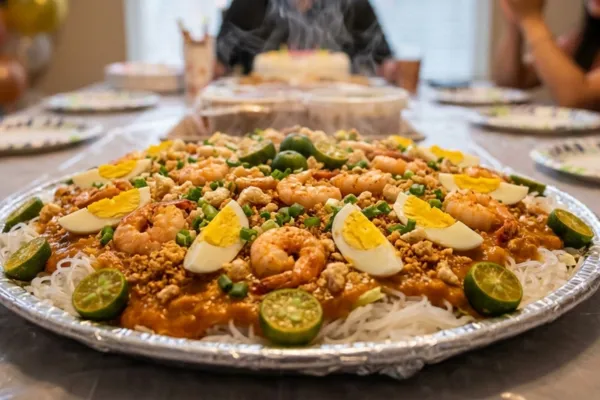
Pansit Palabok: The Filipino Noodle TasteAtlas Ranked #1
Studio Tributes / Filipino Food / What Is Pansit Palabok?
What Is Pansit Palabok?
The Filipino Noodle Dish That TasteAtlas Called the Country's Best — and the One Most Filipinos Can Describe in One Color
Ask a Filipino to describe pansit palabok in one word and they will almost always say the same thing.
Orange.
That specific, warm, vivid orange — the color of the sauce that makes palabok instantly recognizable across every Filipino table, every birthday celebration, every fiesta spread, every Jollibee visit. The color that comes from annatto seeds — atsuete — simmered into a shrimp-and-pork broth until it turns the thick, glossy, deeply savory sauce into something that looks like it was designed to be celebrated.
And it was. Palabok is, at its core, a celebration noodle.
Not just in the way all Filipino noodle dishes are celebration food — though they all carry the deep cultural belief that long noodles mean long life and that cutting them short is bad luck. Palabok specifically, with its elaborate toppings, its layered flavors, its visual abundance, is the pansit you make when you want a table to look and taste like something special is happening. The shrimp. The tinapa flakes. The crushed chicharron. The hard-boiled eggs. The green onions. The fried garlic. All of it arranged over the orange-sauced noodles with the kind of generous, layered care that says: today matters.
TasteAtlas — the world's most respected traditional food ranking database — named pansit palabok the number one Filipino noodle dish, with a 4.1-star rating. And in its description, TasteAtlas made a distinction worth pausing on: it called palabok "an authentic Filipino invention, unlike other Chinese-influenced versions" of pancit.
In a cuisine shaped by centuries of trade, colonization, and cultural exchange, that is no small thing to say.
At Studio Tributes, we celebrate Filipino food because it carries more than flavor — it carries history, memory, identity, and the specific generosity of a culture that puts its best effort on the table for the people it loves. Today we are going deep into pansit palabok: where it comes from, what makes its sauce unlike anything else in the noodle world, what every topping means and does, and why this dish — orange and abundant and deeply layered — is the one most Filipinos associate with the occasions that mattered most.
🍜 What Is Pansit Palabok?
Pansit palabok (pahn-sit pah-lah-bok), sometimes spelled pancit palabok, is a Filipino noodle dish consisting of thin rice noodles topped with a thick, orange-hued shrimp-and-pork sauce and an elaborate arrangement of toppings — shrimp, crushed chicharron, tinapa flakes, hard-boiled eggs, fried garlic, and green onions — finished with a squeeze of calamansi.
According to Wikipedia's entry on pancit, it is a general term for various traditional Filipino noodle dishes, most of which trace their origins to Chinese traders who brought noodle-making traditions to the Philippines centuries ago. Pansit palabok, however, is specifically noted as one of the most distinctively Filipino versions — the sauce, the toppings, and the composition together represent a uniquely Philippine culinary tradition.
The name breaks down simply:
Pansit / Pancit — from the Hokkien Chinese pian e sit, meaning "something conveniently cooked" or "convenient food"
Palabok — a Filipino word meaning "garnish," "added flavor," or, as some sources describe it, "flowery" — referring to the elaborate, layered toppings that make the dish as visually generous as it is flavorful
A classic pansit palabok includes:
The noodles:
🍜 Bihon — thin rice vermicelli noodles, the most common base for palabok; sometimes cornstarch noodles are used (see the palabok vs luglug section below)
The sauce:
🦐 Hipon — shrimp, both for the stock and as a topping; shrimp heads and shells are simmered to create the base broth
🐷 Giniling na baboy — ground pork, sautéed into the sauce for savory depth
🟠 Atsuete / Annatto — the seeds or powder that give the sauce its signature golden-orange color
🐟 Patis — fish sauce, the essential saltiness and umami
🥬 Cornstarch — for thickening the sauce to its characteristic glossy, coating consistency
The toppings:
🦐 Hipon — whole boiled shrimp, arranged over the sauce
🐟 Tinapa flakes — smoked fish, flaked and scattered over the noodles
🥚 Itlog na nilagang — hard-boiled eggs, sliced
🐷 Chicharon — crushed pork rinds, providing the essential crunch
🌱 Dahon ng sibuyas — green onions, for freshness
🧄 Prito na bawang — fried garlic bits, for fragrance and crunch
🍋 Kalamansi — Philippine lime, served on the side, squeezed over everything just before eating
📜 The Story Behind It
The story of pansit palabok is the story of the Philippines in miniature: Chinese foundations, Spanish ingredients, indigenous ingenuity, and an outcome that belongs entirely to the islands.
Noodles arrived in the Philippines through Chinese traders. Wikipedia documents that noodles were introduced to the Philippines by Chinese immigrants, and that the Hokkien Chinese term pian e sit — conveniently cooked food — became pancit in Filipino. The world's oldest Chinatown, Binondo in Manila, was established in the 16th century, and it was through this trading post and the centuries of Chinese immigration and cultural exchange that noodle-making became embedded in Filipino food culture.
The original Chinese noodle dishes were stir-fried, simple, practical — designed for the efficient cooking of the panciteria, the Chinese-Filipino noodle shop that became a fixture of Philippine street food. Pansit bihon, pansit canton, pansit sotanghon — all of these retain clear connections to their Chinese culinary ancestry.
But palabok is different. TasteAtlas specifically notes that pancit palabok "is considered to be an authentic Filipino invention, unlike other Chinese-influenced versions." The shrimp-and-pork sauce thickened with cornstarch and colored with annatto, the layering of tinapa flakes and crushed chicharron, the elaborate topping composition — these are Filipino developments, not imports.
The annatto — the atsuete seeds that give the sauce its color — is itself a bridge across the Philippines' colonial history. The achiote tree, from which annatto seeds come, was introduced to the Philippines by the Spanish during the colonial period. But indigenous Filipinos had already been using native orange and red colorings in cooking. The annatto became the standard because it produced exactly the right hue — warm, vivid, celebratory — and contributed a mild earthy flavor that complemented the shrimp broth without competing with it.
The tinapa — smoked fish — is a Filipino preservation tradition that long predates any colonial influence. The chicharron is a Spanish import that Filipinos made their own. The calamansi is as Filipino as any ingredient gets. Together, the toppings are a quiet autobiography of the Philippines itself: indigenous, Chinese, Spanish, and distinctly none of those alone.
Pre-colonial Filipino communities crafted noodles from locally available ingredients such as rice flour or cornstarch, and these early preparations were often made for special occasions and celebrations — symbolizing abundance and community gathering. As Chinese immigrants arrived and brought more sophisticated noodle-making techniques, Filipino cooks absorbed the techniques and began building distinctly Filipino preparations around them.
Palabok emerged from that synthesis — a dish with Chinese noodles, Spanish annatto, Filipino seafood, and a sauce technique that has no real equivalent in any of the cuisines that shaped it. It is, genuinely, a Filipino invention.
🟠 The Annatto Sauce — The Heart of Everything
If palabok has a soul, it lives in the sauce.
The palabok sauce is what makes this dish immediately and permanently recognizable. Thick, glossy, deeply orange, fragrant with shrimp stock, savory with ground pork and fish sauce, coating every strand of noodle completely. It is not a light sauce. It does not drizzle. It pours generously and pools at the edges of the plate and soaks into the noodles so that every forkful carries the full flavor of everything in it.
The sauce begins with shrimp. Not just shrimp meat — the heads and shells, pounded and simmered to extract every bit of flavor from the crustacean. This shrimp stock is the backbone. It provides a sweetness and depth that no broth from a cube or powder can replicate. Filipino cooks who make palabok from scratch take this step seriously — the quality of the sauce depends almost entirely on the quality of the shrimp stock.
Ground pork is sautéed separately — with garlic and onions — then the shrimp stock is added, and the mixture is brought to a simmer. The atsuete (annatto) is dissolved in water or oil to release its color, then stirred into the sauce. A cornstarch slurry thickens everything to the right consistency — thick enough to coat the noodles heavily, loose enough to flow beautifully when poured. Fish sauce provides the salt. Black pepper gives warmth.
The result is something that looks festive and tastes complex — simultaneously sweet from the shrimp, savory from the pork and fish sauce, slightly earthy from the annatto, rich from the fat that carries all of it.
Without the sauce, you have plain rice noodles. With it, you have palabok.
🍜 Palabok vs Luglug vs Malabon
This is the comparison that every Filipino cook has an opinion on — and every answer is slightly different depending on who you ask and where they grew up.
Pansit Palabok: The most widely recognized version. Uses thin bihon (rice vermicelli) noodles. The sauce is the palabok sauce — shrimp stock, ground pork, annatto, fish sauce, cornstarch. Toppings are arranged on top (not tossed in). Named for the elaborate topping arrangement (palabok = garnish).
Pansit Luglug: Considered the Kapampangan version of palabok. The primary difference is the noodles: luglug traditionally uses thicker cornstarch noodles rather than thin bihon. The word luglug refers to the cooking technique — dipping the noodles briefly into boiling broth for just a few seconds before plating. The sauce and toppings are essentially the same as palabok. In practice, many Filipinos and even many markets use the names interchangeably.
Pansit Malabon: Named after the coastal city of Malabon in Metro Manila, famous for its seafood. Uses thick tubular rice noodles. More seafood in both the sauce and the toppings — squid, oysters, and crab are common additions. The sauce often incorporates crab fat, giving it a deeper, more oceanic richness. The ingredients are usually more incorporated (mixed in) rather than simply arranged on top.
The simplest way to remember the difference: thin noodles + arranged toppings = palabok. Thicker noodles + similar sauce = luglug. Thick tubular noodles + heavy seafood + crab fat = Malabon.
All three are extraordinary. The argument about which is best is one of the most reliably entertaining conversations you can start at any Filipino table.
👅 What Does Pansit Palabok Taste Like?
Pansit palabok does not taste like anything else in the Filipino pantry — and it does not taste like any noodle dish outside the Philippines either.
The first thing you notice is the sauce. Rich, savory, subtly sweet from the shrimp, with a warmth from the black pepper and a brightness from the annatto that makes it feel more alive than a plain broth-based sauce. The orange color is not a trick — it is what the dish genuinely looks like, and it prepares you for a flavor that is equally warm and vivid.
Then the noodles, which are soft and yielding — not chewy, not firm, but the kind of gentle that allows the sauce to be the dominant character. They carry the sauce completely.
Then the toppings begin their work in your mouth simultaneously. The chicharron shatters — that specific crunch against the soft noodles and thick sauce is one of the most satisfying textural contrasts in all of Filipino food. The tinapa flakes bring a smoky, ocean-depth to the sweetness of the shrimp. The hard-boiled egg provides a gentle richness that rounds everything. The fried garlic is fragrant and slightly bitter at the edges, cutting through the richness. The green onions bring freshness.
And then you squeeze the calamansi.
This is the moment that completes the dish. The bright, sharp citrus of the Philippine lime cuts through every layer of richness and sweetness and smoke and crunch — sharpening everything, brightening everything, making you want to take another bite immediately.
If I had to describe it simply:
Pansit palabok tastes like abundance. Layered, generous, vivid, warm. Every topping doing its own job. Every bite different from the last. The kind of dish that justifies the occasion that was made for it.
🗣️ Learn the Tagalog
The language around pansit palabok is the language of celebration, of long life, of the specific Filipino belief that what you eat at a birthday shapes the year ahead.
The dish and its parts:
Pansit / Pancit (pahn-sit) — noodles; the general category
Palabok (pah-lah-bok) — garnish, added flavor; the specific type
Pansit palabok — the dish
Luglug (loog-loog) — a cooking technique; also the name of the Kapampangan version
Sabaw ng hipon (sah-bahw nang hee-pon) — shrimp broth; the soul of the sauce
The color and the sauce:
Atsuete / Achuete (at-sweh-teh) — annatto seeds; the source of the orange
Sarsa (sar-sah) — sauce; what makes palabok palabok
Malapot (mah-lah-pot) — thick, viscous; describing the ideal sauce consistency
Patis (pah-tees) — fish sauce; the salt that carries everything
The toppings:
Tinapa (tee-nah-pah) — smoked fish; the ocean-depth topping
Chicharon (chee-chah-ron) — pork rinds; the crunch that completes every bite
Itlog (ee-tlog) — egg; always hard-boiled, always sliced
Bawang (bah-wahng) — garlic; fried crispy, always present
Kalamansi (kah-lah-man-see) — Philippine lime; the final essential step
The birthday tradition:
Mahabang buhay (mah-hah-bang boo-hai) — long life; what the long noodles symbolize
Huwag putulin ang pansit (hoo-wahg poo-too-lin ang pahn-sit) — don't cut the noodles; the instruction that preserves the symbolism
Para sa mahabang buhay! (pah-rah sah mah-hah-bang boo-hai) — For long life! (the toast made with every birthday pansit)
That last phrase is the most important. In Filipino culture, serving pansit at a birthday is not optional — it is the specific culinary prayer for the birthday celebrant's health and long life. And the most important instruction in all of Filipino birthday food culture: never cut the noodles. The long noodles are the wish. Cutting them short is cutting the life.
🎨 Color It!
Bring Filipino food to life in a whole new way — through art.
Pansit palabok is one of the most visually spectacular dishes in Filipino cuisine to color. The canvas is extraordinary: the deep golden-orange of the sauce coating the white noodles, the pale pink of whole boiled shrimp arranged across the top, the caramel-brown flakes of tinapa scattered like confetti, the ivory of sliced hard-boiled egg, the dark crushed chicharron, the green of spring onions, and the bright fresh green of calamansi on the side.
It is a dish that rewards careful coloring. Each topping has its own color, its own texture, its own story. When you sit with a palabok coloring page and choose your oranges — how deep, how warm, how saturated — and then begin arranging the colors of each topping, something happens. You start thinking about the occasion it was made for. Who made it. Whether they used fresh shrimp or packet palabok mix. Whether the chicharron was bought or made at home. Whether the calamansi was from a neighbor's tree.
You think about the birthday, the fiesta, the family table where this dish appeared.
Our Filipino Food Coloring Book on Amazon was built from exactly that belief — that coloring a dish is a way of sitting with a memory long enough to really see it. Pansit palabok — with its vivid colors, its layered composition, its deep cultural connection to celebration and long life — is one of the most satisfying pages in the book to color and one of the richest conversations it can open.
This makes it especially meaningful for:
🌼 Filipino families who want to talk about birthday traditions, the long-noodle belief, and whose palabok was the best
🌼 Parents and grandparents sharing the specific Filipino food symbolism of noodles with the next generation
🌼 Anyone in the Filipino diaspora who grew up eating palabok at every birthday and wants to remember what that table looked like
🌼 Non-Filipino partners and friends discovering the dish for the first time through Jollibee's Palabok Fiesta or a Filipino restaurant
🌼 Teachers, homeschoolers, and cultural groups exploring Filipino heritage through art
Each page can open a question worth asking: Whose birthday always had palabok? Was it from scratch or Mama Sita's mix? Did your family argue about cutting the noodles? Did you eat it at Jollibee before you ever made it at home?
Share your completed pansit palabok page on Facebook or Instagram and tag @StudioTributes — we would love to celebrate your version with the whole community.
If you would like to explore Filipino food through art, memory, and family connection, download your FREE Filipino Food Coloring pages — they are waiting for you.
👉 What Filipino Food Are You? Take the quiz →
👉 Get your FREE Filipino coloring pages here.
🤩 Fun Facts About Pansit Palabok
1. TasteAtlas named it the #1 Filipino noodle dish. TasteAtlas ranked pansit palabok the top Filipino noodle dish with a 4.1-star rating, describing it as "one of the most famous varieties of the traditional pancit dishes" and specifically noting it as "an authentic Filipino invention, unlike other Chinese-influenced versions."
2. The word "palabok" means "garnish" or "added flavor." The name refers to the elaborate, layered toppings that define the dish. The Tagalog word palabok carries the meaning of something that is decorated, adorned, or made more complex through addition — which perfectly describes what the toppings do to the noodles and sauce beneath them.
3. The orange color is entirely natural. The vivid golden-orange of the sauce comes from annatto seeds (atsuete), not food coloring. The same seeds are used in chicken inasal basting oil and in many other Filipino dishes. The annatto adds a mild earthy flavor and a color that no artificial dye has ever convincingly replicated.
4. Pancit noodles must not be cut — it's bad luck. One of the most firmly held Filipino food beliefs is that cutting pancit noodles is cutting the life of the person being celebrated. Long noodles represent long life. This is why Filipinos are often seen struggling with extremely long strands of pansit at birthday parties rather than cutting them — the inconvenience is the point.
5. Jollibee's Palabok Fiesta introduced it to a global Filipino diaspora. Jollibee, the most beloved Filipino fast food chain, serves palabok as "Palabok Fiesta" — one of its signature dishes alongside the Chickenjoy and the Filipino-style spaghetti. For millions of Filipinos living abroad, Jollibee Palabok Fiesta has become a powerful taste memory — the flavor of home accessible in a fast food wrapper in a country far from the Philippines.
6. The dish is a fusion of Chinese, Spanish, and indigenous Filipino elements. The noodles came from Chinese traders. The annatto was introduced by the Spanish. The tinapa is a Filipino preservation tradition. The calamansi is indigenous to the Philippines. The shrimp stock technique reflects centuries of Filipino seafood cooking. Every element in palabok is a different chapter of the same cultural history.
7. The shrimp stock is made from the shells, not just the meat. Traditional palabok sauce is made by pounding shrimp heads and shells to extract their concentrated flavor, then simmering the extracted liquid to create the sauce base. This technique — using the entire shrimp, not just the edible portion — is one of the reasons homemade palabok sauce is so much richer than any commercial substitute.
8. Pancit Malabon is the seafood-heavy Malabon City cousin. Named after the coastal city of Malabon in Metro Manila, the Malabon version features thick tubular rice noodles, a crab-fat-enriched sauce, and an even more elaborate array of seafood toppings including squid and oysters. The city's proximity to Manila Bay historically gave it access to the freshest seafood, which is embedded directly into the dish's DNA.
9. Palabok is also commonly eaten at room temperature. Unlike many noodle dishes that must be eaten hot, palabok holds up well at room temperature — making it ideal for the long, unhurried pace of Filipino celebrations where dishes are set out and people graze throughout the afternoon. Some Filipinos actually prefer it slightly cooled, when the sauce has thickened further and the flavors have had time to settle together.
10. The Binondo Chinatown in Manila is considered the origin point of Filipino pancit culture. Founded in 1594, Binondo is the world's oldest Chinatown and was the center of Chinese-Filipino trade and culinary exchange for centuries. It was in the panciterias of Binondo that Chinese noodle traditions first merged with Filipino ingredients, eventually producing the distinctly Filipino pancit variations — including the palabok — that spread throughout the archipelago.
🌍 How Pansit Palabok Connects Filipinos Everywhere
Ask a Filipino about the first birthday dish they remember and the answer is often pansit.
Not just any pansit — specifically the one that appeared at their birthday table. The one with the orange sauce. The one where someone reminded them not to cut the noodles. The one that meant not just food but a specific Filipino wish for their life to be as long as the strands in the bowl.
For Filipinos living abroad, the birthday pansit tradition has a particular emotional weight. In the Philippines, pansit is a given — it is simply what you have at a birthday, as unavoidable as the cake and as important as the prayer before the meal. But abroad, making pansit for a birthday becomes an intentional act. You have to go to the Filipino grocery. You have to find annatto. You have to make the sauce. You have to resist cutting the noodles. The effort is the love, expressed in a specific dish that carries a specific Filipino belief about life and time and what it means to share a table.
Jollibee's international expansion has made palabok accessible in new ways — in Jollibee branches in California, New York, Toronto, London, Dubai, and across the Middle East and Southeast Asia, the Palabok Fiesta is on the menu. For Filipinos whose children have never been to the Philippines, Jollibee's palabok is sometimes the first taste of this dish — and with it, the first conversation about why Filipinos eat noodles at birthdays, and what they mean.
TasteAtlas's recognition of pansit palabok as the top Filipino noodle dish confirms what Filipinos have always felt: that this orange-sauced, topping-generous, calamansi-brightened celebration of a dish is not just the best noodle in the Philippines but the one that most completely represents what Filipino celebration cooking is about. Abundance, layering, meaning, and generosity — everything on the table at once.
❓ FAQ — Pansit Palabok
What is pansit palabok? Pansit palabok is a Filipino noodle dish made with thin rice noodles topped with a thick, orange-hued shrimp-and-pork sauce and an elaborate arrangement of toppings including shrimp, crushed chicharron, tinapa flakes, hard-boiled eggs, fried garlic, and green onions, finished with a squeeze of calamansi. According to TasteAtlas, it is the #1 Filipino noodle dish and is considered an authentic Filipino invention, distinct from other Chinese-influenced pancit variations.
Where does "palabok" come from? The word palabok is Tagalog and means "garnish" or "added flavor" — referring to the elaborate topping arrangement that defines the dish. The word pancit comes from the Hokkien Chinese pian e sit, meaning "something conveniently cooked," reflecting the dish's Chinese noodle ancestry. According to Wikipedia, most pancit dishes in the Philippines trace their origins to noodle-making traditions introduced by Chinese immigrants.
What makes the palabok sauce orange? The orange color comes from annatto seeds (atsuete in Filipino), which are soaked in water or simmered in oil to release their vivid golden-orange pigment. The same annatto is used in chicken inasal basting oil. It adds a mild earthy flavor and a warm, celebratory color. No artificial food coloring is used in traditional palabok.
What is the difference between pancit palabok and pancit luglug? The primary difference is the noodles. Pancit palabok traditionally uses thin bihon (rice vermicelli). Pancit luglug uses thicker cornstarch noodles and the name refers to the technique of briefly dipping the noodles in boiling broth before plating. The sauce and toppings are essentially the same. Pancit luglug is considered the Kapampangan version of palabok. In practice, many Filipinos and Asian markets use the terms interchangeably.
What is pancit Malabon? Pancit Malabon is a variation from the coastal city of Malabon in Metro Manila. It uses thick tubular rice noodles, a richer sauce that often incorporates crab fat, and heavier seafood toppings including squid and oysters. It is more incorporated (mixed together) than palabok, and the sauce is typically darker and more intensely oceanic.
Why do Filipinos eat pancit at birthdays? In Filipino culture, long noodles symbolize long life. Serving pansit at a birthday is a cultural tradition expressing the wish for the celebrant's long life and good health. The most important accompanying rule: never cut the noodles. Cutting them is believed to cut the life they symbolize. This belief has Chinese origins but has been fully absorbed into Filipino birthday tradition.
What is Jollibee Palabok Fiesta? Jollibee, the Philippines' most beloved fast food chain, serves palabok as "Palabok Fiesta" — a single-serve or family-size version of the dish featuring rice noodles in palabok sauce with shrimp, pork, and egg. It is one of Jollibee's signature Filipino dishes and is available in Jollibee branches worldwide, including in the United States, Canada, the UAE, and the UK.
Is pansit palabok spicy? No. Pansit palabok is savory, sweet from the shrimp, and aromatic from the garlic and tinapa — but not spicy. Black pepper is used but contributes warmth rather than heat. Calamansi adds brightness and acidity, not spice. Some people add chili as a personal addition, but traditional palabok is not a spicy dish.
What is tinapa and why is it in palabok? Tinapa is smoked fish — typically milkfish (bangus) — a Filipino food preservation tradition that pre-dates colonial influence. The smoky, slightly oily flavor of tinapa flakes is one of the most distinctive flavors in palabok, adding depth and ocean character that contrasts with the richness of the shrimp sauce. It is an irreplaceable topping — no other ingredient does the same flavor work.
💛 Closing
Pansit palabok arrived in the Filipino kitchen through a winding path — Chinese noodle traders, Spanish annatto, indigenous tinapa and shrimp and calamansi, and the Filipino cook's genius for synthesizing all of it into something that is entirely its own.
TasteAtlas called it an authentic Filipino invention, and they are right. The Chinese brought the noodles. The Spanish brought the annatto. But the orange sauce, the layered toppings, the tinapa flakes, the chicharron crunch, the calamansi brightness — the specific, particular, unmistakable experience of eating pansit palabok — that is Filipino. That belongs to the Philippines.
And it belongs most completely to the birthday table. To the long noodles that must not be cut. To the specific wish embedded in every strand that the person being celebrated will have more years — more birthdays, more tables, more occasions worth making this dish for.
At Studio Tributes, we celebrate Filipino culture through food, art, and the stories that travel with both. Whether you grew up eating pansit palabok at every birthday or discovered it for the first time at a Jollibee counter, we hope this gave you something deeper to bring to the table.
Keep exploring Filipino food and culture with us:
🎨 Get our Filipino Food Activity Book on Amazon
📚 Read more Filipino food stories on our blog
💭 A Memory to Hold Onto
Did pansit palabok bring someone to mind?
Maybe the birthday where someone reminded you not to cut the noodles and you had to eat an entire 12-inch strand in one attempt. Maybe your lola making the sauce from scratch, pounding the shrimp heads in the mortar at dawn, the whole house smelling like the sea. Maybe a Jollibee birthday party in the Philippines where the orange-sauced noodles arrived at your table with the ceremonial seriousness of something important. Maybe eating it at room temperature the morning after a celebration, cold from the refrigerator, somehow still perfect.
Whose pansit palabok do you still think about? Did they make the sauce from scratch? Did you eat it at a birthday — and did you cut the noodles?
If a memory came back — share it with us.
Tag @StudioTributes on Facebook or Instagram with your pansit palabok story, or share a photo of your colored page using #StudioTributes and #FilipinoFoodMemories.
We read every single one. 🇵🇭🍜
We invite you to explore our collection.
👉 Explore on StudioTributes.com
👉 Order for Libraries & Retailers
👉 Learn More About Studio Tributes
Read Next
📚 References & Further Reading
Wikipedia — Pancit — Comprehensive entry on pancit's Chinese origins, Hokkien etymology (pian e sit), the full list of Filipino pancit varieties including palabok and luglug, and cultural significance in Filipino celebrations. Cited throughout this article.
TasteAtlas — Pancit Palabok — Traditional Noodle Dish from Philippines — Global culinary database entry describing palabok as "one of the most famous varieties of the traditional pancit dishes and considered to be an authentic Filipino invention, unlike other Chinese-influenced versions." Rating: 4.1 stars, #1 Filipino noodle dish.
GMA Network — "Palabok tops TasteAtlas' list of best Filipino noodle dishes" — Philippine news coverage of TasteAtlas ranking pancit palabok #1 among Filipino noodle dishes, with the full top 13 list and recommended Manila restaurants.
Kitchen Confidante — "Pancit Palabok: Filipino Rice Noodles with Pork and Shrimp Sauce" — Detailed breakdown of the differences between palabok, luglug, and Malabon, with recipe and cultural context on the blended Chinese-Spanish-Filipino ingredients.
FOODICLES — "Pancit History: Origins of the Famous Filipino Noodles" — Historical overview of pancit's Chinese trading origins, the founding of Binondo Chinatown, and the evolution of Filipino pancit from Chinese noodle traditions.
Tito Boy's Jerky — "Uncovering Palabok: A History of the Iconic Filipino Dish" — Cultural and historical essay on palabok's pre-colonial roots, Spanish and Chinese influences, and evolution into the modern dish.
Jollibee USA — Palabok Fiesta — Official Jollibee product page for Palabok Fiesta, the fast food version that has introduced pansit palabok to Filipino communities worldwide.
Panlasang Pinoy — Pancit Palabok Recipe — Widely used Filipino home cooking reference with classic recipe, ingredient notes, and cultural context on the palabok vs luglug vs Malabon distinction.
Encyclopaedia Britannica — Adobo | Description, History, Variations & Uses — Referenced for broader context on Chinese trade influence on Filipino cuisine and the synthesis of foreign ingredients into distinctly Filipino dishes.
This article blends Studio Tributes storytelling with cultural and culinary research to create a warm, family-friendly learning experience.