
What Is Pancit? The Filipino Noodle That Contains Multitudes
Studio Tributes / Filipino Food / What Is Pancit?
Quick Answer — What Is Pancit?
🍜 What it is: The Filipino umbrella term for noodle dishes — not one recipe, but a family of over 101 documented varieties across the Philippines.
📖 Name meaning: From the Hokkien Chinese phrasepian i sit— "conveniently cooked food." Introduced by Chinese traders centuries ago.
🎂 Birthday rule: Noodles must never be cut — their length symbolizes long life. Cutting them is believed to cut the years they carry.
🗺️ Regional reach: Researchers documented 101 varieties across Luzon alone. Every province and many towns have their own version.
🍋 The finishing touch: Calamansi squeezed at the table before eating — the citrus lift that completes almost every bowl.
✨ When it's served: Birthdays, fiestas, New Year, graduations, weddings — every occasion where Filipinos gather to mark life.
Some foods are one dish. Pancit is more like a whole world.
Say the word to any Filipino and something happens before they even answer. A birthday table appears in their mind. A wide platter of noodles in the center. Steam rising. Someone reminding someone else not to cut them. The smell of garlic in hot oil arriving a moment before the food does.
Pancit — also spelled pansit — is the Filipino word for noodle dishes. But calling it simply "noodles" is like calling the ocean simply "water." It is technically correct and completely inadequate. Pancit is a universe of stir-fried, sauced, soupy, and regional noodle dishes that has been growing and branching across the Philippine archipelago for centuries. Academic researchers published in the Journal of Ethnic Foods documented over 101 distinct varieties across Luzon alone. And that is just one island group.
At Studio Tributes, we celebrate Filipino food because it carries more than flavor — it carries the whole story of a people. Today we are going all the way in on pancit: what it is, where the word really comes from, why it shows up at every birthday, what José Rizal wrote about it in a novel, what happens when you eat it from a banana leaf in Lucban, and why the Filipino diaspora across six continents still makes it when someone turns another year older.
🍜 What Is Pancit?
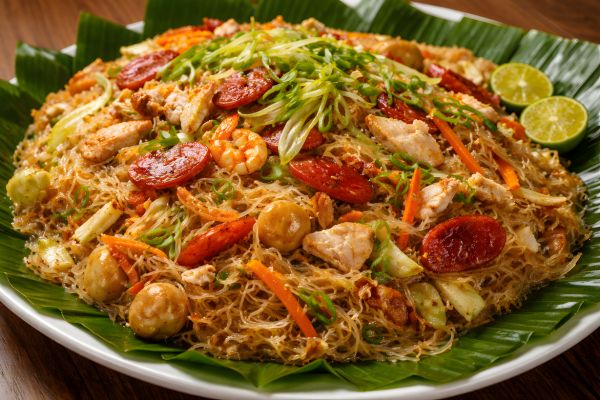
Pancit is the Filipino umbrella term for noodle dishes. It does not refer to one single recipe. It refers to a vast and growing family of noodle dishes — each using different noodles, different cooking techniques, different regional ingredients, and carrying different cultural meaning depending on where and when it is served.
According to Wikipedia, pancit dishes are often named for the type of noodle used, the cooking method, the place of origin, or the main ingredients — which is why there are so many of them, and why Filipinos can spend considerable time debating which is best. The most widely eaten varieties include:
🍝Pancit canton— thick wheat flour egg noodles, stir-fried with meat, shrimp, and vegetables; the birthday table standard across the Philippines
🍚Pancit bihon— thin rice vermicelli, lighter in flavor, often served alongside canton at the same party
✨Pancit sotanghon— glass noodles (soybean threads), delicate and soft, traditionally associated with wakes and vigils
🦐Pancit palabok— rice noodles topped with a rich orange shrimp-based sauce, crushed chicharon, boiled eggs, and smoked fish flakes
🌊Pancit Malabon— thick rice noodles from the coastal city of Malabon, topped with an extraordinarily seafood-rich sauce that reflects the city's proximity to Manila Bay
🍲Pancit lomi— thick fresh egg noodles in a rich, viscous broth thickened with eggs; comfort food at its most fundamental
🍃Pancit habhab— from Lucban, Quezon; served on banana leaves and eaten without utensils, directly from the leaf
🖤Pancit pusit— rice noodles cooked with squid and squid ink, producing noodles of a deep, dramatic black color unlike any other Filipino noodle dish
🥘Pancit molo— from Iloilo; a wonton noodle soup in a rich pork and chicken broth, technically more dumpling soup than noodle dish but firmly in the pancit family
And these are only the most widely known. The full spectrum — across Visayas, Mindanao, and Luzon — includes varieties made with young coconut strips, unripe papaya, mung bean sprouts, bamboo shoots, and seaweed in place of conventional noodles. Pancit is, at its core, a philosophy of adaptation as much as it is a dish.
📜 The History: How a Chinese Trader's Portable Meal Became the Philippines' Most Beloved Dish
The story of pancit begins in the water — with traders from Fujian province, China, making their way across the South China Sea to the Philippine archipelago in the centuries before Spanish colonization.
These Hokkien traders brought noodles with them as a practical food: easy to cook, portable, calorie-dense, and endlessly adaptable. The term they used for these quick-cooking noodle meals —pian i sit, meaning "conveniently cooked food" — became, over generations of Filipino pronunciation, the word "pancit." The name was not coined to describe a specific dish. It was coined to describe a category of fast, convenient noodle cooking. The Philippines took that category and built 101 varieties out of it.
During the Spanish colonial period, the demand for pancit from Chinese food hawkers — the panciteros — grew so quickly that vendors began establishing permanent roadside stalls. These became the Philippines' first covered restaurants: the panciterias. The word itself encodes this history — "pancit" from Hokkien Chinese, "-ería" from Spanish. One word. Two empires. The institution of the Filipino neighborhood eatery grew directly out of noodles.
Spanish colonial influence also added new ingredients to the pancit tradition. Garlic, onions, and tomatoes — brought from the Americas via the galleon trade — became standard aromatics in pancit. The Chinese stir-fry technique met Spanish sautéing, and what emerged was something neither purely Chinese nor purely Spanish, but fully Filipino: savory, garlicky, adaptable, and made to feed a crowd.
The José Rizal connection deepens the story further. The Philippine national hero mentioned Pancit Langlang — a pancit dish from Cavite — in his novelNoli Me Tangere, calling it the "soup par excellence." While living and traveling abroad, Rizal also regularly cooked pancit and had noodles shipped to him from his hometown of Calamba, Laguna — because making pancit was the most direct way he knew to remain Filipino while separated from the Philippines. The national hero's chosen comfort food was noodles. Every Filipino abroad who has sourced noodles from the one Filipino grocery in the city is doing what Rizal did.
By the 19th century, pancit was not simply a dish — it was a cultural institution. The panciteria was the place where Manila's working population ate. The platter of pancit at the fiesta table was as expected as the lechon. And the birthday noodle tradition — long noodles for long life — was already so deeply embedded in Filipino culture that it would survive colonization, war, immigration, and the passage into every continent on Earth.
🗺️ A Guide to Pancit Across the Regions
One of the most extraordinary things about pancit is that it is simultaneously one of the Philippines' most universal foods and one of its most local. Almost every province, and many individual towns, have their own distinct version — shaped by what grows there, what lives in the waters nearby, and what the people who live there have always eaten.
The sheer variety reveals something important: pancit is not a dish that was handed down complete. It is a dish that kept evolving, kept absorbing local ingredients and local tastes, kept branching into new forms as Filipino cooks in every corner of the archipelago asked the same essential question — what can we do with these noodles here, now, with what we have?
👅 What Does Pancit Taste Like?
Pancit does not have one single taste, because there are over 100 kinds of pancit. But across styles, a few qualities appear again and again that make the experience recognizably, fundamentally Filipino.
A stir-fried pancit — canton or bihon — tastes savory, garlicky, and faintly smoky from the high heat of the pan. The noodles absorb the seasoning as they cook, taking on the flavor of the broth, the soy sauce, the oyster sauce, the meat, and the vegetables all at once. The garlic is always first — browned in oil until golden before anything else goes in. That smell is the starting gun for every Filipino celebration meal.
Texture varies dramatically by type. Thin bihon noodles feel light and slippery, soaking up seasoning without adding much body of their own. Canton noodles are chewier and more substantial, with a springiness that holds up against heavy sauce. Sotanghon noodles are translucent and delicate. Lomi noodles are thick and soft, swimming in a glossy, egg-thickened broth that coats every strand.
Sauced dishes like pancit palabok add a completely different dimension — the orange shrimp sauce is rich, savory, and oceanic, the chicharon adds crunch, the boiled eggs add creaminess, and the whole dish is a lesson in how many contrasting textures can coexist on one plate without competing.
And then there is calamansi. Almost every pancit dish is served with calamansi on the side — the small Philippine citrus squeezed over the noodles at the table just before eating. That single squeeze changes everything. The acidity cuts through the fat and the salt, lifts the flavor of the noodles, and makes the whole dish feel bright and alive in a way it was not a second before. Lime comes close. Nothing else does.
If I had to describe pancit in one sentence: it tastes like celebration that knows how to feed people well. Savory, comforting, garlicky, adaptable — and just bright enough from the calamansi to keep you going back for another bite.
🎂 The Birthday Rule: Long Noodles for Long Life
No aspect of pancit is more important, more widely observed, or more emotionally loaded than the birthday tradition.
In Filipino culture — a belief inherited so completely from Chinese Filipino tradition that most Filipinos now experience it simply as Filipino — noodles represent the thread of life. Their length maps to the length of years ahead. You eat them on your birthday to carry the wish of long life into the year. And there is one rule, stated at every birthday table, across every generation, in the Philippines and in every city abroad where Filipinos have settled:
Do not cut the noodles.
Not with scissors. Not with a fork. Not by biting them in half. The food writer Nancy Reyes Lumen, writing for the Philippine Center for Investigative Journalism, documented this tradition specifically: "Noodles represent long life and good health — they must not be cut, as that would corrupt the symbolism." The symbolism is only intact if the thread is unbroken. Cutting the noodle is cutting the life it represents.
This is taken seriously enough that in many Filipino families, the serving spoon at the birthday table is specifically chosen for its ability to lift noodles without cutting them. Someone always says the instruction aloud. Someone younger always has to be reminded. And every year, at every Filipino birthday in the world, the same words are spoken:huwag gupitin ang pansit— do not cut the noodles.
According to Wikipedia, this tradition is so embedded in Filipino life that Chinese restaurants throughout the Philippines specifically list "birthday noodles" on their menus — a dedicated category that exists for no other purpose than this occasion. The birthday table without pancit is not, in Filipino understanding, a complete birthday table.
🗣️ Learn the Tagalog
The vocabulary around pancit reflects how deeply it is woven into Filipino life — not just as food but as event, as gathering, as tradition, and as love.
The dish and its family:
🍜 Pansit / Pancit (pan-sit) — noodles; the broad term for the entire family of Filipino noodle dishes
🍝 Canton (kan-ton) — the wheat flour egg noodle variety
🍚 Bihon (bi-hon) — thin rice vermicelli
✨ Sotanghon (so-tang-hon) — glass noodles
🏠 Panciteria (pan-si-te-ri-ya) — a noodle restaurant; the Philippines' first restaurant institution
👨🍳 Pancitero (pan-si-te-ro) — the noodle vendor or cook; the original Chinese food hawkers
🎉 Guisado (gee-sah-do) — sautéed; pansit guisado is the stir-fried style
The birthday tradition:
🙏 Matagal na buhay (ma-ta-gal na bu-hay) — long life; the wish the noodles carry
✂️ Huwag gupitin ang pansit(hoo-wahg goo-pi-tin ang pan-sit) — do not cut the noodles
🎂 Para sa mahabang buhay (pa-ra sa ma-ha-bang bu-hay) — for a long life
🎉 Handaan (han-da-an) — a celebration feast; pancit is never absent
🍽️ Kain na! (ka-in na) — let's eat! — the call that means the pancit is ready
In the kitchen:
🧄 Bawang (ba-wang) — garlic; always first in the hot oil
🧅 Sibuyas (si-boo-yas) — onion
🫙 Toyo (to-yo) — soy sauce; the primary seasoning
🐟 Patis (pa-tis) — fish sauce; the finishing seasoning
🍋 Kalamansi (ka-la-man-si) — the Filipino citrus; squeezed over the dish at the table
🍳 Kawali (ka-wa-li) — wok or wide pan
🥬 Gulay (goo-lay) — vegetables
At the table:
😋 Ang sarap! (ang sa-rap) — so delicious!
❓May pansit ba sa handaan? (mai pan-sit ba sa han-da-an) — Is there pancit at the celebration?
🍋 Dagdag pa ng kalamansi (dag-dag pa nang ka-la-man-si) — add more calamansi
👵Luto ng lola (loo-to nang lo-la) — grandma's cooking; the standard every pancit is measured against
🎨 Color It!
Bring Filipino food to life in a whole new way — through art.
Pancit is one of the most satisfying Filipino dishes to color because it gives you movement. Long noodles tangled across a wide platter. Scattered vegetables — orange carrots, dark green cabbage, bright snap peas. Bits of shrimp and meat. The gloss of soy sauce coating everything. A half-squeezed calamansi on the side. And the whole abundant, generous feeling of a dish made to be shared.
When you sit with a pancit coloring page from our Filipino Food Coloring Book and begin choosing your colors — how golden to make the noodles, how vivid the vegetables, how to capture the shine of the sauce — something happens. You start thinking about whose pancit you grew up with. Which kind the family made most often. Whether the calamansi was already halved on the table before anyone sat down. Whether someone said the thing about not cutting the noodles.
Our Filipino Food Coloring Book on Amazon was built from exactly that belief: that every dish is a memory, and every coloring page is an invitation to remember.
This makes it especially meaningful for:
🌼 Filipino families who want to talk about birthday traditions, celebration foods, and the long-life rule they grew up with
🌼 Parents raising children abroad who want to pass on the birthday pancit tradition even when family is far away
🌼 Non-Filipino friends and partners who have eaten pancit at a Filipino gathering and want to understand the culture behind the dish
🌼 Anyone in the Filipino diaspora for whom the smell of garlic hitting a hot kawali is the fastest way back to a specific birthday
🌼 Teachers, homeschoolers, and cultural groups celebrating Filipino heritage through art
If you’d like to explore Filipino food through art, memory, and family connection, download our FREE Filipino Food Coloring pages—they are waiting for you.
👉 What Filipino Food Are You? Take the quiz →
👉 Get your FREE Filipino coloring pages here.
🤩 Fun Facts About Pancit
1. Researchers have documented over 101 varieties of pancit — just in Luzon.A peer-reviewed study published in the Journal of Ethnic Foods titled "Ysla de Panciteria" documented 101 distinct pancit varieties across eight regions of Luzon Island alone. The researchers noted that each variety differs in characteristics and significance. That study was published in 2020. The count has only grown since.
2. "Pancit" literally means fast food.The Hokkien phrase pian i sit translates to "conveniently cooked food." The Philippines' most beloved celebration noodle arrived as the original quick meal — something a trader could cook fast, eat on the go, and share easily.
3. Pancit created the Philippines' first restaurants. The demand from Chinese food hawkers — panciteros — grew so quickly during the Spanish colonial period that vendors began establishing permanent covered stalls. These became the panciterias: the Philippines' first restaurants. One word, "panciteria," carries two colonial histories — "pancit" from Hokkien Chinese and "-ería" from Spanish.
4. José Rizal mentioned pancit in a novel and had noodles shipped to him while living abroad. The Philippine national hero referenced Pancit Langlang — a dish from Cavite — in Noli Me Tangere. He also regularly cooked pancit while traveling and had miki noodles shipped from Calamba, Laguna, because making pancit was his most direct way of remaining Filipino while far from home.
5. One pancit variety is eaten without utensils, from a banana leaf. Pancit Habhab from Lucban, Quezon is served on banana leaves and eaten by picking up the leaf and sliding the noodles directly into your mouth. The name "habhab" is an onomatopoeia of the eating sound. It is one of the Philippines' most purely local culinary experiences — and one of its most joyful.
6. One pancit variety has black noodles. Pancit Pusit from Cavite is cooked with squid and squid ink, turning the rice noodles a deep, dramatic black. It is unlike any other noodle dish in the Philippines in color or flavor — and it is a reminder of how far Filipino cooks will go to use the full character of their local ingredients.
7. One "pancit" variety uses no noodles at all. Pancit Estacion from Cavite City uses mung bean sprouts instead of noodles. It is served with a sauce of cornstarch, atsuete, smoked fish, and kamias. The dish challenges the definition of pancit entirely — and in doing so, confirms that pancit is as much a spirit as it is a recipe.
8. The birthday pancit tradition has survived every diaspora migration. In Los Angeles, Toronto, London, Dubai, and Sydney — wherever Filipinos have settled — the birthday pancit has followed. Filipino parents make it for children who were born abroad and have never seen the Philippines. The noodles are longer than any distance, and the tradition is older than any immigration wave.
9. Pancit sotanghon and pancit canton carry opposite emotional meanings. Pancit canton is the birthday noodle — joyful, celebratory, loud. Pancit sotanghon, made with delicate glass noodles, is traditionally associated with wakes and vigils in many Filipino communities. The same family of dishes can carry completely opposite emotional registers depending on which noodle is in the bowl. Filipinos understand this distinction without needing it explained.
10. Pancit to Filipinos is what pasta is to Italians. Knorr Philippines put it plainly: "Today, pancit to Filipinos is like pasta to Italians — ubiquitous, comforting, and needs no occasion." That comparison is more precise than it sounds. Both are umbrella categories with hundreds of regional varieties. Both are the thing a people reach for when they want to feel at home. Both have been adopted so completely that their foreign origins feel irrelevant. They simply belong.
🌍 How Pancit Connects Filipinos Everywhere
Pancit travels differently than most Filipino dishes — not because it is easy, but because it is necessary.
Lechon requires a whole pig. Kare-kare requires banana blossom and bagoong. But pancit requires only noodles, garlic, and the will to make it — which means it travels wherever Filipinos go, including the places where Filipino grocery stores are forty minutes away and calamansi has to be substituted with lime.
For the estimated 12 million Filipinos living outside the Philippines, the birthday pancit is not just food. It is proof of continuity. Each birthday where the noodles appear — however imperfectly assembled, however far from the Philippines the kitchen — is proof that the tradition survived the move. That the meaning traveled with the people. That the rule about not cutting the noodles is still being said, still being heard, still being followed.
The Tenement Museum in New York has collected oral histories from Filipino Americans in which pancit is described as "a tradition that connects us to our past and shapes our perception of family, culture, and values." That is a significant statement about a plate of stir-fried noodles. But it is also simply accurate.
Pancit is how Filipino families say we are still here. We still know what these noodles mean. We are still Filipino — in this kitchen, in this city, on this birthday — and we will be Filipino next year, too, when we make pancit again and tell whoever is turning another year older not to cut the noodles.
❓ FAQ — Everything You Need to Know About Pancit
What is pancit?
Pancit is the Filipino umbrella term for noodle dishes — not one recipe but a family of over 101 documented varieties across the Philippines, each using different noodles, techniques, and ingredients depending on the region, household, and occasion. According to Wikipedia, pancit dishes are commonly named for the type of noodle, cooking method, place of origin, or main ingredients.
What does pancit mean in Filipino?
The word pancit comes from the Hokkien Chinese phrase pian i sit, meaning "conveniently cooked food." It was introduced by Chinese traders from Fujian province who arrived in the Philippines centuries ago. The word is not native Filipino — it is one of the many linguistic traces left by centuries of Chinese trade and settlement in the Philippines.
Why is pancit served at Filipino birthdays?
Long noodles symbolize long life — a belief inherited from Chinese Filipino tradition. The noodles must not be cut before or during eating, because cutting them is believed to cut the life they represent. This tradition is observed at birthday celebrations throughout the Philippines and across the global Filipino diaspora. Many Filipino restaurants specifically list "birthday noodles" on their menus for this purpose.
How many types of pancit are there?
Researchers published in theJournal of Ethnic Foods documented over 101 distinct varieties of pancit across Luzon alone. Every region and many individual towns have their own version. The full spectrum across all Philippine island groups is significantly larger.
What is the difference between pancit canton and pancit bihon?
The primary difference is the noodle. Pancit canton uses thick wheat flour egg noodles — golden and chewy. Pancit bihon uses thin rice vermicelli — lighter and more delicate. Both are stir-fried with similar vegetables and meats, but the texture and sauce absorption produce very different results. Many Filipino parties serve both at the same table.
What does pancit taste like?
Pancit tastes savory, garlicky, and satisfying — with the exact flavor depending on which variety you are eating. Stir-fried versions are deeply seasoned with soy sauce and oyster sauce. Sauced versions like palabok are rich and oceanic. Broth-based versions like lomi are warm and hearty. Almost all pancit dishes are finished with calamansi at the table, which adds the citrus brightness that lifts everything.
Is pancit always noodles?
Almost always — but not always. Pancit Estacion from Cavite uses mung bean sprouts instead of noodles. Some regional varieties substitute young coconut, unripe papaya, bamboo shoots, or seaweed for conventional noodles. Pancit is as much a category of eating as it is a noodle dish.
Is pancit Filipino or Chinese?
Both — and neither, in the way that matters most. Pancit was introduced by Chinese traders, carries Chinese birthday symbolism, and uses Chinese stir-frying techniques. But it has been adapted so completely by Filipino cooks, with Filipino ingredients, Filipino seasoning, and Filipino cultural meaning, that it is now experienced as simply and completely Filipino. The transformation is total. The origin is acknowledged. Both things are true simultaneously — which is perhaps the most Filipino thing about it.
💛 Closing
Pancit did not become the Philippines' most universal dish because it is the most sophisticated food in the Filipino canon. It became universal because it is the most generous.
It can feed a hundred people from one wide kawali. It can be made with whatever noodle is available, whatever protein is in the market, whatever vegetables are in season. It can be assembled in a studio apartment in New Jersey or in a farmhouse in Pampanga or in a panciteria in Manila that has been open since before anyone working there was born. It shows up. At every birthday. At every fiesta. At every occasion where Filipinos gather to mark life and wish each other more of it.
One word. 101 varieties. Five centuries of history. Endless regional variation. And one rule — unchanged, uncompromised, spoken at every birthday table in the world wherever a Filipino family has gathered — that the noodles must stay long.
Because the noodle is the life. And the life is worth keeping long.
At Studio Tributes, we celebrate Filipino food because it carries more than flavor — it carries the whole story of a people. Pancit carries that story in its Hokkien name, its panciteria origins, its 101 varieties, its birthday rule, and in every kitchen where someone still knows not to reach for the scissors.
Keep exploring Filipino food and culture with us:
🎨 Get our Filipino Food Activity Book on Amazon
📚 Read more Filipino food stories on our blog
💭 A Memory to Hold Onto
Did pancit bring back a birthday or a gathering?
Maybe a wide platter arriving at the center of the table and everyone making room. Maybe the steam and the garlic smell that arrived just before the dish did. Maybe someone — always the same someone — saying the thing about the noodles before anyone had even picked up their fork.
Maybe you are the one who makes it now. The one who holds the kawali. The one who says the thing about the noodles. Maybe you are in another country and you make it from approximations — lime instead of calamansi, a noodle brand from the one Asian grocery in the city — and somehow, on someone's birthday, it is close enough.
Which kind of pancit did your family make most often? Whose recipe? Did anyone ever remind you not to cut the noodles — and did you listen?
Tag@StudioTributeson Facebook or Instagram with your pancit story using#StudioTributesand#FilipinoFoodMemories.
We read every single one. 🇵🇭
Read Next
• What Is Pandesal?
• What Is Lechon?
• What Is Halo-Halo?
• What Is Turon?
Each dish tells a different story—of mornings, celebrations, comfort, and sweetness.
📚 References & Further Reading
Wikipedia — Pancit— Primary reference for varieties, cultural significance, birthday traditions, and regional overview.
Journal of Ethnic Foods — "Ysla de Panciteria: A Preliminary Study on the Culinary Heritage Significance of Pancit" (2020)— Peer-reviewed source for the 101 documented pancit varieties across Luzon.
Pepper.ph — "Pancit: The History of This Long Life Noodle"— Source for pancitero history, panciteria origins, and regional variety overview.
Tasting Table — "The Double Meaning Behind Filipino Pancit"— Source for the Hokkien etymology and the first Manila panciteria.
Knorr Philippines — "8 Pancit Varieties From Around the Philippines"— Source for the pasta-to-Italians comparison and Pancit Langlang in Rizal's fiction.
Ang Sarap — "24 Regional Varieties of Pancit in the Philippines"— Source for Pancit Habhab, Pancit Estacion, and other regional varieties.
Guide to the Philippines — "12 Best and Unique Pancit Noodle Dishes"— Source for Pancit Pusit (squid ink noodles) and Pancit Habhab eating tradition.
Tenement Museum — "Pancit in Filipino Culture"— Oral history source on pancit's role in Filipino American diaspora identity.
Pinas Cuisine — "What Is the Cultural Significance of Pancit Types?"— Source for the no-cutting tradition and long-life symbolism context.
Encyclopaedia Britannica — Philippine Cuisine— Supporting cultural context for Filipino culinary history.
This article blends Studio Tributes storytelling with cultural and culinary research to create a warm, family-friendly learning experience.