
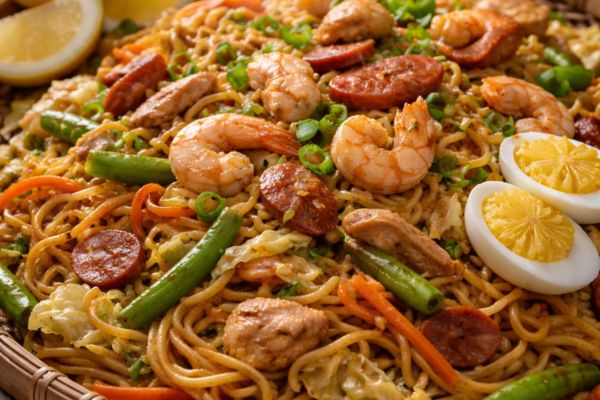
What Is Pansit Canton? Filipino Birthday Noodles Explained
Studio Tributes / Filipino Food / What Is Pancit Canton?
Quick Answer: What Is Pansit Canton?
🍜What it is: A Filipino stir-fried egg noodle dish with meat, shrimp, and vegetables in a savory soy and oyster sauce — served at nearly every birthday and celebration in the Philippines.
🥜Key ingredients: Canton (wheat flour egg) noodles, pork, chicken, shrimp, cabbage, carrots, string beans, soy sauce, oyster sauce, fish sauce, and calamansi to finish.
🎂The birthday rule: Noodles must never be cut — their length symbolizes long life. Cutting them is believed to cut short the years they are meant to bring.
🌏Name origin: From the Hokkien phrasepian i sit— "conveniently cooked food." Despite the name, pansit canton has no proven roots in Guangdong (formerly Canton), China.
🇨🇳🇵🇭Chinese or Filipino? Both — introduced by Chinese traders, transformed into something that now belongs entirely to the Philippines.
✨When it's served: Every birthday, every fiesta, every celebration where someone wants to wish the people they love a long and healthy life.
Every Filipino who has ever had a birthday knows the rule. The noodles must be long. And you must not cut them.
It does not matter whose birthday it is. It does not matter which region of the Philippines your family is from, or which city abroad you are celebrating in, or how long the noodles have been sitting on the table waiting. When pansit canton is placed in front of you on your birthday, the understanding is the same across every Filipino household in the world: the length of the noodle is the length of your life. You eat it whole. You eat it carefully. You eat it with gratitude.
This is pansit canton — the Filipino egg noodle dish that may carry more emotional weight than any other food in the Filipino canon. Not because it is the most complex or most expensive. But because it shows up at every birthday table, every graduation, every fiesta — every occasion where one Filipino wants to say to another:I wish you a long life. Here — eat these noodles and let them carry the wish forward.
🍜 What Is Pansit Canton?
Pansit canton is a Filipino stir-fried noodle dish made with thick egg noodles — wheat flour noodles that are dried and sometimes lightly fried before packaging — cooked in a hot wok or wide pan with garlic, onion, pork or chicken, shrimp, and a colorful combination of vegetables. The sauce is built from soy sauce, oyster sauce, and fish sauce, with calamansi squeezed over the top just before eating to cut through the richness and add a bright citrus lift that no other fruit quite replicates.
According to Wikipedia, pansit (also spelled pancit) is a broad category of noodle dishes that became one of the most popular Filipino dishes after being introduced by Chinese traders. Canton specifically refers to this egg noodle variety — thick, golden, slightly chewy — distinct from the thinner rice vermicelli used in pansit bihon, or the rice noodles topped with shrimp sauce used in pansit palabok.
A classic pansit canton includes:
Canton noodles (egg noodles)— thick wheat flour noodles, dried and golden; they absorb the sauce as they cook directly in the broth, no pre-boiling required
Pork belly or pork shoulder— sliced thin and stir-fried until lightly browned; the fat renders into the sauce and adds depth
Chicken— often used alongside or instead of pork; boneless thighs work best for tenderness
Shrimp— added near the end so they stay tender; their brine deepens the overall savoriness of the dish
Chinese sausage (chorizo de Bilbao or lap cheong)— a classic addition that adds sweet, fatty richness; optional but deeply traditional
Cabbage— shredded or torn; absorbs the sauce and softens beautifully without going mushy
Carrots— julienned or sliced thin; adds color and a mild sweetness
String beans / snap peas— for freshness and crunch against the rich sauce
Celery— a less obvious but important aromatic; adds a faint herbal note that lifts the whole dish
Soy sauce— the primary seasoning; gives the noodles their characteristic golden-brown color
Oyster sauce— adds a glossy richness and umami depth
Fish sauce (patis)— a few drops at the end; intensifies the savory flavor without overwhelming
Calamansi— the Filipino citrus served on the side; squeezed over just before eating, it is the single most important finishing touch
The beauty of pansit canton is its flexibility. Every family has a version. Some add quail eggs, fish balls, squid, or liver. Some use only chicken. Some load it with shrimp and Chinese sausage and consider everything else optional. Some cook it swimming in sauce; others prefer it drier, with every noodle coated but nothing pooling at the bottom of the pan. All of these versions exist simultaneously, across every province in the Philippines and every Filipino kitchen abroad. All of them are correct.
📜 The Name and Its Secrets
The word "pansit" — or pancit, both spellings are correct — does not come from the Filipino language at all. It comes from the Hokkien Chinese phrasepian i sit, which translates literally to "conveniently cooked food" or "something cooked fast." The Hokkien people from China's Fujian province were the predominant group among the early Chinese traders who arrived in the Philippines, and pian i sit was their term for the quick, portable, ready-to-eat noodle meals they brought with them on their voyages.
The "canton" in pansit canton, however, is a different story entirely — and one of the most interesting puzzles in Filipino culinary history.
You would be forgiven for assuming pansit canton refers to Guangdong province in China, which was known to Western traders as Canton. The name creates that impression. But as culinary historians and food writers at Pepper.ph have noted, pansit canton has no documented roots in Guangdong whatsoever. No similar dish exists there. No historical connection has been established. The most plausible explanation, according to food research on the subject, is that an enterprising pancitero — a Chinese noodle vendor in the Philippines — named the dish "canton" to make it sound more authentically Chinese, appealing to customers who were looking for what was then called a "Comida China" experience. The name stuck. The origin it implies did not.
And so pansit canton is named after a place it has nothing to do with, using a word from a language that is not Filipino, to describe a dish that has become one of the most Filipino things that exists. That is either a comedy of naming errors across centuries, or it is the most honest possible description of how Filipino food works: absorbing, transforming, and making entirely its own whatever arrives on its shores.
The word "panciteria" — the Filipino noodle restaurant — carries this history inside it perfectly. "Pancit" from the Chinese Hokkien, "-ería" from Spanish colonial influence. The name of the institution where Filipinos go to eat noodles is itself a layered record of every culture that has passed through the archipelago.
📖 The History: How Chinese Traders Created Filipino Fast Food
The story of pansit in the Philippines begins between the 10th and 16th centuries, when Chinese traders from Fujian province began establishing regular trade routes to the Philippine archipelago. They brought silk, porcelain, and other goods — and they brought their food. Among that food were noodles: quick to cook, portable, filling, and easily adapted to whatever ingredients were available locally.
As food historian Felice Sta. Maria has documented, the demand for these convenient noodle meals from Chinese food hawkers — the panciteros — grew so rapidly during the Spanish colonial period that vendors began setting up permanent roadside stalls to serve the working population. These stalls, which served workers from the cigar factories and travelers passing through, eventually became the Philippines' first covered restaurants: the panciterias.
This is a remarkable detail. The institution that gave the Philippines its first restaurant culture — the neighborhood eatery where you could sit down and eat a proper meal — grew directly out of the demand for pansit. The carinderia, which we discussed in the kare-kare origin story, may have a separate lineage. But the panciteria predates it as a documented institution, with Panciteria Antigua, founded in 1866, standing as one of the earliest on record as a cultural symbol of the era.
The connection to José Rizal — the Philippines' national hero — deepens the significance of pansit as a cultural anchor. According to research in Felice Sta. Maria's work "The Governor-General's Kitchen," Rizal, while traveling and living abroad, regularly cooked pansit to stay connected to home. He had miki noodles shipped to him from his hometown of Calamba, Laguna — at considerable effort and expense — because the act of cooking and eating pansit was, for Rizal, the most direct way to remain Filipino even while separated from the Philippines. The national hero chose noodles as his most portable piece of home.
That detail has never lost its resonance. Every Filipino living abroad who has ordered pansit canton ingredients online, or driven an hour to the nearest Filipino grocery store, or made it from scratch in a kitchen that smelled nothing like their lola's kitchen — they are doing what Rizal did. They are keeping themselves tethered to something that cannot be bought at a local supermarket.
🎂 The Birthday Rule: Long Noodles for Long Life
Of all the things that make pansit canton distinct from every other stir-fried noodle dish in the world, the birthday rule is the most important. And the most specific. And the most non-negotiable.
The belief originates from Chinese Filipino tradition, absorbed into Filipino culture so completely that most Filipinos today experience it simply as Filipino, full stop. Noodles represent the thread of life. Their length maps to the length of years ahead. The longer the noodle you manage to eat in a single bite — without breaking it — the more life the noodle is carrying for you.
The critical instruction, passed down through families and documented in food writing by Nancy Reyes Lumen of the Philippine Center for Investigative Journalism:do not cut the noodles. Not with scissors. Not with your fork. Not by biting them in half. The symbolism is only intact if the thread is unbroken. To cut the noodle is to cut the life it represents. This is taken seriously enough that in many Filipino households, the person whose birthday it is will not touch the scissors near the pansit. Someone else will serve them. Someone else will make sure the noodles are long enough.
According to Wikipedia, this tradition is so embedded that Chinese restaurants throughout the Philippines commonly list "birthday noodles" on their menus — a dedicated category that exists specifically for this occasion. The birthday table without pansit is, in Filipino understanding, not quite a birthday table.
What is remarkable about this tradition is how it has traveled. In Los Angeles, in New Jersey, in Toronto, in London, in Dubai, in Sydney — wherever Filipinos have settled, the birthday pansit has followed. Filipino parents who grew up in the Philippines make it for their children who were born abroad. Filipino grandparents visiting from the provinces bring their own noodle brands because the ones available locally are never quite right. The birthday rule has crossed every ocean the Filipino diaspora has crossed, and it has not weakened in transit.
If anything, it has deepened. Because for Filipinos living far from the Philippines, the birthday pansit is not just a wish for a long life. It is proof that the culture is long — longer than the distance, longer than the years away, longer than the generations that have passed since someone first carried the tradition from Fujian province to the Philippine archipelago and watched it take root.
👅 What Does Pansit Canton Taste Like?
Pansit canton tastes like a celebration that has been stir-fried over high heat until it became something savory and golden and entirely satisfying.
The noodles are the first thing you notice — thick, slightly chewy, with a bite that holds even after they have absorbed the sauce. They are not soft the way pasta goes soft if overcooked. They have their own character. The soy sauce and oyster sauce give them a deep golden-brown color and a savory richness that is the foundation of everything. The garlic — cooked first, in hot oil, until just turning golden — is the first thing you smell. It is one of the most recognizable smells in all of Filipino cooking.
Then the meat. Pork belly browned in the wok adds fat and depth. Shrimp adds a clean, briny sweetness. Chinese sausage, when it is there, adds a sweet-savory richness that no other ingredient replicates. The vegetables bring freshness and relief: the cabbage soft and sweet, the carrots tender, the string beans with enough bite left in them to feel like a counterweight to the richness of the sauce.
And then calamansi. A whole calamansi squeezed over the plate at the table, just before the first bite — this single act changes the dish. The acidity cuts through the soy sauce and the fat. It lifts everything. It makes the noodles taste brighter than they were a second ago. This is the Filipino finishing touch that no substitute — not lime, not lemon, not any citrus grown outside the Philippines — quite captures, though lime comes closest.
Pansit canton tastes like the noise of a Filipino birthday party made edible. It tastes like the wok hitting full heat. Like garlic in oil before anything else goes in. Like the specific savoriness of a sauce that has been tasted, adjusted, tasted again, and adjusted one more time before the noodles go in. Like the moment someone sayskain na— let's eat — and the table finally comes together around the food.
🗺️ Regional Variations Across the Philippines
Pansit in the Philippines is not one dish. It is a family of dishes — each province, each region, each city with its own version shaped by local ingredients, local traditions, and the particular creativity of the people who live there. Canton is the most popular variant nationwide, but across the archipelago the variations tell a larger story about how deeply food is woven into place and identity.
Pansit Canton (Nationwide)— The most widely eaten version. Thick egg noodles, stir-fried with pork, shrimp, vegetables, soy sauce, and oyster sauce. This is the birthday table standard from Manila to Mindanao. The one that appears on every celebration spread. The one with the long-life rule.
Pansit Bihon (Nationwide)— The most common companion to canton; thin rice vermicelli noodles with a lighter, more delicate sauce. Many families serve both at the same party — canton for richness, bihon for lightness. The combination is called pansit bihon-canton guisado, and it is greater than the sum of its parts.
Pansit Malabon (Malabon, Metro Manila)— Named after the coastal city where it originated. Uses thick rice noodles topped with a rich shrimp-based sauce, seafood toppings, crushed chicharon, and boiled eggs. Its proximity to Manila Bay means the seafood has always been exceptional. Food writers consider it one of the most distinctive regional pansit varieties.
Pansit Lucban / Habhab (Quezon Province)— Made with flat, hand-rolled rice noodles called miki Lucban, served on banana leaves and traditionally eaten directly from the leaf with no utensils. The name "habhab" means to slurp or eat quickly. This version is considered one of the most purely local — its banana leaf presentation and noodle style are not found anywhere else.
Pansit Batil Patong (Cagayan Valley)— From Tuguegarao City in the north. Uses miki noodles topped with carabeef (carabao beef), liver, and a poached egg, with a separate bowl of batil soup on the side made from the carabeef stock. The name means "beaten egg on top." Distinctive, deeply regional, and little known outside Cagayan.
Pansit Chami (Lucena City, Quezon)— A thick noodle dish made with miki noodles, pork, shrimp, and a slightly sticky, glossy sauce that clings to every noodle. The viscosity of the sauce is its defining characteristic — thicker than canton, thinner than a gravy. It is a Lucena specialty that has spread through Quezon province but is rarely found elsewhere.
Pansit Sotanghon (Nationwide)— Glass noodles or soybean thread noodles, cooked in a lighter broth with chicken and mushrooms. Often served at wakes and vigils — a cultural association that makes it different from canton and bihon in how and when it appears at the Filipino table. Its presence carries a different emotional weight than the birthday noodles.
🥢 Pansit Canton vs. Chow Mein: How Close Are They Really?
The question comes up every time someone who grew up with chow mein tries pansit canton for the first time: are these the same dish?
The honest answer is: related, but meaningfully different — and the differences are what make pansit canton distinctly Filipino.
Both dishes use wheat flour noodles stir-fried with vegetables and meat in a soy sauce-based sauce. Both trace their lineage back to Chinese cooking traditions. Both are eaten as celebration food in their respective cultures. The family resemblance is real.
But there are three specific differences that matter. The first is in the noodle itself. As Kitchen Confidante notes, chow mein typically uses egg noodles that are boiled or fried separately before being added to the stir-fry. Pansit canton noodles — the dried, packaged variety found in Filipino grocery stores — are added dry directly to the broth in the wok, absorbing liquid as they cook. This produces a different texture: less slippery, more absorbent, with the sauce coating each noodle from the inside out rather than just coating the surface.
The second difference is in the seasoning. Pansit canton uses fish sauce (patis) and calamansi as finishing touches — neither of which appears in traditional Chinese chow mein. These two ingredients are distinctly Filipino additions that shift the flavor profile away from purely Chinese seasoning toward something specific to the Philippine palate. The fish sauce adds a salinity and depth that soy sauce alone does not provide. The calamansi changes the entire dish the moment it is squeezed.
The third difference is cultural weight. Chow mein is a meal. Pansit canton is a ritual. The birthday rule, the long-life symbolism, the no-cutting instruction — none of these exist in Chinese chow mein culture. They are Filipino additions that transformed a borrowed dish into something sacred. You do not eat chow mein on your birthday to wish yourself a long life. Filipinos eat pansit canton on their birthday for exactly that reason. The cultural freight they carry is entirely different, even when the noodles look similar in the bowl.
🗣️ Learn the Tagalog
Filipino food vocabulary around pansit is rich with occasion, instruction, and affection. These are the words that live around the dish — at the birthday table, in the kitchen, and in the memory of every Filipino who has ever been told to let the noodles stay long.
The dish and its family:
Pansit / Pancit (pan-sit) — noodles; the broad term for the entire family of Filipino noodle dishes
Pansit canton (pan-sit kan-ton) — the egg noodle version; the birthday staple
Pansit bihon (pan-sit bi-hon) — the thin rice vermicelli version
Guisado (gee-sah-do) — sautéed; pansit guisado means the stir-fried style, as opposed to noodles in soup
Panciteria (pan-si-te-ri-ya) — a noodle restaurant; the Philippines' first restaurant institution
Pancitero (pan-si-te-ro) — a noodle vendor or cook; the original Chinese food hawkers who popularized pansit
The birthday tradition:
Matagal na buhay (ma-ta-gal na bu-hay) — long life; the wish the noodles carry
Huwag gupitin ang pansit (hoo-wahg goo-pi-tin ang pan-sit) — don't cut the noodles; the most important instruction at any Filipino birthday table
Para sa mahabang buhay (pa-ra sa ma-ha-bang bu-hay) — for a long life; the phrase spoken when pansit is served at a birthday
Handaan (han-da-an) — a celebration feast; pansit is never absent from the handaan table
Kain na! (ka-in na) — let's eat! — the call that means the pansit is ready and everyone should gather
In the kitchen:
Igisa (ee-gi-sa) — to sauté; the first step of every pansit, starting with garlic and onion
Bawang (ba-wang) — garlic; the aromatic foundation of pansit canton
Sibuyas (si-boo-yas) — onion; always paired with garlic in the first step
Toyo (to-yo)—soy sauce; the primary seasoning
Patis (pa-tis) — fish sauce; the finishing seasoning that deepens the savoriness
Kalamansi (ka-la-man-si) — the Filipino citrus; squeezed over the finished dish, it completes it
Kawali (ka-wa-li) — wok or wide pan; the vessel for cooking pansit
At the table:
Ang sarap! (ang sa-rap) — so delicious! — the appropriate response to a well-made pansit
Dagdag pa ng kalamansi (dag-dag pa nang ka-la-man-si) — add more calamansi; the most common request at the pansit table
Luto ng nanay / lola(loo-to nang na-nay / lo-la) — mom's / grandma's cooking; the highest possible standard for pansit, as with every Filipino dish
🎨 Color It!
Bring Filipino food to life in a whole new way — through art.
Pansit canton is one of the most visually dynamic dishes in Filipino cuisine — and one of the most rewarding to color. Because a finished plate of pansit canton is never one color. It is a composition of warm and vivid tones layered together in a wide pan or piled into a serving dish: the deep golden-brown of the soy-sauced noodles, the bright orange of carrots, the deep green of string beans and cabbage wilting at the edges, the pink of shrimp curling in the heat, the pale yellow of egg noodles before the sauce stains them, the dark gloss of oyster sauce coating everything.
When you sit with a pansit canton coloring page from our Filipino Food Coloring Book and begin choosing your colors — how dark to make the noodles, how vivid the vegetables, how to capture the shine of the sauce — something happens. You start thinking about whose pansit you grew up with. The wide kawali carried to the birthday table. The steam rising from it. The calamansi already halved and waiting beside the serving spoon.
You think about the noise of a Filipino birthday. About what pansit looks like when it has just been made for twenty people and the first scoop goes onto someone's plate. About the instruction — said every time, by someone — about not cutting the noodles.
Our Filipino Food Coloring Book on Amazon was built from exactly that belief: that every dish is a memory, and every coloring page is an invitation to remember. Pansit canton — with its golden noodles, its celebration history, and its deep roots in Filipino birthday culture — is one of the most meaningful pages in the book to color and one of the richest conversations it can open.
This makes it especially meaningful for:
🌼 Filipino families who want to talk about birthday traditions, celebration foods, and the long-life rule they grew up with
🌼 Parents raising children abroad who want to pass on the birthday pansit tradition even when family is far away
🌼 Non-Filipino friends and partners who have eaten pansit at a Filipino gathering and want to understand the culture behind the dish they loved
🌼 Anyone in the Filipino diaspora for whom the smell of garlic hitting a hot kawali is the fastest way back to a specific birthday in a specific kitchen
🌼 Teachers, homeschoolers, and cultural groups celebrating Filipino heritage through art and storytelling
Each page can open a question worth asking: Whose birthday always had pansit on the table? Did your family make canton, bihon, or both? Who held the calamansi? Was anyone ever told — or did anyone ever tell someone else — not to cut the noodles?
If you would like to explore Filipino food through art, memory, and family connection, download our FREE Filipino Food Coloring pages — they are ready for you now.
👉 What Filipino Food Are You? Take the quiz →
👉 Get your FREE Filipino coloring pages here.
🤩 Fun Facts About Pansit Canton
1. The name "canton" has nothing to do with Canton, China.Despite what the name implies, pansit canton has no documented historical roots in Guangdong (formerly Canton) province. Food historians believe a 19th-century pancitero likely named the dish "canton" to appeal to customers seeking an authentic Chinese dining experience. The name stuck. The actual Chinese province it references played no role in the dish's creation.
2. "Pancit" literally means fast food.The Hokkien phrasepian i sittranslates to "conveniently cooked" or "ready-made food." Pansit arrived in the Philippines as the original quick meal — something a trader could cook fast, eat on the go, and share easily. The Philippines' most beloved celebration noodle began its life as the archipelago's first convenience food.
3. Pansit created the Philippines' first restaurant industry.The demand for pansit from Chinese food hawkers (panciteros) during the Spanish colonial period grew so quickly that vendors began establishing permanent covered eateries to serve the working population. These became the first panciterias — the Philippines' first restaurants. The institution of the Filipino neighborhood eatery grew directly from noodles.
4. José Rizal had pansit shipped to him while living abroad.The Philippine national hero, while traveling and temporarily living in Europe, regularly had miki noodles shipped from his hometown of Calamba, Laguna so he could cook pansit. For Rizal, making and eating pansit was the most direct way to remain tethered to the Philippines while far from home. The national hero's chosen comfort food was noodles.
5. The no-cutting rule is taken seriously enough to influence how the dish is cooked.Because noodles must remain uncut to preserve their long-life symbolism, traditional pansit canton is cooked with long noodles that are never pre-cut or broken before going into the pan. Some families ensure the serving spoon is specifically designed to lift rather than sever. Others make a point of saying the instruction aloud at the birthday table every single year.
6. The word "panciteria" encodes two colonial histories in one name."Pancit" from Hokkien Chinese; "-ería" from Spanish. The noodle restaurant that became the backbone of Filipino food culture carries, in its very name, a record of the two most influential outside forces in Philippine history. It is one word and two empires.
7. The instant pansit canton packet is one of the most divisive subjects in Filipino food culture.Lucky Me! and other instant pansit canton brands are beloved pantry staples for millions of Filipinos — especially overseas, where they represent an accessible, fast version of home. But purist Filipino home cooks maintain that instant pansit has created a misunderstanding of what the dish actually is. Authentic pansit canton, made with real noodles, real vegetables, real meat, and real sauce, is a fundamentally different experience — and a disappearing one in some diaspora kitchens where the instant version has become the default.
8. Pansit is the only Filipino dish that also serves as a linguistic institution.The Filipino word for noodles — pansit — became the name of the eateries that served them (panciterias), the people who cooked them (panciteros), and the broader culture of noodle eating that shaped Filipino food history. No other single ingredient generated this much language around it.
9. Pansit canton is both the most Chinese and the most Filipino dish on the birthday table. It arrived from China, carries a Chinese birthday symbolism, uses techniques from Chinese cooking — and has been so thoroughly adapted by Filipino cooks, with Filipino ingredients, Filipino flavor profiles, and Filipino cultural meaning, that it is now experienced as simply and completely Filipino. The transformation is total. The origin is acknowledged. Both things are true simultaneously, which is perhaps the most Filipino thing of all.
10. The birthday pansit tradition travels intact across every ocean. In Los Angeles, New Jersey, Toronto, London, Dubai, Sydney, and every other city where Filipinos have built communities, the birthday pansit is present. Filipino parents make it for their children who were born abroad and have never seen the Philippines. Filipino grandparents visit from the provinces and cook it in unfamiliar kitchens. The noodles are longer than any distance, and the tradition is older than any immigration wave. It does not diminish with distance. It deepens.
🌍 How Pansit Canton Connects Filipinos Everywhere
Of all the Filipino dishes that travel well, pansit canton travels best — not because it is the easiest to make abroad, but because it is the most necessary.
Lechon requires a whole pig and a fire pit. Kare-kare requires oxtail, banana blossom, and bagoong. Halo-halo requires specific preserved ingredients and the right kind of shaved ice. These dishes travel with effort and intention. Pansit canton travels with urgency — because it is the birthday dish, and birthdays do not wait for the right ingredients to be available.
Filipinos abroad have developed a resourcefulness around pansit canton that is worth noting. Lucky Me! instant noodles, ordered in bulk from Filipino grocery stores. Dried canton noodles sourced from Asian supermarkets where the Filipino section is small. Calamansi replaced with a combination of lime and orange when the real thing is not available — never quite right, always appreciated. Chinese sausage from the lap cheong section of a Cantonese grocery. The dish assembled from whatever approximation is possible, because the birthday cannot pass without it.
What this resourcefulness reveals is something important about pansit canton's role in Filipino diaspora life. It is not just food. It is a practice of continuity. Each birthday where the pansit appears — however imperfectly assembled, however far from the Philippines the kitchen — is proof that the tradition survived the move. That the meaning traveled with the people. That the noodles remained long even when everything else changed.
Food researchers tracking Filipino diaspora food culture have noted that noodle dishes, particularly pansit, are among the most commonly cited foods in conversations about cultural identity and belonging. The Tenement Museum in New York has collected oral histories from Filipino Americans in which pancit is described not just as food but as "a tradition that connects us to our past and shapes our perception of family, culture, and values." That is a significant statement about a plate of stir-fried noodles. But it is also simply accurate.
The birthday pansit is how Filipino families say: we are still here. We still know the rule about the noodles. We still know what they mean. We are still Filipino, in this kitchen, in this city, on this birthday, in this year — and we will be Filipino next year, too, when we make pansit canton again and tell whoever is turning older not to cut the noodles.
❓ FAQ — Everything You Need to Know About Pansit Canton
What is pansit canton?
Pansit canton is a Filipino stir-fried noodle dish made with thick wheat flour egg noodles cooked in a hot wok with meat, shrimp, vegetables, soy sauce, and oyster sauce, finished with calamansi. According to Wikipedia, it is one of the most popular Filipino noodle dishes and a staple at birthdays and celebrations throughout the Philippines.
Why is pansit served at Filipino birthdays?
Noodles represent long life in Filipino culture — a belief inherited from Chinese Filipino tradition. The long strands of pansit are symbolic of the years ahead, and they must not be cut before or during eating because cutting the noodles is believed to cut the life they represent. This tradition is followed at birthday celebrations throughout the Philippines and across the Filipino diaspora worldwide.
What does "pansit" mean?
Pansit comes from the Hokkien Chinese phrasepian i sit, meaning "conveniently cooked food" or "ready-made food." It was introduced by Chinese traders from Fujian province who arrived in the Philippines between the 10th and 16th centuries. The word is neither Filipino in origin nor derived from Tagalog — it is one of the many linguistic traces left by centuries of Chinese trade and settlement in the Philippines.
Is pansit canton the same as chow mein?
They are related but different. Both are stir-fried wheat noodle dishes with Chinese origins. The key differences are in how the noodles are cooked (pansit canton noodles are added dry to the broth rather than pre-boiled), the seasonings used (pansit uses Filipino fish sauce and calamansi as finishing touches), and the cultural weight the dish carries. Pansit canton has the birthday noodle tradition, the long-life symbolism, and centuries of Filipino cultural identity attached to it — none of which exist in Chinese chow mein.
What noodles do you use for pansit canton?
The specific noodle is dried wheat flour noodles — golden, slightly thick, sold in Filipino grocery stores labeled "pancit canton noodles" or "flour noodles." Some brands contain egg powder. These are not the same as lo mein noodles or chow mein noodles, though egg noodles can work as a substitute. The authentic pansit canton noodle, when cooked properly, absorbs the broth and sauce from the inside, producing a specific texture that other noodles do not replicate exactly.
What is the difference between pansit canton and pansit bihon?
The primary difference is the noodle. Pansit canton uses thick egg noodles made from wheat flour — golden and chewy. Pansit bihon uses thin rice vermicelli — delicate, pale, and lighter in flavor. Both are cooked with similar vegetables and meats, but the texture, sauce absorption, and overall experience are quite different. Many Filipino parties serve both at the same table — canton for richness, bihon for lightness — and eating them together is a tradition in its own right.
Can you make pansit canton at home?
Yes, and it is one of the more approachable Filipino dishes to cook. The canton noodles are available at Filipino or Asian grocery stores. The vegetables are widely available anywhere. The sauce is built from soy sauce, oyster sauce, and fish sauce — all shelf-stable and easy to find. The most important step is cooking over high heat so the garlic and meat brown properly before the liquid goes in. A pressure cooker is not needed. A wide pan or wok and about 30–40 minutes is all it takes.
Is it bad luck to cut the pansit noodles?
In Filipino cultural tradition — specifically the birthday tradition inherited from Chinese Filipino customs — cutting the noodles is considered to cut short the long life they symbolize. Food writer Nancy Reyes Lumen of the Philippine Center for Investigative Journalism has documented this tradition specifically: since "noodles represent long life and good health, they must not be cut." Most Filipino families observe this tradition at birthday celebrations, though interpretations vary by household. Some families are strict; others treat it with affectionate superstition. All of them know the rule.
💛 Closing
Pansit canton did not become the Philippines' birthday noodle because it is the most sophisticated dish in the Filipino canon. It became the birthday noodle because it is the most generous.
It can feed twenty people from one wide kawali. It can be made with whatever meat is available, whatever vegetables are in season, whatever budget the family has. It can be assembled in a kitchen in Pampanga or in a studio apartment in New Jersey or in a shared house in London where the only Filipino thing in the pantry is a package of Lucky Me! noodles and a bottle of soy sauce. It shows up. Every year. At every birthday. Without fail. Because it has to.
The noodles are long because life is long — or because we want it to be. The rule about not cutting them is serious and not serious at the same time, the way the best family traditions always are. You follow it because you were taught to follow it. You teach it to your children because they should know it too. Because the knowing is the inheritance.
There is a version of this story where pansit is just noodles. Where the history is just history. Where the birthday tradition is just a superstition that has outlasted its original meaning. But that is not how Filipino families tell it. They tell it the way the Tenement Museum collected it, the way Rizal lived it, the way every Filipino in every city abroad tells it when they make pansit on a birthday far from home: this is who we are. This is what we eat. These noodles are long, and we are keeping them long, and we are staying long in the world — because that is what the dish asks of us, and we have been saying yes to it for centuries.
At Studio Tributes, we celebrate Filipino food because it carries more than flavor — it carries the whole story of a people. Pansit canton carries that story in its golden noodles, its Hokkien name, its panciteria origins, its birthday rule, and in every kitchen where someone still refuses to cut the noodles.
Keep exploring Filipino food and culture with us:
🎨 Get our Filipino Food Activity Book on Amazon
📚 Read more Filipino food stories on our blog
💭 A Memory to Hold Onto
Did pansit canton bring back a birthday?
Maybe the wide kawali being carried from the kitchen to the table and everyone moving to make room for it. Maybe the steam and the garlic smell that arrived a moment before the dish did. Maybe someone — always the same someone — reminding everyone not to cut the noodles before the first scoop was even served. Maybe the calamansi already halved on the table, the way it always was, without anyone having to ask.
Maybe you are in another country now and the pansit you make for your birthday is assembled from whatever approximation you could find — the canton noodles from the one Filipino store forty minutes away, lime standing in for calamansi, and somehow, despite everything, it tasted close enough to make you stop for a moment before eating.
Maybe you are the one who always makes it for your family now. The one who holds the pan. The one who says the thing about the noodles.
What birthday do you remember when you think of pansit canton? Whose kitchen? Whose recipe? Did anyone ever catch you about to cut the noodles — and did you listen?
If a memory came back — share it with us.
Tag@StudioTributeson Facebook or Instagram with your pansit story or a photo of your colored pansit page using#StudioTributesand#FilipinoFoodMemories.
We read every single one. 🇵🇭
Read Next
📚 References & Further Reading
Wikipedia — Pancit— Primary reference for ingredient list, cultural significance, birthday traditions, and regional variations.
Pepper.ph — "Pancit: The History of This Long Life Noodle"— Source for pancitero history, panciteria origins, the Guangdong name mystery, and regional variation overview.
The ASEAN Frontier — "Filipino Pancit: Stirred by History and Shaped by Culture and Identity" (2026)— Source for Felice Sta. Maria's research on Panciteria Antigua (1866) and the José Rizal pansit connection.
Foodicles — "Pancit History: Origins of the Famous Filipino Noodles"— Source for Chinese trader origins, Hokkien etymology, and the panciteria name etymology (pancit + -ería).
Executive Gourmet — "Pancit: History, Meaning, and Why It's Served in Filipino Celebrations" (2026)— Source for long-life symbolism and celebration context.
Kitchen Confidante — "Pancit Canton (Filipino Stir-Fried Noodles)"— Source for pansit canton vs. chow mein noodle and technique differences.
Hungry Huy — "Pancit Canton Recipe"— Source for Hokkien etymology, no-Canton-roots confirmation, and ingredient overview.
Tenement Museum — "Pancit in Filipino Culture"— Oral history source on pansit's role in Filipino American diaspora identity and cultural continuity.
Manila Sun — "Pancit: The Filipino Celebration Noodles for Long Life"— Source forpian i sittranslation and Chinese settler introduction context.
Chopsticks Alley — "The Long and Short of It: An Introduction to the Noodles of the Philippines"— Source for the no-cutting tradition and long-life thread symbolism.
Encyclopaedia Britannica — Philippine Cuisine— Supporting cultural context for Filipino culinary history and Chinese trade influence.
This article blends Studio Tributes storytelling with cultural and culinary research to create a warm, family-friendly learning experience.