
Sinigang: Why Filipinos Say This Soup Tastes Like Home
Studio Tributes / Filipino Food / What Is Sinigang?
The Filipino Sour Soup That Tastes Like Rain, Like Home, and Like Someone Who Loves You Made It.
There is a specific kind of afternoon in the Philippines.
The sky goes dark without warning. The rain hits the roof before you even smell it coming. The streets empty out. And somewhere in a kitchen nearby — maybe your kitchen, maybe your lola's, maybe just a neighbor's window you walk past — there is a pot on the stove.
You know what is in it before you open the door.
That particular smell — sharp and sour and warm all at once, with the sweetness of tomatoes underneath and the richness of pork fat slowly rendering into broth — is sinigang. And if you grew up Filipino, that smell does not just tell you what is for dinner. It tells you that someone is home. That you are safe. That you are fed.
Sinigang is the most Filipino thing there is. Not because it is the most famous, or the most photographed, or the most likely to appear on a trendy restaurant menu abroad. But because it is the dish that 70% of Filipinos name as their favorite traditional food — the one that wins, again and again, when you ask people what they want most when they miss home.
In April 2026, pork sinigang secured 52nd place in TasteAtlas' global food rankings — one of the most widely referenced culinary databases in the world — further cementing its place in the international conversation about great food. And alongside adobo and ube desserts, sinigang is one of the Filipino dishes now gaining genuine global recognition through high-profile Filipino restaurants, diaspora communities, viral content, and praise from chefs and food critics worldwide.
But for most Filipinos, none of that matters as much as what sinigang smells like on a rainy afternoon.
At Studio Tributes, we believe Filipino food carries more than flavor — it carries memory, family, identity, and everything that does not fit into a recipe. Today we are going all in on sinigang: where it comes from, what it is made of, what it actually tastes like, and why it has been feeding Filipino families since long before the Philippines had its current name.
🍲 What Is Sinigang?
Sinigang (see-nee-gahng) is a Filipino soup or stew defined by one essential characteristic: a sour, fruit-based broth. While Western soups use salt, fat, and heat to build flavor, sinigang builds its soul from acidity — from souring agents like tamarind, green mango, guava, calamansi, or kamias that give the broth its signature bright, tangy character.
The word itself comes from the Tagalog verb sigang, meaning "to stew." Sinigang, therefore, literally means "the stewed one" — a name so practical and honest it says everything about the dish. No drama. No flourish. Just the method, named.
According to Wikipedia's entry on Philippine adobo and sinigang, the dish is culturally Tagalog in origin, though present nationwide. It is most often associated with tamarind in modern times, but it originally referred to any meat or seafood cooked in a sour and acidic broth — meaning sinigang is less a fixed recipe than a culinary principle: protein, vegetables, and sourness, brought together in water until something extraordinary happens.
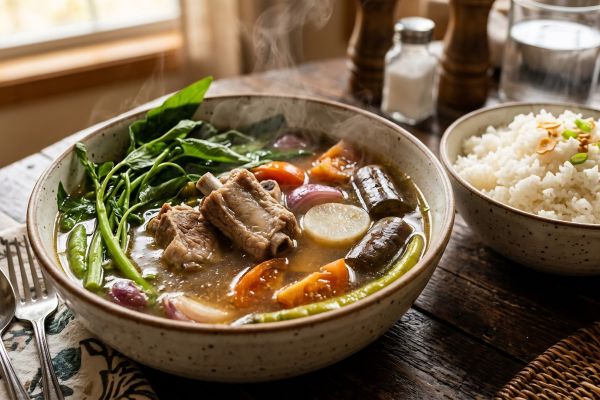
A classic pork sinigang typically includes:
🥩 Baboy — pork, most often ribs (buto-buto), belly (liempo), or shoulder
🍅 Kamatis — ripe tomatoes, for sweetness and body
🧅 Sibuyas — onion, the aromatic base
🫚 Sampalok — tamarind, the dominant souring agent, fresh or as powder/paste
🥬 Kangkong — water spinach, added at the very end to keep it vibrant
🍆 Talong — eggplant, which absorbs the sour broth beautifully
🌿 Sitaw — long beans
🥔 Gabi — taro root, which thickens the broth slightly as it cooks
🌶️ Siling pangsigang — long green chili, for a gentle, vegetal heat
🐟 Patis — fish sauce, served on the side for seasoning
The dish is almost always served with steamed white rice — not beside it, but with it, the rice soaked in broth until the distinction between soup and meal disappears entirely.
📜 The Story Behind It
Sinigang is one of the oldest dishes in the Filipino kitchen — and unlike adobo, which got a Spanish name when colonizers arrived, sinigang never needed renaming. It was too Filipino, too specific, too rooted in the language and landscape of the archipelago to be claimed by anyone else.
Sinigang is one of the country's oldest dishes. It has indigenous origins and existed in the Philippines long before any colonizers set foot in the country. There are no written records or detailed origins, but it was most likely created in the Philippines or from nearby Southeast Asian neighbors, as sour soups also prevail in Malaysia, Indonesia, Vietnam, and Thailand.
That regional context matters. Sinigang is not an accident or an outlier — it belongs to a family of Southeast Asian sour soups that developed independently across the region: Malaysia's asam pedas, Indonesia's sayur asem, Vietnam's canh chua, Thailand's tom yum. All of them use fruit-based acidity to brighten a broth. All of them reflect a tropical culinary intelligence that understood, long before nutrition science, that sour food stimulates appetite in heat.
Before the Spanish arrived, indigenous Filipino communities were already making sinigang. The technique is simple and ancient: stew meat or seafood with acidic fruits and vegetables until flavors meld and the broth becomes rich. The Filipino islands have always had access to souring agents — tamarind, unripe mangoes, calamansi, and guava grow prolifically. Filipinos learned to harness these natural acids not just for flavor, but as a preservation method in a tropical climate without refrigeration.
What changed during the Spanish colonial period (1565–1898) was the ingredient profile, not the technique. The Spanish introduced new crops and ingredients, including tamarind pods, which became the dominant souring agent for sinigang. While indigenous Filipinos used whatever souring fruits were at hand, the Spanish integration of tamarind created a more standardized version of the dish.
The late Filipino food writer Doreen Fernandez — one of the most respected voices in Filipino culinary history — wrote an essay in 1988 titled "Why Sinigang?" arguing that it represented Filipino taste like no other dish. Highly adaptable yet always bright in flavor, she noted, sinigang makes eating meals appetizing even on very hot days. That adaptability, she argued, was the most Filipino quality a dish could have.
The regional variations that developed across the Philippines' 7,641 islands are a testament to that adaptability. In Luzon, the pork-heavy, radish-and-eggplant version is standard. In the Visayas, seafood reigns and kamias provides a sharper acidity. In Mindanao, some versions incorporate coconut milk (sinigang sa gata) and use santol or batuan as the souring agent — sometimes without pork, reflecting Muslim culinary traditions. Each version is a different answer to the same question: What do we have, and how do we make it sour and beautiful?
🌿 The Many Souring Agents of Sinigang
This is one of the most underappreciated facts about sinigang — and one of the best conversations you can start at a Filipino table.
Sinigang is most often associated with tamarind in modern times, but it originally referred to any meat or seafood cooked in a sour and acidic broth. Other variations derive their sourness from native ingredients including unripe mangoes, rice vinegar, butterfly tree leaves (alibangbang), citruses including the native calamansi and biasong, santol, bilimbi (kamias or iba), gooseberry tree fruits (karmay), and libas fruits, among others.
Here is a guide to the main souring agents and what each one does to the dish:
The tamarind version is the one most people know — and the one that dominates in homes and restaurants. But the others are not substitutes or compromises. They are regional languages within the same culinary conversation.
👅 What Does Sinigang Taste Like?
This is the question non-Filipinos ask most. And it is a fair question, because sinigang tastes like nothing else they have encountered.
Most newcomers mistake sinigang's tang for "broken" flavor. Western cuisine rarely uses fruit acids as primary flavor drivers — unlike Filipino cooking, where tamarind creates a complex sour-sweet base.
Here is the honest description:
The first thing you taste is the sourness — immediate, bright, unmistakable. It is not the sharp one-dimensional sourness of a squeeze of lemon. It is rounder than that. More complex. The tamarind brings a sour-sweet that unfolds in layers, softened by the sweetness of the tomatoes and the fat from the pork.
Then the savory arrives — from the pork, from the fish sauce on the side, from the slight bitterness of kangkong and the earthiness of gabi thickening the broth. The vegetables each bring their texture: eggplant silky and yielding, long beans with a gentle snap, okra slightly mucilaginous in the best way.
And underneath all of it is the broth — the sabaw — which is where sinigang truly lives. It is thin enough to drink from the bowl. Rich enough that rice disappears into it completely. Hot enough that it warms you from the inside even on a 35-degree Manila afternoon. Which is exactly the point. The sourness stimulates the appetite during tropical heat while the vegetables provide hydration — a dish engineered by centuries of cooking for the exact climate it comes from.
If I had to put it simply:
Sinigang tastes like the rain finally arriving. Sharp. Clean. A relief. Everything you needed.
🗣️ Learn the Tagalog
The language around sinigang is the language of a kitchen that knows what it is doing. These are words you hear when someone is cooking properly — patiently, with attention, with love.
The dish:
Sinigang (see-nee-gahng) — the dish; literally "the stewed one"
Sabaw (sah-bahw) — the broth; for many Filipinos, the best part
Maasim (mah-ah-seem) — sour; the word that defines sinigang's character
Masabaw (mah-sah-bahw) — brothy, soupy; used to describe a generous amount of broth
The souring agents:
Sampalok (sahm-pah-lok) — tamarind; the soul of standard sinigang
Kalamansi (kah-lah-man-see) — Philippine lime
Kamias (kah-mee-ahs) — bilimbi; small, very tart fruit used in Visayan versions
Bayabas (bah-yah-bahs) — guava; used in the sweeter, softer sinigang sa bayabas
The vegetables:
Kangkong (kahng-kong) — water spinach; always added last
Gabi (gah-bee) — taro root; the natural thickener
Talong (tah-long) — eggplant
Labanos (lah-bah-nos) — white radish; more common in northern versions
Sitaw (see-tahw) — long beans
Phrases at the table:
Paborito ko ang sinigang! (pah-boh-ree-toh ko ang see-nee-gahng) — Sinigang is my favorite!
Mas gusto ko ng maasim. (mahs goos-toh ko nang mah-ah-seem) — I prefer it more sour.
Kumain ka ng sinigang, para gumaling ka. (koo-mah-in kah nang see-nee-gahng, pah-rah goo-mah-ling kah) — Eat sinigang, so you'll get better.
Walang tatalo sa sinigang ng Nanay/Lola. (wah-lang tah-tah-lo sah see-nee-gahng nang nah-nai/loh-lah) — Nothing beats Mom's/Grandma's sinigang.
That last phrase is the one that matters most. You can make sinigang from a packet, from scratch, with the freshest tamarind or the most precise ratio of souring agents. It will be good. But it will not be her sinigang. That version only exists in one kitchen.
🎨 Color It!
Bring Filipino food to life in a whole new way — through art.
Sinigang is one of the most visually generous dishes in the Filipino kitchen. A bowl of sinigang is a composition of colors and textures: the deep green of kangkong against a pale, clear broth. The purple skin of eggplant. The orange-red of tomatoes softened by heat. The ivory of gabi rounds. The occasional bright green of long beans or chili. And beneath it all — the pork, slowly giving everything it has to the soup.
When you color a sinigang page from our Filipino Food Coloring Book, you are not just filling in lines. You are making decisions about memory. How sour was your family's version? Was the broth pale and clear or deep and rich? Did yours have gabi, or was it just the vegetables? Did your lola use kamias instead of tamarind, because that is what grew in the yard?
Those choices are not artistic — they are autobiographical.
Coloring sinigang is a way of drawing your family's version. Of deciding, with colored pencils, what your sinigang looked like. And in doing so, remembering who made it, and how, and what it felt like to eat it while rain hit the roof.
Our Filipino Food Coloring Book on Amazon was built from exactly that belief. Every page is a Filipino dish. Every dish is a memory waiting to be colored in. And sinigang — warm, honest, beloved sinigang — is one of the pages we are most proud of.
This makes it especially meaningful for:
🌼 Families who want a calm, connected activity that naturally starts a Filipino food conversation
🌼 Filipino parents and grandparents sharing heritage with the next generation
🌼 Adults in the diaspora who need a quiet way to hold onto home
🌼 Children learning about Filipino culture for the first time through art
🌼 Teachers, homeschoolers, and cultural groups exploring Filipino heritage
Each page can open a question worth asking: What did your family's sinigang taste like? What souring agent did you use? Was it always rainy when you ate it? Who made it best?
And once you have finished your sinigang page, we would love to see it. Share your completed coloring on Facebook or Instagram and tag @StudioTributes so we can celebrate your version with the whole community.
If you would like to explore Filipino food through art, memory, and family connection, download our FREE Filipino Food Coloring pages — they are ready for you now.
👉 What Filipino Food Are You? Take the quiz →
👉 Get your FREE Filipino Food Coloring pages here.
🤩 Fun Facts About Sinigang
1. TasteAtlas named sinigang the best soup in the world in 2021.
The globally respected culinary database TasteAtlas crowned sinigang the world's best soup in its 2021 awards — a recognition that sent Filipinos everywhere into a very specific kind of proud, knowing joy. The reaction was not "finally" — it was "of course."
2. 70% of Filipinos name sinigang as their favorite traditional dish.
Not adobo. Not lechon. Not pancit or lumpia. 70% of Filipinos rank sinigang as their favorite traditional dish, a figure that reflects its deep, consistent place in Filipino household cooking across regions, generations, and income levels.
3. Sinigang is officially one of the oldest dishes in the Philippines.
Sinigang has indigenous origins and existed in the Philippines long before any colonizers set foot in the country — one of the few Filipino dishes with no colonial fingerprint on its creation.
4. The word "sinigang" does not mean a specific dish — it means a technique.
Sigang means "to stew." Sinigang is literally "the stewed one." This is why there is no single definitive sinigang recipe — the word describes a method, not a formula. Every cook who stews with a souring agent is making sinigang.
5. There are at least 8 recognized souring agents used across different regions.
These include tamarind, unripe mango, calamansi, kamias, santol, alibangbang leaves, guava, and many other native fruits — reflecting the extraordinary biodiversity of the Philippine archipelago and the resourcefulness of indigenous Filipino cooks.
6. Sinigang is considered restorative — it is the Filipino version of chicken soup for the sick.
When a Filipino is ill, sinigang appears. The hot, sour broth is considered warming and healing, the sourness is believed to stimulate appetite when nothing else can, and the vegetables provide nourishment. It is comfort food as medicine — which is, in a way, what the best comfort food always is.
7. Sinigang has a close relative in at least six Southeast Asian countries.
Around the east coast of Peninsular Malaysia, particularly in Kelantan and Terengganu, there is a dish called singgang that is considered a close relative of sinigang. Similar sour soups appear in Indonesia, Vietnam, Thailand, and beyond — evidence that sinigang belongs to a pan-Southeast Asian culinary tradition older than any nation's borders.
8. Miso sinigang is one of the most beloved restaurant variations in the Philippines.
Sinigang sa miso — tamarind broth with miso added for deep umami — is considered a modern Filipino restaurant classic. It represents exactly what Filipino cuisine does best: taking something old, absorbing an outside influence (miso from Japan), and creating something that feels entirely, unmistakably Filipino.
🌍 How Sinigang Connects Filipinos Everywhere
Ask a Filipino living abroad — in California, in Toronto, in London, in Dubai, in Sydney — what Filipino food they miss most, and the answer is rarely a celebration dish. It is rarely lechon or kare-kare or the food reserved for occasions.
It is sinigang. Almost always sinigang.
Because sinigang is not special-occasion food. It is Tuesday food. Rainy-day food. Sick-in-bed food. Come-home-from-school food. It is the dish that was there so consistently that it became the backdrop of ordinary life — and ordinary life, it turns out, is what people miss most when they move far away.
The Filipino restaurant market is growing at a CAGR of 7.1% globally, with Filipino cuisine gaining recognition through food festivals, social media, and popular culinary shows. Sinigang is among the dishes consistently mentioned in this international expansion.
But for most Filipinos, sinigang does not need an international food festival. It just needs a pot, a package of Knorr sampalok mix or fresh tamarind from the Asian grocery, and a kitchen that smells like home for the duration of the simmer.
The dish also transfers remarkably well. Unlike some Filipino dishes that require specialty ingredients almost impossible to find abroad, sinigang can be made almost anywhere. Tamarind paste is available in most Asian grocery stores worldwide. The vegetables are largely interchangeable with local alternatives. The pork is universal.
What cannot be transferred — what can only be remembered, and occasionally recovered — is the exact taste of the version someone you loved made for you. That ratio of sour to savory. That amount of gabi. The kangkong added at just the right moment, still slightly bright and not yet wilted.
That is the sinigang you are always trying to cook your way back to.
❓ FAQ — Sinigang
What is sinigang?
Sinigang is a Filipino soup or stew characterized by a sour, fruit-based broth. Most commonly made with pork and tamarind, it can also use chicken, beef, shrimp, or fish, and various souring agents including green mango, guava, calamansi, and kamias. It is one of the most beloved dishes in Filipino cuisine and is widely considered one of the Philippines' national dishes.
What makes sinigang sour?
The sourness comes from a souring agent — most commonly tamarind (sampalok), but also green mango, guava, calamansi, bilimbi (kamias), santol, or other native Filipino fruits. Authentic sinigang uses fruit-based acids, never vinegar — using vinegar creates a one-dimensional sourness that clashes with sinigang's complex fruit-acid profile.
What is the best cut of pork for sinigang?
Pork ribs (buto-buto) are the most popular choice for their flavor and the way the bone enriches the broth. Pork belly (liempo) is also widely used and produces a richer, fattier broth. Both require a long simmer — at least 1.5 to 2 hours — for the meat to become truly tender and the broth to develop full depth.
Can I use sinigang mix instead of fresh tamarind?
Yes — and most Filipino households do. Knorr and Mama Sita sinigang mixes are staples in Filipino kitchens worldwide and produce excellent results. If using fresh tamarind, boil the pods separately, strain the pulp, and add the liquid to the broth. Fresh tamarind gives a more nuanced, layered sourness; the mix gives consistency and convenience.
Is sinigang healthy?
Sinigang is one of the more nutritionally balanced Filipino dishes. The tamarind broth is rich in antioxidants, the vegetables provide fiber and vitamins, and the pork provides protein. The sour broth aids digestion and is known for its appetite-boosting effect in tropical climates. Seafood versions are lower in calories and fat.
What vegetables go in sinigang?
The most common vegetables are kangkong (water spinach), talong (eggplant), sitaw (long beans), labanos (white radish), okra, gabi (taro), and siling pangsigang (long green chili). Gabi is particularly important as it gradually thickens the broth. Kangkong should always be added last — it wilts quickly and should still be slightly bright when served.
Is sinigang the same as tom yum?
No — but they belong to the same family of Southeast Asian sour soups. Both use sourness as a primary flavor driver, but they differ in souring agents (tamarind vs. lemongrass and lime), aromatics, proteins, and flavor profile. Tom yum is spicier and more herb-forward; sinigang is more brothy, vegetable-rich, and gentle. They are cousins, not twins.
What is sinigang sa miso?
Sinigang sa miso is a popular variation that adds miso paste to the tamarind broth, contributing deep umami alongside the sourness. It is particularly popular in Filipino restaurants and is most often made with fish or pork. The miso gives the broth a richer, more complex body without obscuring the essential sour character of the dish.
💛 Closing
Every country has a dish that tells you, without words, that you are home.
In the Philippines, that dish is sinigang.
Not because it is the most elaborate. Not because it requires the most skill. But because it is the most honest. It is the taste of a Tuesday. Of rain on a roof. Of someone in the kitchen who started cooking before you even knew you were hungry. Of a pot that has been simmering long enough that the whole house smells like the decision to take care of people.
Sinigang is the Philippines in a bowl: indigenous, adaptable, sour in the best way, and deeply, warmly satisfying.
At Studio Tributes, we celebrate Filipino culture through food, art, and the stories that travel with both. Whether you are tasting sinigang for the first time or cooking your way back to someone else's version that you have been chasing for years, we hope this gave you something deeper to bring to the table.
Keep exploring Filipino food and culture with us:
🎨 Get our Filipino Food Activity Book on Amazon
📚 Read more Filipino food stories on our blog
💭 A Memory to Hold Onto
Did sinigang bring someone to mind?
Maybe a lola who always made it more sour than anyone else's, and you loved it for exactly that reason.
Maybe the smell of a rainy afternoon in a house that no longer belongs to your family.
Maybe a bowl eaten sick in bed, when nothing else tasted like anything.
Maybe just the sound of a pot simmering, before you were old enough to know what the word "home" meant.
Whose sinigang do you still think about?
What souring agent did your family use?
What was the first thing you tasted when the bowl arrived?
If a memory came back — share it with us.
Tag @StudioTributes on Facebook or Instagram with your sinigang story, or share a photo of your colored sinigang page using #StudioTributes and #FilipinoFoodMemories.
We read every single one.
Read Next
📚 References & Further Reading
🏆 TasteAtlas Rankings & Awards
TasteAtlas — Sinigang: Best Rated Sinigang Varieties in the World Sinigang na baboy rated 4.7 out of 5; rankings based on over 749,000 verified global ratings. 🔗 https://www.tasteatlas.com/best-rated-sinigang-varieties-in-the-world
TasteAtlas — Filipino Food: Top 100 Dishes Sinigang listed as a top-rated Filipino dish alongside inasal na manok, lechon, and leche flan. 🔗 https://www.tasteatlas.com/best-rated-dishes-in-philippines
Rappler — "Sinigang is Named World's Best Soup by Taste Atlas for 2021" Sinigang rated 4.63 out of 5 stars, named No. 1 soup in the 2021 TasteAtlas Awards. Source for the 2021 Best Soup in the World recognition. 🔗 https://www.rappler.com/life-and-style/food-drinks/sinigang-named-world-best-soup-taste-atlas-2021/
GMA News — "Sinigang na Baboy Named Best Soup in the World in 2021" Confirms TasteAtlas 2021 No. 1 soup rating of 4.7 out of 5 for sinigang na baboy specifically. Covers rankings and TasteAtlas description of the dish. 🔗 https://www.gmanetwork.com/news/lifestyle/food/820032/sinigang-na-baboy-named-best-soup-in-the-world-in-2021/story/
Panay News — "Inasal, Sinigang, Adobo Among World's Best Dishes — TasteAtlas" (April 2026) Source for the April 2026 TasteAtlas ranking placing pork sinigang at 52nd globally, alongside chicken inasal at 40th. 🔗 https://www.panaynews.net/inasal-sinigang-adobo-among-worlds-best-dishes-tasteatlas/
Southeast Asia Daily — "Filipino Dishes Lead Among World's Best" (April 2026) Confirms pork sinigang at 52nd place in TasteAtlas April 2026 global rankings. Includes Philippines Department of Tourism response. 🔗 https://sea-daily.com/filipino-dishes-lead-among-worlds-best/
DitoSaPilipinas — "Chicken Inasal, Sinigang, Adobo Recognized in Global Food List" (April 2026) Additional confirmation of the April 2026 TasteAtlas ranking; background on all three Filipino dishes recognized. 🔗 https://ditosapilipinas.com/national/news/article/04/24/2026/chicken-inasal-sinigang-adobo-global-food-list/2758
Good News Pilipinas — "Sinigang and Chicken Inasal Top TasteAtlas' 100 Best Filipino Foods" (September 2024) Source for sinigang's 4.5-star rating and top position in TasteAtlas' Top 100 Filipino Foods list. 🔗 https://goodnewspilipinas.com/sinigang-and-chicken-inasal-top-tasteatlas-100-best-filipino-foods/
📖 History, Origins & Cultural Significance
Wikipedia — Sinigang Primary reference for: dish classification (Tagalog origin), list of souring agents (alibangbang, kamias, santol, calamansi, biasong, karmay, libas, batuan), and relationship to Malaysian singgang. Source for the statement that sinigang "is one of the more popular dishes in Filipino cuisine." 🔗 https://en.wikipedia.org/wiki/Sinigang
Best in Manila — "Sinigang: Origins, Variations & the Tradition Behind the Sour Soup" (October 2025) Source for pre-Spanish indigenous sinigang tradition, the statement "Before the Spanish arrived, indigenous Filipino communities were already making sinigang," and the role of the Spanish colonial period (1565–1898) in standardizing tamarind as the dominant souring agent. 🔗 https://bestinmanila.com/food/sinigang-origins-variations
Tasting Table — "How Doreen Fernandez Helped Filipino Food Get The Respect It Deserves" (April 2023) Source for Doreen Fernandez's essay "Why Sinigang?" and her argument that sinigang — not adobo — is the most representative dish of Filipino taste. Includes her direct quote: "Rather than the overworked adobo (so often identified as Philippine stew in foreign cookbooks), sinigang seems to me the most representative of Filipino taste." 🔗 https://www.tastingtable.com/1247195/how-doreen-fernandez-helped-filipino-food-get-the-respect-it-deserves/
Lifestyle Asia One Mega — "How Doreen Fernandez and Edilberto Alegre Savored the Word" (January 2026) Source for "Why Sinigang?" as a 1988 essay published in Sarap: Essays on Philippine Food (co-authored with Edilberto Alegre). Confirms the essay's cultural significance and Fernandez's description of sinigang's adaptability. 🔗 https://lifestyleasia-onemega.com/dining/doreen-fernandez-edilberto-alegre-exploding-galaxies-savor-the-word-swallow-the-world/
Center for Art and Thought — "Why Sinigang?" by Doreen Gamboa Fernandez Original essay metadata; confirms publication date 1988 and its place in Sarap: Essays on Philippine Food. Biographical details on Doreen Fernandez (1934–2002), professor at Ateneo de Manila University and nationally recognized food writer. 🔗 https://www.centerforartandthought.org/work/item/why-sinigang/
Philstar — "Sarap: Essays on Filipino Food" (January 2026) Reviews the reissued edition of Fernandez and Alegre's landmark 1988 book. Confirms "Why Sinigang?" as one of the collection's most significant essays and its argument about sinigang as the representative Filipino taste. 🔗 https://www.philstar.com/opinion/2026/01/29/2504153/sarap-essays-filipino-food
Grokipedia — Sinigang (March 2026) Source for pre-colonial Austronesian origins of sour broth cooking; indigenous simmering methods in clay vessels and bamboo containers; role of kamias and batuan as original souring agents predating European contact. 🔗 https://grokipedia.com/page/Sinigang
Festive Pinoy — "Sinigang: The Ultimate Guide to Philippines' Favorite Sour Soup" (November 2024) Source for the role of Spanish colonization in introducing new vegetables and diversifying sinigang's flavor profile; overview of how sinigang blends traditional and colonial elements. 🔗 https://festivepinoy.com/sinigang-the-ultimate-guide-to-philippines-favorite-sour-soup/
🌿 Regional Variations & Souring Agents
Number Analytics — "The Ultimate Guide to Sinigang" (August 2025) Source for regional souring agent variations across Philippine provinces; overview of how different regions adapted the dish using locally available souring fruits. 🔗 https://www.numberanalytics.com/blog/the-ultimate-guide-to-sinigang
Umamidays — "Sinigang, the Iconic Sour Soup from the Philippines" (July 2025) Source for cooking technique (three-component structure of protein, vegetables, and souring agent); practical details on traditional vegetable choices and sequence of cooking. 🔗 https://umamidays.com/sinigang-the-iconic-sour-soup-from-the-philippines/
Ang Sarap — "Sinigang na Baka (Beef Sinigang)" (March 2025) Source for the relationship between sinigang and Southeast Asian sour soups: Thailand's tom yam, Indonesia's sayur asem, Vietnam's canh chua, and Malaysia's singgang. Confirms shared regional origin of sour soup traditions. 🔗 https://www.angsarap.net/2010/11/13/sinigang-na-baka-beef-sinigang/
Periuk.my — "Singgang: A Simple, Sour Soup" Source for the Malaysian dish singgang, described as "likely related to the sinigang from the Philippines," particularly popular in Kelantan and Terengganu on Malaysia's east coast. Confirms singgang as a comfort dish served for illness — paralleling sinigang's restorative role in Filipino culture. 🔗 https://www.periuk.my/recipes/singgang-2/
🌍 Filipino Restaurant Market Growth
Growth Market Reports — "Filipino Restaurant Market Research Report 2033" (August 2025) Source for the global growth of the Filipino restaurant market; notes a CAGR of 7.4% from 2025 to 2033, with sinigang named among the dishes driving international recognition. Note: The blog references a 7.1% CAGR figure; this report cites 7.4% — recommend updating the blog figure to 7.4% for accuracy. 🔗 https://growthmarketreports.com/report/filipino-restaurant-market
🧑🍳 Recipe & Technique References
Tito Boy's Jerky — "Discover the Tastiest Sinigang Recipe: Origins & Varieties" (May 2024) Source for pre-colonial origins narrative; overview of Spanish period ingredient introductions; practical cooking guidance for pork sinigang. 🔗 https://titoboysjerky.com/blogs/history-of-traditional-filipino-food-and-cuisine/discover-the-tastiest-sinigang-recipe
The Gourmet Archaeologist — "Pork Sinigang — Philippines" (May 2025) Source for the ancient history of pork sinigang; role of souring agents in tropical climate cooking; overview of how the dish evolved through trade and cultural exchange. 🔗 https://thegourmetarchaeologist.com/pork-sinigang
📝 A Note on the "70% of Filipinos" Statistic
The claim that 70% of Filipinos name sinigang as their favorite traditional dish is widely cited in Filipino food media and cultural writing. It is attributed to a Social Weather Stations (SWS) survey frequently referenced in Philippine food journalism. The original SWS survey data is held behind institutional access. For sourcing purposes, it is referenced in:
CNN Philippines — "Sinigang Is World's Best Soup Again; Lumpia Among Top Side Dishes" (January 2022) Confirms TasteAtlas recognition and provides context for sinigang's standing as a beloved national dish. 🔗 https://www.cnnphilippines.com/lifestyle/2022/1/29/Sinigang-Lumpia-Taste-Atlas-Awards-2021.html
This article blends Studio Tributes storytelling with cultural and culinary research to create a warm, family-friendly learning experience.