
Ube: The Filipino Purple Yam That Predates Starbucks by 11,000 Years
Studio Tributes / Filipino Food / What Is Ube Halaya?
What Is Ube Halaya?
If you are Filipino, you already know.
You know the smell of ube halaya cooking — the thick, sweet, coconut-milk richness of it, the way it changes color as it thickens in the pan, the patience it takes to stir and stir until it becomes that deeply purple, impossibly creamy jam that has been sitting in glass jars and plastic containers on Filipino tables for generations.
You know ube cake at every birthday. Ube ice cream on a hot summer afternoon. Ube in halo-halo, that one magnificent layer of purple under the shaved ice and everything else. Ube pandesal, warm from the bakery, slightly sweet, brilliantly violet.
You have eaten ube your whole life and never thought of it as a trend. Because it never was one. It was just food. It was just home.
And if you are not Filipino — if you discovered ube through a Starbucks menu or a Trader Joe's shelf or a viral TikTok of someone pulling apart a purple cheesecake — then welcome. You have just found something that Filipinos have known since before recorded history. You are not late to a trend. You are late to a 11,000-year-old story.
Either way — you are in exactly the right place.
Ube offerings have risen by 230% across restaurant menus in the United States in the past four years. In April 2026, King's Hawaiian launched Ube Coconut Sweet Rolls nationwide after an earlier online release sold out quickly. Starbucks expanded its spring 2026 lineup to include an Ube Matcha Latte and Ube Vanilla Macchiato. From Costco to Costa Coffee in the UK, from Filipino bakeries in New Jersey to dessert cafés in Sydney — ube's purple reign is everywhere right now.
But for Filipinos who grew up with it, this moment is not about a trend. It is about recognition. It is about something that always deserved this and is only now getting it.
At Studio Tributes, we celebrate Filipino food because it carries more than flavor — it carries memory, identity, and the quiet pride of knowing that what you grew up eating is extraordinary. Today we are going all in on ube: what it is, where it comes from, what it actually tastes like, every dessert it has ever graced, and why — for Filipinos everywhere — it has always been more than purple.
📜 The Story Behind It
The story of ube begins before the Philippines had a name.
Archaeological finds in Ille Cave, Palawan, revealed ube remains from as far back as 11,000 BC. That is 13,000 years ago. Ube was being eaten — and possibly cultivated — in the Philippine islands thousands of years before any of the world's great ancient civilizations began building their first structures.
From those ancient roots, ube spread throughout Southeast Asia and the Pacific carried by the Austronesian peoples — among the most remarkable maritime cultures in human history. Beginning around 3,000 to 5,000 BCE, Austronesian communities from what is now Taiwan spread south and eastward across the islands of Southeast Asia, the Pacific, and eventually reaching Madagascar and the coast of South America. Ube traveled with them as a staple crop — hardy, nutritious, adaptable to the tropical climates of every island they settled.
The first Tagalog and Spanish dictionary published in 1613 mentioned ube — recorded as "uvi" — as a type of camote (sweet potato) before it was later correctly classified as a yam in the Dioscorea family. Food historian Felice Prudente Sta. Maria confirmed this early documentation, noting that ube's presence in the written record of Filipino food culture dates to the very first attempts to document that culture in language.
What is remarkable about ube's history is what it was not subjected to. Unlike rice — which was taxed, industrialized, and made the center of colonial agricultural policy — ube was never appropriated by colonial systems. It was never stripped of its local meaning. Unlike rice, ube was never the focus of nationalist agricultural programs. It was not industrialized or subjected to colonial taxation. It remained a Filipino crop in the most honest sense — grown in small plots, traded locally, cooked at home, passed down through families.
That independence from colonial economics is part of why ube remained so deeply connected to Filipino identity through centuries of Spanish and American colonial influence. It was never taken. It just kept growing.
The transformation of ube into the desserts Filipinos love — the halaya, the cakes, the ice cream — happened gradually and organically. Filipino food historian Felice Prudente Sta. Maria notes that there is no known record of exactly when Filipinos first made ube into a sweetened jam. But later culinary records from the early 20th century documented recipes resembling jam-based desserts that may have influenced the development of ube halaya as it exists today. What is certain is that by the mid-20th century, ube halaya had become one of the most beloved and iconic Filipino sweet preparations — present at town fiestas, birthdays, Christmas celebrations, and every occasion that called for something purple and extraordinary.
🟣 What Is Ube?
Ube (pronounced oo-beh) is a purple yam native to the Philippines — scientifically known as Dioscorea alata — with a deep violet flesh, a mildly sweet flavor, and a cultural significance that stretches back further than any dessert trend.
The word ube comes from Tagalog and means simply "tuber." But in Filipino culture, that simple word carries enormous weight. Ube is not just an ingredient. According to Wikipedia's entry on Dioscorea alata, the Philippines shows the highest phenotypic diversity of ube of any country in the world, making it one of the likely centers of origin of ube domestication — which means ube did not simply become Filipino. It is, in the deepest botanical sense, originally Filipino.
It is important to know what ube is not. Ube is frequently confused with:
Taro — a different tuber, more savory, less vibrant in color, used in dishes like laing and some versions of sinigang
Purple sweet potato (camote) — a different plant, sweeter and less nutty, often used as a substitute but distinctly different in flavor
Okinawan purple sweet potato — a Japanese variety with similar color but different taste and texture
Ube is its own thing. Its color is more vivid — a deep, saturated violet that does not exist naturally in most other foods. Its flavor is its own: mildly sweet, with a subtle nuttiness and vanilla-like warmth that makes it ideal for desserts without overpowering them.
The most celebrated variety is kinampay — the ube of Bohol in the central Philippines, traditionally referred to as the "Queen of Philippine Yams." The kinampay variety is particularly renowned for its rich color, aromatic scent, and subtly nutty, vanilla-like flavor. In Bohol, ube is not simply food — it is cultural identity. Historical accounts describe how Boholanos who accidentally dropped a ube tuber would traditionally kiss it — a gesture of deep respect for a crop that had sustained their community through hardship and drought.
That is the kind of relationship Filipinos have with ube. Not a trend. A tradition.
🍠 The Ube Desserts You Need to Know
Ube's genius is its versatility. It can be a jam, a cake, a bread, an ice cream, a cheesecake, a cookie, a latte, a croissant. It absorbs other flavors beautifully — coconut milk, condensed milk, cream cheese, white chocolate — while retaining its essential character. It photographs magnificently. And it tastes like nothing else.
Here are the Filipino ube desserts that started it all — long before Starbucks discovered purple:
Ube Halaya Jam — The original. The cornerstone. A thick, rich jam made by cooking grated or mashed ube with coconut milk, condensed milk, and butter over low heat, stirring patiently until it becomes dense and deeply purple. Eaten on its own, spread on bread, used as a filling, or spooned generously into halo-halo. Ube halaya is where every other ube dessert begins. Originally made with fresh carabao milk — milk from the Philippine water buffalo — it is one of the oldest Filipino sweet preparations in existence.
Ube Cake — The celebration cake. Soft, purple layered sponge cake with ube halaya between the layers and ube-flavored frosting covering the whole thing. Found at every Filipino birthday, every graduation, every occasion worth celebrating. The purple is not a decoration — it is the point. Ube cake is what Goldilocks and Red Ribbon are famous for. It is what Filipino birthdays smell like.
Ube Ice Cream — Arguably ube's most internationally recognizable form. Deep purple, creamy, with that characteristic sweet-nutty flavor that surprises people who have only ever had standard ice cream flavors. Magnolia's ube ice cream is a Filipino institution. The sight of it being scooped into a cone at a Filipino party in the 1980s, 1990s, or any decade since is one of the most specific and beloved childhood memories Filipinos carry.
Halo-Halo — The beloved Filipino shaved-ice dessert where ube halaya sits as one of the essential layers under shaved ice, evaporated milk, and a rainbow of toppings. Halo-halo without ube halaya is incomplete. The purple layer is what gives the whole composition its visual anchor and its richest flavor note.
Ube Pandesal — A modern Filipino bakery phenomenon. The classic Filipino bread roll — soft, slightly sweet, coated in breadcrumbs — made with ube dough, turning it vivid purple. Often filled with ube halaya or cream cheese. Went viral in the Philippines during the pandemic and has since become a bakery staple nationwide and in Filipino communities abroad.
Ube Cheesecake — The Filipino-American hybrid that helped ube break into the US mainstream. Filipino-owned bakeries in California, New York, and New Jersey were making ube cheesecakes years before major chains noticed. The combination of tangy cream cheese and sweet ube is unexpectedly perfect.
Ube Waffles and Ube Champorado — Regional and homestyle preparations that show ube's versatility beyond the dessert counter. Ube waffles are vivid purple at breakfast. Ube champorado — the Filipino chocolate rice porridge made with ube instead — is a comfort food that exists quietly in Filipino homes and rarely makes it to menus, which is part of what makes it special.
Ube Leche Flan — A fusion of two Filipino classics: the silky, egg-yolk-rich leche flan and ube. The result is a two-tone, layered dessert that is simultaneously traditional and inventive — exactly the kind of thing Filipino home bakers have been experimenting with for decades.
👅 What Does Ube Actually Taste Like?
This is the question every non-Filipino asks. And it deserves a real, honest answer — because ube is frequently misrepresented.
Ube does not taste intensely sweet. It is not candy-purple. It is not like blueberry or grape or any of the purple flavors Western food culture has conditioned people to expect.
Ube is less sweet than other yams, with a starchy texture and a flavor often described as nutty, vanilla-like, and slightly earthy. It is subtle. It is complex. It has depth without being assertive — which is exactly why it works so beautifully with dairy. Cream cheese softens and amplifies it. Coconut milk brings out its sweetness. Condensed milk deepens it. Butter makes it glossy.
The color, meanwhile, is entirely natural. The vivid violet color of purple yam is due to various anthocyanin pigments — the same compounds found in blueberries, red cabbage, and purple sweet potato — which are water-soluble and have been proposed as possible food coloring agents. That purple does not come from food dye. It comes from the tuber itself. Which is why ube halaya, ube cake, and ube ice cream all have that particular shade of violet that no artificial coloring has ever quite managed to replicate.
If I had to describe the experience simply:
Ube tastes like what purple should taste like — warm, sweet, soft, and specific. Like something from a long time ago that somehow still feels entirely new.
For Filipinos, that description needs no explanation. For everyone else discovering it now — welcome to the flavor the Philippines has been sharing for 11,000 years.
🗣️ Learn the Tagalog
The language around ube is the language of sweetness, celebration, and the kitchen that always smelled like something good was happening.
The ingredient:
Ube (oo-beh) — the purple yam; the ingredient and the icon
Halaya (hah-lah-yah) — jam; from the Spanish jalea; ube halaya is the most essential ube preparation
Kinampay (kee-nam-pai) — the premium Bohol variety, the Queen of Philippine Yams
Ubi (oo-bee) — the older Visayan spelling; you may see this on traditional labels
The desserts:
Ube halaya (oo-beh hah-lah-yah) — ube jam; the foundation of all ube desserts
Ube cake (oo-beh keyk) — used directly in Filipino; the celebration cake
Halo-halo (hah-loh hah-loh) — the beloved shaved ice dessert where ube halaya is essential
Pandesal (pan-deh-sahl) — the classic Filipino bread roll; ube pandesal is the purple version
Sorbetes (sor-beh-tes) — traditional Filipino street ice cream; often includes ube flavor
Words at the table:
Masustansya (mah-soos-tahn-syah) — nutritious; often used to describe ube because of its antioxidant content
Paborito ko ang ube! (pah-boh-ree-toh koh ang oo-beh) — Ube is my favorite!
Ang ganda ng kulay! (ang gahn-dah nang koo-lai) — What a beautiful color!
Luto na ba ang halaya? (loo-toh nah bah ang hah-lah-yah) — Is the halaya cooked yet? (The question everyone asks while waiting impatiently around the stove)
Reyna ng kamoteng kahoy. (rey-nah nang kah-moh-teng kah-hoy) — Queen of the yams; the informal title for kinampay ube
That last word — reyna, queen — is important. It is not hyperbole. In Bohol, kinampay ube has been treated with reverence for centuries. A dropped tuber kissed before being picked up. A harvest celebrated. A flavor that defines an entire province's identity. That is not a food trend. That is culture.
🎨 Color It!
Bring Filipino food to life in a whole new way — through art.
Our Filipino Food Coloring Book on Amazon was built from exactly that belief: that every dish is a memory, and every coloring page is an invitation to remember.
This makes it especially meaningful for:
🌼 Filipino families who want to talk about celebration foods, childhood memories, and what made ube special in their household
🌼 Parents raising children abroad who grew up with ube but want to make sure the next generation knows what it is and what it means
🌼 Non-Filipino friends and partners who have just discovered ube and want to explore the culture behind the color
🌼 Anyone in the Filipino diaspora who sees ube on a Starbucks menu and wants to say: we had this first, and here is the whole story
🌼 Teachers, homeschoolers, and cultural groups celebrating Filipino heritage through art
If you would like to explore Filipino food through art, memory, and family connection, download our FREE Filipino Food Coloring pages — they are ready for you now.
👉 Get your FREE Filipino Coloring pages here.
🤩 Fun Facts About Ube
1. Ube has been eaten in the Philippines since 11,000 BC. Archaeological finds in Ille Cave, Palawan, revealed ube remains from as far back as 11,000 BC. This makes ube one of the oldest cultivated crops in Philippine history — predating the Egyptian pyramids by roughly 7,000 years.
2. The Philippines is the world's center of ube diversity. The Philippines shows the highest phenotypic diversity of ube — the greatest variety of cultivars, shapes, colors, and flavors — making it one of the likely centers of origin of ube domestication. Ube did not simply become Filipino. In the deepest botanical sense, it started there.
3. Ube appeared in the very first Tagalog-Spanish dictionary. The first Tagalog and Spanish dictionary published in 1613 mentioned ube — listed as "uvi" — as a type of camote before its reclassification as a yam. This makes ube one of the earliest Filipino food ingredients to appear in written historical record.
4. Ube's purple color is entirely natural. The vivid violet comes from anthocyanins — the same powerful antioxidant pigments found in blueberries and red cabbage. No artificial dye. No food coloring. Just a tuber that grew purple in the Philippine soil for thousands of years.
5. Ube has risen 230% on US restaurant menus in four years. Ube offerings have risen by 230% across restaurant menus in the United States in the past four years, according to food and beverage analytics firm Datassential. It currently features on the menu at 95 chains across the US, and is predicted to grow 74% in the next four years.
6. Major global chains embraced ube in 2025 and 2026. Starbucks added an Iced Ube Coconut Macchiato to its spring US menu. Trader Joe's introduced seasonal products including Ube Mochi Pancake & Waffle Mix, Ube Tea Cookies, Ube Ice Cream, and Ube Spread. Costco began carrying Magnolia Ube Ice Cream. Walmart expanded its offerings to include ube cheesecake, ube dinner rolls, and ube spread.
7. Ube's global rise is causing a supply crunch in the Philippines. The surge in international demand for ube has outpaced what Philippine farmers — most of whom grow ube in small, traditional plots — can currently produce. National ube production has declined from around 30,074 metric tons in 2006 to approximately 14,000 metric tons in 2020. The world wants more ube than the Philippines can grow right now.
8. Kinampay ube from Bohol is called the Queen of Philippine Yams. The kinampay variety, originating from Bohol in the central Philippines, is particularly renowned for its rich color, aromatic scent, and subtly nutty, vanilla-like flavor, earning it the moniker "Queen of Philippine Yams." Boholanos have traditionally kissed a dropped kinampay tuber as a sign of deep cultural respect for the crop.
🌍 How Ube Connects Filipinos Abroad
There is a specific moment that Filipinos in the diaspora describe — the moment they walked into a coffee shop or a supermarket or scrolled past a food video and saw ube. Their ube. The ingredient from their grandmother's kitchen, from the halaya their mother stirred for hours, from the purple cake at every birthday — now on a menu board or a Trader Joe's shelf or a Starbucks app.
The feelings in that moment are complicated. Pride, absolutely. But also something more nuanced — a quiet, complex feeling about who gets to "discover" something that was never lost. Something that was simply waiting, in Filipino kitchens and Filipino bakeries, for the rest of the world to catch up.
For Filipino Americans, ube represents a visible link between heritage cooking, cultural recognition and the evolving presence of Filipino cuisine in the broader American food landscape.
Filipino-American bakeries and cafés played a central role in bringing ube to wider American audiences — years and in some cases decades before major chains arrived. These were Filipino bakers who simply made what they knew, what they grew up eating, and trusted that the people who tried it would understand why it was extraordinary. They were right.
The ingredient's vibrant violet color has contributed significantly to its popularity online — a search of the ube hashtag shows 120,000 posts on TikTok and more than 750,000 posts on Instagram, all featuring ube's striking purple hue. But for Filipinos, ube's meaning was never visual. It was textural. It was the specific weight of a spoonful of halaya. The purple stain on a white plastic container. The smell of coconut milk and condensed milk thickening over heat on a Sunday afternoon.
Ube is what home tastes like, in the most specific possible color.
❓ FAQ - Ube and Ube Desserts
What is ube? Ube (pronounced oo-beh) is a purple yam native to the Philippines, scientifically known as Dioscorea alata. It has a deep violet flesh, a mildly sweet and nutty flavor with vanilla-like notes, and a cultural history in the Philippines dating back 11,000 years. It is distinct from taro, purple sweet potato, and Okinawan purple sweet potato — all different plants with different flavors and culinary uses.
How do you pronounce ube? Oo-beh. Two syllables. The "u" sounds like "oo" as in "moon." The "b" is soft. Not "yoo-bee" — that is the most common mispronunciation. If in doubt, just say oo-beh slowly and confidently.
What does ube taste like? Mildly sweet, nutty, and slightly vanilla-like. Less sweet than taro or purple sweet potato. More subtle and complex than most people expect from something so vividly colored. It absorbs other flavors beautifully — coconut milk, cream cheese, condensed milk — while maintaining its essential character.
Is ube the same as taro? No. Ube and taro are entirely different plants. Taro (gabi in Filipino) has a starchier, more neutral flavor and is used in both savory and sweet Filipino dishes. Ube is sweeter, more fragrant, and used almost exclusively in desserts in Filipino cuisine. Their colors are also different — taro is typically grey-white inside, while ube is deep purple.
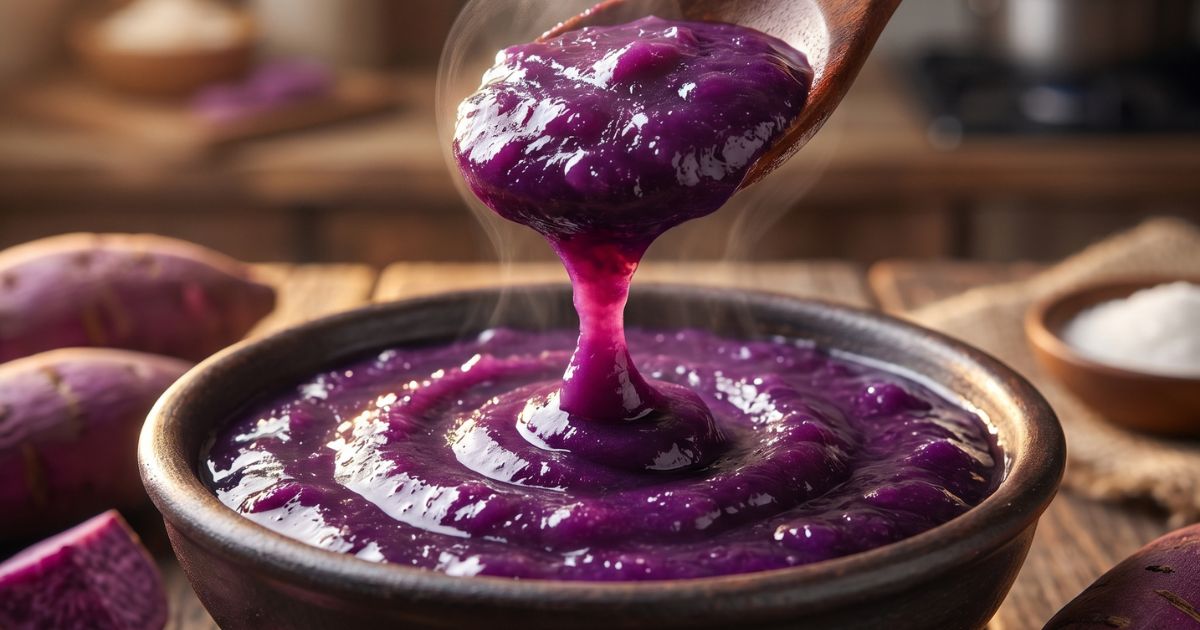
What is ube halaya? Ube halaya is a thick, creamy Filipino ube jam made by cooking grated or mashed purple yam with coconut milk, condensed milk, and butter over low heat until thick and deeply purple. It is the most fundamental ube preparation in Filipino cuisine — eaten on its own, used as a filling or topping, and the essential purple layer in halo-halo.
Why is ube so popular right now? Ube checks multiple consumer trend boxes simultaneously: it is visually striking for social sharing, globally inspired, versatile across dessert and beverage categories, and checks health-conscious boxes through its natural antioxidant content. But for Filipinos, the more accurate answer is: it has always been popular. The world just arrived.
Where can I find ube outside the Philippines? Ube extract, ube powder, and ube halaya are available in most Filipino grocery stores worldwide and increasingly in mainstream Asian grocery chains. Major US retailers including Trader Joe's, Costco, and Walmart now carry seasonal ube products. Ube flavored items are on the menu at Starbucks US locations. Many Filipino-owned bakeries in major cities — particularly in California, New York, Canada, Australia, and the UK — make fresh ube desserts.
Is ube nutritious? Yes. Nutritionally, ube surpasses regular yams in antioxidant content. It is rich in Vitamins A, C, and E and high in potassium. Ube also promotes probiotic bacteria growth due to its high fibre content. Its deep purple color indicates a wealth of anthocyanins, which are known to help reverse cognitive and motor function decline.
What is the difference between ube and purple sweet potato? Ube (Dioscorea alata) is a true yam. Purple sweet potato (Ipomoea batatas) is a sweet potato. They look similar from the outside but differ significantly in flavor — ube is nuttier, less sweet, and more complex — and in texture. They are not interchangeable in traditional Filipino recipes, though purple sweet potato is sometimes used as a substitute in commercial applications.
💛 Closing
Ube did not become extraordinary when Starbucks put it on a menu.
It was extraordinary in Bohol in 11,000 BC, growing in soil that sustained a people. It was extraordinary in 1613, when it was important enough to be among the first Filipino words written into a dictionary. It was extraordinary at every Filipino birthday, every Christmas table, every town fiesta where a jar of halaya appeared alongside the other food. It was extraordinary in the hands of every lola who stirred it over a hot stove for hours, arms aching, until it became the purple jam her family would ask for by name.
The world's discovery of ube does not make it more than it was. It simply confirms what Filipinos always knew: that the things they grew up eating, the ingredients that sustained their communities and defined their celebrations, are extraordinary. They just needed more people to taste them.
At Studio Tributes, we celebrate Filipino food because it carries more than flavor — it carries the whole story of a people. Ube carries that story in its color, its taste, and its 11,000 years of unbroken history in Philippine soil.
Explore more Filipino food, art, and memory with us:
🎨 Get our Filipino Food Activity Book on Amazon
📚 Read more Filipino food stories on our blog
💭 A Memory to Hold Onto
Did ube bring someone to mind?
Maybe your lola stirring halaya on the stove — the smell of coconut milk and sweetness filling the whole house. Maybe the purple Magnolia ice cream at a family party that you always tried to get an extra scoop of. Maybe an ube cake that appeared every single birthday without anyone needing to ask for it. Maybe seeing ube on a Starbucks menu far from the Philippines and feeling something you could not quite name — pride, maybe, and something more complicated too.
What ube memory do you carry? What dish brought it back? Whose kitchen did it smell like?
If a memory came back — share it with us.
Tag @StudioTributes on Facebook or Instagram with your ube story or a photo of your colored ube page using #StudioTributes and #FilipinoFoodMemories.
We read every single one. 🇵🇭💜
Read Next
📚 References & Further Reading
Wikipedia — Dioscorea alata (Purple Yam / Ube) — Comprehensive botanical entry covering ube's origins, cultivation, culinary uses, and nutritional profile.
Wikipedia — Ube Halaya — Entry on the most fundamental Filipino ube preparation, its history and variants.
CNBC — Purple ube's viral rise is turning a Filipino staple into a global trend — but supplies are tightening — April 2026 feature on ube's global surge, Starbucks/Trader Joe's/King's Hawaiian expansion, and Philippine supply constraints.
Datassential — What Is Ube and Why Is It So Popular? — Food industry analytics on ube's 230% menu growth and predicted 74% further growth in the next four years.
Rappler / Time Trowel — Ube: History You Can Eat — Essay on ube's 11,000-year archaeological record, Austronesian migration, and pre-colonial significance.
Kapwa Gardens — More Than a Trend: The History of Ube and What It Means to the Filipino People — Cultural essay on ube's meaning to the Filipino diaspora and the nuances of its international "discovery."
PhilRootcrops / Visayas State University — An Ube Story: The Philippines' Purple Gold — Academic and cultural overview of ube as a Philippine agricultural heritage crop.
Encyclopaedia Britannica — Adobo | Description, History, Variations & Uses — Referenced for broader context on indigenous Filipino culinary traditions and pre-colonial food culture.
Felice Prudente Sta. Maria — Filipino food historian; her documentation of ube's appearance in the 1613 Tagalog-Spanish dictionary is cited across multiple scholarly and culinary sources.
This article blends Studio Tributes storytelling with cultural and culinary research to create a warm, family-friendly learning experience.