
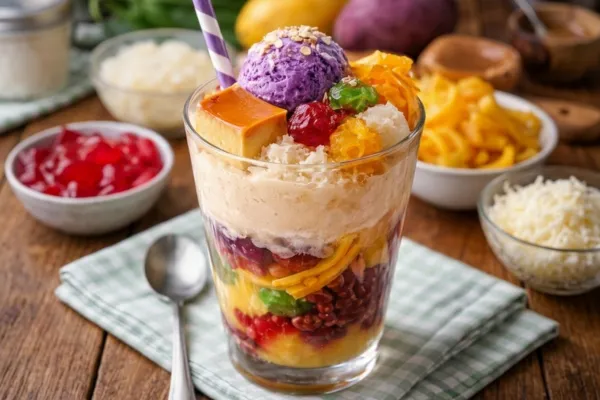
Halo-Halo: The Filipino Dessert You Were Told Not to Mix Yet
Studio Tributes / Filipino Food / What Is Halo-Halo?
What Is Halo-Halo?
The Philippines' Most Joyful Dessert — and the One That Is Never Made the Same Way Twice, On Purpose
If you ask ten Filipino families how to make halo-halo, you may get ten completely different lists of ingredients — and every single one of them will be correct.
For some, halo-halo is summer. It is the dessert you ate after a long afternoon of heat and noise, spooned out of a tall glass that was already dripping cold on the outside before you even got your spoon in. For others, it is the thing ordered at a carinderia or a Chowking counter before the memory even had a name for it — the purple and white and orange layers that you mixed together immediately even though someone always told you to slow down and enjoy it layer by layer first.
For many Filipino Americans and Filipinos living abroad — in Los Angeles, New Jersey, Toronto, London, Dubai, or Sydney — halo-halo can feel like the fastest way back to a specific kind of heat, sweetness, and joy that does not exist on any other continent quite the way it exists in the Philippines.
That is part of what makes halo-halo so enduring. It is chaotic by design. It is personal by nature. And somehow, in every version of it, it always works.
Filipino halo-halo is a layered shaved ice dessert made with sweetened beans, jellies, preserved fruits, milk, and crushed ice — topped most commonly with leche flan, ube halaya, and a scoop of ice cream. According to Wikipedia, halo-halo is one of the most popular Filipino cold desserts, and its name comes directly from the Tagalog word halò, meaning "to mix" — a reflection of the fact that the dish is meant to be stirred together before eating.
At Studio Tributes, we love dishes like halo-halo because they carry more than flavor. They carry summer, chaos, comfort, and the specific kind of joy that belongs to childhood and never entirely leaves. Today we are going deep — what halo-halo is, where it comes from, what every layer tastes like, and why it continues to hold such a vivid, colorful place in Filipino culture everywhere in the world.
🍧 What Is Halo-Halo?
Halo-halo is one of the most joyful desserts in Filipino cuisine — not just because it is colorful and cold, but because it teaches you something essential about how Filipino food works.
At its core, halo-halo is a shaved ice dessert built in layers. The base is a combination of sweetened and preserved ingredients — beans, fruits, jellies, and root vegetables — piled into a tall glass. Crushed or shaved ice is packed over those layers, followed by cold fresh milk or evaporated milk, and then crowned with toppings that can include leche flan, ube halaya (purple yam jam), and ice cream.
Wikipedia describes halo-halo as a popular cold dessert in the Philippines made up of crushed ice and evaporated milk mixed with various ingredients including sweet beans, coconut strips, sago pearls, gulaman (agar jelly), ube, and leche flan. The word itself — halo — means "to mix" in Tagalog, and the instruction is built directly into the name: you are supposed to mix it before you eat it.
A classic halo-halo typically includes:
🍮 Leche flan — creamy caramel custard, usually placed on top as a crowning layer
💜 Ube halaya — purple yam jam, one of the most beloved and iconic toppings
🍨 Sorbetes or ice cream — a scoop on top, usually ube, vanilla, or macapuno flavor
🧊 Maiz con yelo — sweetened corn kernels mixed with the shaved ice
🫘 Sweetened red munggo and white beans — the traditional base layers
🥥 Nata de coco — coconut gel squares, slightly chewy and sweet
🟢 Gulaman — colored agar jelly, often green or orange, cut into small cubes
🔴 Sago — tapioca pearls, soft and slightly sweet
🍌 Saging na saba — sweetened plantain banana, soft and caramelized
🥛 Gatas — evaporated milk or fresh milk poured over the ice
What makes halo-halo especially beloved is its range. Some families add ube ice cream. Some use coconut sport strips (macapuno). Some include pinipig — toasted young rice that crackles against the cold. Some load their glass with jackfruit (langka) or sweet potato (kamote). The structure is a guide, not a rule.
So if you have ever wondered why halo-halo feels almost impossible to define precisely — the answer is simple: it was built to be personal. Halo-halo belongs to whoever is making it.
📜 The Story Behind It
Halo-halo's origin story is a perfect example of why Filipino food becomes more interesting the deeper you go.
The dessert is widely believed to have roots in the Japanese kakigori tradition — a Japanese shaved ice dessert made with flavored syrup — brought to the Philippines by Japanese immigrants in the early twentieth century, particularly in the decades before World War II. Wikipedia notes that Japanese immigrants in the Philippines introduced a dessert of sweetened red beans over shaved ice, which Filipino vendors then adapted over time into the layered, heavily topped version that exists today.
That adaptation is where the story becomes distinctly Filipino. What began as a simple Japanese-influenced sweet was transformed by Filipino creativity, tropical ingredients, and the country's deeply layered dessert traditions. Sweetened local fruits, native root vegetables like ube and kamote, local coconut products, and the Filipino tradition of leche flan were folded into the glass. The result was a dessert that shared almost nothing with its origin except the shaved ice foundation.
In that way, halo-halo is deeply Filipino: it took an outside influence, made it its own, and produced something that belonged entirely to the Philippines.
The dish grew in popularity throughout the twentieth century, moving from street vendors and local markets into dedicated dessert shops, fast food chains, and eventually into Filipino restaurants worldwide. Today, halo-halo appears on menus from Manila to Los Angeles to Tokyo — and each version carries the signature of whoever is serving it.
👅 What Does It Taste Like?
Halo-halo tastes like contrast turned into joy.
The shaved ice is cold and soft. The milk adds creamy sweetness. The beans bring gentle earthiness. The nata de coco gives a clean, chewy pop. The jackfruit adds tropical fragrance. The leche flan adds rich custard depth. The ube contributes a sweet, earthy, almost floral note. Food & Wine and Bon Appétit both emphasize that halo-halo is defined by this range of textures and flavors.
And that is before it is mixed.
Once everything is stirred together, the experience changes. The ingredients stop feeling like separate toppings and start becoming one dessert with many personalities at once. Bon Appétit describes the end result as packing in contrasting textures from chewy to crunchy, creamy to sticky.
If I had to describe it simply, I’d say this:
Halo-halo tastes like summer layered in a glass.
It is sweet, but not one-note. Cold, but not plain. Creamy, fruity, chewy, crunchy, and playful all at once. It feels less like eating one flavor and more like enjoying a whole dessert conversation in a single spoonful.
🗺️ Regional Variations Across the Philippines
One of the most important things to understand about halo-halo is that the Philippines is an archipelago of over 7,641 islands — and halo-halo, like every great Filipino dish, adapts to every corner of it.
This table is a reminder that when someone says "the best halo-halo I ever had was from my lola's version," they are almost certainly right — because that version was shaped by her region, her pantry, and her specific understanding of what joy tastes like.
👅 What Does Halo-Halo Taste Like?
Halo-halo tastes like joy with texture.
The first thing you notice is the cold — immediate, striking, and deeply refreshing. Then comes the sweetness, which is layered rather than flat: the creamy richness of leche flan, the earthy sweetness of ube, the mild dairy softness of evaporated milk soaking into the shaved ice. Then the textures arrive. Soft beans. Chewy sago. Silky coconut gel. Crispy pinipig, if it is there. Cold, creamy ice cream beginning to melt into everything.
Wikipedia describes halo-halo as a colorful and refreshing combination of flavors and textures — an observation that sounds simple but is actually exactly right. The dish is not unified by a single flavor. It is unified by the experience of eating it: the mix, the chill, the layering of sweetness that never becomes overwhelming because no single ingredient dominates.
If I had to describe it simply:
Halo-halo tastes like summer afternoon made edible. Sweet but not cloying. Cold but not sharp. Texturally chaotic but surprisingly harmonious. And when the leche flan breaks and the ube melts into the milk and you have one spoonful that somehow catches a little of everything — that is when it becomes unforgettable.
🗣️ Learn the Tagalog
One of the most meaningful ways to connect with halo-halo is through the words that live around it.
Filipino food vocabulary is not only about ingredients. It is also about family rituals, shared summer afternoons, and the particular language people use when a dessert is making them happy. With halo-halo, the vocabulary becomes playful almost immediately.
The dish and the action:
Halo-halo (hah-loh hah-loh) — the dessert, literally "mix-mix"
Haluin mo (hah-loo-in moh) — mix it; the instruction you give before the first bite
Mag-halo tayo (mag-hah-loh tah-yoh) — let's mix (it) together
Ihalo mo na (ee-hah-loh moh nah) — go ahead and mix it now
The ingredients:
Yelo (yeh-loh) — ice; the base of everything
Gatas (gah-tahs) — milk
Ube (oo-beh) — purple yam
Leche flan (leh-cheh flahn) — caramel custard
Sago (sah-goh) — tapioca pearls
Gulaman (goo-lah-mahn) — agar jelly
Mais (mah-is) — corn / sweet corn
Nata de coco (nah-tah deh koh-koh) — coconut gel squares
Pinipig (pee-nee-pig) — toasted young rice
Macapuno (mah-kah-poo-noh) — coconut sport strings
At the table:
Anong gusto mong ilagay sa halo-halo mo? (ah-nong goos-toh mong ee-lah-guy sah hah-loh hah-loh moh) — What do you want in your halo-halo?
Huwag munang haluin, tingnan muna! (hoo-wahg moo-nahng hah-loo-in, ting-nahn moo-nah) — Don't mix it yet, look at it first!
Ang sarap! Malamig na malamig! (ang sah-rahp! mah-lah-mig nah mah-lah-mig) — So good! So cold!
Gusto ko pa ng ube! (goos-toh koh pah nang oo-beh) — I want more ube!
Pati leche flan, huwag kalimutan! (pah-tee leh-cheh flahn, hoo-wahg kah-lee-moo-tahn) — And the leche flan — don't forget it!
These words do not float above the dish — they live inside it. Haluin mo matters because mixing is the ritual. Ube matters because its color is the first thing you see. And yelo matters because without the ice, there is no halo-halo at all.
🎨 Color It!
Bring Filipino food to life in a whole new way — through art.
Halo-halo might be one of the most colorful dishes in all of Filipino cuisine, and that makes it one of the most beautiful to color. The layers are distinct and vivid: the deep violet of ube halaya, the golden amber of leche flan, the translucent white of shaved ice stained by milk, the pale yellow of sweet corn, the green and orange cubes of gulaman, the soft pink of ice cream melting at the edges, the dark rounds of sago below everything.
When you sit with a halo-halo coloring page and take your time choosing each color — how dark to make the ube, how golden the flan, how translucent the ice — something happens. You start thinking about your own version. Did yours always have leche flan on top, or was it just ube? Did your family add pinipig? Did you eat it fast before it melted, or did you slow down and eat it layer by layer the way someone older always told you to?
Our Filipino Food Coloring Book on Amazon was built from exactly that idea. Every page is a dish with a story. Every coloring session is an invitation to remember.
That makes it especially meaningful for:
🌼 Families who want a calm, shared activity that naturally opens a real conversation
🌼 Parents and grandparents introducing Filipino heritage to the next generation
🌼 Adults and seniors who find nostalgic, mindful creativity deeply satisfying
🌼 Anyone in the Filipino diaspora who needs a quiet, colorful way to hold onto home
🌼 Teachers, homeschoolers, and community groups exploring multicultural learning through art
Each page can open a question worth asking: Who made halo-halo in your family? Did you go to a specific shop for it every summer? Was the ube always the best part, or was it the leche flan? Did it taste better when someone else made it?
Those are the kinds of questions that make creativity feel like connection.
Share your completed halo-halo coloring on Facebook or Instagram and tag @StudioTributes — we would love to celebrate your version with the community.
If you would like to explore Filipino food through art, memory, and family connection, download our FREE Filipino Food Coloring pages — they are waiting for you now.
👉 Get your FREE Filipino coloring pages here.
🤩 Fun Facts About Halo-Halo
1. The name is literally the instruction — and most people translate it slightly wrong. Halo-halo is commonly described as meaning "mix-mix" in English, but according to the Commission on the Filipino Language's official dictionary, the prescribed term halúhalò is actually an adjective meaning "mixed together" — not a verb repeated. The reduplication intensifies the idea of thoroughness, not the action itself. The dish's name is still telling you exactly what to do before you pick up your spoon — it is just doing so with more precision than most people realize.
2. Halo-halo likely has Japanese roots — but became entirely Filipino. Wikipedia notes that Japanese immigrants in the Philippines introduced a dessert of sweetened red beans served over shaved ice before World War II. Filipino vendors and home cooks adapted it with local ingredients and traditions until it became something that bears almost no resemblance to its origin — except for the ice.
3. There is no official recipe, and there never will be. Unlike some dishes that have been standardized or codified, halo-halo belongs to whoever is making it. Families argue (lovingly) about whether mais belongs in it, whether you need both ube and ice cream, and whether leche flan on top is essential or optional. All of them are right.
4. Ube is not just a flavor — it is a color. The vivid purple of ube halaya is part of what makes halo-halo so visually iconic. Ube ice cream's unmistakable violet hue has also become one of Filipino cuisine's most recognized visual signatures internationally — appearing in viral food content across every social platform.
5. It is the most photogenic Filipino dessert, and it knows it. Halo-halo's layered presentation — before the mixing — is considered part of the experience. Taller is better. More layers is better. The crowning scoop of ice cream leaning just slightly to one side is a feature, not a flaw.
6. Chowking and Red Ribbon helped make it a national institution. Filipino fast food chains popularized halo-halo as an everyday dessert, not just a special occasion treat. Chowking's halo-halo in particular has been a beloved version for generations of Filipinos — making it as tied to fast food culture as it is to lola's kitchen.
7. The leche flan on top is both topping and crown. In the most traditional presentations, a whole slice of leche flan is placed directly on the ice. It melts slowly into the dessert as you eat, turning the milk slightly richer and more caramel. Some people save the flan for last. Some mix it in immediately. Both strategies have passionate defenders.
8. Halo-halo has gone international through Filipino diaspora restaurants. From Los Angeles to London, halo-halo now appears on menus far beyond the Philippines — introducing the dessert to non-Filipino diners who encounter it for the first time and immediately want to understand every layer. It has become one of Filipino cuisine's most effective ambassadors to the world.
9. Pinipig adds a surprising textural element. Toasted young rice — pinipig — is one of the underrated additions to halo-halo. It adds a light crunch that contrasts with everything soft and cold around it, giving the dessert an unexpected textural moment just when it might otherwise feel uniformly creamy.
10. It is almost impossible to eat slowly, and everyone knows it. Despite every instruction to appreciate the layers first, to look before you mix, to enjoy each component separately — halo-halo is almost always devoured enthusiastically, quickly, and joyfully. That might be the most honest thing about it.
11. TikTok is giving halo-halo a second wave of fame — and the dessert is built for it. In 2025 and into 2026, halo-halo has become one of the most-filmed Filipino foods on TikTok. Food analysts note that it leads because it gives the camera several things at once: color, height, crushed ice, and a final stir that changes the whole glass in seconds. No other Filipino dessert has that complete visual arc in under ten seconds. The mixing moment alone stops the scroll.
12. A single halo-halo jingle went viral and hit 2 million views in seven hours. In March 2025, Mang Inasal released a music video for their Extra Creamy Halo-Halo featuring Pinoy Big Brother winner Fyang Smith. The video trended #1 on X (formerly Twitter) and reached two million organic views across platforms in just seven hours — with "Mang Inasal Halo-Halo" trending on Facebook for the entire day. It was a reminder that halo-halo is not just a heritage dessert. It is currently one of the most culturally alive foods in the Philippines right now.
🌍 How Halo-Halo Connects Filipinos Everywhere
Halo-halo has a specific kind of reach that is hard to explain until you have experienced it.
Some dishes travel because of their practicality — adobo keeps well, travels light, and requires ingredients found anywhere on Earth. Halo-halo is the opposite. It requires cold equipment, specific Filipino pantry items, and a little more effort to assemble. And yet it travels anyway — because no one who grew up with it ever fully stops craving it.
For many in the Filipino diaspora — the estimated 12 million Filipinos living outside the Philippines — halo-halo is one of those taste memories that becomes almost mythological with distance. You cannot easily find it on every corner. You sometimes have to make it yourself from preserved ingredients ordered online or found at the Filipino grocery store two towns over. And when you finally have it — layered correctly, cold, with ube on top — it feels like an event.
That is actually something halo-halo and the Filipino diaspora share: the ability to take what is available and make something that feels completely, unmistakably like home. Different ingredients, different city, same spirit.
Filipino restaurants and dessert shops abroad have recognized this. Halo-halo now appears on menus in New York, Los Angeles, Toronto, London, and Dubai — often as the showpiece dessert, the thing that makes non-Filipino diners stop mid-conversation and take a photograph. It has become one of the desserts most associated with the rising international profile of Filipino cuisine.
That visibility has accelerated on social media. Food analysts tracking TikTok trends in 2025 noted that halo-halo consistently outperforms other Filipino desserts on video platforms because its structure is ideal for a short-form camera: the layered presentation before mixing, the dramatic stir, and the color transformation in the glass make it one of the few desserts that tells a complete visual story in under ten seconds. The scroll stops for halo-halo. That is not an accident — it is the same quality that has made people stop and stare at it on a carinderia counter for a hundred years. The dessert was always meant to be seen before it was eaten.
But even in a restaurant setting, halo-halo still asks you to do one thing before you eat it: haluin mo. Mix it. Make it yours. That instruction has not changed in a hundred years, and it never will.
❓ FAQ — Everything You Need to Know About Halo-Halo
What is halo-halo? Halo-halo is a popular Filipino cold dessert made with a base of sweetened preserved ingredients — including beans, jellies, fruits, and coconut products — topped with shaved or crushed ice, milk, leche flan, ube halaya, and ice cream. According to Wikipedia, the name comes from the Tagalog word halò, meaning "to mix," and the dessert is designed to be stirred together before eating.
What does halo-halo mean in English? Most people describe halo-halo as meaning "mix-mix" in English — and while that is close, it is slightly imprecise. According to the Commission on the Filipino Language's official dictionary, the prescribed spelling is halúhalò, and it functions as an adjective meaning "mixed together" rather than a repeated verb. The reduplication implies thoroughness — the idea of something being fully, completely mixed — which is exactly what the dish asks of you before eating. The name is both a description and an instruction.
What does halo-halo taste like? Halo-halo tastes sweet, cold, creamy, and texturally layered. It combines the richness of leche flan and ube, the dairy softness of evaporated milk, the mild sweetness of beans and jellies, and the chilled crunch of shaved ice. No single flavor dominates — instead, the dish creates a harmonious mix of complementary sweetness and texture.
What are the ingredients in halo-halo? Classic halo-halo includes sweetened red munggo beans, white beans, sago pearls, gulaman (agar jelly), nata de coco, sweetened corn (mais), saging na saba (caramelized plantain), shaved ice, evaporated milk, leche flan, ube halaya, and ice cream. Regional and family variations add or substitute other ingredients including macapuno, langka (jackfruit), pinipig, kamote (sweet potato), and ube ice cream.
Where did halo-halo come from? Halo-halo is widely believed to have evolved from a Japanese shaved ice dessert brought to the Philippines by Japanese immigrants in the early twentieth century. Filipino creativity and local ingredients transformed it into something distinctly and entirely Filipino over the following decades.
What is the purple stuff in halo-halo? The purple component in halo-halo is ube halaya — a jam made from purple yam (Dioscorea alata), a native Filipino root crop. It is one of the most iconic and beloved toppings, both for its deep violet color and its earthy, slightly sweet flavor. Ube ice cream — also purple — is sometimes added as a second ube element on top.
Is halo-halo healthy? Halo-halo is a dessert, and most versions are high in sugar from the sweetened toppings and preserved ingredients. However, many of its components — beans, root vegetables, coconut gel — offer fiber, protein, and micronutrients. The shaved ice base adds no calories. A version made with less condensed milk and lighter toppings can be a reasonably moderate dessert option.
Can you make halo-halo at home? Yes. Halo-halo is very achievable at home with ingredients commonly found at Filipino grocery stores or Asian supermarkets. Most sweetened toppings — red beans, sago, nata de coco, gulaman — are available in jars or cans. The shaved ice can be made with a blender or shaved ice machine. Ube halaya and leche flan can be purchased ready-made or prepared from scratch.
What is the difference between halo-halo and kakigori? Kakigori is a Japanese shaved ice dessert typically made with flavored syrup poured over finely shaved ice. Halo-halo is the Filipino adaptation — far more heavily layered, with multiple preserved ingredients, beans, jellies, and multiple toppings including leche flan, ube, and ice cream. The two share a shaved ice foundation but are otherwise entirely different desserts from different culinary traditions.
What is the best way to eat halo-halo? The classic instruction is to admire the layers first, then mix everything together thoroughly before eating. The mixing is not optional — it is built into the name. Once mixed, the ice breaks down into the milk and ingredients, creating a cold, unified dessert where every spoonful catches a little of everything. Most people eat it quickly before it melts, and that is considered entirely appropriate.
💛 Closing
Halo-halo is more than a famous Filipino dessert. It is one of those experiences that carries summer inside it — the particular heat of a Filipino afternoon, the relief of something impossibly cold, the colors arriving in layers before you mix them together, and the joyful permission to make it exactly as chaotic as you want.
It started as a borrowed idea and became something that belongs entirely to the Philippines. It adapted to every region, every family, every generation, and every Filipino kitchen abroad that found a way to put it together with whatever was available. It became the dessert that non-Filipinos photograph on first encounter and Filipinos talk about like a childhood friend.
At Studio Tributes, we celebrate Filipino culture through food, art, and the stories that travel with both. Whether you are tasting halo-halo for the first time or remembering it from a very specific summer a long time ago, we hope this gave you a warmer, more colorful way to connect with one of the Philippines' most joyful classics.
Keep exploring Filipino food and culture with us:
🎨 Get our Filipino Food Activity Book on Amazon
📚 Read more Filipino food stories on our blog
💭 A Memory to Hold Onto
Did halo-halo bring back a hot afternoon for you?
Maybe a glass set down in front of you with a long spoon and a smile.
Maybe a favorite topping you always looked for first.
Maybe the little debate between mixing everything right away or keeping the layers neat for as long as possible.
What always had to be in your halo-halo?
Did you love the ube, the leche flan, or the chewy toppings most?
What memory comes back when you picture that first icy spoonful?
If a memory came to mind, share your halo-halo story on Facebook or Instagram and tag @StudioTributes so we can celebrate it with you. And if you’d like more warm Filipino food stories, cultural memories, and creative inspiration, come spend time with us on social media.
Read Next
• What Is Pandesal?
• What Is Lechon?
• What Is Filipino Food?
📚 References & Further Reading
Wikipedia — Halo-Halo — Primary reference for ingredient list, name etymology, Japanese origins, and cultural significance. Cited throughout this article.
Wikipedia — Ube Halaya — Reference for ube halaya as a Filipino dessert component and its cultural visibility.
Wiktionary — Halo-Halo (KWF Dictionary Citation) — Documents the Komisyon sa Wikang Filipino's official KWF Diksiyonaryo ng Wikang Filipino (2025) entry, including the prescribed spelling halúhalò and its classification as an adjective meaning "mixed together."
Komisyon sa Wikang Filipino — Official Website — Homepage of the Philippine government's constitutional language authority, publisher of the KWF Diksiyonaryo ng Wikang Filipino.
TasteAtlas — Halo-Halo — Global culinary database entry for halo-halo, including ranking in the Top 50 Best Frozen Desserts in the World (43rd place, 2023).
PhilStar Life — Sorbetes, Halo-Halo Among TasteAtlas Best Frozen Desserts — Philippine news coverage of the TasteAtlas 2023 frozen desserts recognition.
GMA News — Sorbetes, Halo-Halo Among TasteAtlas Top 50 — Supporting Philippine news coverage of the TasteAtlas recognition with additional detail on rankings.
Mang Inasal — Fyang Smith Goes Viral with New Halo-Halo Video (March 2025) — Official source for the Extra Creamy Halo-Halo music video viral moment: 2 million organic views in 7 hours, #1 trending on X.
Pinoy Recipe — Filipino Desserts on TikTok: Halo-Halo, Ube, and Viral Sweet Trends (2025–2026) — Analysis of halo-halo's dominance on short-form video platforms, citing DataReportal data and the visual structure that drives engagement.
Encyclopaedia Britannica — Philippine Cuisine — Supporting cultural context for Filipino dessert traditions and culinary history.
If This Story Resonates
If halo-halo reminds you of someone — or somewhere — you’re not alone.
Filipino Fast Food Chain and Comfort Food Favorites includes:
• 80 thoughtfully designed pages
• Bilingual dish names (English + Tagalog)
• Easy coloring for all ages
This article blends Studio Tributes storytelling with cultural and culinary research to create a warm, family-friendly learning experience.