
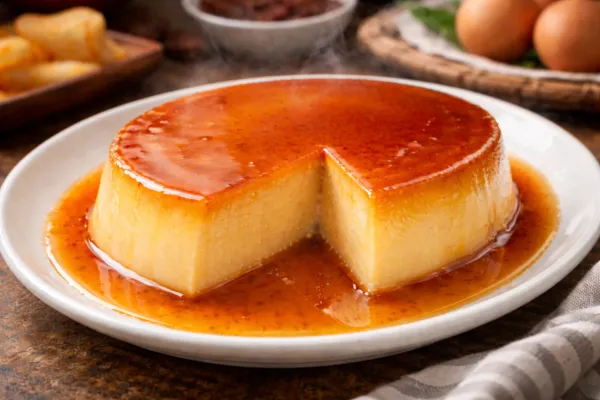
Leche Flan: The Filipino Custard That Crowns Every Celebration
The Creamy Caramel Custard That the Philippines Made Its Own — and the World Ranked Third Best
There is a dessert in the Philippines that carries an unlikely story inside it.
Not just a story about flavor — though the flavor alone would be worth telling. A story about colonization, resourcefulness, and the specific Filipino genius for taking something that arrived from elsewhere and making it so thoroughly, completely their own that the original version feels like a rough draft by comparison.
That dessert is leche flan.
Walk into any Filipino celebration — a birthday, a fiesta, a Noche Buena, a reunion — and leche flan will be there. Sitting in its oval llanera mold, glistening with amber caramel, smooth as silk, unmistakably Filipino. It will be in the refrigerator, chilling since the day before, because leche flan is one of those desserts that must be prepared ahead, must be patient, must be allowed time to become fully itself.
In August 2023, TasteAtlas — the world's most respected traditional food ranking database — named Filipino leche flan the third best custard in the world, with a rating of 4.5 stars. It placed ahead of Italy's zabaione, Germany's Bavarian cream, France's crème caramel, and Catalonia's crema catalana. Only America's frozen custard and France's crème brûlée ranked higher.
Filipinos received this news the way they receive most confirmation of what they already know: with pride that was gratifying precisely because it was never really in doubt.
At Studio Tributes, we celebrate Filipino food because it carries more than flavor — it carries history, memory, family, and the particular ingenuity of a culture that has always found a way to make something beautiful out of what it was given. Today we are going deep into leche flan: where it came from, the extraordinary story of how egg whites built Philippine churches and egg yolks became dessert, what makes the Filipino version unlike anything else in the custard world, and why this dish — simple, silky, amber-crowned — belongs at every table that matters.
🍮 What Is Leche Flan?
Leche flan (leh-cheh flahn) is a Filipino caramel custard dessert made primarily from egg yolks, sweetened condensed milk, and evaporated milk — steamed in an oval tin mold called a llanera until set, then chilled and inverted onto a plate so that the caramel layer flows over the top.
The name comes directly from Spanish: leche meaning milk, and flan referring to caramel custard. According to Wikipedia's entry on leche flan, the dish is essentially a caramel custard and is considered one of the most popular Filipino desserts, traditionally served at celebrations and social gatherings. TasteAtlas describes it as "a Filipino dessert that is essentially a caramel custard consisting of milk, sugar, and eggs, with the addition of vanilla flavoring" — oval-shaped due to the use of llanera tin molds, best served chilled and coated with its own caramel syrup.
A classic Filipino leche flan uses:
🥚 Pula ng itlog — egg yolks only (not whole eggs), which give Filipino leche flan its characteristic golden color and dense, rich texture
🥛 Gatas na may asukal (condensed milk) — sweetened condensed milk, for deep sweetness and body
🥛 Evaporated milk — for additional creaminess without over-sweetening
🍬 Asukal — white sugar, caramelized in the llanera before the custard is added
🍦 Vanilla — a small amount of vanilla extract for fragrance and depth
🍋 Dayap or calamansi zest — in some traditional recipes, a citrus note to cut the richness
The llanera — the oval tin mold that gives leche flan its distinctive shape — is as important as the ingredients. Traditionally made from thin tin and barely larger than two outstretched hands, the llanera creates the specific proportion of caramel-to-custard that defines the dish. The caramel is made directly in the llanera itself, heated on the stove until it achieves the perfect amber depth, then set aside to harden before the custard is poured over it. The whole thing is covered with foil and steamed — never baked — until just set.
That choice to steam rather than bake is one of the things that makes Filipino leche flan distinctly Filipino. The steaming process creates a denser, heavier, silkier texture than baked custard — something between a French crème caramel and nothing else at all.
📜 The Story Behind It
The history of leche flan begins, unexpectedly, not in a kitchen — but on the walls of a Philippine church.
To understand why Filipino leche flan uses only egg yolks — not whole eggs, as European flan does — you need to know what happened to the egg whites.
When Spanish colonizers arrived in the Philippines in the 16th century, they brought Christianity with them, and with Christianity came an urgent need for churches. Grand stone churches, built to last, built to impress and convert. These churches required strong plaster — and in colonial-era Philippines, the Spanish used egg whites as an emulsifier in the concrete mortar. Professor Ricardo Jose, who has written extensively on traditional Philippine building materials, documents in his essay Palitada: Skin of the Church that "as early as 1780, duck eggs were combined with lime, powdered brick and miel de cana [syrup] to seal the dome of the Manila Cathedral." Egg whites, in enormous quantities, went into the walls and foundations of Spanish-era Philippine churches — some of which still stand today, having survived typhoons and volcanic eruptions that destroyed newer buildings.
This created a problem that was also an opportunity: millions of leftover egg yolks.
Culinary historian Pia Lim-Castillo writes: "The extensive use of egg white and eggshells brought about the ingenuity of the Filipino women who saw all these egg yolks being thrown in the river. Recipes were created to make use of the egg yolks, like pan de San Nicolas, yema, tocino del cielo, leche flan, pastries, and tortas." Food historian Felice Prudente Sta. Maria has also noted this connection, while acknowledging that the full documentary evidence is still being assembled. What began as a story of colonial architecture became the origin story of some of the Philippines' most beloved sweets.
The churches were built with egg whites. The desserts were made with what was left behind.
The flan itself arrived with the Spanish colonizers, who brought their version of the dish from Spain — where flan de leche had roots in a culinary tradition that stretched back to ancient Rome. Recipes for custard date back to the Roman empire, where eggs and milk were cooked together and sweetened with honey. Through the Middle Ages, custard evolved across Europe into the caramelized form we recognize today. Spain's version traveled with the colonizers to the Philippines in the 16th century.
But here is what the Filipinos did with it:
They replaced the whole eggs with only the yolks — those abundant, golden, architecturally surplus yolks. They replaced fresh cream with evaporated and condensed milk, ingredients introduced during the American colonial period that arrived with WWII-era food supplies and changed Filipino cooking permanently. They chose to steam rather than bake. They developed the llanera as the specific vessel, giving the dessert its oval shape and its particular caramel-to-custard ratio.
The result is a dessert that has the same name and conceptual DNA as French crème caramel but tastes nothing like it. Richer. Denser. More golden. More Filipino.
Jose Rizal, the national hero of the Philippines, referenced flan in his 1887 novel Noli Me Tangere — set in the 1800s during the Spanish colonial period — as a dessert served at the fictional party of Kapitan Tiago. This places leche flan firmly in the Filipino cultural imagination well before the country's independence, embedded in the daily life of the Filipinos Rizal was writing both for and about.
🍮 Leche Flan vs. Crème Caramel vs. Crème Brûlée
This is the question every non-Filipino asks. And it deserves a clear, honest answer — because the differences are real, not superficial.
Filipino Leche Flan:
Made with egg yolks only (not whole eggs)
Uses condensed milk and evaporated milk — no fresh cream
Steamed, not baked
Dense, heavy, intensely creamy and rich
Deep golden color from the yolks
Soft, liquid caramel top that pools around the custard when inverted
Oval-shaped, from the llanera mold
Served cold, after several hours or overnight in the refrigerator
French Crème Caramel:
Made with whole eggs
Uses fresh cream and whole milk
Baked in a bain-marie (water bath)
Lighter, more delicate, more wobbly
Paler color
Same inverted caramel concept but less intense
Usually round, in a ramekin
French Crème Brûlée:
Made with egg yolks and heavy cream
The top is caramelized with a blowtorch to form a hard, crackable sugar crust
Never inverted — the caramel stays on top as a hard crust, not a liquid
Served at room temperature or slightly warm
The key distinction: if the caramel pours liquid when you invert it, you're likely eating leche flan or crème caramel. If you crack the caramel with a spoon, it's crème brûlée. And if the custard is unapologetically dense, rich, and golden, and it was made by someone who also made pancit for the same table — it's definitely leche flan.
👅 What Does Leche Flan Taste Like?
Leche flan tastes like the most satisfying sweet thing that has ever held still.
The first thing you notice is the caramel — slightly bitter, deeply amber, warm in its sweetness. It runs over the surface of the custard when you invert the llanera, pooling around the edges of the plate, catching the light. You taste it first because it arrives first, coating the spoon before the custard does.
Then the custard itself. Dense. Not light — not trying to be light. Filipino leche flan does not want to melt away. It wants to be present, to register, to satisfy. The condensed milk and the egg yolks together create a richness that you feel through the whole mouthful. It is sweet — unambiguously, unapologetically sweet — but the sweetness is balanced by the slight bitterness of the caramel and, in the best versions, a faint citrus note from dayap or calamansi zest that cuts through the richness and makes you want another bite.
Cold from the refrigerator, leche flan is at its best. The texture is firm but yielding. The caramel, which was warm when the dish was first made, has deepened overnight into something more complex — the sugar has had time to settle into the custard, the vanilla has bloomed, the egg yolks have contributed their full depth of flavor.
The last bite, where the caramel has pooled thickest, is almost always the best one.
If I had to describe it simply:
Leche flan tastes like a celebration decided to become a dessert. Rich. Patient. Unmistakably worth making.
👅 What Does It Taste Like?
Leche flan tastes silky, rich, creamy, and deeply sweet.
The first thing many people notice is the density. This is not an airy pudding and not a whipped dessert. Filipino leche flan tends to feel substantial, almost velvety, with a texture that is smooth but not light. Panlasang Pinoy explicitly notes that Filipino leche flan usually tastes heavier and richer than crème caramel.
Then comes the caramel.
That top layer adds more than sweetness. It brings a slight bitterness and depth that keeps the dessert from feeling flat. Without the caramel, leche flan could be merely sweet. With it, the whole dessert feels warmer, rounder, and more complete.
And then there is the egg-yolk richness — not in a sulfuric or sharp way, but in the sense that the custard tastes full, lush, and almost luxurious. Kawaling Pinoy’s classic description of leche flan as silky smooth, rich, and creamy captures that exactly.
If I had to describe it simply, I’d say this:
Leche flan tastes like celebration made silky.
It is sweet, yes, but also calm. It is indulgent, but not chaotic. It has the kind of richness that asks for a small slice, and then makes you think about taking another anyway.
🗣️ Learn the Tagalog
The language around leche flan is the language of sweetness, celebration, and the specific Filipino relationship with desserts that are prepared ahead of time, with care, for people who are worth caring for.
The dish:
Leche flan (leh-cheh flahn) — the dessert; a Spanish-Filipino name that has fully entered Tagalog
Karamelyadong pudding (kah-rah-mel-yah-dong poo-ding) — caramel pudding; the more descriptive Tagalog equivalent
Natunaw na asukal (nah-too-nahw nah ah-soo-kahl) — caramelized sugar; the process of making the topping
The equipment:
Llanera (yah-neh-rah) — the oval tin mold that defines leche flan's shape; the word comes from Spanish
Steamer / kaldero — the traditional cooking vessel; leche flan is steamed, not baked
Foil — used to cover the llanera during steaming, to prevent water from dripping onto the custard
The ingredients:
Pula ng itlog (poo-lah nang ee-tlog) — egg yolk; the defining ingredient of Filipino leche flan
Gatas na may asukal (gah-tahs nah mai ah-soo-kahl) — condensed milk; the sweetness
Evaporated milk / gatas na de lata — canned milk; the creaminess
Dayap (dah-yahp) — Philippine lime; the citrus note in some traditional recipes
At the table:
May leche flan! (mai leh-cheh flahn) — There's leche flan! (the announcement that makes everyone pay attention)
Paborito kong dessert! (pah-boh-ree-toh kong deh-sert) — My favorite dessert!
Ang tamis! (ang tah-mees) — How sweet! (said with appreciation, not complaint)
Handa na ba ang leche flan? (hahn-dah nah bah ang leh-cheh flahn) — Is the leche flan ready? (asked the night before, and always answered: it needs more time in the refrigerator)
That last exchange is important. Filipino leche flan is always made the day before. It cannot be rushed. The overnight refrigeration is not optional — it is the final step in the recipe. The patience that goes into making it is part of what makes receiving it meaningful.
🎨 Color It!
Bring Filipino food to life in a whole new way — through art.
Leche flan is one of the most visually elegant Filipino desserts to color — and one of the most meditative. The composition is simple and beautiful: the smooth, pale golden oval of the custard, the amber caramel pooling around it on the plate, the faint sheen that tells you it was chilled. There are no distracting colors, no competing elements. It is a study in gold, amber, ivory, and the particular warmth of caramelized sugar.
When you sit with a leche flan coloring page and make your choices — how deep to go with the amber, how pale to leave the custard, whether the caramel is still warm and runny or has set to a deeper shade — something happens. You start thinking about whose leche flan you are coloring. How your family made it. Whether they used dayap or calamansi. Whether the caramel was light or dark. Whether someone always made it the day before or always, somehow, managed to make it the morning of.
You start thinking about the occasion it was made for.
Our Filipino Food Coloring Book on Amazon was built from exactly that belief — that coloring a dish is a way of sitting with a memory long enough to really see it. Leche flan — with its elegant simplicity, its specific cultural history, and its permanent place at every Filipino celebration — is one of the most meaningful pages to color and one of the most personal conversations it opens.
This makes it especially meaningful for:
🌼 Filipino families who want a calm, shared activity that naturally opens a real conversation about celebrations and tradition
🌼 Parents and grandparents introducing Filipino heritage and the specific flavors of Filipino celebrations to the next generation
🌼 Anyone in the Filipino diaspora who grew up with leche flan at every important occasion and wants to remember it differently
🌼 Non-Filipino partners and friends who have just tried it for the first time and want to understand why it matters so much
🌼 Teachers, homeschoolers, and cultural groups exploring Filipino heritage through art
Each page can open a question worth asking: Who made leche flan in your family? Did they use dayap? Was it always ready the day before, or was there always a moment of anxiety about whether it had set? What occasion comes to mind when you picture it?
Share your completed leche flan page on Facebook or Instagram and tag @StudioTributes — we would love to celebrate your version with the whole community.
If you would like to explore Filipino food through art, memory, and family connection, download your FREE Filipino Food Coloring pages — they are waiting for you.
👉 What Filipino Food Are You? Take the quiz →
👉 Get your FREE Filipino coloring pages here.
🤩 Fun Facts About Filipino Leche Flan
1. TasteAtlas ranked it the third best custard in the world. In August 2023, TasteAtlas named Filipino leche flan the world's third best custard with a 4.5-star rating — ahead of Italy's zabaione, France's crème caramel, Germany's Bavarian cream, and Spain's crema catalana. It also ranked 33rd among the 50 best desserts in the world in the same year.
2. The reason it uses only egg yolks is architectural. The story goes that Spanish-era churches in the Philippines were built using egg whites as a binding agent in the mortar — a technique documented by Professor Ricardo Jose. The surplus egg yolks inspired Filipino cooks to develop rich, yolk-heavy desserts. Culinary historian Pia Lim-Castillo writes that leche flan, yema, tocino del cielo, and other classic Filipino sweets were born from this surplus.
3. The llanera mold may have originated from repurposed milk cans. The distinctive oval llanera molds that give leche flan its shape are believed to have originated during the American colonial period — when canned milk became widely available and empty tins were repurposed as baking molds. This practical adaptation became so iconic that the oval shape is now synonymous with the dessert itself.
4. Condensed milk was introduced by American colonial-era canned goods. The original Spanish flan used fresh milk or cream. Filipino leche flan became richer and denser when condensed milk became widely available — a direct result of American colonial influence and, later, the presence of American forces in the Philippines during WWII, who brought canned goods including condensed and evaporated milk that permanently changed Filipino cooking.
5. Filipino leche flan is steamed, not baked. Unlike French crème caramel, which is baked in a water bath, Filipino leche flan is steamed over a stovetop. This technique produces a denser, heavier custard with a silkier texture — one of the defining characteristics that makes it distinct from its European cousins.
6. Jose Rizal referenced flan in Noli Me Tangere. The Philippine national hero Jose Rizal included flan as a dessert at the fictional party of Kapitan Tiago in his 1887 novel Noli Me Tangere — set in the 1800s during the Spanish colonial era. This literary reference places leche flan firmly in the Filipino cultural imagination of the 19th century.
7. It is almost always made the day before. Filipino leche flan is not a same-day dessert. The overnight refrigeration is essential — it allows the custard to firm fully, the caramel to deepen, and the flavors to settle and unify. Most Filipino cooks consider next-day leche flan not just practical but superior to freshly made.
8. The caramel must be made in the llanera itself. Unlike many custard preparations where caramel is made separately and poured in, traditional Filipino leche flan caramelizes the sugar directly in the llanera — heating the sugar on the stovetop in the same mold the custard will be cooked in. This gives the cook direct control over the caramel color and creates the distinctive layer that flows over the custard when inverted.
9. Leche flan is also a classic halo-halo topping. Beyond being served on its own, sliced or whole pieces of leche flan are a key ingredient in halo-halo — the Filipino shaved ice dessert where the rich custard provides one of the most satisfying flavor contrasts against the icy sweetened layers above and below it.
10. Every family has a "secret" to making it smooth. The most common point of pride in Filipino leche flan recipes is texture — specifically, the absence of bubbles or holes in the custard. Straining the mixture multiple times, steaming at a gentle simmer rather than a rolling boil, and covering the llanera with foil to prevent condensation drops are all techniques passed down within families as closely guarded secrets. Most Filipino cooks have a story about learning the right straining technique from a mother or lola.
🌍 How Leche Flan Connects Filipinos Everywhere
Ask a Filipino living abroad what dessert they associate most strongly with celebration, and the answer is often leche flan.
Not the most dramatic dessert. Not the most visually complex. But the one that appears at every occasion important enough to justify the preparation — the overnight wait, the patient caramelizing, the careful steaming, the anxious check the morning of the party to make sure it set properly. Leche flan is labor that looks like effortlessness when it arrives at the table, and that effortlessness is itself a form of love.
For Filipinos in the diaspora — in the United States, Canada, Australia, the UK, the UAE, across Europe and the Middle East — leche flan occupies a specific emotional space. It is the dessert at the Noche Buena table. The one a lola made. The one that required a special trip to the Asian grocery for condensed milk and a search for llanera molds that eventually resulted in using ramekins and accepting that it would not be quite the same shape.
The fact that Filipino leche flan cannot be perfectly replicated with substitutions — that the llanera matters, that the steaming matters, that the condensed milk is non-negotiable, that it must be made the day before — means it always carries intention with it. You cannot accidentally make leche flan. You have to mean it.
And because you mean it, it always means something when it arrives.
TasteAtlas's recognition of Filipino leche flan as a world-class dessert confirmed what every Filipino who has ever made it for a celebration already knew: that this custard, humble in its ingredients, extraordinary in its execution, belongs on any table in the world. The colonizers brought the concept. The Filipinos built the churches, saved the yolks, and made something the world has only recently caught up with.
❓ FAQ — Filipino Leche Flan
What is Filipino leche flan? Filipino leche flan is a steamed caramel custard made from egg yolks, sweetened condensed milk, evaporated milk, and sugar — cooked in an oval tin mold called a llanera. According to TasteAtlas, it is one of the most popular Filipino desserts, traditionally prepared for celebrations and social gatherings, and was ranked the third best custard in the world in 2023 with a 4.5-star rating.
How is Filipino leche flan different from French crème caramel? Filipino leche flan uses egg yolks only (not whole eggs), condensed milk and evaporated milk (not fresh cream or milk), and is steamed rather than baked. The result is a denser, richer, more intensely flavored custard with a deep golden color — significantly different from the lighter, more delicate French crème caramel.
Why does Filipino leche flan use only egg yolks? The use of egg yolks is one of the most distinctive features of Filipino leche flan. It traces back to the Spanish colonial period, when egg whites were used as a binding agent in the mortar for Philippine church construction. The surplus egg yolks inspired Filipino women to create rich, yolk-heavy desserts — a story documented by culinary historians Pia Lim-Castillo and Felice Prudente Sta. Maria.
What is a llanera? A llanera is the oval tin mold traditionally used to make Filipino leche flan. The sugar is caramelized directly in the llanera, then the custard mixture is poured over the hardened caramel, covered with foil, and steamed until set. The llanera gives leche flan its distinctive oval shape and creates the specific caramel-to-custard ratio that defines the dish.
Why is leche flan steamed and not baked? Steaming is the traditional Filipino method for making leche flan. It produces a denser, silkier custard than baking and requires no oven — reflecting practical Filipino kitchen traditions. The steaming process creates a very different texture from baked French crème caramel, making it more heavily set and rich.
When is leche flan served in the Philippines? Leche flan is served at virtually every significant Filipino celebration — birthdays, fiestas, Christmas (Noche Buena), New Year, weddings, baptisms, and family reunions. Its presence at a table signals that the occasion was considered important enough to justify the preparation. It is also a key ingredient in halo-halo, the Filipino shaved ice dessert.
What does leche flan taste like? Rich, deeply sweet, intensely creamy, with a slightly bitter amber caramel topping that balances the sweetness. The egg yolks give it a deep golden flavor that is more substantial than French crème caramel. In the best versions, a faint citrus note from dayap or calamansi zest cuts through the richness. It is served cold, which firms the texture and deepens the caramel.
How do you make Filipino leche flan smooth? The key to smooth leche flan is straining the custard mixture multiple times (at least twice through a fine-mesh sieve or cheesecloth) before cooking, steaming at a very gentle simmer rather than a rolling boil, and covering the llanera tightly with foil to prevent condensation from dripping onto the surface. These techniques — passed down within Filipino families — prevent bubbles and produce the signature silky texture.
Can leche flan be made without a llanera? Yes. Ramekins, small round baking pans, or any ovenproof container can be used as substitutes. The shape will differ from the traditional oval, but the flavor and technique remain the same. Many Filipino cooks in the diaspora use ramekins when llaneras are unavailable, while acknowledging that the shape is slightly different from the original.
💛 Closing
Leche flan arrived in the Philippines on a Spanish ship. It was made from European technique, caramelized sugar, and a custard tradition that dated back to ancient Rome.
Then Filipino women got hold of the egg yolks left over from building churches and did something extraordinary with them.
They steamed the custard instead of baking it. They used condensed milk when it became available and discovered it made the dessert richer and better. They developed the llanera, the specific oval vessel that gives the dessert its shape and its proportion. They made it ahead of time, overnight, because they understood that patience is part of what makes a celebration feel like one.
And then they served it at every occasion worth marking — every birthday, every fiesta, every Christmas table, every gathering of people they loved enough to cook for — until the dish became so deeply Filipino that its Spanish origins became a footnote to a much more interesting story.
TasteAtlas ranked it third in the world. Rome invented the custard. Spain named the dish. But the Filipino leche flan — dense, golden, steamed in its oval llanera, chilled overnight, inverted onto a plate with a rush of amber caramel — that belongs entirely to the Philippines.
Explore more Filipino food, art, and memory with us:
🎨 Get our Filipino Food Activity Book on Amazon
📚 Read more Filipino food stories on our blog
💭 A Memory to Hold Onto
Did leche flan bring someone to mind?
Maybe a lola who made it the day before every celebration without anyone asking, because it was simply what you did. Maybe the specific amber color of the caramel on a holiday table when you were small. Maybe the sound of the llanera being tapped on the counter before inverting — that moment of uncertainty and then the satisfying release. Maybe eating it cold, with a spoon, the morning after a party that went late, standing at the kitchen counter in the quiet house.
Who made leche flan in your family? Did they use dayap or calamansi? What occasion comes to mind when you picture the llanera on the table?
If a memory came to mind, share your leche flan story on Facebook or Instagram and tag @StudioTributes so we can celebrate it with you. And if you’d like more warm Filipino food stories, cultural memories, and creative inspiration, come spend time with us on social media.
If This Story Feels Familiar
If leche flan reminds you of holidays, family kitchens, or trays cooling on the counter — you’re not alone.
Filipino Fast Food Chain and Comfort Food Favorites was created to preserve these flavors and the memories that come with them.
Because culture is not just passed through recipes.
It’s passed through repetition.
Explore the full collection and continue the story.
Read Next
If you enjoyed learning about leche flan, you might also like:
• What Is Halo-Halo?
• What Is Lechon?
• What Is Pansit?
• What Is Pandesal?
📚 References & Further Reading
Wikipedia — Leche Flan — Comprehensive entry on leche flan's history, ingredients, preparation method, and its place in Filipino culinary culture. Cited throughout this article.
TasteAtlas — Leche Flan — Traditional Dessert from Philippines — Global culinary database entry describing leche flan's key characteristics and cultural significance. Source for the #3 ranking in the Best Rated Custards in the World list with a 4.5-star rating.
Rappler — "Flan-tastic! Leche flan among Best Custards in the World according to Taste Atlas" — Philippine news coverage of the August 2023 TasteAtlas ranking, with full list of top 10 custards.
SBS Food Australia — "Separation of church and eggs: The surprising history of yolks and whites in the Philippines" — Detailed account of the egg white church construction story, citing Professor Ricardo Jose's essay Palitada: Skin of the Church and food historian Felice Prudente Sta. Maria.
Atlas Obscura — "How Building Churches Out of Egg Whites Transformed Filipino Desserts" — Feature on culinary historian Pia Lim-Castillo's documentation of how egg yolk-based Filipino desserts, including leche flan, emerged from the surplus of church-construction egg whites.
Asian Journal News — "From mortar to dessert: How a colonial building technique shaped Filipino architecture and cuisine" — 2025 feature further documenting the architectural origins of egg yolk-based Filipino desserts, including the American colonial period introduction of condensed and evaporated milk.
The Quirino Kitchen — "Leche Flan and Its Philippine Origins" — Cultural and historical essay on leche flan's origins in the Spanish colonial era, including the Jose Rizal Noli Me Tangere connection and the carabao milk tradition.
Encyclopaedia Britannica — Adobo | Description, History, Variations & Uses — Referenced for broader context on Spanish colonial influence on Filipino culinary traditions and the transformation of introduced dishes into uniquely Filipino classics.
Panlasang Pinoy — Leche Flan Recipe — Widely used Filipino home cooking reference with classic recipe, technique notes, and cultural context on the llanera and steaming method.
This article blends Studio Tributes storytelling with cultural and culinary research to create a warm, family-friendly learning experience.