
Longganisa: The Filipino Sausage With a Hundred Hometowns
The Breakfast Sausage That Changes Its Personality Every Time It Crosses a Provincial Line
Ask a cook from Vigan and a cook from Lucban to make you "longganisa," and you will end up with two completely different sausages — and both of them will insist theirs is the real one.
For a lot of Filipino households, longganisa is the smell that starts the day. It is the sizzle in the pan before anyone has fully opened their eyes. It is garlic and vinegar and rendered pork fat curling through the kitchen while someone shouts that the rice is almost ready. It is the sausage that shows up at every reunion breakfast, every out-of-town Pasalubong box, every "huli-hati" call from a lola who just came back from the province with a cooler full of frozen links.
For Filipino Americans and Filipinos scattered across Toronto, Los Angeles, Dubai, London, and everywhere in between, longganisa can be the fastest possible trip home — long before the coffee is even done brewing. One bite of the right kind, and suddenly you are back at a specific table, in a specific town, being handed a specific plate by a specific person.
That is the part that makes longganisa so much more interesting than a simple breakfast sausage. It is not one dish. It is dozens of them, each one carrying the name, the spice cabinet, and the pride of the town it came from.
Longganisa is the Filipino term for a wide family of seasoned pork sausages found across nearly every region of the Philippines, most commonly served for breakfast alongside garlic fried rice and a fried egg. According to Wikipedia, longganisa comes from the Spanish word longaniza and generally falls into two broad styles — de recado , which is savory and garlicky, and hamonado , which is sweet — with hundreds of hyper-local variants shaped by each region's own spices, curing traditions, and taste.
At Studio Tributes, dishes like longganisa are some of our favorites to explore, because they are really maps disguised as food. Today we are digging into what longganisa actually is, where it came from, why Vigan and Lucban became its two most famous rival hometowns, and why this humble breakfast sausage says so much about how Filipino identity was built — one province, one spice blend, one family recipe at a time.
🌭 What Is Longganisa?
Longganisa is one of the most quietly powerful dishes in Filipino cuisine — not because it is flashy, but because it is everywhere, and everywhere it is a little different.
At its core, longganisa is a fresh or lightly cured pork sausage, usually made from coarsely ground pork and pork fat, mixed with garlic, salt, sugar, vinegar, and a regional blend of spices, then either stuffed into a casing or shaped by hand into "skinless" patties known as longganisang hubad . Wikipedia notes that longganisa are typically made with varying ratios of lean meat and fat along with garlic, black pepper, coarse salt, sugar, and vinegar, and that most versions can be sorted into two broad families: sweet ( hamonado ) or garlicky ( de recado ).
Unlike a single, standardized recipe, longganisa is closer to a category — the way "barbecue" means something different in Texas than it does in Kansas City. What actually goes into the casing depends entirely on where you are standing:
🧄 De recado (savory) — heavy on garlic, black pepper, salt, and vinegar, with little to no sugar; the style behind Vigan, Lucban, and Tuguegarao longganisa
🍯 Hamonado (sweet) — built around brown sugar, giving the sausage a caramelized, almost candied edge when fried; the style most associated with Pampanga and Cebu
🟠 Achuete-colored — many varieties are dyed a deep reddish-orange using achuete (annatto seeds), giving longganisa its signature sunrise color in the pan
🥩 Not always pork — while pork is most common, Wikipedia notes that Filipino longganisa can also be made with chicken, beef, or even tuna, unlike the Spanish sausages it descended from
🌭 Casing optional — commercial longganisa comes in natural or synthetic casings, but many home versions are made "skinless," rolled into small logs without any casing at all
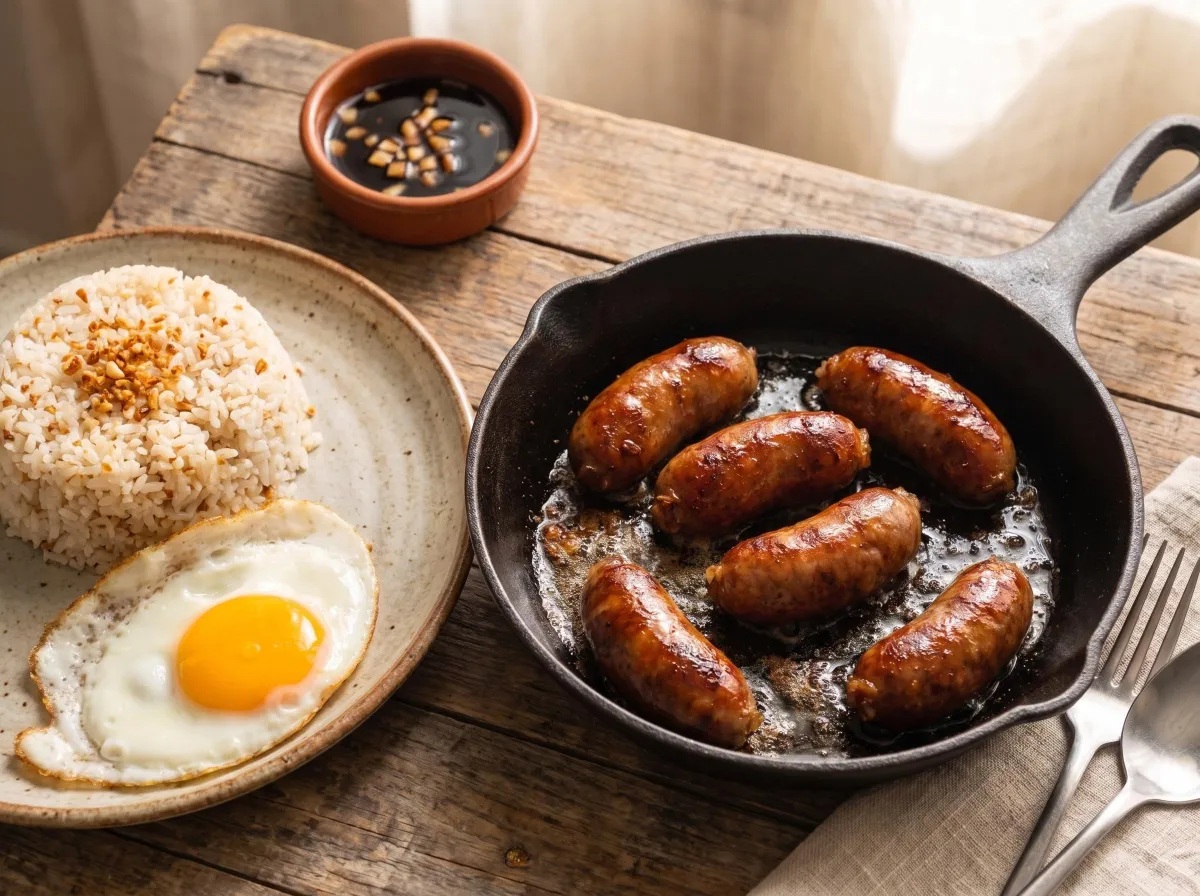
What unites each version, no matter how differently it is seasoned, is its role at the table. Longganisa is, first and foremost, a breakfast sausage usually — fried in its own rendered fat until the outside turns dark gold, then plated next to sinangag (garlic fried rice) and itlog (a fried egg). Put those three together, and you get one of the most beloved combinations in Filipino food: longsilog — long ganisa, si nangag, and it log .
It is worth pausing on that name, because it causes real confusion. Longsilog is not a dish on its own — it is the plate. Longganisa is the sausage on that plate. They are related, but they are not the same thing, the same way "burger" and "combo meal" are related without being interchangeable.
📜 The Story Behind It
Longganisa's history is a genuinely good detective story, because it starts thousands of thousands and centuries away from the Philippines.
The word longganisa comes from the Spanish longaniza , a cured sausage still eaten across Spain and Latin America today. But longaniza itself is older than Spain's colonial reach — food historians trace the word back to lucanica , a spiced sausage from the ancient region of Lucania in southern Italy. Roman soldiers are believed to have carried lucanica-style sausages across the empire, the recipe traveling into Spain long before Spain ever set foot in Asia. From there, the sausage crossed the Pacific with Spanish traders and colonizers, arriving in the Philippines starting around the 1500s, brought over by traders traveling from the Americas as part of the same colonial exchange that introduced hogs and pork-heavy cooking to the islands.
That is where the story stops being a Spanish story and starts becoming a Filipino one.
Once longaniza landed in the Philippines, it did not stay Spanish for long. Local cooks adapted the recipe using what they had — native garlic, sugarcane vinegar, achuete for color, and whatever regional spice combinations their own province favored. Over the following centuries, with the Philippines' 144-plus ethno-linguistic groups each putting their own signature on the sausage, longganisa splintered into what food writers now describe as hundreds of distinct regional variants — some built around sugar, some around garlic, some smoked, some sun-dried, some studded with local herbs found nowhere else.
That transformation is the whole point. Longganisa did not just survive being imported — it was completely re-authored by the country it landed in. What started as a Roman-Italian sausage recipe carried through Spain became, in the Philippines, a breakfast tradition so localized that people can often name the exact town a longganisa came from just by tasting it.
Today, that regional pride is celebrated out loud. Vigan hosts its own Longganisa Festival every January, and towns like Cabanatuan and Alaminos run their own longganisa festivals and cook-offs, complete with parades, record-breaking sausage lengths, and fierce, good-natured bragging rights.
🗺️ Two Famous Hometowns: Vigan vs. Lucban
If longganisa has a rivalry, it is this one — and it is a friendly rivalry that Filipino breakfast tables have been having for generations.
Vigan longganisa , from the historic city of Vigan in Ilocos Sur, is a recado sausage built almost entirely around garlic. It is made from coarsely ground pork, colored with achuete for its signature yellow-orange hue, and seasoned heavily with garlic, black pepper, salt, and Ilocos sugarcane vinegar ( sukang Iloko ). The result is bite-sized, chunky, salty, garlicky, and distinctly sour — a sausage built to be eaten quickly, in multiples, with rice that can soak up everything left in the bread.
Lucban longganisa , from the town of Lucban in Quezon province, is also a recado , but it takes a very different road to get there. Lucban's version leans on Mediterranean-influenced spices — oregano and paprika in particular — layered over the same garlic-and-vinegar backbone, giving it a more herbal, aromatic profile with a slightly sour kick. It is traditionally paired with pancit habhab , a noodle dish from the same town, eaten straight off a banana leaf without utensils.
Put simply: Vigan longganisa hits you first with garlic and tang. Lucban longganisa hits you first with garlic and oregano. Both are savory. Neither is sweet. And Filipinos from each town will tell you, warmly but firmly, that theirs is the one worth flying home for.
They are far from the only two hometowns worth knowing, though. Here is a quick regional passport:
🧄 Pampanga longganisa — the most commercially famous variety, sweet-leaning ( hamonado ), from the province often called the Philippines' culinary capital
🍬 Cebu longganisa (Chorizo de Cebu) — small, round, distinctly sweet and slightly spiced, with a bright red color from achuete
🧅 Calumpit longganisa (Bulacan) — long, lean, garlicky, with a firmer texture and less fat than most
🌿 Alaminos longganisa (Pangasinan) — small links separated by coconut-leaf midribs instead of string, mild and slightly sour, a popular Pasalubong
🧄 Tuguegarao / Ybanag longganisa (Cagayan Valley) — intensely garlicky, salty, and traditionally made without preservatives
🥩 Cabanatuan longganisa / batutay (Nueva Ecija) — one of the few made with beef instead of pork, garlicky and tangy
🩸 Pinuneg (Cordillera) — a blood sausage made with pig's blood, fat, and aromatics, traditionally prepared during ceremonial pig sacrifices
No single list can cover every version — that is really the whole point of longganisa. It was never meant to be standardized. It was meant to belong to wherever it was made.
👅 What Does Longganisa Taste Like?
Longganisa tastes like whichever spice cabinet raised it — but a few things hold true across almost every version.
There is always garlic, usually a lot of it, cooked down until it turns sweet and slightly nutty in the rendered fat. There is always some acidity, whether from cane vinegar or calamansi, cutting through the richness of the pork. And there is always fat — good fat, the kind that turns the outside of the sausage dark gold and a little crisp while the inside stays juicy.
From there, the two families split completely. A de recado longganisa like Vigan's hits salty and sour first, garlic loud and up front, with barely any sweetness at all. A hamonado longganisa like Pampanga's or Cebu's goes the opposite direction — the sugar in the mix caramelizes as it fries, creating a sticky, almost candied glaze that makes the sausage taste closer to a savory-sweet treat than a straightforward breakfast meat.
If I had to describe it simply:
Longganisa tastes like garlic, vinegar, and pork fat arguing — and somehow winning together.
It is bold in a way that is meant to stand up to a mountain of garlic rice and a runny fried egg. It is not a background flavor. It is the flavor the rest of the plate is built around.
🗣️ Learn the Tagalog
Longganisa vocabulary is really breakfast-table vocabulary — the words families use every single morning, often without even noticing how much culture is packed into them.
The dish and the plate:
Longganisa (long-gah-NEE-sah) — the sausage itself
Longsilog (long-SEE-log) — the full breakfast plate: longganisa, sinangag, and itlog
Sinangag (see-NAH-ngag) — garlic fried rice
Itlog (EET-lohg) — egg
Prito (PREE-toh) — fried
De recado or hamonado:
Matamis (mah-TAH-mees) — sweet, describing hamonado-style longganisa
Maalat (mah-AH-laht) —salty
Maasim (mah-AH-seem) — sour, a key note in de recado varieties
Mabawang (mah-BAH-wahng) — garlicky
At the table:
Ilagay mo sa kawali (ee-LAH-guy moh sah kah-WAH-lee) — put it in the pan
Prituhin mo hanggang mag-golden brown (pree-too-HEEN moh hahng-GAHNG mag-golden brown) — fry it until golden brown
Anong klaseng longganisa 'to? (ah-NONG klah-SENG long-gah-NEE-sah toh) — what kind of longganisa is this?
Taga-Vigan ba 'to or taga-Lucban? (tah-gah VEE-gahn bah toh oh tah-gah LOOK-bahn) — is this one from Vigan or from Lucban?
Sarap! Kailangan ko pa ng kanin (sah-RAHP! kai-LAH-ngahn koh pah nang kah-NEEN) — so good! I need more rice
These are not just cooking instructions. Taga-Vigan ba 'to or taga-Lucban? is a question that has started genuinely passionate breakfast debates in Filipino households for generations — because for a lot of families, the answer says something about where they are from.
🎮 Play: What Kind of Longganisa Are You?
Before we get to the coloring pages, we built something a little different for this one.
Longganisa's biggest personality trait is regional pride — the fact that a sausage from Vigan and a sausage from Lucban can taste completely different and both are "the right one." So we turned that into a short, playful Tagalog word-and-flavor game: pick your favorite breakfast habits, and find out which regional longganisa style matches your personality — garlicky and bold like Vigan, herbal and aromatic like Lucban, or sweet and caramelized like Pampanga.
Once you get your result, scroll back up and tell us in the comments whether it matches the longganisa you actually grew up eating — a lot of readers are surprised.
🎨 Color It!
Bring Filipino food to life in a whole new way — through art.
Our Filipino Food Coloring Book on Amazon was built from exactly that idea. Every page is a dish with a story. Every coloring session is an invitation to remember.
That makes it especially meaningful for:
🌼 Families who want a calm, shared activity that naturally opens a real conversation
🌼 Parents and grandparents introducing Filipino heritage to the next generation
🌼 Adults and seniors who find nostalgia, mindful creativity deeply satisfying
🌼 Anyone in the Filipino diaspora craving a quiet, colorful way to hold onto home
🌼 Teachers, homeschoolers, and community groups exploring multicultural learning through art
If you would like to explore Filipino food through art, memory, and family connection, download our FREE Filipino Food Coloring pages — they are waiting for you now.
👉 What Filipino Food Are You? Take the quiz →
👉 Get your FREE Filipino coloring pages here.
🤩 Fun Facts About Longganisa
1. Its family tree runs through ancient Rome. The word longganisa traces back through Spanish longaniza to lucanica , a spiced sausage from the Lucania region of southern Italy, believed to have spread across the Roman Empire through military supply routes centuries before it ever reached Spain—let alone the Philippines.
2. It arrived with the pigs. Longaniza is generally understood to have reached the Philippines starting around the 1500s, carried by Spanish traders traveling from the Americas — arriving alongside the same colonial trade routes that introduced widespread pork consumption to the islands.
3. There is no single "correct" longganisa. With over 144 ethno-linguistic groups across the Philippine archipelago, food historians describe longganisa as having hundreds of regional variants — from Aparri in the north to Jolo in the south — each shaped by local spices, sugar availability, and curing traditions.
4. It splits into exactly two philosophical camps. Almost every regional variety can be sorted into de recado (savory, garlicky, little to no sugar) or hamonado (sweet, sugar-forward) — a fundamental divide that Filipino cooks use the terms the way other cuisines might use "spicy" versus "mild."
5. Not every longganisa needs a casing. Homemade versions are often made "skinless" — rolled by hand into small logs without any casing at all, known as longganisang hubad , making the sausage closer to a seasoned patty than a traditional link.
6. Some varieties skip pork entirely. Unlike the Spanish sausages it descended from, Filipino longganisa is also made with chicken, beef, and even tuna in certain regions — a flexibility that has helped it adapt to different local economies and available meats.
7. Alaminos longganisa has a built-in ID card. Longganisa from Alaminos, Pangasinan is divided into segments not with string, but with small pieces of coconut leaf midrib — a detail unique enough that it is often the fastest way to identify the variety at a glance.
8. Vigan holds a current festival in his honor. Vigan City in Ilocos Sur hosts an annual Longganisa Festival every January, celebrating the town's famously garlicky sausage with cooking competitions, parades, and, unsurprisingly, a great deal of eating.
9. Cabanatuan once cooked a 3.3-kilometer longganisa. During its 2005 Longganisa Festival, the city of Cabanatuan prepared a continuous 3.3-kilometer string of longganisa, grilled by ten meat vendors over three hours, using roughly 2,560 kilograms of meat — deliberately surpassing an earlier 2.2-kilometer record set by the city of Laoag in 2001.
10. "Longsilog" is a plate, not a sausage. One of the most common mix-ups: longganisa is the sausage, but longsilog is the full breakfast combo of longganisa, sinangag (garlic fried rice), and itlog (fried egg) served together — the sausage is only one-third of the name.
11. Its color usually comes from a seed, not a dye. The reddish-orange or golden-yellow hue seen in varieties like Vigan and Alaminos longganisa most often comes from achuete (annatto seeds), a natural coloring and flavoring agent used across Filipino cooking, not artificial dye.
12. It has its own charcuterie board moment. Food writers and stylists have started arranging Vigan, Alaminos, and Cebu longganisa together on shared platters as a distinctly Filipino take on the charcuterie board — regional variety, presented side by side, meant for comparing and discussing over.
🌍 How Longganisa Connects Filipinos Everywhere
Longganisa travels in a very particular way — not because it is easy to transport, but because it is easy to recognize, no matter how far from home it is cooked.
Some Filipino dishes carry culture through complexity — layers, ceremony, a long list of ingredients that has to be exactly right. Longganisa carries culture through repetition. It shows up every single morning in millions of Filipino households, in the Philippines and across the diaspora, which means it has had more chances than almost any other dish to become a genuine daily ritual rather than an occasional celebration food.
For the estimated millions of Filipinos living outside the Philippines, longganisa is often one of the first things people look for at a Filipino grocery store abroad — frozen in labeled bags, sorted by region, sold specifically because buyers know exactly what they are looking for. A Vigan expat in Toronto and a Lucban expat in the same city might walk past each other in that freezer aisle reaching for two completely different bags, both equally certain they are choosing the "real" one.
That regional specificity is actually the diaspora connection. Longganisa does not offer one generic taste of the Philippines — it offers a very particular taste of one particular hometown, which means the sausage someone chooses to cook is often, quietly, also a small act of remembering exactly where their family comes from.
And every single time, the ritual is the same: the bread heats up, the garlic starts to smell like morning, and somewhere in the kitchen, someone is already asking whether the rice is ready yet.
❓ FAQ — Everything You Need to Know About Longganisa
What is longganisa? Longganisa is a Filipino sausage, typically made from coarsely ground pork, garlic, salt, vinegar, and regional spices, either stuffed into a casing or shaped by hand without one. According to Wikipedia, it descends from the Spanish longaniza and falls broadly into two styles — savory de recado and sweet hamonado — with hundreds of local variants across the Philippines.
What is the difference between longganisa and longsilog? Longganisa is the sausage itself. Longsilog is the full breakfast plate that includes longganisa alongside sinangag (garlic fried rice) and itlog (a fried egg). The two terms are related but not interchangeable — longganisa is one part of what makes up longsilog.
What is the difference between Vigan and Lucban longganisa? Both are de recado (savory, garlicky) styles, but Vigan longganisa from Ilocos Sur leans heavily on garlic, black pepper, and cane vinegar for a salty-sour bite, while Lucban longganisa from Quezon province adds Mediterranean-style spices like oregano and paprika for a more herbal, aromatic profile.
Is longganisa sweet or savory? It can be either, depending on the region. Hamonado varieties, like those from Pampanga and Cebu, are sweet and sugar-forward, developing a caramelized glaze when fried. De recado varieties, like those from Vigan, Lucban, and Tuguegarao, are savory and garlicky with little to no sugar.
Where did longganisa come from? Longganisa traces back to the Spanish longaniza , which itself is believed to descend from lucanica , an ancient sausage from the Lucania region of southern Italy. Spanish traders introduced the sausage tradition to the Philippines starting around the 1500s, and Filipino cooks adapted it over centuries into today's many regional varieties.
What is longganisa made of? Most longganisa is made from ground pork and pork fat, seasoned with garlic, salt, black pepper, sugar, and vinegar, with regional additions like achuete (annatto) for color or oregano and paprika for aroma. Some regional versions use chicken, beef, or tuna instead of pork.
How is longganisa traditionally served? Longganisa is most commonly served for breakfast, pan-fried in its own rendered fat until golden brown, and plated with garlic fried rice and a fried egg as part of a longsilog meal. Vinegar or a garlic-vinegar dipping sauce is a common accompaniment, especially with savory de recado varieties.
Can you make longganisa at home? Yes. Longganisa is very achievable at home, with ground pork, garlic, vinegar, sugar, and spices as the core ingredients. Many home cooks skip the casing entirely and make "skinless" longganisa, rolling the seasoned meat into small logs with parchment or plastic wrap before freezing and frying.
Is longganisa the same as chorizo? They are closely related but not identical. Longganisa is generally a fresh sausage, seasoned with garlic or sugar depending on the style, while Spanish-style chorizo is typically a cured sausage defined by smoked paprika. In some Philippine regions, particularly the Visayas, longganisa is even called "chorizo" or "tsoriso" locally, which adds to the overlap.
💛 Closing
Longganisa is more than a breakfast sausage. It is a small, edible map of the Philippines — a dish that changed its recipe every time it crossed into a new province, absorbing whatever spices, sugar, and pride that province had to offer.
It started as a sausage recipe carried across an empire and an ocean, and it became something that now belongs, distinctly, to Vigan, to Lucban, to Pampanga, to Cebu, and to dozens of towns in between — each one certain theirs is the one worth waking up early for.
At Studio Tributes, we celebrate Filipino culture through food, art, and the stories that travel with both. Whether Vigan garlic or Lucban oregano is the flavor that says "home" to you, we hope this gave you a warmer, more colorful way to connect with one of the Philippines' most everyday, most beloved classics.
Keep exploring Filipino food and culture with us:
🎨 Get our Filipino Food Activity Book on Amazon 📚 Read more Filipino food stories on our blog
💭 A Memory to Hold Onto
Did longganisa bring back a specific breakfast for you?
Maybe the smell that woke you up before your alarm ever did. Maybe a specific brand or town your family swear by. Maybe the ongoing, half-serious debate over sweet versus garlicky.
Was your family's longganisa sweet, or garlicky? Do you know which town or region it came from? What memory comes back when you picture that first sizzle in the bread?
If a memory came to mind, share your longganisa story on Facebook or Instagram and tag @StudioTributes so we can celebrate it with you. And if you'd like more warm Filipino food stories, cultural memories, and creative inspiration, come spend time with us on social media.
Read Next
📚 References & Further Reading
Wikipedia — Longaniza — Primary reference for longganisa's etymology, de recado/hamonado classification, ingredient list, and regional variants. Cited throughout this article.
Wikipedia — Lucban Longganisa — Reference for Lucban longganisa's specific ingredients and oregano-forward seasoning.
Wikipedia — Alaminos Longganisa — Reference for Alaminos longganisa's coconut-midrib segmenting and ingredient profile.
Wikipedia — Cabanatuan Longganisa — Source for the Cabanatuan Longganisa Festival's 3.3-kilometer sausage record.
Rappler — Love Longganisa? Here Are the Various Kinds From Different Regions — Regional overview of Vigan, Lucban, Alaminos, Tuguegarao, Cavite, Cabanatuan, and Cebu longganisa varieties.
Ang Sarap — The 11 Varieties of the Filipino Longganisa — Supporting detail on regional flavor profiles and de recado/hamonado classification.
Inquirer USA — Different Types of Longganisa and Where to Find Them — Supporting detail on Alaminos and Lucban longganisa characteristics.
If This Story Resonates
If longganisa reminds you of someone — or somewhere — you're not alone.
Filipino Fast Food Chain and Comfort Food Favorites includes:
80 thoughtfully designed pages
Bilingual dish names (English + Tagalog)
Easy coloring for all ages
This article blends Studio Tributes storytelling with cultural and culinary research to create a warm, family-friendly learning experience.