
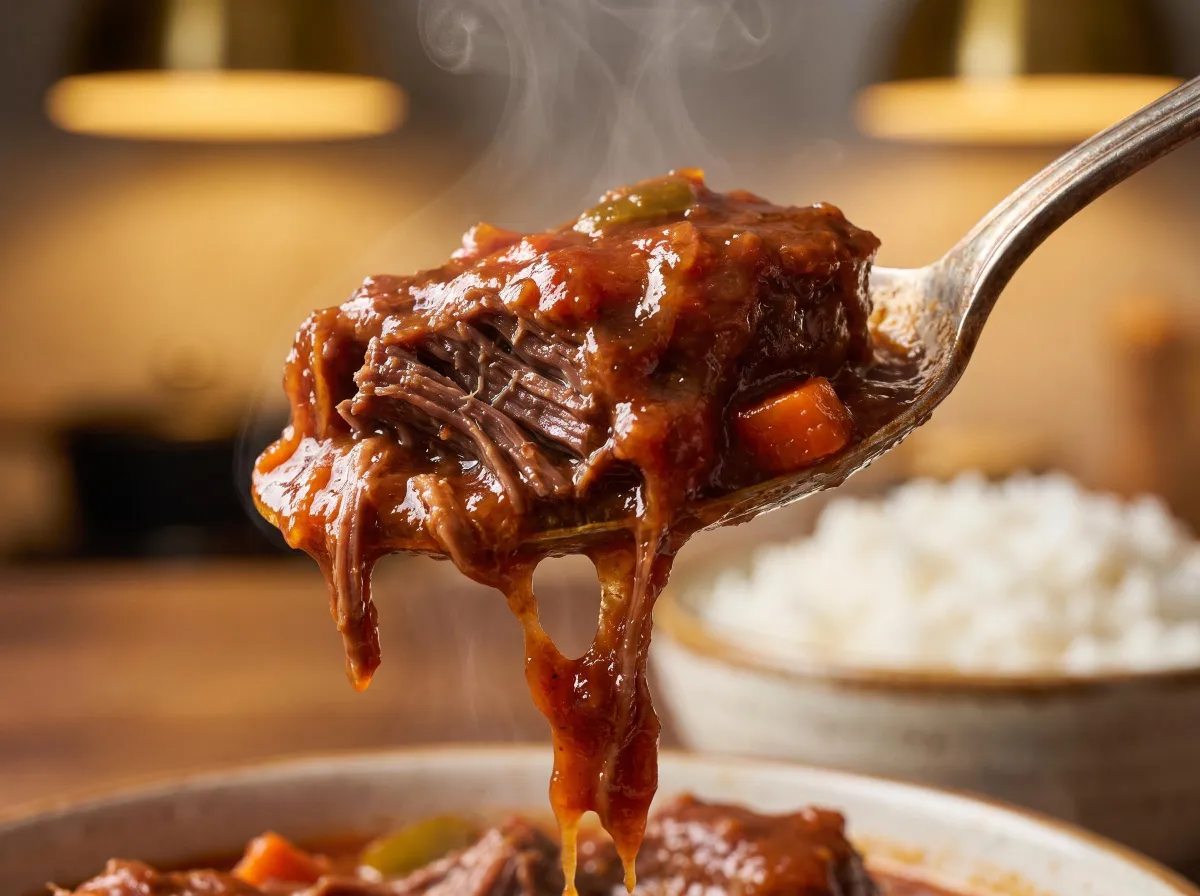
What Is Mechado? The Filipino Beef Tomato Stew
What Is Mechado? The Filipino Beef Tomato Stew
Studio Tributes / Filipino Food / What Is Mechado?
You smell it from the hallway before you even get to the kitchen door.
Tomato, garlic, soy sauce, and something faintly sweet all folded into one another, simmering low on the back burner for what sounds like it has been hours already. Somewhere under the lid, chunks of beef are going soft in a sauce the color of brick, sharing the pot with potatoes that have gone slightly orange from soaking up all that flavor and carrots that are just barely holding their shape. Nobody is rushing this. The stove is on low. Someone — a mother, a lola, a tita who "just knows" — checks it every twenty minutes, not because it needs help, but because it is close, and close deserves attention.
🍲 Before we go any further — we made something for you.
That pot is mechado, and if you grew up in a Filipino household, there is a very good chance this exact scene has played out in your own kitchen — probably on a Sunday, probably for a birthday, probably with rice already steaming on the side before the stew is even done.
Mechado is a Filipino beef stew braised low and slow in a rich tomato-based sauce with soy sauce, calamansi or vinegar for tang, and usually potatoes and carrots simmered right along with the meat until everything is tender. According to Wikipedia, mechado is a Filipino stew traditionally made by inserting strips of pork fat into a cut of beef to lard it — a technique that also gave the dish its name. Today, most home cooks skip the larding and simply simmer beef chunks in the same tomato-soy-calamansi sauce until they are fork-tender, but the flavor profile that made mechado famous has never changed.
At Studio Tributes, we tell the stories behind Filipino food because every dish carries a piece of Filipino history inside it, whether or not the person eating it knows that history is there. Mechado carries a big one: three hundred years of Spanish colonial rule, quietly folded into a pot of beef and tomatoes, sitting on tables across the Philippines almost every single week. Today we're getting into all of it — what mechado actually is, where the name comes from, how it differs from its tomato-based cousins, and why this stew has earned a permanent seat at the Filipino "big four."
🍅 What Is Mechado?
Let's start with the basics, because mechado is simple to describe and a little more complicated to actually understand — in a good way.
Mechado is a Filipino beef stew, sometimes made with pork, braised in a tomato-based sauce built on soy sauce and calamansi (or vinegar), then simmered low and slow with potatoes and carrots until the meat is tender enough to shred with a spoon. It sits in the same family as menudo, afritada, and kaldereta — the group of Filipino tomato-sauce stews that Filipino home cooks affectionately joke about mixing up at family parties — but mechado has its own specific identity, built around three things: the cut of beef, the tang of the sauce, and a piece of cooking history hiding in its name.
According to Wikipedia, mechado was traditionally prepared by inserting strips of pork fatback into a cut of beef in a technique called larding, then braising the whole thing in soy sauce, calamansi, and a tomato-based sauce until tender. The dish was originally shaped like a sliced roll — closer in form to morcón, the Filipino stuffed beef roulade — with the "wick" of fat running through the center of the meat, giving the finished slices a marbled cross-section that looked as good as it tasted.
Modern mechado, the version most Filipino households actually cook today, is more straightforward. Beef chunks — chuck, brisket, short rib, or another well-marbled cut — are browned, then simmered in a sauce built from tomato sauce or tomato paste, soy sauce, calamansi juice or vinegar, garlic, onion, and bay leaf. Potatoes and carrots go in partway through cooking so they soften without turning to mush. The whole pot cooks low and slow — sometimes for over an hour — until the beef reaches that specific tenderness Filipino cooks call "kinakain ng dila," or "eaten by the tongue": so soft you barely need to chew.
The core mechado lineup looks like this:
🥩 Beef (or pork) — traditionally larded with pork fat; modern versions use well-marbled cuts like chuck or brisket simmered until tender
🍅 Tomato sauce or tomato paste — the base of the braise, giving mechado its signature brick-red color
🥢 Soy sauce — for salt, umami, and that deep savory backbone shared with adobo
🍋 Calamansi or vinegar — for the tang that cuts through the richness of the sauce
🥔🥕 Potatoes and carrots — added partway through cooking, soaking up the sauce as they soften
🧄🧅 Garlic, onion, and bay leaf — the aromatic foundation sautéed before the braise even begins
You eat mechado with rice — always with rice — and the test of a good pot is simple: the sauce should be thick enough to cling to a spoonful of rice, and the beef should give way with almost no resistance at all.
📜 The Story Behind It
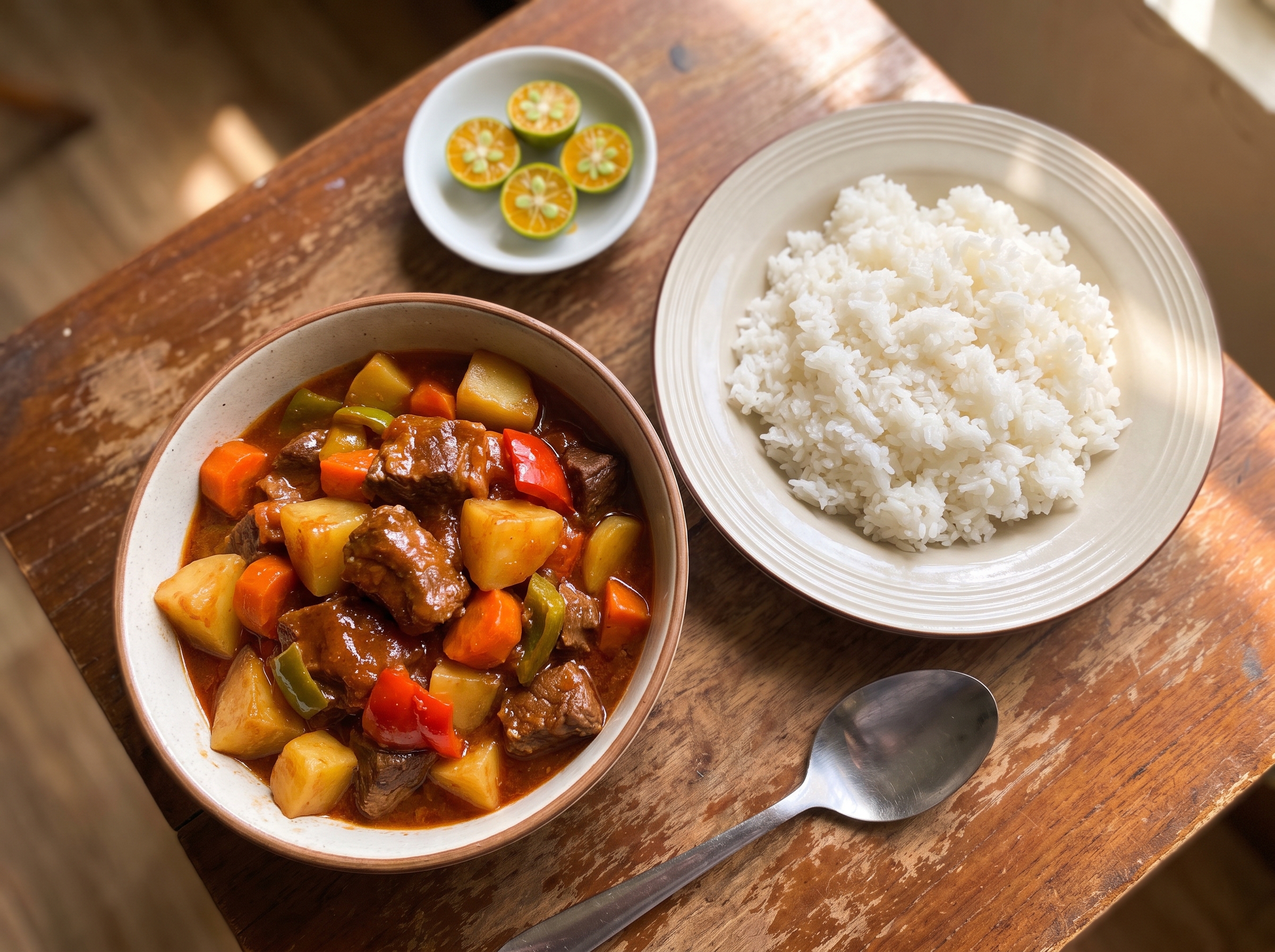
Mechado's story is, in many ways, the story of the Philippines itself: something foreign arrives, gets reshaped by Filipino hands and Filipino pantries, and comes out the other side as something distinctly its own.
The dish traces back to Spain's roughly 300-year colonial presence in the Philippines, from the 16th century until 1898. During that period, Spanish cooking techniques and ingredients moved into Filipino kitchens and mixed with what was already there, producing the tomato-based stews that now sit at the center of Filipino home cooking — mechado among the very first.
The name itself tells the origin story directly. According to Wikipedia, "mechado" comes from the Spanish words mecha or mechar, meaning "wick" or "to lard," referring to the traditional technique of threading strips of pork fatback through lean beef — the same way a candle is threaded with a wick. Spanish cooks used larding to solve a real problem: tougher, leaner cuts of beef needed help staying moist and flavorful through a long braise, and a strip of fat running through the center did exactly that as it slowly rendered during cooking.
Filipino cooks adopted the larding technique, but they didn't just copy the recipe wholesale — they adapted it with what was already in the local pantry. Spanish cooking traditionally leaned on ingredients like wine and olive oil for acidity and richness, but Filipino cooks swapped in calamansi, the small native citrus fruit, for the tang, and soy sauce — an ingredient that arrived in the Philippines through trade with China long before Spanish colonization — for the umami-forward salt. Tomatoes, introduced to the Philippines by the Spanish, became the base of the sauce. The result was something that looked Spanish in structure but tasted unmistakably Filipino: soy sauce, calamansi, and tomato, three ingredients from three different corners of the world, meeting inside one pot.
Over time, as home cooking in the Philippines modernized and pork fat became something people wanted to cook with less of rather than more, the actual larding step started to disappear from most kitchens. The "mecha" — the wick of fat that gave the dish its name — quietly dropped out of the recipe while the name stayed exactly the same. What remains today is the flavor profile that made mechado worth doing in the first place: the tomato-soy-calamansi braise, the slow simmer, the fall-apart beef. It's a small, quiet irony that a dish named for a technique now mostly cooked without that technique — but that's true of plenty of heritage recipes that evolve while keeping their name as a signpost pointing back to where they came from.
Mechado earned its place at Filipino family tables specifically because it photographs well on a special occasion and tastes even better than it looks. It shows up at birthdays, fiestas, Sunday lunches, and holiday spreads across the country, usually served in a large communal pot or platter meant for the whole table to share. It has never really left. Every generation of Filipino home cooks has their own version — a little more vinegar here, a little more sugar there, maybe bell peppers added by a household that likes to blur the line between mechado and its cousin kaldereta — but the bones of the dish, the tomato and soy and calamansi and the long slow simmer, have carried through for generations largely untouched.
👅 What Does Mechado Taste Like?
If you have never had mechado, here is the shortest possible description: it tastes like the version of tomato sauce that grew up eating rice.
The base flavor is savory-sweet-tangy, all three working at once. The tomato sauce provides a gentle sweetness and a bright acidity of its own. Soy sauce lays down a deep, salty umami note that ties the whole dish to the broader Filipino pantry — the same base note you'll recognize from adobo, from menudo, from a dozen other Filipino stews built on soy sauce as a foundation. Calamansi or vinegar adds a citrusy tang that keeps the sauce from tasting flat or heavy, cutting through the richness of the beef fat exactly the way it's supposed to.
The texture is where mechado really earns its reputation. Done properly, the beef falls apart with almost no resistance — that low, slow braise breaks down the connective tissue in tougher cuts until the meat practically dissolves against a fork. The potatoes, added partway through, soften into something almost custardy, having spent an hour or more soaking up the sauce around them. The carrots hold just enough of their shape to still have a bite, offering a small textural break from all that softness elsewhere in the bowl.
The sauce itself should be thick — not soupy, not a thin broth, but a clinging, glossy sauce with body, the kind that coats a spoonful of rice rather than running off it. A well-made mechado sauce is almost as important as the beef itself, because that sauce is what actually ends up on the rice, and rice-and-sauce is where most Filipinos will tell you the real magic of the dish happens.
If I had to describe it simply:
Mechado tastes like a slow Sunday afternoon — savory, a little sweet, a little tangy, and rich enough that one bowl with rice counts as a full meal.
🍳 How Mechado Comes Together
Mechado isn't a fast dish, and that's kind of the point. Here's the general shape of how it's built, whether in a home kitchen in Manila or in a Filipino household anywhere else in the world.
Step 1 — Marinate (optional but common). Beef chunks are sometimes marinated briefly in soy sauce and calamansi before cooking even begins, giving the meat a head start on flavor before it ever touches the pan.
Step 2 — Sear. The beef is browned in a hot pan first. This isn't just for color — searing builds a layer of caramelized flavor on the surface of the meat that carries through the entire braise.
Step 3 — Sauté the aromatics. Garlic and onion go in next, cooked until fragrant, forming the base that the rest of the sauce builds on top of.
Step 4 — Build the braise. Tomato sauce, more soy sauce, and water or broth go into the pot, along with a bay leaf. The beef goes back in, and the whole thing is brought to a simmer.
Step 5 — Low and slow. The pot goes down to low heat and stays there — often 45 minutes to over an hour, sometimes longer for tougher cuts — until the beef is genuinely tender, not just cooked through.
Step 6 — Add the vegetables. Potatoes and carrots go in during the last 15 to 20 minutes of cooking, timed so they finish soft but intact, not falling apart into the sauce.
Step 7 — Rest, if you can stand to wait. Like a lot of braised dishes, mechado is often even better the next day, once the flavors have had a full day to settle into the meat and the sauce has thickened further sitting in the fridge overnight.
There's a reason mechado shows up more often on weekends than weeknights: this is a dish that rewards patience, and most people don't have an hour and a half to spare on a Tuesday.
🆚 Mechado vs. Menudo vs. Afritada vs. Kaldereta
This is the question that follows mechado everywhere it goes, because Filipino food culture has a running joke about how similar these four tomato-based stews look on a buffet table — and how differently they actually taste once you dig in. Here's the breakdown.
Mechado uses beef (sometimes pork), simmered in a tomato sauce built with soy sauce and calamansi or vinegar, alongside potatoes and carrots. The sauce tends to be thick and glossy, and the flavor leans savory-tangy rather than sweet. The name comes from the Spanish mecha — "wick" — referring to the traditional larding technique.
Menudo uses pork, typically diced small, along with chopped pork or beef liver, potatoes, and often garbanzo beans (chickpeas) or raisins depending on the household. The flavor is more sweet-savory than mechado, and the liver gives it a distinct richness mechado doesn't have.
Afritada typically uses chicken or pork in a milder, thinner tomato sauce, with potatoes, carrots, and bell peppers. It skips the soy sauce and vinegar that give mechado its tang, landing as the simplest and mildest of the four.
Kaldereta (or caldereta) traditionally uses goat, though beef is a common substitute, simmered in a bold tomato sauce with liver spread, bell peppers, potatoes, carrots, and sometimes green olives. According to GMA News Online, mechado is built from beef or pork in a tomato sauce with vinegar and soy sauce, while caldereta features beef in a tomato sauce with liver spread added in. Kaldereta is the boldest and spiciest of the group — some versions use chili peppers directly — and the liver spread gives its sauce a thicker, creamier body than mechado's.
So — what is the actual difference between mechado and caldereta, the single most-asked version of this question? The short answer: liver spread and bell peppers. Caldereta almost always includes liver spread stirred into the sauce, which thickens it further and adds a mineral richness mechado doesn't have, plus bell peppers for color and a slight bitterness. Caldereta also tends to run spicier and bolder overall, often reserved for bigger, more festive occasions, while mechado stays a little more everyday-comforting — the stew you make on a normal Sunday rather than the one you pull out for a fiesta centerpiece. If your stew has liver spread and bell peppers in the sauce, you're most likely looking at kaldereta. If it's just tomato, soy sauce, and calamansi with potatoes and carrots, that's mechado.
A quick cheat sheet if you're staring at a buffet table trying to figure out what's in front of you:
🥩 Mechado — beef, tomato-soy-calamansi sauce, potatoes, carrots, no liver spread
🍖 Menudo — pork, liver, potatoes, sometimes garbanzo beans or raisins, sweeter profile
🐔 Afritada — chicken or pork, milder thin tomato sauce, potatoes, carrots, bell peppers
🐐 Kaldereta — beef or goat, liver spread, bell peppers, bolder and spicier, often for special occasions
🗺️ Mechado Across the Philippines
Mechado is genuinely a nationwide dish, but like most Filipino comfort food, it picks up small regional habits depending on where it's cooked.
Metro Manila and Luzon households tend to cook the most "classic" version — beef, potatoes, carrots, a tomato-soy-calamansi sauce, kept relatively simple and consistent from household to household, the version most cookbooks and food blogs describe as the standard.
Kapampangan kitchens, from a region famous across the Philippines for its refined home cooking, sometimes push mechado toward a slightly richer, more layered sauce, treating it with the same care given to other celebratory Kapampangan stews.
Visayan and Mindanao households occasionally blur the line between mechado and its cousins, adding bell peppers or a touch more sugar, landing somewhere between a classic mechado and a milder kaldereta depending on the family recipe passed down.
Filipino catering and party menus across the country lean on mechado specifically because it holds up well in large batches, reheats beautifully, and looks impressive in a chafing dish — a big pot of glossy, brick-red beef stew is an easy crowd-pleaser at a debut, wedding, or reunion.
And like most of the "big four" stews, mechado has followed Filipino families into the diaspora. Filipino households in the United States, Canada, the Middle East, Australia, and the UK cook it regularly, often adjusting for whatever cut of beef is easiest to find locally and whatever tomato product is on the shelf — canned tomato sauce, tomato paste diluted with water, even ketchup in a pinch, in households far from a Filipino grocery store.
🗣️ Learn the Tagalog
Mechado comes with its own small vocabulary — the words of the pot, the pantry, and the Sunday table.
The dish and its family:
Mechado (meh-CHA-do) — the beef and tomato stew itself; from the Spanish mecha, "wick"
Mitsado (meet-SA-do) — a common Filipino spelling/pronunciation variant of mechado
Menudo (meh-NOO-do) — the pork and liver stew often confused with mechado
Afritada (ah-free-TA-da) — the milder chicken or pork tomato stew
Kaldereta (kal-deh-REH-ta) — the bolder beef or goat stew with liver spread
Ulam (oo-LAHM) — the main savory dish eaten with rice; the category mechado belongs to
The ingredients and technique:
Baka (bah-KAH) — beef
Kalamansi (kah-lah-MAHN-see) — the small native citrus used for tang
Toyo (TOH-yoh) — soy sauce
Suka (SOO-kah) — vinegar
Patatas (pah-TAH-tas) — potatoes
Karot (KAH-rot) — carrots
Bawang (BAH-wahng) — garlic
Sibuyas (see-boo-YAHS) — onion
Mecha (MEH-cha) — the Spanish/Filipino term for the strip of pork fat used in traditional larding
Lutong bahay (LOO-tong BAH-hai) — home cooking; the category mechado firmly belongs to, as opposed to restaurant food
At the table:
Kain na! (kah-IN nah) — Let's eat!
Sarap! (sah-RAHP) — Delicious!
Malambot ang karne (mah-LAHM-bot ahng KAR-neh) — The meat is tender
May ulam na (my OO-lam nah) — There's already a viand/main dish (a common phrase when someone asks what's for dinner)
Extra rice, please — a phrase that needs no translation at a table with mechado sauce still left in the pot
🎨 Color It!
Bring Filipino food to life in a whole new way — through art.
Our Filipino Food Coloring Book on Amazon was built from exactly that kind of question. Every page is a dish with a story. Every coloring session is an invitation to remember.
That makes it especially meaningful for:
🌼 Families who want a creative activity that naturally opens a conversation about Filipino food heritage
🌼 Filipino parents and grandparents sharing their regional food traditions with the next generation
🌼 Adults and seniors who find nostalgic, mindful creativity deeply satisfying
🌼 Anyone in the Filipino diaspora who wants a quiet, beautiful way to hold onto what home tastes like
🌼 Teachers, homeschoolers, and community groups exploring Filipino food and culture through art
👉 Get your FREE Filipino Coloring pages here.
👉 Which Filipino "Big Four" Stew Are You? Take the quiz →
🤩 Fun Facts About Mechado
1. The name literally means "larded" or "wicked" — as in, fitted with a wick. According to Wikipedia, "mechado" comes from the Spanish mecha or mechar, meaning "wick" or "to lard," referring to the technique of threading pork fat through beef before braising it.
2. Traditional mechado was shaped like a roll, not loose chunks. The original preparation involved a larger cut of larded beef, sliced into rounds after cooking — closer in appearance to morcón, the Filipino stuffed beef roulade, than to the chunky stew most people picture today.
3. Most modern mechado skips the larding entirely. As home cooking modernized and pork fat fell out of everyday use, the actual "mecha" — the wick of fat that gave the dish its name — quietly disappeared from most recipes, even as the name stayed exactly the same.
4. Mechado is one of Filipino food's "big four" tomato stews. Alongside menudo, afritada, and kaldereta, mechado belongs to a well-known family of Spanish-influenced Filipino stews that Filipino families jokingly admit they sometimes mix up at parties — despite each having a clearly different flavor and ingredient list once you look closely.
5. Calamansi is doing more work in this dish than people realize. The small citrus fruit isn't just a garnish here — it's responsible for the tang that keeps mechado's sauce from tasting flat, balancing the sweetness of the tomato and the saltiness of the soy sauce.
6. It's considered a "special occasion" dish in many households, even though it's genuinely simple to make. Because of the long simmer time and the beef itself, mechado has landed a reputation as something you cook for guests or celebrations rather than a rushed weeknight dinner — even though the ingredient list is short and mostly pantry staples.
7. Leftover mechado is widely considered better than fresh mechado. Like a lot of braised stews, a rested pot of mechado — refrigerated overnight and reheated the next day — tends to taste even richer, as the sauce has had time to fully soak into the beef and vegetables.
8. Bell peppers are the unofficial line between mechado and kaldereta. Some households add bell peppers to their mechado, quietly nudging it toward kaldereta territory. Purists will tell you real mechado stays without them — but plenty of beloved family recipes cross that line anyway.
9. Mechado is often the dish that introduces non-Filipinos to Filipino tomato stews. Because the flavor profile — savory, tangy, tomato-forward, familiar in structure to Western beef stew — reads as approachable to first-timers, mechado frequently ends up being the "gateway" Filipino stew for people trying Filipino food for the first time.
10. The dish reflects three different food cultures in a single pot. Soy sauce arrived through trade with China. Tomatoes and the larding technique arrived through Spanish colonization. Calamansi is native to the Philippines. Mechado quietly combines all three origins into one everyday meal — a small, edible history lesson most people eat without ever realizing it.
🌍 How Mechado Connects Filipinos Everywhere
Unlike some Filipino dishes that are tied to a specific street corner or a specific city, mechado travels easily — which is exactly why it has followed Filipino families to nearly every country they've settled in.
For Filipinos abroad, mechado tends to be one of the first "real" dishes a home cook learns to make from memory, often taught by a parent or grandparent standing in the kitchen giving instructions by feel rather than by measuring cup — a pinch of this, a splash of that, "until it looks right." It doesn't require ingredients that are hard to find outside the Philippines. Beef, tomato sauce, soy sauce, potatoes, and carrots are available almost anywhere in the world, with only calamansi occasionally swapped for lemon or lime when the real thing isn't around. That accessibility has made mechado one of the more common Filipino dishes served at potlucks, community gatherings, and family dinners in the diaspora — a dish that consistently gets asked about, and consistently gets shared.
For Filipino families overseas, a pot of mechado on the stove often means the same thing it means back home: a bigger occasion is happening, guests are coming, or someone simply decided the family deserved a proper Sunday meal. The smell alone — tomato, soy sauce, garlic, all folded together and simmering slowly — can pull someone straight back to a specific kitchen, a specific relative, a specific table they haven't sat at in years.
For non-Filipinos encountering mechado for the first time, it tends to land as instantly comforting rather than unfamiliar — closer in structure to a beef stew many cultures already recognize, but carrying a flavor profile (the soy sauce backbone, the calamansi brightness) that reads as distinctly its own. It's often the dish that convinces someone to try more Filipino food, precisely because it doesn't ask them to take a leap of faith the way some other dishes might.
❓ FAQ — Everything You Need to Know About Mechado
What is mechado? Mechado is a Filipino beef stew (sometimes made with pork) braised in a tomato-based sauce built with soy sauce and calamansi or vinegar, typically simmered with potatoes and carrots until the meat is tender. It's one of the "big four" Filipino tomato-based stews, alongside menudo, afritada, and kaldereta.
What does mechado taste like? Savory, tangy, and slightly sweet, with a thick, glossy tomato sauce and beef tender enough to fall apart with a fork. The soy sauce gives it a deep umami backbone, while calamansi or vinegar keeps the sauce bright rather than heavy.
Where does the name "mechado" come from? According to Wikipedia, the name comes from the Spanish words mecha or mechar, meaning "wick" or "to lard," referring to the traditional technique of threading strips of pork fat through lean beef before braising it.
What is the difference between mechado and caldereta? The main differences are liver spread and bell peppers. Caldereta almost always includes liver spread stirred into the sauce for extra richness and thickness, plus bell peppers, and tends to run bolder and spicier overall. Mechado sticks to a tomato-soy-calamansi sauce with potatoes and carrots, without the liver spread, landing as a milder, more everyday-comforting dish.
What is the difference between mechado and menudo? Menudo uses pork along with chopped liver, and often includes garbanzo beans or raisins for a sweeter profile. Mechado uses beef (or sometimes pork) without liver, in a tangier, soy-and-calamansi-forward sauce.
What is the difference between mechado and afritada? Afritada typically uses chicken or pork in a milder, thinner tomato sauce without soy sauce or vinegar. Mechado uses beef in a thicker, tangier sauce built specifically on soy sauce and calamansi.
Does real mechado need pork fat larding? Traditionally, yes — the original technique involved threading pork fatback through the beef, which is where the dish gets its name. Most modern home recipes skip this step and simply simmer well-marbled beef chunks in the same sauce until tender, which is now considered a completely legitimate way to make mechado.
What cut of beef is best for mechado? A well-marbled cut works best because mechado cooks low and slow — chuck, brisket, short rib, or a similar cut with enough fat and connective tissue to become tender rather than dry over a long braise.
Can mechado be made with pork instead of beef? Yes. While beef is the more traditional protein, pork mechado is a common and widely accepted variation, especially in households that prefer pork or want a shorter cooking time.
💛 Closing
Mechado is not a flashy dish. It doesn't need a special occasion to justify its own existence, even though it usually gets served on one anyway. It is, at its core, a pot of beef and tomato and soy sauce and calamansi, given the one thing that actually makes it good: time.
That patience is the whole point. Mechado asks you to sear the beef properly, sauté the aromatics until they're actually fragrant, and then simply wait — through the low simmer, through the moment the potatoes go in, through the last twenty minutes when the whole kitchen starts to smell like it's finally close. There is no shortcut that gets you to the same place. The dish rewards exactly the kind of unhurried attention that a Sunday afternoon, and a Filipino household with a big pot on the stove, has always been able to give it.
For over a century, mechado has carried a small, quiet piece of Philippine history inside every bowl — Spanish larding technique, Chinese soy sauce, native Philippine calamansi, all folded into a dish that has nothing to prove and everyone at the table asking for seconds anyway.
At Studio Tributes, we tell the stories of Filipino food because Filipino food is worth knowing deeply. Mechado deserves that same attention: not just as one more tomato stew on a crowded buffet table, but as a dish with a real history, a real technique, and a flavor that has quietly earned its spot at the family table for generations.
The next time a pot of mechado shows up at your table, you'll know exactly what's simmering in it, where the name came from, and why it's never, ever the same dish as caldereta.
Get your rice ready. Wait for the beef to fall apart. Take seconds.
Keep exploring Filipino food and culture with us:
🎨 Get our Filipino Food Activity Book on Amazon 📚 Read more Filipino food stories on our blog
💭 A Memory to Hold Onto
Did mechado bring a Sunday back?
Maybe it's the specific pot — the one your lola always used, the one that somehow made everything taste better even when you tried to copy her recipe exactly.
Maybe it's the ongoing family debate about whether "real" mechado has bell peppers in it or not, and which relative is dead wrong about it.
Maybe it's the extra plate of rice you always asked for, specifically because there was still sauce left in the pot and it felt wrong to let it go to waste.
Maybe it's a kitchen on a Sunday afternoon, the smell of tomato and soy sauce drifting through the whole house, and a pot that everyone kept lifting the lid on just to check.
Mechado, menudo, afritada, or kaldereta — which one wins in your family? Do you add bell peppers to your mechado, or is that sacrilege at your table? Whose recipe is the one you're still chasing?
If a memory came to mind, share your mechado story on Facebook or Instagram and tag @StudioTributes — we would love to hear it.
Read Next
📚 References & Further Reading
Wikipedia — Mechado — Primary reference for the dish's ingredients, traditional larding technique, the etymology of "mechado" from the Spanish mecha/mechar, and its evolution into the modern stew form.
Wikipedia — Kaldereta — Reference for kaldereta's Spanish caldera origin and its shared tomato-based lineage with mechado and afritada.
GMA News Online — Afritada, Mechado, Kaldereta: What's the Difference? — Reference for the core ingredient distinctions between mechado, afritada, and kaldereta.
Yummy.ph — What's the Difference Between Mechado and Kaldereta — Reference for the sauce, vinegar, and bell pepper distinctions between mechado and kaldereta.
TasteAtlas — Mechado — Reference for mechado's classification as a Filipino fusion dish shaped by Spanish influence.