
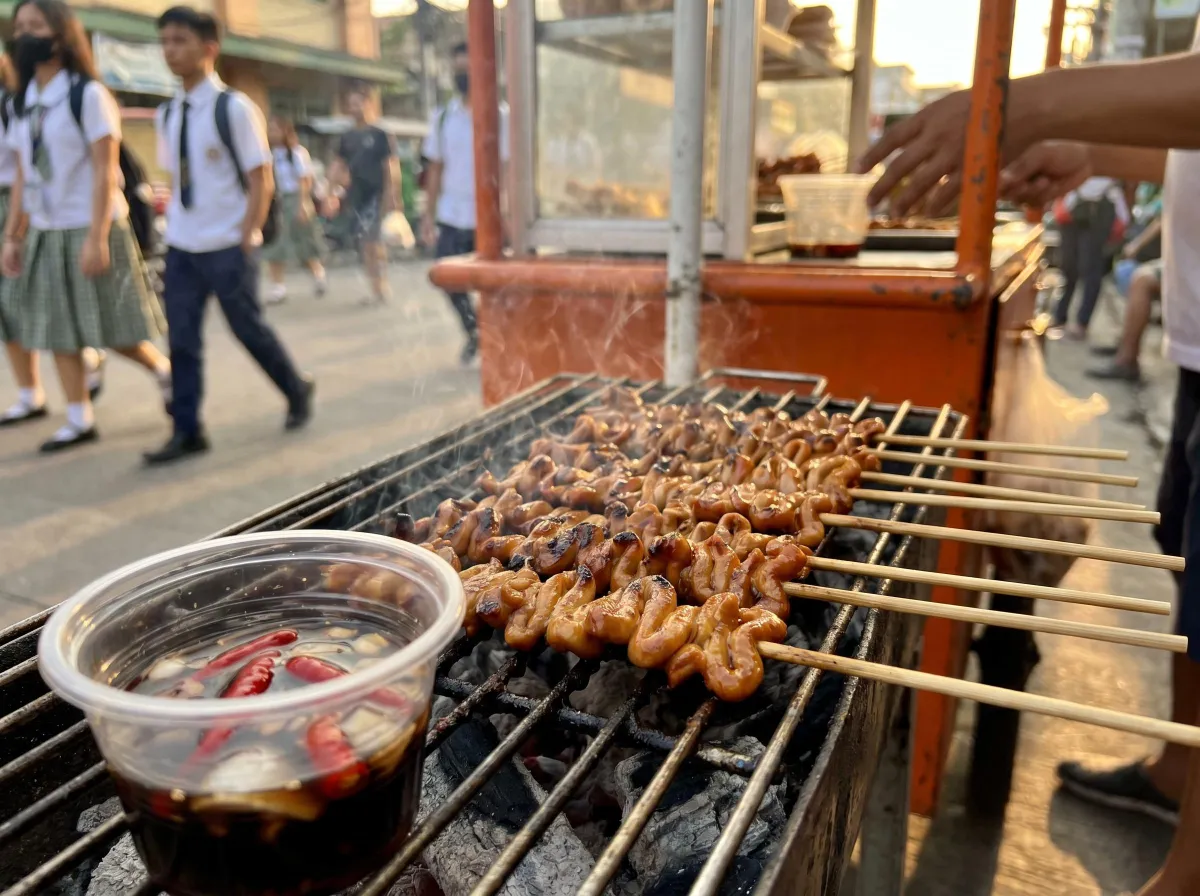
What Is Isaw? The Filipino Grilled Chicken Intestines
Filipino Food · Studio Tributes
Studio Tributes / Filipino Food / What Is Isaw?
You smell it before you see it.
Somewhere in the late afternoon, in a city or a town in the Philippines, there is smoke. Charcoal smoke, specifically — the kind that carries with it the smell of something savory and slightly fatty sizzling over heat, and it is coming from a small cart or a makeshift grill on the sidewalk, and a vendor with tongs in hand is turning skewers and checking his charcoal and looking completely unbothered by the fact that he is producing one of the most compelling aromas in Filipino street food.
🍢 Before we go any further — we made something for you.
Find out what your isaw choices say about you. Takes about a minute.
You follow the smoke. You find the cart. You look at the bamboo skewers laid out, each one threaded with coiled, marinated intestines — chicken or pork, glistening slightly from the marinade and the heat of the grill, starting to char at the edges. And if you have eaten isaw before, you already know: you are about to spend the next fifteen minutes eating standing up on a sidewalk, dipping each skewer into a cup of spiced vinegar, and being completely happy about it.
That is the isaw experience. It is not glamorous. It does not require a reservation, a menu, or a table. What it requires is a few pesos, a willingness to eat something unfamiliar if you have not eaten it before, and the good sense to follow the smoke when you smell it.
Filipino isaw is grilled chicken or pork intestines — cleaned thoroughly, boiled, skewered on bamboo sticks, and cooked over charcoal until the outside is slightly charred and the inside is tender and smoky. According to Wikipedia, isaw is a Tagalog word for intestines in a culinary context, distinct from the general word bituka, and it is one of the most popular street foods in the Philippines. It is served with sawsawan — a spiced vinegar dipping sauce — and it is eaten on sidewalks, outside school gates, at festivals, in food parks, and anywhere a charcoal grill can be set up.
At Studio Tributes, we celebrate Filipino food because Filipino food carries Filipino life inside it. Isaw carries a very specific kind of life: the afternoon life, the after-school life, the life of standing on a sidewalk with three pesos in your pocket and four friends beside you, watching the grill and waiting for your skewer. Today we are going all the way into isaw — where it came from, what it tastes like, why it is safe to eat, and why this one stick of grilled intestines has been holding a central place in Filipino street food culture for over half a century.
🔥 What Is Isaw?
Okay, let's talk about it directly — because if you have not eaten isaw before, the first thing you are going to encounter is the ingredient, and it is worth addressing that head-on.
Isaw is grilled intestines. Chicken intestines (isaw manok) are the most common variety. Pork intestines (isaw baboy) are the other. Both are cleaned, boiled, and grilled. Both are served on bamboo skewers. Both are dipped in spiced vinegar. And both are, when prepared well, genuinely delicious in a way that surprises people who arrive at an isaw cart with doubt and leave as converts.
The preparation is more involved than it looks. The intestines go through a rigorous cleaning process: turned inside out, rinsed repeatedly under running water, rubbed with salt to remove any remaining impurities, rinsed again. Then they are boiled fully — not blanched, but properly cooked through — to kill any pathogens and begin the tenderizing process. After boiling, the cleaned and cooked intestines are threaded onto bamboo skewers in a coiled, looped pattern that maximizes surface area on the grill. They are often marinated in a mixture of soy sauce, vinegar, garlic, and spices before the grill, and sometimes brushed with additional marinade as they cook.
The grill is always charcoal. This is non-negotiable in isaw culture. The charcoal gives the exterior a smokiness and a slight char that no other heat source replicates, and the char at the edges of each skewer — where the marinade has caramelized and the natural fat of the intestines has rendered slightly — is exactly where the flavor lives.
The full isaw experience looks like this:
🍢 Isaw manok — chicken intestines, the classic; smaller, slightly more delicate, the most common version
🍢 Isaw baboy — pork intestines, larger and fattier with a stronger, more robust flavor
🫙 Sawsawan — the dipping sauce, almost always a spiced vinegar: sukang pinakurat with siling labuyo (bird's eye chili), raw onion, and garlic
🫙 Sweet sauce — some vendors offer a ketchup-based sweet dipping sauce as an alternative
🌶️ Siling labuyo — bird's eye chili, available separately for people who want more heat
You eat isaw standing up. You eat it off the stick. You dip it in the shared vinegar cup — a gesture of communal trust that is completely normal in Filipino street food culture — and you eat it hot, immediately after it comes off the grill, before the char at the edges has had a chance to cool.
Isaw manok vs. isaw baboy: These are the two primary varieties, and regulars tend to have a strong preference for one. Isaw manok is smaller and loops more tightly on the skewer; isaw baboy is larger, fattier, and has a more assertive flavor that some find more satisfying. The difference is noticeable. Most isaw carts sell both.
📜 The Story Behind It
Isaw's origin story is a story about resourcefulness, economic necessity, and the specific Filipino gift for turning what other people discard into something worth eating.
Before the 1970s, Filipino street food vendors primarily sold the cuts of meat that people wanted: pork barbecue, chicken barbecue, the parts that commanded a price. The intestines and other offal — the parts called laman-loob (innards) — were typically discarded or used in home cooking, but they were not, broadly speaking, street food.
Then the economic crisis of the 1970s changed the calculation. Rising meat prices made the popular cuts less accessible to street vendors and their customers alike. In response, vendors began turning to the parts that were cheap, available, and had previously been overlooked. The intestines of chickens and pigs, cleaned and grilled, were among them. According to Esquire Philippines, this is when isaw rose to widespread popularity — when necessity made it valuable and when vendors discovered that the cleaning and cooking process could produce something genuinely appealing.
The word itself has a debated but interesting etymology. According to Esquire Philippines, isaw is believed by some to derive from sawsawan — the dipping sauce — essentially meaning "the thing you dip in sauce." Others note that isaw is simply the Tagalog/Filipino culinary term for intestines prepared as food, separate from the generic word bituka. Either way, the word traveled from inside Filipino kitchens out to street corners, and there it stayed.
By the 1980s, isaw had become embedded in Philippine street food culture — particularly around universities, high schools, and busy commercial streets. And at the center of that embedding was one name that every Filipino who went to UP Diliman knows:
Mang Larry.
Lauro Condencido Jr. — known as Mang Larry — opened his isawan at the University of the Philippines Diliman in 1984. What started as a humble food cart became one of the most famous food stalls in Philippine history. Mang Larry's Isawan developed a reputation for isaw that was meticulously cleaned, reliably cooked, and genuinely good — not just cheap but worth returning to specifically for the flavor and the experience.
At its peak, Mang Larry's reportedly sold 3,000 skewers in a single day. Generations of UP students, faculty, alumni, and visitors made the trek to his stall — at various points relocated across multiple spots on campus — to eat isaw and sit at the plastic tables that became an informal extension of the university's social life. Student leaders plotted rallies over skewers. Barkadas decompressed after exams. Professors stopped by, making it neutral ground in a university known for its strong political pulse.
In February 2026, the main UP Diliman branch of Mang Larry's Isawan was closed by a court order — an event that generated genuine emotional responses from alumni and food writers across the Philippines. The stall had been part of the campus for over four decades. Within weeks, Mang Larry's had reopened at a new location in Project 8, Quezon City, and announced continued operations at its Magiting and UST branches. The smoke, as the Inquirer once wrote, never really stops.
Mang Larry's story is isaw's story in miniature: resourceful, affordable, deeply embedded in a community, and far more meaningful than its price tag suggests.
👅 What Does Isaw Taste Like?
Here is where we need to be straightforward, because the honest answer is also the most persuasive one: isaw tastes genuinely good. Not "good for what it is." Not "surprisingly acceptable." Actually good.
The flavor profile of properly cooked isaw is smoky, savory, and slightly fatty — in the best possible sense of all three words. The charcoal grill imparts a smokiness that is distinctly different from any other cooking method, and the char at the edges of each piece adds a slight bitterness that balances the savory marinade underneath. The marinade itself — soy sauce, vinegar, garlic — penetrates during the pre-boil marination and gives the meat a tangy, savory depth that remains present even through the grilling.
The texture is chewy. This is the word most people use, and it is accurate. Isaw is not soft — the intestines have a natural texture from the muscle and the collagen that makes them more substantial than you might expect. The boiling tenderizes them significantly, but the grilling firms them back up, and the final result is something that gives resistance when you bite into it and then yields into something rich and flavorful. The slightly fatty interior — particularly in isaw baboy — provides richness that melts slightly against the chewy exterior.
And then the sawsawan. This is not optional. Dipping isaw in spiced vinegar is the move that completes the dish: the sharp, acidic, chili-hot vinegar cuts through the richness of the grilled intestines in exactly the way it was designed to do. Without it, isaw is good. With it, isaw makes sense as a complete flavor experience. The heat of the siling labuyo, the sharpness of the vinegar, the raw onion — all of it lands against the smoky, fatty skewer and produces a contrast that is genuinely exciting.
If I had to describe it simply:
Isaw tastes like the street corner at 4pm — smoky, a little sharp, chewy and satisfying, and impossible to eat just one.
✅ Is Isaw Safe to Eat?
This is the question that non-Filipino readers — and some hesitant first-timers — always ask, and it deserves a direct answer: yes, isaw is safe to eat when properly prepared. Here is why.
The preparation process is specifically designed to address the safety concerns that intestines naturally present. This is a multi-step process, not a casual one:
Step 1 — Deep cleaning. The intestines are turned inside out, rinsed thoroughly under running water, massaged with salt, and rinsed again. This removes impurities and reduces any bacterial load on the surface. Vendors who take isaw seriously — and the best ones do — spend significant time on this step.
Step 2 — Full boiling. Before the grill, the cleaned intestines are boiled fully in water. This is not a quick blanch — it is a proper boil that cooks the intestines through completely, killing pathogens and further tenderizing the meat. By the time isaw reaches the grill, it is already fully cooked. The grill is for flavor, char, and texture.
Step 3 — High-heat grilling over charcoal. The final charcoal grill at high heat adds another layer of safety through heat exposure, while simultaneously producing the char and smokiness that make isaw taste the way it does.
The key variable — as with any street food anywhere in the world — is vendor quality. Isaw from a well-established vendor with a high turnover of product, proper cleaning practices, and consistent preparation is thoroughly safe. Isaw from a vendor whose hygiene practices are unclear is a different matter. This is why regulars have their vendor, their specific stall, the one they trust.
For visitors and first-timers: go to popular, established stalls with high customer turnover (high turnover means fresh product), and do not hesitate to observe the grill before you buy. A grill that is actively being used and restocked is a reliable signal. The smoke is your friend here — it means things are fresh and hot.
A note for context: Filipino people have been eating isaw for more than fifty years. It is consumed by millions of people across the Philippines regularly, from students to office workers to everyone in between. If it were broadly unsafe, it would not have remained this popular for this long. The preparation process exists precisely because Filipino vendors and cooks understood the hygiene requirements and developed the technique to meet them.
🗺️ Isaw Across the Philippines
Street food culture in the Philippines is hyperlocal, and isaw adapts to where it is sold.
Metro Manila is the center of isaw culture — the street corners, the school gates, the university enclaves. UP Diliman, Ateneo, La Salle, UST, PUP — every university district in Metro Manila has its own cluster of isaw vendors, each with regulars and loyal customers who return to specific stalls for specific reasons. Manila's street food strips — Maginhawa in Quezon City, Malate, the areas around major markets — are where isaw exists alongside kwek-kwek, fish balls, kikiam, and betamax in the full tusok-tusok (skewered food) ecosystem.
Cebu has its own grilled food culture, and isaw appears in night markets alongside other Cebuano street food staples. The marinade traditions differ slightly — Cebuano versions sometimes lean more heavily on local spices and coconut vinegar in the sawsawan.
Davao and other Mindanao cities have active street food cultures where isaw competes alongside local variations on grilled meats and offal. The spice profiles of the dipping sauces sometimes reflect regional preferences for more complex heat.
Provincial markets across the Philippines sell isaw in the context of their local markets (palengke), often positioned alongside fresh meat vendors — a reminder that isaw originated as a way of using every part of the animal and remains connected to that tradition.
Isaw also shows up in a Filipino diaspora context. Filipino grocery stores in the United States, Canada, the Middle East, and Australia sometimes carry frozen, pre-marinated isaw. Filipino restaurants abroad occasionally include it on menus as part of a Filipino street food section. And Filipino home cooks who grew up eating isaw outside the school gate have figured out how to make it at home — the cleaning and grilling process, adapted to whatever kitchen equipment they have available.
🗣️ Learn the Tagalog
Isaw has its own vocabulary — the words of the street corner, the grill, and the social ritual that happens around both.
The food and the experience:
Isaw (ee-saw) — intestines prepared as food; the dish itself
Isaw manok (ee-saw mah-nok) — chicken intestines; the most common variety
Isaw baboy (ee-saw bah-boy) — pork intestines; larger, fattier, more robust
Inihaw (ee-nee-haw) — grilled; the cooking category that isaw belongs to
Ihaw-ihaw (ee-haw ee-haw) — a grilling station or grill setup; also used to describe a variety of grilled street foods
Tusok-tusok (too-sok too-sok) — skewered street food; the broader category that includes isaw, kwek-kwek, fish balls, and kikiam
Laman-loob (lah-mahn loo-ob) — innards, offal; the culinary category that isaw belongs to
Bituka (bee-too-kah) — intestines in the general sense; the generic word, as opposed to isaw which is the culinary/street food term
The sauce and the grill:
Sawsawan (saw-sah-wahn) — dipping sauce; the essential accompaniment to all Filipino street food
Suka (soo-kah) — vinegar; the base of the isaw sawsawan
Sukang pinakurat (soo-kahng pee-nah-koo-raht) — spiced vinegar; the classic isaw dipping sauce with chili, onion, and garlic
Siling labuyo (see-ling lah-boo-yoh) — bird's eye chili; the small, intensely hot pepper added to the sawsawan
Sibuyas (see-boo-yas) — onion; raw, sliced, added to the vinegar
Uling (oo-ling) — charcoal; the only acceptable fuel for real isaw
Usok (oo-sok) — smoke; the first signal that a grill is nearby and active
At the street corner:
Pabili! (pah-bee-lee) — I'd like to buy some! The approach to the cart
Ilan ang gusto mo? (ee-lahn ang goos-toh moh) — How many do you want?
Dalawa lang, isaw manok. (dah-lah-wah lahng, ee-saw mah-nok) — Just two, chicken intestines.
Dagdag na suka! (dag-dag nah soo-kah) — More vinegar, please!
Maanghang ba? (mah-ah-ngahng bah) — Is it spicy?
Ang sarap! (ahng sah-rahp) — So delicious! The natural response
Isa pa! (ee-sah pah) — One more! The inevitable second skewer
The phrase dagdag na suka — more vinegar please — might be the single most used phrase at any isaw cart in the Philippines. The vinegar runs out. It always runs out. The vendor always refills it. This is the rhythm of the isaw experience.
🎨 Color It!
Bring Filipino food to life in a whole new way — through art.
Our Filipino Food Coloring Book on Amazon was built from exactly that kind of question. Every page is a dish with a story. Every coloring session is an invitation to remember.
That makes it especially meaningful for:
🌼 Families who want a creative activity that naturally opens a conversation about Filipino food heritage
🌼 Filipino parents and grandparents sharing their regional food traditions with the next generation
🌼 Adults and seniors who find nostalgic, mindful creativity deeply satisfying
🌼 Anyone in the Filipino diaspora who wants a quiet, beautiful way to hold onto what home tastes like
🌼 Teachers, homeschoolers, and community groups exploring Filipino food and culture through art
👉 Get your FREE Filipino Coloring pages here.
👉 What Filipino Food Are You? Take the quiz →
🤩 Fun Facts About Isaw
1. Isaw became popular because of an economic crisis. When rising meat prices in the 1970s made conventional street food cuts expensive, Filipino vendors turned to the parts that had been discarded — intestines, organs, offal. What began as resourceful necessity became a beloved tradition that outlasted the crisis that created it.
2. The word "isaw" may come from "sawsawan." According to Esquire Philippines, the most widely cited etymology traces isaw to sawsawan — the dipping sauce. Essentially, it is named after the thing you eat it with. In a food culture where the sauce is as important as the protein, this makes complete sense.
3. Chicken intestines on a skewer are colloquially called "IUD." Because of the looping, coiled shape of grilled chicken isaw on a bamboo stick — which resembles the shape of an intrauterine device — the nickname "IUD" circulates in Filipino street food culture. Filipino street food naming conventions are, in general, creative, darkly humorous, and extremely specific.
4. Mang Larry's Isawan at UP Diliman reportedly sold 3,000 skewers a day. Lauro "Mang Larry" Condencido Jr. opened his isawan at the University of the Philippines Diliman in 1984 and built it into one of the most famous food stalls in Philippine history. At its peak, the stall sold thousands of skewers daily. The main UP Diliman branch closed in February 2026 following a court order, but operations continue at other locations.
5. The charcoal is non-negotiable. Ask any isaw vendor or devoted isaw eater whether a gas grill or an oven could substitute for charcoal, and the answer is immediate: no. The smokiness that charcoal imparts — the usok that you follow to the cart — is not a cooking method. It is a flavor. The char and smoke are part of what isaw tastes like, and they cannot be replicated by any other heat source.
6. The cleaning process is genuinely rigorous. The intestines are turned inside out, rinsed repeatedly, salted, rinsed again, and then fully boiled before ever hitting the grill. The preparation takes significantly more time and effort than most other street foods, and vendors who do it correctly take real pride in that process. The cleaning is what makes isaw safe, and established vendors know exactly what they are doing.
7. There is a whole ecosystem of Filipino offal street food. Isaw exists within a family of Filipino grilled street foods that use parts of the animal others leave behind. Atay (liver), tenga (pig's ears), balunbalunan (gizzard), tumbong (pork rectum), betamax (coagulated blood), and adidas (chicken feet, named for the three toes that resemble the three stripes of the shoe brand) are all part of this ecosystem. Filipino creativity with naming — and with cooking — applies across the whole group.
8. Isaw is one of the most social Filipino street foods. You cannot eat isaw alone and feel like you are eating it right. The experience is designed for a group: everyone standing around the grill, sharing a cup of vinegar, arguing about whether isaw manok or isaw baboy is better, dipping and eating off the stick. The social dimension is baked into the format.
9. The sweet sauce vs. vinegar debate is real. Some isaw vendors offer both a sweet sauce (sometimes ketchup-based, sometimes a sweet soy reduction) and the traditional spiced vinegar. Regular customers have strong, consistent preferences, and they will express them. The vinegar camp is larger and louder. The sweet sauce camp is quieter but equally committed.
10. Isaw is one of the most affordable foods in the Philippines. A single stick of isaw costs roughly 15 to 35 pesos — a fraction of a dollar. This affordability is fundamental to its cultural role: it is the street food that students with almost no money can still afford, that factory workers eat on break, that everyone can participate in regardless of economic situation. Its cheapness is not incidental to its identity. It is the whole point.
11. Isaw has entered Filipino food parks and restaurants. While isaw's natural habitat is the sidewalk cart, it has also migrated into Filipino food parks, night markets, and even some restaurants that serve it as part of a street food-style menu. The sit-down isawan — with proper tables, napkins, and a menu — exists. Purists debate whether this is progress or dilution. Everyone agrees the charcoal still needs to be charcoal.
12. The cultural significance of the school gate vendor. The isaw vendor stationed outside a school gate — present every afternoon when students pour out — is one of the most consistent images in Filipino childhood and adolescence. It is not a generic street food memory. It is a specific, recurring, reliably comforting presence: the vendor who was there every day, who knew what you usually ordered, who was still there the next day and the day after that.
🌍 How Isaw Connects Filipinos Everywhere
Isaw does not travel the way some Filipino foods do. You cannot freeze it and ship it easily. You cannot buy it in a box at most international grocery stores. You cannot order it on DoorDash in most cities outside the Philippines.
What travels instead is the memory of it.
For Filipinos living abroad — in the United States, Canada, the Middle East, Australia, the United Kingdom — isaw belongs to a specific category of food memories: the ones that are deeply embedded in a particular time, place, and activity. The school gate at 3:30pm. The cluster of students around the cart. The wait for your skewer to come off the grill. The first dip in the vinegar. The second skewer you ordered because you told yourself you would only have one.
Filipino diaspora food writers, bloggers, and community members consistently identify isaw as one of the street foods they miss most intensely — not because it is the most sophisticated food, but because the experience of eating it is irreproducible abroad. You can marinate pork intestines. You can grill them over charcoal in your backyard. You can make sukang pinakurat from chili and vinegar. But you cannot recreate the smoke-thick air of a Manila afternoon, or the social equation of a school gate, or the specific way a bamboo skewer feels in your hand when the isaw is still hot from the grill.
This is why isaw generates the kind of emotional response it does when Filipinos abroad encounter it — in a Filipino food festival, at a heritage event, or at the rare restaurant that has added it to the menu. It is not just food. It is a portal.
For non-Filipinos encountering isaw for the first time: the honest advice is to go in without overthinking it. Follow the smoke. Find the vendor. Watch how the regulars eat. Dip the skewer, eat it off the stick, and see what you think. The flavor does the rest of the work. Isaw has been converting skeptics into regulars for over fifty years, and it is very good at that job.
❓ FAQ — Everything You Need to Know About Isaw
What is isaw? Isaw is a popular Filipino street food made from chicken or pork intestines that are thoroughly cleaned, boiled, skewered on bamboo sticks, and grilled over charcoal until smoky and slightly charred. It is served with a spiced vinegar dipping sauce and is one of the most iconic street foods in the Philippines.
What does isaw taste like? Smoky, savory, and chewy, with a charred exterior and a rich, slightly fatty interior. The spiced vinegar sawsawan cuts through the richness with sharp, bright acidity. Together it is one of the most satisfying flavor contrasts in Filipino street food.
Is isaw safe to eat? Yes, when properly prepared. The intestines are thoroughly cleaned, boiled fully to kill pathogens, and then grilled over high heat. Buying from established, reputable vendors who clearly practice good hygiene is the key variable. Isaw has been eaten safely by millions of Filipinos for decades.
What is the difference between isaw manok and isaw baboy? Isaw manok uses chicken intestines — smaller, more delicate, the most common. Isaw baboy uses pork intestines — larger, fattier, more robust. Both are cleaned, boiled, and grilled the same way. Most vendors sell both and regulars have strong preferences.
What sauce do you eat with isaw? Sawsawan — typically sukang pinakurat, a spiced vinegar with siling labuyo (bird's eye chili), raw onion, and garlic. Some vendors also offer a sweet sauce. The vinegar is the traditional and most popular choice.
Where does the word isaw come from? According to Esquire Philippines, isaw is believed to derive from sawsawan — the dipping sauce. Others note it is simply the culinary Tagalog/Filipino term for intestines prepared as food, distinct from the generic word bituka.
When did isaw become popular? During the economic crisis of the 1970s, when rising meat prices led vendors to repurpose discarded intestines. By the 1980s it was embedded in Philippine street food culture, particularly around universities. Mang Larry's Isawan, opened at UP Diliman in 1984, became the most famous isaw stall in the country.
Is isaw the same as Filipino barbecue? They are related but different. Filipino barbecue (inihaw) is the broad category that includes isaw, but Filipino pork or chicken barbecue typically refers to more conventional cuts marinated in a sweet soy sauce mixture. Isaw is specifically intestines. They often appear on the same grill, at the same cart, selling to the same customers.
💛 Closing
Isaw is not trying to be refined. It is not trying to be anything other than exactly what it is: a bamboo skewer of cleaned, grilled intestines, eaten standing up on a sidewalk in the afternoon, dipped in spiced vinegar, for a price that fits in the smallest pocket.
That honesty is the whole point.
Filipino street food culture was built on the principle that good food should be accessible to everyone — not just the people with tables and menus, but the students with fifteen pesos, the workers with ten minutes on break, the passers-by who followed the smoke. Isaw is the most direct expression of that principle. It took the parts that were being thrown away, found a way to make them genuinely delicious, and put them on a stick affordable enough for anyone.
For over fifty years, it has been doing exactly that. At school gates and market corners. At food parks and campus stalls. At Mang Larry's, in six locations across UP Diliman and now at new spots in Quezon City. In Filipino community food festivals in cities on the other side of the world, where the smoke from a charcoal grill produces a scent that makes people stop and remember an afternoon they did not know they were still carrying.
At Studio Tributes, we tell the stories of Filipino food because Filipino food is worth knowing deeply. Isaw deserves to be known: not just as a curiosity or a novelty, but as a dish with history, technique, cultural meaning, and real flavor.
The next time you follow the smoke and find the cart, you will know exactly where it came from, what goes into making it, and why the vinegar always runs out first.
Get your skewer. Dip it. Eat it hot.
Keep exploring Filipino food and culture with us:
🎨 Get our Filipino Food Activity Book on Amazon 📚 Read more Filipino food stories on our blog
💭 A Memory to Hold Onto
Did isaw bring an afternoon back?
Maybe the specific vendor outside your school who was always there, always reliable, always had the grill going at exactly the right time.
Maybe the argument — still ongoing, probably — between your friends about whether isaw manok or isaw baboy is the one true isaw.
Maybe the time the vinegar cup ran out and you had to wait for the refill and it felt like an eternity.
Maybe a street in Manila at dusk, smoke rising, the day almost over, one skewer left on the grill with your name on it.
Isaw manok or isaw baboy — and is this actually a debate worth having? Did you go sweet sauce or vinegar? And do you judge people who go sweet sauce? Who was your vendor — and do you still think about their specific isaw?
If a memory came to mind, share your isaw story on Facebook or Instagram and tag @StudioTributes — we would love to hear it.
Read Next
📚 References & Further Reading
Wikipedia — Isaw — Primary reference for ingredient overview, dish classification, the distinction between isaw and bituka, the Wikipedia-noted similarity to other inihaw dishes, and the note about the "IUD" colloquialism.
Esquire Philippines — History of Street Food in the Philippines — Reference for the origin of isaw's popularity in the 1970s economic crisis, the etymology of isaw from sawsawan, and the broader creative naming culture of Filipino street food.
When In Manila — Mang Larry's Isawan Closes Main Branch — Documentation of the February 2026 closure of the Mang Larry's Isawan main branch at UP Diliman, including the stall's founding in 1984 and its cultural significance.
GMA News Online — Mang Larry's Isawan Reopens in Quezon City — Documentation of Mang Larry's Isawan's reopening at Project 8, Quezon City following the UP Diliman closure.
People Places Plates — Mang Larry's Isawan: The UP Diliman Icon — Cultural essay on Mang Larry's significance as an institution within UP Diliman, including the 3,000-skewers-per-day figure and the stall's role in campus social life.
Grokipedia — Isaw — Reference for the rigorous cleaning and preparation process, the multi-step safety protocol, and the 1980s popularization of isaw near universities including Mang Larry's role.