
What Is Crispy Pata? The Filipino Deep-Fried Pork Leg
Filipino Food · Studio Tributes
Studio Tributes / Filipino Food / What Is Crispy Pata?
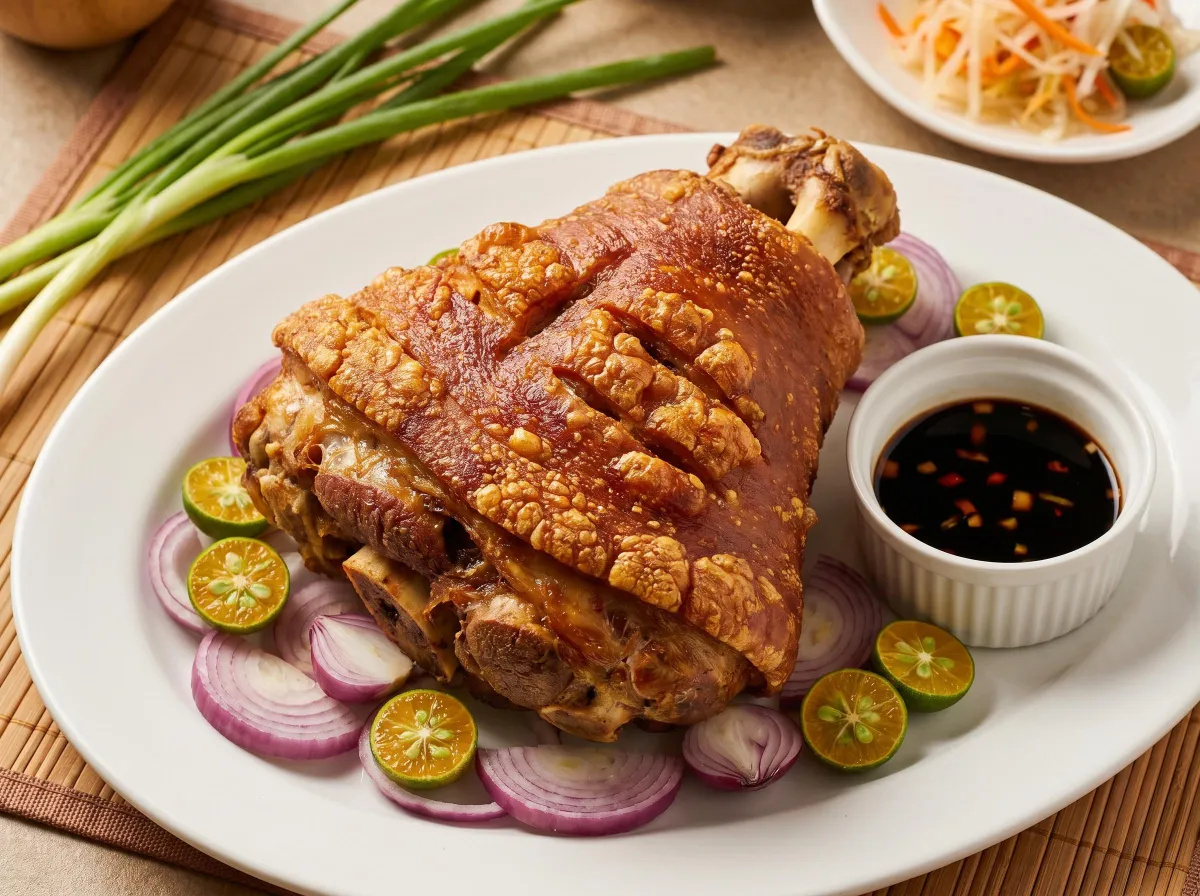
There is a moment at every Filipino celebration when the crispy pata arrives at the table — and the whole room pauses.
It does not matter what else has been served. It does not matter how much food is already on the table. When the platter comes out — a whole pork leg, golden-brown and glistening, skin blistered into a crackled, shatteringly crispy shell — conversations stop, hands reach, and someone always says the same thing: kain na tayo. Let's eat.
But before we go deeper — want to play a quick game first?
Find out what your crispy pata choices say about you. Takes about a minute.
That is the power of crispy pata. It is not a subtle dish. It does not ask you to pay close attention or use a particular fork. It is joyful and enormous and impossible to ignore, and it has been anchoring Filipino celebration tables for over six decades. It is the dish that tells everyone at the table: this is a special occasion, and we are going to eat properly.
For Filipinos living abroad — in Los Angeles, Chicago, Toronto, Dubai, London, or Sydney — crispy pata carries that same power in a different register. It is the dish ordered at Filipino restaurants when the whole group is together. It is the thing someone's tita makes at a birthday party that fills the whole apartment with the smell of rendered fat and garlic. It is the dish that takes hours to prepare and disappears in minutes, because no one can stop.
Crispy pata is a Filipino dish consisting of a whole pork leg — from the hock to the trotter — slow-boiled with aromatics until the meat is completely tender, then deep-fried in very hot oil until the skin blisters into a golden, crackling shell. According to Wikipedia, it is served with a soy-vinegar dipping sauce called sawsawan and is one of the most popular and recognizable dishes in Filipino cuisine. Wikipedia also notes that crispy pata is quite similar to the German Schweinshaxe — a comparison that helps explain the dish's universal appeal across cultures that have never encountered a Filipino table before.
At Studio Tributes, we celebrate Filipino food because Filipino food carries Filipino life inside it. Today we are going all the way into crispy pata — its origin story, the technique behind it, what it actually tastes like, why the dipping sauce matters as much as the pork, and why this one dish keeps appearing at every table that matters.
🍖 What Is Crispy Pata?
Crispy pata is, at its most literal, deep-fried crispy pork leg. But describing it that way is like describing halo-halo as shaved ice with toppings — technically accurate and entirely insufficient.
The dish begins with a whole pork leg — the pata — which typically includes the hock, the knuckle, the skin, and the bone. This is not a refined cut. It is the full, honest, bone-in leg of a pig, chosen specifically because the combination of skin, fat, connective tissue, and meat produces a result that no leaner cut can replicate.
The cooking happens in two distinct stages, and both matter:
Stage one — the braise: The pork leg is submerged in water with aromatics — typically bay leaves, black peppercorns, whole garlic, onion, and salt — and simmered low and slow for one to two hours. Some cooks add soda (cola or sprite) to the boiling liquid, which tenderizes the meat and adds a subtle sweetness to the skin. The goal is to cook the meat all the way through until it is completely tender and the collagen in the connective tissue has broken down into gelatin. The skin, at this stage, looks nothing like what it will become.
Stage two — the fry: The boiled pork leg is removed from the liquid, dried as thoroughly as possible — many experienced cooks leave it uncovered in the refrigerator overnight — and then lowered into a deep pot of very hot oil. What follows is one of the most dramatic transformations in Filipino cooking: the skin begins to bubble, blister, and crackle. It puffs and blisters and turns golden in a process called maillard reaction meets rendered fat, and within minutes the pale boiled skin has become a shatteringly crispy golden shell that holds the soft, gelatinous, deeply savory meat inside it.
The result is served whole, on the bone, with:
🫙 Sawsawan — the essential dipping sauce: soy sauce, vinegar, calamansi (Philippine lime), raw onion slices, and siling labuyo (bird's eye chili) for heat
🥒 Atsara — pickled green papaya, sweet and slightly sour, served alongside to cut through the richness
🌾 Steamed white rice — the foundation, always
The word pata itself comes from the Spanish word for an animal's foot, leg, or paw — one of approximately forty percent of Filipino food vocabulary that was introduced during over three centuries of Spanish colonization (1521–1898). The adjective crispy is English, absorbed into Filipino through the Taglish hybrid that characterizes contemporary Filipino language. The dish's name is, in this way, a small linguistic portrait of Philippine history: Spanish noun, English descriptor, Filipino soul.
📜 The Story Behind It
Crispy pata is a young dish by the standards of Filipino cuisine — and it has a specific, traceable origin story, which is unusual in a food culture where most dishes evolved over centuries without a named inventor.
The story begins in the 1950s, at an eatery called Barrio Fiesta in Caloocan, a city just north of Manila. The restaurant was founded by Sixta "Mama Chit" Evangelista Ongpauco, and it would eventually grow into one of the most influential Filipino restaurant chains in the country's culinary history.
According to the most widely told version of the origin story, Mama Chit's son, Rodolfo "Rod" Ongpauco, began buying the pork legs that lechon houses and other establishments were discarding — the part of the pig that other restaurants did not want. Rod boiled them with spices, then deep-fried them. The result was a revelation: the skin had transformed into something shatteringly crispy, while the meat inside was tender and rich. An alternative version credits Mama Chit herself with the invention. In either version, it is not disputed that Barrio Fiesta introduced crispy pata to Philippine restaurant culture, and the dish went on to define the restaurant's reputation.
From Barrio Fiesta, crispy pata spread outward through Philippine restaurant culture with remarkable speed. It paired naturally with kare-kare — the rich peanut-based oxtail stew that had long been a Barrio Fiesta specialty — and the combination became one of the most iconic pairings in Filipino dining. Eventually crispy pata appeared on menus across the country, from fine dining restaurants in Makati to small carinderias in the provinces, from balikbayan boxes brought abroad to Filipino restaurant menus in cities the Philippines can barely reach.
The Esquire Philippines magazine documented crispy pata's evolution, noting that from its inception at Barrio Fiesta, the dish built an entire culinary movement around itself — inspiring boneless versions, miniaturized versions (using baby pata legs), goose-fat-fried versions, and air-fried modern adaptations. Metro New Zealand quoted a Filipino restaurant owner who said: "Every restaurant in the Philippines has crispy pata. You'd just close down without it."
That is not hyperbole. It is documentation.
For non-Filipino food readers, the comparison to German Schweinshaxe is the most useful entry point. Wikipedia explicitly draws this parallel, and it holds in important ways: both dishes center on a pork knuckle braised until tender and then finished to achieve maximum skin crispiness. Both are centerpiece dishes at celebratory meals. Both are served with acidic accompaniments to balance the richness of the pork. The differences are in the finishing — Schweinshaxe is typically roasted rather than deep-fried, and served with sauerkraut and mustard rather than soy-vinegar sawsawan — but the underlying logic of the dish, and the pleasure it produces, is immediately recognizable across both traditions.
Crispy pata is the Philippines' answer to that same universal human understanding: that slow-cooked pork with crispy skin, served at the center of a table full of people who matter to each other, is one of the great pleasures in any food culture on earth.
👅 What Does Crispy Pata Taste Like?
Crispy pata tastes like the answer to the question: what if we made the pork as tender as possible and the skin as crispy as possible at the exact same time?
The first thing you encounter is the skin. It is shatteringly, dramatically crispy — the kind of crispy that makes a sound when you break through it, that produces a resistance and then a sudden give that is deeply satisfying in a way that is almost physical. The skin has been rendered of most of its fat during the long braise and the high-heat fry, and what remains is a thin, puffed, golden shell with a crackle that holds its texture for a surprising amount of time.
Beneath the skin is a layer of fat — not heavy or greasy, but silky and almost melting, the fat having softened during the braise until it carries a richness that coats without overwhelming. This fat layer is the bridge between the crispy exterior and the meat interior.
The meat itself is soft, gelatinous, and deeply savory. The collagen that once held the connective tissue together has dissolved into gelatin during the long simmer, giving the meat a sticky, rich quality that makes it pull easily from the bone. It tastes of the aromatics it was cooked in — the garlic, the bay leaves, the peppercorn — and of the pork itself, rendered patient and generous by time and heat.
And then the sawsawan. The dipping sauce is not optional. It is the dish's essential counterpoint — the sharp, bright, acidic soy-vinegar mixture that cuts through the richness of the pork like a blade through butter. A piece of crispy pata dipped in sawsawan becomes a completely balanced bite: rich and sharp, crispy and soft, savory and bright, all in one.
If I had to describe crispy pata simply:
Crispy pata tastes like Filipino hospitality made edible — enormous, generous, unapologetic, and impossible to ignore.
It does not ask you to be restrained. It asks you to sit down, stop whatever you were doing, and eat.
🗺️ Crispy Pata Across Filipino Culture
Crispy pata is a celebratory dish — and in the Philippines, celebration is not rare.
The dish appears at birthdays, which in Filipino culture are major events regardless of the age being celebrated. It appears at fiestas — the barangay patron saint celebrations that dot the Filipino calendar throughout the year and that are the primary community gathering events in every neighborhood and town. It appears at family reunions, at graduation parties, at debut parties (the Filipino quinceañera equivalent, typically celebrated at eighteen), at Christmas and New Year gatherings, and at the simple but profound occasion of a family member returning home from abroad.
At these gatherings, crispy pata almost always arrives at the table on a large platter, whole, and is almost always shared. Filipino dining culture is fundamentally communal — dishes are ordered for the table, not for the individual, and the largest, most impressive dish is the one that signals abundance and generosity. Crispy pata fulfills this role perfectly.
It also appears in Filipino restaurant culture in a specific way. Ordering crispy pata at a Filipino restaurant is a statement. It says: we are celebrating, or we have a reason to be together, or we just want to eat something that requires the whole table's attention. It is not a solo dish. Its scale ensures that.
Crispy pata in the Filipino diaspora carries an additional emotional charge. For Filipinos living in the United States, Canada, the Middle East, or elsewhere, crispy pata is one of the dishes most strongly associated with the experience of gathering — the tita's birthday party in a rented community hall, the balikbayan boxes that sometimes contain frozen crispy pata brought from Manila, the Filipino restaurant in an American strip mall that has been on the menu since the day it opened and always will be.
Food writers documenting the Filipino diaspora experience consistently note that crispy pata is among the dishes that cause the strongest reactions: not only hunger, but memory. The specific smell of pork skin rendering in hot oil, the sound of the crust cracking under a fork, the sight of the whole leg on a platter surrounded by calamansi and sawsawan — these are sensory triggers that belong to a specific kind of being-together that immigration makes rare and irreplaceable.
🗣️ Learn the Tagalog
Crispy pata has its own vocabulary — the words of preparation, table conversation, and the particular pleasure of sharing something that required real effort to make.
The dish and its parts:
Pata (pah-tah) — pork leg; from the Spanish pata, meaning an animal's foot or leg
Balat (bah-laht) — skin; the part everyone reaches for first
Karne (kar-neh) — meat; from the Spanish carne
Buto (boo-toh) — bone; the scaffolding the whole dish is built around
Taba (tah-bah) — fat; the silky layer beneath the skin that makes crispy pata what it is
The sauce and the sides:
Sawsawan (saw-sah-wahn) — dipping sauce; the essential companion to any Filipino fried or grilled dish
Suka (soo-kah) — vinegar; the sharp element in sawsawan
Toyo (toh-yoh) — soy sauce; the savory base of the dipping sauce
Calamansi (kah-lah-mahn-see) — Philippine lime; squeezed into the sauce for brightness
Siling labuyo (see-ling lah-boo-yoh) — bird's eye chili; for heat
Atsara (ah-chah-rah) — pickled green papaya; the acidic side that balances the richness
Sibuyas (see-boo-yas) — onion; sliced thin, raw, into the sawsawan
At the table:
Kain na tayo! (kah-in nah tah-yoh) — Let's eat! The announcement that the crispy pata has arrived
Huwag kalimutan ang sawsawan (hoo-wahg kah-lee-moo-tahn ang saw-sah-wahn) — Don't forget the dipping sauce
Ang crispy ng balat! (ang krees-pee nang bah-laht) — The skin is so crispy!
Sino ang may gusto ng buto? (see-noh ang may goos-toh nang boo-toh) — Who wants the bone?
Pwede pa ba? (pweh-deh pah bah) — Can I have more? (the question that means the food was good)
Sayang, naubusan na (sah-yahng, nah-oo-boo-sahn nah) — Too bad, it's all gone (the sound of a successful crispy pata)
These words carry the meal. Kain na tayo is the sound of everyone stopping what they were doing. Ang crispy ng balat is the highest possible compliment. Sayang, naubusan na — too bad, it's gone — is the review that tells the cook they succeeded.
🤩 Fun Facts About Crispy Pata
1. A fourteen-year-old invented it. According to multiple sources including Mom Food Blog, Rodolfo Ongpauco invented crispy pata in 1958 when he was only fourteen years old — buying unused pork legs, boiling them with spices, and deep-frying them at his mother's restaurant. The dish that would go on to anchor the menus of Filipino restaurants worldwide was created by a teenager who did not want to waste a perfectly good pork leg.
2. Wikipedia explicitly compares it to German Schweinshaxe. The Wikipedia entry for crispy pata notes that the dish is "quite similar to the German Schweinshaxe" — the roasted pork knuckle that is a staple of Bavarian cuisine. Both center on the same cut, both achieve maximum skin crispiness, and both are served at celebratory tables as centerpiece dishes. The technical difference is in the finishing method: Schweinshaxe is typically roasted, crispy pata is deep-fried. The cultural difference is the dipping sauce.
3. The secret to the crispiness is drying, not frying. Experienced crispy pata cooks know that the fry is almost secondary to what happens before it. The boiled pork leg must be dried as thoroughly as possible — many cooks leave it uncovered in the refrigerator overnight, sometimes patting it with paper towels multiple times — before the oil ever gets involved. Moisture trapped in the skin prevents it from crisping properly and causes dangerous oil splatter. The overnight dry is the technique that separates good crispy pata from great crispy pata.
4. Some cooks add soda to the boiling water. Cola or Sprite is a common addition to the boiling liquid in many crispy pata recipes — not for flavor, but for tenderizing. The mild acids in carbonated drinks help break down the connective tissue in the pork leg faster, and some cooks swear the subtle sweetness the soda leaves in the skin contributes to a deeper caramelization during frying. It is one of those Filipino cooking techniques that sounds unexpected and works completely.
5. Boneless crispy pata is a restaurant specialty. Many Filipino restaurants offer a boneless version of crispy pata — where the pork leg is deboned after the braise but before frying, then formed back into its original shape and deep-fried. The result is easier to portion and serve, and every bite gets both crispy skin and tender meat without navigating bone. It is more labor-intensive than the bone-in version, which is why boneless crispy pata is typically more expensive at restaurant prices.
6. "Every restaurant in the Philippines has crispy pata — you'd just close down without it." This quote, from a Filipino restaurant owner speaking to Metro New Zealand, is not hyperbole. Crispy pata appears on the menu of virtually every full-service Filipino restaurant, from Manila's fine dining establishments to provincial carinderias to overseas Filipino restaurants from Los Angeles to London. It is the dish that Filipino diners expect to find, and its absence from a menu would be genuinely surprising.
7. The dipping sauce is as important as the pork. Filipino food culture has a deep understanding of the role that sawsawan — dipping sauces — play in a dish's complete experience. For crispy pata, the soy-vinegar-calamansi sawsawan is not an afterthought. It is the acid balance that makes the richness of the deep-fried pork sustainable across an entire shared plate. Without it, crispy pata would be delicious but exhausting. With it, every bite is fresh.
8. Lechon kawali is crispy pata's belly sibling. Many Filipinos compare crispy pata to lechon kawali — deep-fried pork belly — because both use the same two-stage boil-then-fry technique and both prioritize crispy skin. The difference is the cut: lechon kawali uses pork belly (liempo) and is more everyday, easier to make at home in smaller quantities. Crispy pata uses the whole leg and is more festive — the one you order when there are enough people to finish it and enough reason to celebrate.
9. Air fryer crispy pata is now a thing — and it works. Since the late 2010s, Filipino home cooks have adapted the crispy pata technique for air fryers and convection ovens, achieving comparable crispiness with significantly less oil. The air fryer version requires the same essential prep — thorough boiling and drying — but the finishing step becomes more accessible for everyday home cooking. Filipino food YouTube channels have made air fryer crispy pata tutorials some of their most-viewed content, introducing the dish to a new generation of home cooks.
10. Crispy pata pairs with kare-kare at almost every traditional Filipino celebration. The combination of crispy pata (richly savory, crispy, served with soy-vinegar) and kare-kare (peanut-sauced oxtail stew, served with bagoong fermented shrimp paste) is one of the most beloved pairings in Filipino dining. This pairing was popularized by Barrio Fiesta, the restaurant where crispy pata was invented, and it has endured as the quintessential Filipino celebration feast combination for over sixty years.
11. The skin is a Filipino cultural touchstone. Ask any group of Filipinos who ate crispy pata as children what the most anticipated moment was, and the answer is almost universal: the skin. The fight (loving, but real) over the crispiest piece of skin is a recurring memory in Filipino family stories about this dish. It is the bite that validates the hours of preparation. It is the thing someone always saves for the youngest person, or for the guest, or for the person who cooked it.
12. Crispy pata is an act of generosity. The dish requires time, attention, and effort — hours of boiling, overnight drying, and careful frying. It cannot be rushed. When someone makes crispy pata for you, they made a decision to spend hours working so that you could have this specific pleasure. In Filipino food culture, where cooking for others is one of the primary expressions of love, crispy pata is a statement: you matter enough for me to do this much.
🌍 How Crispy Pata Connects Filipinos Everywhere
Crispy pata travels.
It travels in the memories of Filipinos who grew up in the Philippines and now live in other countries — the specific smell of the oil when the pork leg goes in, the sound of the skin crackling as the fork presses through it, the table crowded with hands all reaching at once.
It travels in the menus of Filipino restaurants from Los Angeles to London to Dubai to Sydney, where it is almost always one of the dishes most ordered by Filipinos and most remarked upon by non-Filipinos encountering it for the first time. The experience of watching someone unfamiliar with Filipino food try crispy pata is a particular joy: the surprise at the crispiness, the softness that follows, the second immediate reach for more.
It travels in the cultural vocabulary of the Filipino diaspora, where "let's get crispy pata" is shorthand for "we should be together more often" and "this is worth celebrating." The dish requires a group to finish it properly. Ordering it alone is technically possible and quietly sad. Its scale enforces community.
Filipino food scholars and cultural writers have noted that crispy pata occupies a specific position in the diaspora's emotional geography: it is a dish that tastes like the Philippines feels — abundant, generous, unapologetic about its richness, and best when shared with a table full of people who are happy to be there.
For non-Filipinos encountering crispy pata for the first time through this post or through a Filipino friend's invitation to a party: the Schweinshaxe comparison is the most useful entry point for what to expect. But know that what you will find in a Filipino kitchen is the same dish filtered through a completely different culinary culture — more generous in its portioning, more festive in its context, and served with a dipping sauce that changes everything.
Crispy pata does not need an occasion. But it always creates one.
❓ FAQ — Everything You Need to Know About Crispy Pata
What is crispy pata? Crispy pata is a Filipino dish made from a whole pork leg — slow-boiled with aromatics until tender, then deep-fried until the skin blisters into a shatteringly crispy, golden shell. It is served with a soy-vinegar dipping sauce called sawsawan and is one of the most iconic Filipino celebration dishes.
What does crispy pata taste like? The skin is shatteringly crispy and golden. The interior meat is soft, gelatinous, and deeply savory from the long braise. The fat layer beneath the skin is silky and melting. The sawsawan cuts through the richness with bright, sharp acidity. Together, the combination is one of the most satisfying contrasts in Filipino cuisine.
Who invented crispy pata? Crispy pata is widely credited to Rodolfo "Rod" Ongpauco, son of Barrio Fiesta founder Sixta "Mama Chit" Ongpauco, in the 1950s in Caloocan, north of Manila. Rod began deep-frying discarded pork legs, creating the dish that would become a cornerstone of Filipino restaurant menus.
What is the dipping sauce for crispy pata? The sawsawan is typically soy sauce and vinegar with calamansi, raw onion, and siling labuyo (bird's eye chili). The acidity is essential — it balances the richness of the deep-fried pork. Atchara (pickled green papaya) is also commonly served alongside.
How is crispy pata different from lechon kawali? Both are Filipino deep-fried pork dishes using the same two-stage boil-then-fry technique. Crispy pata uses the whole pork leg and is more festive, typically served at celebrations. Lechon kawali uses pork belly (liempo) and is more everyday and easier to make at home in smaller portions.
Is crispy pata similar to German Schweinshaxe? Yes — Wikipedia explicitly notes the similarity. Both center on a pork knuckle braised until tender and finished with crispy skin. The differences are in finishing method (deep-fried vs. roasted) and accompaniments (sawsawan vs. sauerkraut and mustard).
What does pata mean in Filipino? Pata comes from the Spanish word for an animal's foot, leg, or paw, introduced during over three centuries of Spanish colonization (1521–1898). In Filipino cooking, pata specifically refers to the pork leg or hock.
Can you make crispy pata at home? Yes. Boil the pork leg for one to two hours with bay leaves, peppercorns, garlic, and salt. Dry thoroughly — ideally refrigerate uncovered overnight. Deep-fry in very hot oil until the skin blisters and crisps. The drying step is the most critical: moisture prevents crispiness. Air fryer adaptations now make the finishing step more accessible at home.
💛 Closing
Crispy pata is not trying to be subtle.
It arrives at the table as a whole pork leg, golden and crackling, demanding the room's attention in a way that is completely unapologetic. It was invented by a teenager who did not want to waste good pork. It built a restaurant empire. It spread to every Filipino restaurant menu in the country and eventually to Filipino restaurant menus on nearly every continent. It has been on Filipino celebration tables for over sixty years, and it will be on them for sixty more.
At Studio Tributes, we tell the stories of Filipino food because Filipino food is worth understanding deeply — not just eating. Crispy pata carries one of the clearest stories in that tradition: a dish created from resourcefulness, perfected by time and technique, and now inseparable from what it means to gather, celebrate, and feed the people you love.
The next time someone puts a platter of crispy pata on the table and says kain na tayo — you will know exactly what you are eating, where it came from, and what it means.
And you will still reach for the skin first. Everyone does.
🎯 What Filipino Food Are You? Take the quiz →
👉 Get your FREE Filipino Coloring pages here.
Keep exploring Filipino food and culture with us:
🎨 Get our Filipino Food Activity Book on Amazon 📚 Read more Filipino food stories on our blog
💭 A Memory to Hold Onto
Did crispy pata bring a moment back?
Maybe the first time you heard the sound of the skin cracking under a fork — and the table went quiet for half a second before everyone started talking again at once.
Maybe a tita who always made it for reunions and never told anyone how long it took her, which is how you knew she loved you.
Maybe standing in a Filipino restaurant abroad, scanning the menu, seeing crispy pata listed, and feeling something loosen in your chest that you did not realize had been tight.
Did you always go for the skin first, or the meat near the bone? Who made crispy pata in your family — and what table did it always appear on? What did the room smell like when it was almost ready?
If a memory came to mind, share your crispy pata story on Facebook or Instagram and tag @StudioTributes — we would love to hear it and celebrate it with the whole community.
Read Next
📚 References & Further Reading
Wikipedia — Crispy Pata — Primary reference for dish overview, ingredient classification, Wikipedia's comparison to German Schweinshaxe, and confirmation of Barrio Fiesta as the originating restaurant.
Esquire Philippines — The Evolution of Crispy Pata — Detailed cultural history of the dish's evolution from Barrio Fiesta's original invention through the fine dining, boneless, and modern variants. Includes documentation of Rodolfo Ongpauco's role and the dish's cultural position in Philippine restaurant culture.
Metro New Zealand — More Than Skin Deep — International perspective on crispy pata, including the direct quote "every restaurant in the Philippines has crispy pata — you'd just close down without it" and the comparison to German pork knuckle traditions.
Grokipedia — Crispy Pata — Reference for the Spanish etymology of pata, documentation of modern air-fried and plant-based adaptations, and the statistic that Spanish influence accounts for approximately 40% of modern Filipino vocabulary including food-related terms.
Appetizing Adventure — Who Invented Crispy Pata? — Origin story documentation tracing the dish to Barrio Fiesta and the Ongpauco family, confirming Rod Ongpauco's role as the dish's inventor.
Eat Your World — Crispy Pata in Manila — Independent culinary travel documentation of crispy pata as a ubiquitous Filipino restaurant dish, with notes on the two-stage cooking method and serving tradition.