
What Is Lugaw? The Filipino Rice Porridge That Heals
Studio Tributes / Filipino Food / What Is Lugaw?
Lugaw: The Filipino Rice Porridge That Has Been Healing People Since Before Anyone Can Remember
If you ask ten Filipino families what lugaw is, you may get ten completely different answers — and every single one of them will be right.
For some, lugaw is medicine. It is what appeared on the bedside table when you were sick as a child, warm and pale and impossibly gentle, spooned out slowly by someone who loved you. For others, it is street food — a styrofoam cup of thick, gingery porridge eaten standing at a corner carinderia, still steaming at six in the morning before the city fully woke up. For others still, lugaw is the comfort that no other dish quite replaces: the thing you make when someone in the family needs warmth more than anything else.
For Filipinos living abroad — in Toronto, Los Angeles, Dubai, London, or Sydney — lugaw can be the fastest route back to a kitchen that smells like ginger and garlic, to a morning that felt safe because someone was cooking for you.
That is what makes lugaw one of the most quietly powerful dishes in Filipino cuisine. It does not arrive with ceremony. It does not require a long table or a special occasion. It asks almost nothing of the person eating it, because it is designed for moments when that person has very little left to give. Lugaw shows up exactly when it is needed, and it always, always helps.
Lugaw is a Filipino rice porridge — a slow-cooked dish of rice simmered in broth or water until it breaks down into a thick, comforting consistency somewhere between congee and cream of rice. It is served plain or topped with garlic, ginger, green onions, and a soft-cooked egg. Its variations include arroz caldo (rice porridge with chicken and ginger), goto (rice porridge with beef tripe), and champorado (sweet chocolate rice porridge).
At Studio Tributes, we tell the stories of Filipino food because Filipino food has earned the telling. Today we are going deep on lugaw — what it is, where it comes from, what every version tastes like, and why it continues to hold such a quiet, steady, essential place in Filipino homes and hearts everywhere in the world.
🍚 What Is Lugaw?
Lugaw is the foundational Filipino rice porridge — and it is worth understanding what that word "foundational" actually means before anything else.
In the hierarchy of Filipino comfort food, lugaw sits somewhere near the very beginning. Not because it is the oldest dish, or the most elaborate, or the most celebrated. But because it is the one that appears at the moments when everything else falls away: illness, exhaustion, early mornings, difficult days, and the ordinary human need to be fed something that asks nothing complicated of your body or your heart.
At its most basic, lugaw is rice cooked in far more liquid than usual — broth or water — until the grains break down and the whole mixture becomes thick, smooth, and almost creamy in texture. The result is a porridge that is gentle on the stomach, easy to eat, and quietly satisfying in a way that does not call attention to itself.
The base of lugaw is simple:
🍚 Bigas — white rice, usually long-grain or jasmine, rinsed well before cooking
🫙 Sabaw — broth (chicken, pork, or plain water, depending on the version and what is available)
🧅 Sibuyas — onion, often sautéed at the beginning to build the base flavor
🧄 Bawang — garlic, fried until golden and used as both an ingredient and a finishing garnish
🫚 Luya — ginger, sliced or bruised, added early to give the porridge its characteristic warmth
🥣 Patis — fish sauce, for seasoning and depth
🌿 Dahon ng sibuyas — green onions, sliced thin, scattered on top before serving
🥚 Itlog — a soft-boiled or poached egg, a nearly universal topping
From that simple base, lugaw branches into a whole family of related dishes — each one distinctly Filipino, each one with its own identity and tradition.
Lugaw in its plain form is the most stripped-back version: white rice, broth, and ginger. It is what you feed a sick child, what you eat when your stomach is upset, what you make when there is almost nothing in the pantry.
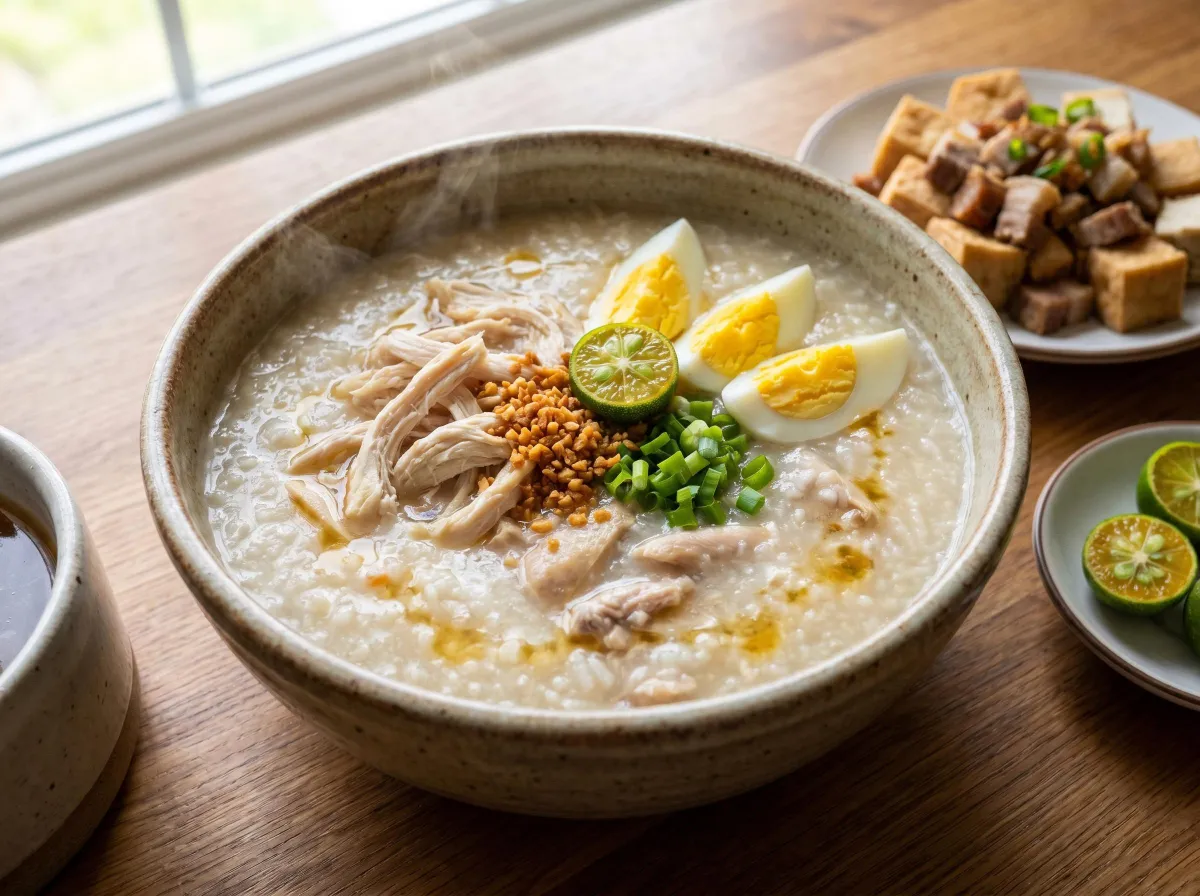
Arroz caldo is lugaw's most popular form — enriched with chicken, saffron or kasubha (safflower), and sometimes eggs, served with calamansi (Philippine lime) squeezed over the top. The name comes from the Spanish arroz (rice) and caldo (broth), a remnant of three hundred years of colonial presence that Filipino cooking absorbed and made entirely its own.
Goto is lugaw made with beef tripe — a more robustly flavored version, deeply savory, traditionally served with toasted garlic, green onions, and tokwa't baboy (crispy tofu and pork) on the side. It is the version sold at merienda counters and street stalls, the one that smells incredible from half a block away.
Champorado takes the same rice porridge method and turns it sweet — chocolate (traditionally made with tablea, compressed balls of roasted cacao) is stirred into the rice as it cooks, producing a thick, dark, sweet porridge served with a splash of evaporated milk and sometimes tuyo (dried salted fish) alongside as a salty counterpoint. This combination — sweet and salty, warm chocolate and cold milk — is one of the most uniquely Filipino breakfast experiences in existence.
Arroz caldo with tokwa't baboy pairs the ginger porridge with crispy fried tofu and boiled pork belly dressed in soy sauce and vinegar — a complete merienda plate that has been a Filipino institution for generations.
What unites all of them is the base: slow-cooked rice, broken down by time and liquid until it becomes something entirely new. Lugaw does not keep the rice intact. It transforms it — which is, perhaps, part of why it is so comforting.
📜 The Story Behind It
Lugaw's origin story is a long one, because lugaw itself is ancient.
Rice porridge is one of the oldest prepared foods in the world. Across Asia, variations of slow-cooked rice have fed people for thousands of years — congee in China and Hong Kong, juk in Korea, kayu in Japan, zhou in Mainland China, bubur in Malaysia and Indonesia. The shared foundation of all of these dishes — rice, water, heat, time — reflects the fact that rice porridge was a practical answer to a universal human need: how do you make a small amount of rice feed a large number of people, especially people who are sick or cold or very young or very old?
The answer has always been the same: cook it slowly in a lot of liquid until it becomes more than the sum of its parts.
Lugaw arrived in the Philippines through a combination of indigenous practice and trade contact with China, whose influence on Filipino cuisine is deep and long-running. Filipino food scholars note that the Chinese community in the Philippines — the Tsinoy — brought their own versions of rice porridge, which over centuries fused with indigenous Filipino cooking traditions and the Spanish colonial influence that arrived in the sixteenth century and reshaped Filipino food vocabulary, ingredients, and technique for the next three hundred years.
The word lugaw itself is believed to be pre-colonial — a Tagalog word with roots in the indigenous practice of cooking rice until soft. The Spanish left their mark not in the dish's foundation but in its names and variations: arroz caldo is pure Spanish vocabulary, and yet the dish is entirely, unmistakably Filipino in flavor and feeling.
What is remarkable about lugaw's history is how it absorbed influence from multiple directions and produced something that belongs entirely to the Philippines. Chinese congee tradition, indigenous rice practices, Spanish vocabulary, the specific Filipino combination of ginger, garlic, fish sauce, and calamansi — all of these came together in a single bowl that tastes like none of its source influences and entirely like itself.
That, too, is a deeply Filipino story: taking what arrived from outside and returning something entirely new.
👅 What Does Lugaw Taste Like?
Lugaw tastes like warmth made edible.
This is not a poetic exaggeration — it is actually the most accurate description available. Lugaw's defining flavor characteristic is not complexity or brightness or intensity. It is warmth: the slow, gentle heat of ginger working through a creamy rice base, undercut by the savory depth of broth and fish sauce, finished with the sharpness of fried garlic crisps and the fresh green cut of spring onion.
Plain lugaw — the most stripped-back version — is mild, slightly earthy, gently savory, and deeply soothing. It does not demand your attention. It simply feeds you.
Arroz caldo adds the fragrant richness of chicken and the golden warmth of kasubha or saffron to the base, producing a porridge that is more complex and satisfying without losing the fundamental gentleness of lugaw. The calamansi squeezed over the top at the table adds a bright, citrusy note that cuts through the richness and lifts the whole bowl. This is one of the more perfect flavor pairings in Filipino cooking: the squeeze of calamansi over warm rice porridge is both functionally useful and emotionally right.
Goto adds depth and intensity — the beef tripe gives the broth a distinctive, savory richness that plain chicken lugaw does not have. Goto is not a mild porridge; it is a full, assertive bowl that warms from the inside out. It is the version for cold mornings, for recovery, for the kind of hunger that needs something substantial.
Champorado tastes exactly like what it is: rich, dark chocolate porridge, sweet and thick, made slightly wilder by the addition of cold evaporated milk poured over the top so it melts into rivulets of cream. It is dessert as breakfast, or breakfast as dessert, and the combination with tuyo — dried salted fish — sounds unlikely to everyone who encounters it for the first time and reveals itself as exactly right to everyone who tries it.
If I had to describe lugaw simply:
Lugaw tastes like someone who loves you decided to put that love in a bowl.
It is not showy. It is not loud. But it is exactly what you needed, and somehow it always knows.
🗺️ Regional Variations Across the Philippines
The Philippines is an archipelago of over 7,641 islands, and lugaw adapts to every corner of it.
Metro Manila and Luzon: The arroz caldo and goto served at karinderya stalls and merienda spots across Manila are considered the benchmark versions — heavily garnished with fried garlic, green onions, and a wedge of calamansi, often accompanied by tokwa't baboy or hard-boiled eggs.
Pampanga: The culinary heartland of the Philippines, Pampanga is home to some of the most richly flavored arroz caldo in the country, often using native chicken (manok na pinaso) for a more intense broth. Kapampangan cooks are not subtle with their garlic.
Bicol: Bicolano versions of lugaw may incorporate coconut milk into the base — a reflection of Bicol's deep love for gata (coconut milk), which turns the porridge richer and slightly sweeter, with a silkier texture.
Visayas: In the Visayan region, lugaw-style dishes often appear under different local names — pospas in some areas refers to a similar rice porridge dish, sometimes made with banana or other local starch additions. The garnishes shift regionally, sometimes featuring local vinegar-dressed side dishes.
Mindanao: Muslim Filipino communities in Mindanao have their own porridge traditions that reflect both indigenous cooking and the influence of neighboring Malaysia and Indonesia. Spice profiles differ — turmeric appears more frequently, and the garnishes may include different fresh herbs.
Ilocano tradition: Ilocanos, known for their resourceful cooking, make lugaw with whatever is at hand — sometimes leftover rice cooked down in fresh broth, sometimes with river fish, always deeply practical and deeply good.
The thread connecting all of them is this: slow-cooked rice, ginger warmth, and the knowledge that someone made this for you on purpose.
🗣️ Learn the Tagalog
One of the most meaningful ways to connect with lugaw is through the language that lives around it.
Filipino food vocabulary is not only about ingredients and techniques. It is about the rituals around a bowl — who made it, when they made it, what they said when they put it in front of you.
The dish and the action:
Lugaw (loo-gaw) — the porridge; the dish itself
Arroz caldo (ah-ros kahl-doh) — the chicken rice porridge variation; from the Spanish
Goto (goh-toh) — beef tripe rice porridge
Champorado (chaam-poh-rah-doh) — sweet chocolate rice porridge
Magluto ng lugaw (mag-loo-toh nang loo-gaw) — to cook lugaw
Pakuluan (pah-koo-loo-ahn) — to bring to a boil; the first step
The ingredients:
Bigas (bee-gas) — uncooked rice
Sabaw (sah-baw) — broth or soup
Luya (loo-yah) — ginger; the soul of lugaw
Bawang (bah-wang) — garlic
Sibuyas (see-boo-yas) — onion
Patis (pah-tees) — fish sauce
Dahon ng sibuyas (dah-hon nang see-boo-yas) — green onions / spring onions
Calamansi (kah-lah-mahn-see) — Philippine lime, squeezed over the top at the table
Itlog (eet-log) — egg
Kasubha (kah-soob-hah) — safflower, the local substitute for saffron that gives arroz caldo its golden color
At the table:
Kumain ka na (koo-mah-in kah nah) — eat now; often said with gentle urgency to someone who needs to eat
Mainit pa, ingat (mah-ee-nit pah, ee-ngat) — it's still hot, be careful
Lagyan mo ng calamansi (lag-yahn moh nang kah-lah-mahn-see) — put calamansi on it
Gusto mo bang dagdag na bawang? (goos-toh moh bang dag-dag nah bah-wang) — do you want more garlic?
Para sa iyo ito (pah-rah sah ee-yoh ee-toh) — this is for you; perhaps the most important sentence in Filipino food culture
These words matter because lugaw is not a restaurant performance dish — it is a home language. Kumain ka na matters because someone is worried about you. Para sa iyo ito matters because the whole point of lugaw, in the end, is that someone made it specifically, deliberately, for you.
🤩 Fun Facts About Lugaw
1. Lugaw has been used as medicine in the Philippines for centuries. Before modern pharmaceuticals, and alongside them, Filipino healers and mothers have long prescribed lugaw for the sick, the recovering, the very young, and the very old. Its ease on the digestive system, its warmth, and its hydration content made it practically medicinal — and many Filipinos today still reach for a bowl of arroz caldo the moment a fever arrives.
2. The word lugaw is likely pre-colonial. While Spanish colonization left deep marks on Filipino food vocabulary — arroz, caldo, champorado — the word lugaw itself is believed to be a native Tagalog term with roots far older than the colonial period. It is one of the words that survived centuries of outside influence intact.
3. Champorado was influenced by Mexican chocolate trade. The Spanish colonial connection between the Philippines and Mexico (via the Manila Galleon trade route) brought cacao to the Philippines, which eventually became tablea — the compressed cacao used in traditional champorado. This means champorado carries traces of a Pacific trade route that shaped both Filipino and Mexican food culture simultaneously.
4. Goto is the porridge of early mornings and late nights. In Manila and other major Philippine cities, goto stalls are famous for operating during the hours when most restaurants are closed — very early in the morning and very late at night. Goto has become the unofficial food of taxi drivers, market vendors, nurses finishing overnight shifts, and anyone who needs something hot and real at three in the morning.
5. The fried garlic on top is non-negotiable. Ask any Filipino what lugaw needs, and the first answer will almost always be bawang — garlic, fried in oil until golden and crispy, then scattered generously over the top of the bowl. This garnish transforms the porridge from plain to complete. The crunch of fried garlic against the smooth porridge is one of the most satisfying textural contrasts in Filipino cuisine.
6. Calamansi is the secret ingredient that changes everything. The squeeze of calamansi over arroz caldo at the table is not optional — it is transformative. The bright, sour citrus cuts through the richness of the porridge and ginger, lifting the entire bowl into something more complex and alive. Filipino cooks understand this as instinctively as Italian cooks understand lemon over fish.
7. Lugaw has become a symbol of community care in disaster response. After typhoons, earthquakes, and floods — which the Philippines faces regularly due to its geographic position — lugaw is one of the first foods prepared by community kitchens and relief organizations. It feeds many people from a small amount of rice, it requires no utensils to eat, it warms and nourishes quickly, and it is made from ingredients that survive emergency conditions. Lugaw is both practical and symbolic: in difficult moments, a bowl of porridge means someone is still taking care of you.
8. Arroz caldo is a popular cure for a hangover. Alongside its medical reputation for illness, arroz caldo has an equally beloved reputation as a hangover remedy. The warm broth, the ginger's stomach-settling properties, and the gentle nourishment of the rice make it a culturally accepted prescription for the morning after a celebration. In the Philippines, this is not a folk remedy — it is simply known.
9. Lugaw vendors are a fixture of Filipino street food culture. Across the Philippines, lugaw vendors push carts or set up simple stalls at specific corners of their neighborhoods — often appearing early in the morning and again in the late afternoon merienda hours. Regulars know their vendor by name, know exactly how the porridge is seasoned, and have been eating from the same cart for years. This is hyperlocal food culture at its most personal.
10. The ratio of rice to liquid is everything. Experienced lugaw cooks do not use a recipe for the liquid ratio — they cook by feel, watching how the rice moves in the pot, adjusting the broth as they go. The goal is a porridge that is thick but not stiff, flowing but not soupy — a consistency that Filipinos describe as malapot (thick and sticky). Getting there requires patience and attention, which is perhaps why lugaw cooked by someone who loves you always tastes better than the kind you make when you're just cooking for yourself.
11. Lugaw has gone viral on Filipino cooking content. On TikTok and YouTube, Filipino food creators filming arroz caldo and goto recipes regularly attract hundreds of thousands of views — particularly from the diaspora, who watch these videos late at night in foreign cities and feel, for a moment, like they are back in a kitchen that smells like ginger. The comment sections of these videos are full of people talking about their grandmothers, their childhoods, and the specific way their family's version tasted. No other Filipino dish generates this particular kind of comment.
12. Lugaw teaches you something important about Filipino values. The act of making lugaw for someone is a cultural statement. It says: I see that you are not well, or not your best, or not okay — and I am going to do this specific, patient, loving thing for you. It requires time. It requires attention. It requires someone to stand at a stove and stir. In a culture where food is love made concrete, lugaw is perhaps the most direct expression of that truth.
🌍 How Lugaw Connects Filipinos Everywhere
Lugaw travels differently than other Filipino foods.
Unlike lechon, which requires equipment and ceremony, or halo-halo, which requires specific cold infrastructure, lugaw requires almost nothing. Rice. Water or broth. Ginger. Garlic. Time. These are ingredients available in every country on earth. And yet, somehow, lugaw still carries the specific geography of the Philippines inside it — because the flavor is not just in the ingredients, but in the technique, the garnishes, and the intention behind the cooking.
For the estimated 12 million Filipinos living outside the Philippines, lugaw often becomes the first Filipino dish attempted in a new country — because it can be made without a special grocery store, without unusual equipment, without anything that is not available at the nearest supermarket. And yet it tastes unmistakably like home. The ginger, the patis, the fried garlic, the squeeze of lime over the top — these elements, in combination, create a flavor that exists nowhere else in quite this form.
Filipino community spaces abroad have always been built partly around food, and lugaw has a specific role in that world. During the COVID-19 pandemic, Filipino community kitchens in cities around the world cooked and distributed arroz caldo to healthcare workers — a profound moment that reflected the Filipino understanding of food as care, and lugaw as the food of care. A bowl handed to someone working a difficult shift said what words could not easily say.
At the same time, lugaw has begun attracting genuine attention from non-Filipino food communities. Filipino restaurants abroad that include arroz caldo or goto on their menus often find these dishes become unexpected favorites — the thing non-Filipino diners did not expect to order but could not stop talking about afterward. The flavor profile is familiar enough (rice porridge exists in many cultures) but specific enough (that particular combination of ginger, garlic, fish sauce, and calamansi) that it leaves a distinct impression.
Food writers and culinary journalists covering the rise of Filipino cuisine internationally have noted that lugaw-style dishes offer an accessible entry point: they are visually approachable, comforting in texture, and deeply satisfying without being aggressively unfamiliar. They are the kind of dish that builds new fans and reminds old ones why they were fans in the first place.
But in the end, lugaw's international story is mostly a story told in home kitchens. It is the Filipino nurse in London who makes arroz caldo on a Sunday afternoon because it is the thing that makes the apartment smell like her mother's house. It is the Filipino student in Toronto who calls their lola to ask how much ginger to use, and stands at the stove stirring while the conversation goes on. It is the Filipino family in California who pulls out a pot of goto on a cold December morning because cold mornings require it.
Lugaw travels because it is light enough to carry. And it arrives, always, exactly when it is needed.
❓ FAQ — Everything You Need to Know About Lugaw
What is lugaw? Lugaw is a Filipino rice porridge — white rice slow-cooked in broth or water with ginger, garlic, and onion until the grains break down and the mixture becomes thick and smooth. It is one of the most comforting and culturally significant dishes in Filipino cuisine, served in variations ranging from plain porridge to arroz caldo (chicken), goto (beef tripe), and champorado (sweet chocolate).
What is the difference between lugaw, arroz caldo, and goto? All three are Filipino rice porridges sharing the same fundamental cooking method. Plain lugaw is the most stripped-back version — simple rice porridge with ginger and garlic. Arroz caldo adds chicken and often kasubha (safflower) for golden color and richer flavor. Goto uses beef tripe for a more robustly savory porridge. Each has its own tradition, garnishes, and ideal eating occasion.
What does lugaw taste like? Lugaw tastes warm, gently savory, and deeply comforting. Its defining flavor notes are ginger (fragrant and warming), garlic (aromatic and slightly sharp in its fried garnish form), and the mild savory depth of broth and fish sauce. The texture is smooth and thick — more substantial than soup, gentler than solid food. Arroz caldo adds the richness of chicken and the brightness of calamansi; goto adds the deep, assertive flavor of beef tripe broth.
What are the toppings for lugaw? Classic lugaw and arroz caldo toppings include: crispy fried garlic (toasted in oil until golden), sliced green onions, a soft-boiled or poached egg, and a wedge of calamansi (squeezed over the bowl just before eating). Some versions add toasted pork rinds (chicharon), pork blood (for goto), or a drizzle of sesame oil.
Is lugaw the same as congee? Lugaw and congee share the same fundamental technique — rice cooked in excess liquid until it becomes porridge — and likely share historical roots in the Chinese culinary tradition that influenced Filipino cooking. But the two are distinct dishes with different flavor profiles. Filipino lugaw is defined by ginger, garlic, fish sauce, and calamansi; Chinese congee typically uses different aromatics and condiments. They are related, not interchangeable.
Why do Filipinos eat lugaw when they are sick? Lugaw has been used as recovery food in the Philippines for generations because it is easy on the digestive system, hydrating, warm, and nourishing without requiring significant digestive effort. Ginger — a key ingredient — is widely recognized for its anti-nausea and anti-inflammatory properties. In Filipino culture, lugaw during illness is both practically useful and emotionally significant: it is proof that someone is taking care of you.
What is champorado? Champorado is the sweet variation of lugaw — a chocolate rice porridge traditionally made with tablea (compressed roasted cacao), cooked into the rice as it simmers. It is typically served with evaporated milk poured over the top and, in a beloved Filipino combination, alongside tuyo (dried salted fish) as a salty counterpoint to the sweetness. It is a traditional Filipino breakfast dish.
Can you make lugaw at home? Yes, and easily. The core ingredients — white rice, broth or water, ginger, garlic, and onion — are available everywhere. Arroz caldo adds chicken pieces and kasubha or a pinch of saffron. The key is patience: the rice needs time at a gentle simmer to break down fully. Fish sauce (patis) is the essential Filipino seasoning, though soy sauce can substitute. Calamansi is ideal but lime or lemon juice works in its place.
What is the right consistency for lugaw? Filipino cooks describe ideal lugaw as malapot — thick, cohesive, and slightly sticky, but still fluid enough to pour slowly from a ladle. It should not be soupy (too loose) or stiff (too dry). The rice grains should have broken down enough to be unrecognizable as individual grains, absorbed into the porridge body. Achieving this takes time and occasional stirring.
What do you serve with lugaw? Lugaw is often served alongside: tokwa't baboy (crispy tofu and boiled pork belly in soy-vinegar dressing), hard-boiled eggs, chicharon (pork rinds), steamed or fried dumplings (siomai), or simply on its own with its garnishes. Goto in particular is classically accompanied by tokwa't baboy as a complete merienda or meal.
💛 Closing
Lugaw is not the most dramatic dish in Filipino cuisine. It will not make you stop and stare the way lechon does, or make you reach for your camera the way halo-halo does. It is quieter than that, and it has always been quieter than that — because the people who need lugaw most are usually not in the mood for spectacle.
What lugaw offers instead is something rarer: the feeling of being looked after. Of sitting down to something warm that someone made slowly, with care, because they wanted you to feel better. That feeling does not require elaborate ingredients or impressive technique. It requires time, attention, and ginger.
Lugaw has traveled from ancient rice-cooking traditions through Chinese trade influence, Spanish colonial vocabulary, and the specific creativity of Filipino hands and kitchens — and it has arrived, in the twenty-first century, as one of the most beloved and emotionally resonant dishes in Filipino culture anywhere in the world. It feeds communities after disasters. It heals people after illness. It comforts people after difficult days and warms people through foreign winters. It shows up in the comment sections of TikTok videos about grandmothers' recipes, in apartment kitchens in cities the Philippines can barely reach, in styrofoam cups at street corners at five in the morning.
And it always does what it came to do.
At Studio Tributes, we celebrate Filipino culture through food, art, and the stories that travel with both. Whether you are tasting lugaw for the first time or returning to it after years away, we hope this gave you a warmer, more complete way to understand one of the Philippines' most quietly magnificent dishes.
Keep exploring Filipino food and culture with us:
👉 Get your FREE Filipino coloring pages here
🎨 Get our Filipino Food Activity Book on Amazon
📚 Read more Filipino food stories on our blog
💭 A Memory to Hold Onto
Did lugaw bring back a specific morning for you?
Maybe a bowl set beside you on a sick day when you could barely sit up. Maybe the smell of ginger coming from the kitchen before you were fully awake. Maybe a cup of goto at a counter somewhere, hands wrapped around it in the early cold.
What was always in your family's lugaw? Was it the garlic on top that you loved most, or the calamansi, or the egg? Who made it for you — and what did they say when they handed it to you?
If a memory came to mind, share your lugaw story on Facebook or Instagram and tag @StudioTributes — we would love to celebrate it with you. And if you would like more warm Filipino food stories, cultural memories, and creative inspiration, come spend time with us on social media.
Read Next
📚 References & Further Reading
Wikipedia — Lugaw — Primary reference for ingredient overview, dish classification, and cultural context. Includes the 1613 Vocabulario de la Lengua Tagala documentation of lugaw as one of the earliest historically recorded Filipino dishes.
Wikipedia — Arroz Caldo — Reference for the chicken rice porridge variation, its Spanish colonial naming origins (arroz + caldo), and its relationship to Chinese congee tradition brought to the Philippines.
Wikipedia — Goto (food) — Reference for the beef tripe porridge variation, its full name (arroz caldo con goto), and its Hokkien etymological roots (gû-tǒ͘ = ox tripe).
Wikipedia — Champorado — Reference for the chocolate rice porridge variation and its origins tracing to the Mexican champurrado introduced via the Manila Galleon trade route during the Spanish colonial period.
TasteAtlas — Lugaw — Global culinary database entry for Filipino lugaw with ratings and cultural notes. Arroz caldo ranked 2nd (4.3 stars), lugaw 9th (4.1 stars), and champorado 19th (3.9 stars) among the world's 50 best porridges.
TasteAtlas — Arroz Caldo — Dedicated entry for the chicken rice porridge variation, including its Spanish-community adaptation of Chinese congee tradition in colonial Philippines.
Wikipedia — Filipino Cuisine — Broad reference for Filipino food traditions, colonial culinary history, and the multi-layered cultural influences (Austronesian, Chinese, Spanish, American) that shaped Philippine cooking. Used in place of Encyclopaedia Britannica, which does not maintain a dedicated Philippine cuisine article.
Kulinarya: A Guidebook to Philippine Cuisine — Glenda Rosales Barretto, Margarita Fores, Ninah Ramos, and Michaela Fenix (Anvil Publishing, 2008). Print reference for regional variation context and Filipino cooking technique. Available via major booksellers and Philippine cultural libraries.
Doreen Fernandez, Palayok: Philippine Food Through Time, On Site, In the Pot (Bookmark Inc., 2000). Print reference for the historical and cultural dimensions of Filipino rice dishes and food identity. Fernandez is considered the foremost scholar of Filipino food culture and culinary history.