
What Is Turon? The Filipino Fried Banana Snack That Tastes Like 3 o'Clock
Studio Tributes / Filipino Food / What Is Turon?
Table of Contents
🍌 The Saba Banana — The Only Banana for Turon
🍬 The Caramelized Sugar — The Technique That Makes It Special
🍈 The Jackfruit — The Optional Addition That Becomes Essential
🌍 How Turon Connects Filipinos Everywhere
❓ Turon Quizzes / Interactive Game - Build your Perfect Turon
What Is Turon?
Filipino Fried Banana Spring Roll That Tastes Like the Best Afternoon of Your Childhood
It is 3 o'clock in the afternoon in the Philippines.
The heat is at its most insistent. School has just let out or the office shift has just ended. Somewhere nearby — at a street corner, at a market stall, in a neighbor's kitchen — something is being fried in hot oil with brown sugar, and the smell of it is reaching you before you can see what it is.
Caramelized banana. Crisping lumpia wrapper. The particular sweetness of brown sugar turning amber in a wok. The sound of the sizzle — not aggressive, not violent, but steady and warm — a sound that means something good is almost ready.
That is turon. And that is merienda — the Filipino afternoon snack that fills the gap between lunch and dinner with something sweet, something hot, something uncomplicated in all the best ways.
Turon is one of the most beloved street foods in the Philippines. It is also one of the most democratic — sold for a few pesos at roadside stalls and served as an elegant dessert at hotel restaurants with a scoop of ice cream and a drizzle of caramel on top. The same dish, the same spirit, in very different contexts. That range is not a contradiction. It is exactly what makes turon Filipino.
According to Wikipedia, turon — also known as lumpiang saging or "banana lumpia" — is a Philippine snack made of thinly sliced bananas rolled in a spring roll wrapper, fried until the wrapper is crisp, and coated with caramelized brown sugar. The word is Spanish in origin, but the candy it shares a name with — the Spanish turrón, an almond nougat confection — bears no resemblance to the Filipino dish whatsoever.
The wrapper is Chinese. The name is Spanish. The banana is Filipino. The caramelized sugar that coats everything is genius — and entirely the point.
At Studio Tributes, we celebrate Filipino food because it carries more than flavor — it carries time of day, memory, childhood, and the specific warmth of an afternoon that asked nothing of you except to eat something delicious. Today we are going deep into turon: where it comes from, what makes the saba banana irreplaceable, how the caramelized sugar works, every variation that exists, and why this modest street food has been making Filipino afternoons better for generations.
🍌 What Is Turon?
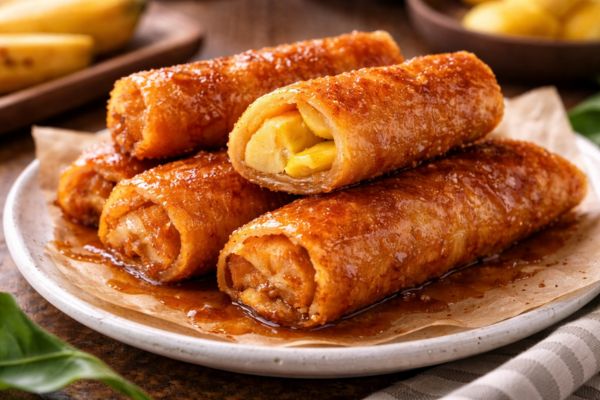
Turon (too-ron) is a Filipino deep-fried snack and dessert made with saba bananas — the thick, starchy cooking banana native to the Philippines — sliced lengthwise, coated in brown sugar, optionally filled with strips of ripe jackfruit (langka), wrapped in a thin spring roll or lumpia wrapper, deep-fried until golden and crisp, and finished with a glaze of caramelized brown sugar that coats the entire exterior in a sweet, crunchy shell.
According to Wikipedia's entry on turon, it is most commonly consumed during merienda — the Filipino afternoon snack period, typically around 3 pm — or as a dessert. It is a popular street food, usually sold alongside banana cue, camote cue, and maruya at the same stalls, often wrapped in wilted banana leaves with the snacks skewered on bamboo sticks.
The essential ingredients:
🍌 Saba banana — the only banana for authentic turon; thicker, starchier, and more intensely flavored than the Cavendish bananas most of the world knows
🍬 Brown sugar / asukal na pula — for the initial coating before frying and for the caramelized shell that forms during and after frying
🥟 Lumpia wrapper — thin spring roll wrappers, derived from Chinese culinary tradition; the wrapper that gives turon its essential crunch
🍈 Langka — ripe jackfruit, the most beloved optional addition; sweet, fragrant, chewy strips that perfume the interior
🛢️ Cooking oil — for deep frying; traditionally coconut oil in the Philippines, which adds a faint nutty warmth to everything it touches
The optional but beloved additions:
🍠 Kamote — sweet potato, cubed and added for starchy sweetness
🥭 Mangga — ripe mango, for a more tropical, fragrant variation
🧀 Keso — cheese, for the sweet-salty turon variation that has become increasingly popular
🥥 Niyog — grated coconut, in some traditional regional versions
📜 The Story Behind It
The story of turon is the story of many great Filipino foods: a meeting of cultures, a surplus that became a tradition, and a technique adapted so naturally to local ingredients that the result feels like it could not have been invented anywhere else.
The spring roll wrapper — the thin, pale sheet that becomes the crunchy exterior of turon — has its origins in Chinese culinary tradition. When Chinese traders and immigrants arrived in the Philippines, they brought with them the techniques for making thin wrappers from flour and water, used in savory preparations like lumpia (spring rolls). The Hokkien-speaking traders who established the world's oldest Chinatown in Binondo, Manila, in 1594 brought these wrapper-making techniques into the Philippine culinary world, where they were quickly adopted and adapted.
The key adaptation for turon was the pivot from savory to sweet. Where Chinese spring roll wrappers enclosed meat and vegetables, Filipino cooks discovered that the same wrapper — fried hot and fast in oil — creates the perfect vessel for a sweet filling. The saba banana, which grows abundantly across the Philippine archipelago and had been eaten by Filipinos since long before Chinese traders arrived, became the obvious filling. The combination of a Chinese wrapper technique and a Filipino tropical fruit created something that belonged to neither tradition alone.
The name turon arrived with the Spanish colonial period — a Spanish-sounding word applied to a distinctly Filipino-Chinese creation. As Wikipedia notes, the word is etymologically Spanish in origin, but bears no similarities to the Spanish candy turrón, which is an almond nougat confection. It is one of those colonial-era namings that tells you more about the history of language in the Philippines than about the history of the dish itself.
The origin story most often told is a practical one: saba bananas grow in such abundance across the Philippine islands that there was always surplus. Families living near banana plantations received extra fruit from the harvest; they fried it wrapped in lumpia wrappers and sold it at roadside stalls to make use of what would otherwise go to waste. The surplus became snack. The snack became street food. The street food became one of the most recognizable flavors of Filipino childhood.
What the banana harvest story captures is something true about turon regardless of the specific details: this is a dish built on abundance. The Philippines has always had an extraordinary relationship with the banana — with 12 different varieties grown across the archipelago, banana appears in savory dishes, sweet desserts, street snacks, and drinks. The saba in particular is a native Philippine hybrid, and it is the banana that makes turon what it is.
🍌 The Saba Banana — The Only Banana for Turon
You cannot make authentic turon with a Cavendish banana — the standard yellow banana found in supermarkets worldwide. This is not snobbery. It is simple chemistry and texture.
The saba (Musa acuminata x balbisiana) is a hybrid variety native to the Philippines, widely recognized as the country's most popular cooking banana. It is shorter and stubbier than the Cavendish, with a thicker skin that goes from green to pale yellow to spotted brown as it ripens. Its flesh is starchy, dense, and firm — qualities that make it completely unsuited for eating raw (unlike the sweetness-forward Cavendish) but ideal for cooking, frying, and caramelizing.
When a saba banana is fried:
The starch converts slowly to sugar under heat, creating a deep natural sweetness that is different from — and better for this dish than — the instant softness of a Cavendish
The dense flesh holds its shape inside the wrapper rather than collapsing into mush
The starchiness absorbs the brown sugar coating and the heat of the oil in a way that creates the characteristic chewiness inside the crisp wrapper
The natural sugars caramelize at high heat to contribute to the exterior glaze
Cavendish bananas, by contrast, become mushy almost immediately when deep-fried — they do not have the structural integrity to survive the hot oil while maintaining their character. The saba is built for this.
For Filipinos living abroad where saba bananas are not available, plantains are the closest substitute — they share the starchy, cooking-appropriate qualities of the saba and behave similarly in the fryer. The flavor is slightly different, but the structural qualities are preserved. Cavendish bananas are not recommended under any circumstances.
🍬 The Caramelized Sugar — The Technique That Makes It Special
The most important thing to understand about turon is that the sugar coating is not simply a topping. It is a two-stage cooking technique that is essential to the dish's identity.
Stage 1 — The pre-fry coating: Before the banana is wrapped in the lumpia wrapper, it is rolled in brown sugar. This sugar coating serves two purposes: it adds sweetness directly to the banana, and it begins caramelizing as soon as it contacts the hot oil, contributing to the flavor from the inside of the fry.
Stage 2 — The wok caramel: As the turon fries, additional brown sugar is added to the oil in the wok. This sugar dissolves in the hot oil and coats the outside of the turon as it fries, creating a thin, brittle, amber-colored caramel shell on the exterior of the spring roll wrapper. When the turon is removed from the wok, this caramel recrystallizes as it cools — slightly — into the crunchy, sweet, shattering outer coat that makes turon distinct from any other fried banana preparation.
This is the technique that separates turon from banana fritters. Banana fritters are coated in flour batter before frying. Turon uses a spring roll wrapper and a sugar-caramel technique that produces an entirely different result — thinner, crunchier, less bready, and more genuinely caramelized.
The best turon has a caramel coat that you can hear — a faint crackle as you bite through it, followed immediately by the crunch of the lumpia wrapper, followed by the dense, sweet, slightly chewy banana inside, with the occasional perfumed sweetness of a jackfruit strip if you are lucky.
That sequence of sounds and textures — crack, crunch, chew — is turon. Everything else is something else.
🍈 The Jackfruit — The Optional Addition That Becomes Essential
Jackfruit — langka in Tagalog — is the optional filling that most Filipinos consider not really optional at all.
A small strip of ripe jackfruit, placed alongside the sugared banana slice before wrapping, does something specific to turon that no other addition replicates. The jackfruit is intensely sweet, slightly fermented-tropical in its ripeness, chewy in a way that contrasts with the soft banana, and — most importantly — aromatic. The scent of ripe jackfruit is one of the most distinctive tropical fruit smells in existence. When it cooks inside the hot wrapper alongside the banana and the caramelizing sugar, it perfumes the whole interior of the turon with a fragrance that is warm, sweet, and unmistakably tropical.
It is the jackfruit that makes you smell the turon before you taste it. It is the jackfruit that makes each bite smell like a Philippine afternoon. It is the jackfruit that turns a good fried banana into something memorable.
The strips are small — barely a few centimeters, placed diagonally against the banana slice before rolling. They do not dominate the flavor. They contribute it. The banana is the substance; the jackfruit is the fragrance.
👅 What Does Turon Taste Like?
Turon tastes like the afternoon it was made for.
The caramel shell cracks when you bite in — not dramatically, but with the satisfying brittleness of properly caramelized sugar. Beneath it, the lumpia wrapper is paper-thin and crisp, golden from the oil, carrying the warmth of the fry. Then the banana: dense, yielding, starchy-sweet, not mushy but soft, the kind of cooked banana that tastes more deeply of itself than a raw one ever could.
The brown sugar is everywhere — in the caramel coat, in the banana, in the occasional sticky pocket where the sugar has pooled at the fold of the wrapper. It is not a refined sweetness. It is a muscovado sweetness — deep, slightly molasses-forward, with the warmth of sugarcane that was not fully refined away.
And then the jackfruit — if you have a good one, with jackfruit — arrives in the mid-bite with its tropical sweetness and that particular languid aroma that says tropics before your brain has finished processing the flavor.
Together: sweet, crunchy, chewy, warm, fragrant. Something that satisfies immediately and thoroughly. No complexity required. No sauce necessary. Just the turon, hot from the wok, in your hand.
If I had to describe it simply:
Turon tastes like 3 o'clock in the Philippines. The best 3 o'clock you can remember.
🗣️ Learn the Tagalog
The language around turon is the language of street corners, afternoon warmth, and the specific Filipino vocabulary of merienda — the sacred daily pause for something sweet and small.
The dish:
Turon (too-ron) — the dish itself; the word is Spanish in origin but entirely Filipino in meaning
Lumpiang saging (loom-pee-ahng sah-ging) — banana lumpia; the descriptive Tagalog name
Sagimis (sah-gee-mees) — the old Batangas term for turon; a portmanteau of saging (banana) and matamis (sweet); still used by older Batangueños
Valencia (vah-len-see-yah) — what turon is called in Malabon, where the mung-bean version takes the name "turon" instead
The ingredients:
Saba (sah-bah) — the cooking banana; the only banana for proper turon
Langka (lahng-kah) — jackfruit; the beloved optional filling
Asukal na pula (ah-soo-kahl nah poo-lah) — brown sugar; what gives turon its color and its caramel coat
Lumpia wrapper — the thin spring roll wrapper; Chinese in origin, Filipino in application
Niyog (nee-yog) — coconut; used in some regional versions
Kamote (kah-moh-teh) — sweet potato; sometimes added to the filling
The merienda context:
Merienda (meh-ree-en-dah) — the afternoon snack, typically around 3 pm; where turon lives
Manong / Manang (mah-nong / mah-nahng) — the respectful term for a street vendor (uncle / auntie); how you would address the turon vendor
Pabili ng turon! (pah-bih-lee nang too-ron) — I'd like to buy turon! (the phrase every Filipino child knows)
Mainit pa! (mah-ee-nit pah) — Still hot! (what the vendor calls out to attract buyers)
Isang turon lang, Manong. (ee-sahng too-ron lahng, mah-nong) — Just one turon, sir.
That last phrase carries something gentle in it. The lang — "just" — is a Filipino linguistic softener that makes even a commercial transaction feel polite and human. One turon, please. Just that, and I'm good.
🎨 Color It!
Bring Filipino food to life in a whole new way — through art.
Turon is one of the most warmly visual Filipino foods to color. The palette is golden: the amber-brown of the caramelized sugar coat, the deep gold of the fried lumpia wrapper, the pale warm yellow of the banana visible at the cut end, the occasional bright yellow-green of a jackfruit strip peeking through. Set against a banana leaf on a street vendor's cart, with the wok of hot oil and the afternoon light — it is a composition of warm, rich, earthy tones that feels immediately like the Philippines.
When you sit with a turon coloring page and choose your golds and ambers, something happens. You think about where you ate it. The street corner. The school gate. The market stall. Whether the vendor wrapped it in a small piece of banana leaf or a paper bag. Whether it was still so hot you had to blow on it before the first bite. Whether the jackfruit was in it — and whether you got lucky and got a piece with more jackfruit than banana, or the other way around.
Our Filipino Food Coloring Book on Amazon was built from exactly that belief — that coloring a dish is a way of sitting with a memory long enough to really see it. Turon — with its warm colors, its street food intimacy, and its specific place in the daily rhythm of Filipino life — is one of the most accessible and meaningful pages in the book to color.
This makes it especially meaningful for:
🌼 Filipino families who want to remember the merienda rituals of childhood in the Philippines
🌼 Parents raising children abroad who want to introduce the specific joy of Filipino afternoon street food culture
🌼 Anyone in the Filipino diaspora who carries a specific street corner or vendor in their memory
🌼 Non-Filipino friends and partners who want to understand what the afternoon smells like in the Philippines
🌼 Teachers, homeschoolers, and cultural groups exploring Filipino heritage and street food traditions through art
Each page can open a question worth asking: Who was your Manong or Manang — your turon vendor? Where was the stall? Did yours always have jackfruit? Have you ever made it at home? What time of day does the smell of caramelized banana take you back to?
Share your completed turon page on Facebook or Instagram and tag @StudioTributes — we would love to celebrate your version with the whole community.
If you would like to explore Filipino food through art, memory, and family connection, download your FREE Filipino Food Coloring pages — they are waiting for you.
👉 What Filipino Food Are You? Take the quiz →
👉 Get your FREE Filipino coloring pages here.
🍌 Turon Recipe
🤩 Fun Facts About Turon
1. Turon's name is Spanish but has nothing to do with the Spanish candy called turrón. The Spanish candy turrón is an almond nougat confection — hard or soft, entirely different in appearance, flavor, and preparation. Wikipedia explicitly notes this: turon is etymologically Spanish in origin but "bears no similarities to the Spanish candy turrón." The name traveled to the Philippines with colonization; the dish itself came from somewhere else entirely.
2. The saba banana is a native Philippine hybrid. The saba (Musa acuminata x balbisiana) is native to the Philippines and is the country's most popular cooking banana. It is grown across the archipelago, matures slower than other varieties (150 to 180 days after flowering), but is harvested year-round. Its starchy, firm flesh makes it ideal for frying — the quality that makes turon possible.
3. The lumpia wrapper technique came from Chinese traders. The thin spring roll wrappers that give turon its essential crunch were introduced to the Philippines by Chinese traders, through the same culinary exchange that gave the Philippines pansit (noodle dishes). Filipino cooks adapted the Chinese savory spring roll wrapper to sweet fillings — a creative pivot that produced not just turon but also lumpia in all its varieties.
4. The caramelized sugar coating is added during frying, not after. Brown sugar is added directly to the hot oil while the turon fries, dissolving and coating the outside of the wrapper as it cooks. When removed from the oil, this caramel recrystallizes into the brittle, sweet shell that makes turon distinct from any other fried banana preparation. This technique — sugar in the oil — is what separates turon from banana fritters.
5. In Malabon, "turon" means something completely different. In the city of Malabon in Metro Manila, the word "turon" or "turrón" refers to a different fried dessert — one filled with sweet mung beans rather than banana. The banana version is called valencia in Malabon, and the triangular-shaped banana turon there is known as valencia trianggulo. Same wrapper, same frying technique, completely different local vocabulary.
6. Turon is sold on the same cart as its street food siblings. The classic Filipino street food cart groups turon with banana cue (caramelized saba on a stick), camote cue (caramelized sweet potato on a stick), and maruya (banana fritters). All four use saba banana or related crops, all four involve caramelized sugar, and all four are merienda food. They are the afternoon snack family — different expressions of the same impulse.
7. Jackfruit strips are the most beloved addition — but never required. The optional jackfruit (langka) filling is technically optional and never appears in all turon. But most Filipinos who grew up eating turon consider the jackfruit version the ideal. The jackfruit is placed as a thin strip alongside the banana slice before rolling — its fragrance perfuming the interior during frying in a way nothing else replicates.
8. Gourmet turon exists and it is remarkable. Some Manila restaurants serve turon as an elevated dessert — bite-sized and perfect, drizzled with caramel sauce, sometimes topped with a scoop of ice cream, with toasted sesame seeds or latik (coconut milk solids) scattered over the top. The street food remains the standard, but the fine dining version demonstrates the genuine flavor potential of the dish when given more attention and resources.
9. The diaspora makes turon in air fryers. Filipino communities abroad — particularly in the United States and Canada — have widely adapted turon for the air fryer, cooking at approximately 375°F for 8 to 10 minutes to achieve a similar crispness with significantly less oil. The result is different from the wok version — less deeply caramelized, slightly less rich — but remarkably close to the original, and it makes turon accessible in overseas kitchens without the deep frying setup.
10. Batangas province had its own name for turon — sagimis. In parts of Batangas province, turon was historically called sagimis — a portmanteau of saging (banana) and matamis (sweet). The older term is disappearing as turon has become universal, but older Batangueños still recognize and sometimes use it. The word is one of many regional Filipino food names that carry a specific local identity within the broader national food culture.
🌍 How Turon Connects Filipinos Everywhere
Every Filipino who grew up in the Philippines knows what 3 o'clock tastes like.
It does not taste like a meal. It tastes like something smaller, something sweeter, something that arrives in a paper bag or wrapped in banana leaves — something you eat standing at a street corner or at your school gate while the afternoon heat has finally peaked and is beginning to think about declining.
For Filipinos living abroad, turon is one of the first dishes they try to recreate in a new country. It is also one of the most emotionally specific — not because it is complicated (it is not) but because the ingredients are so particular. The saba banana does not exist at the neighborhood grocery store. The lumpia wrappers require a trip to the Filipino or Asian market. The brown sugar needs to be the right kind.
Making turon abroad is always an intentional act — a small deliberate effort to recover something specific about a time of day, a temperature, a smell, a vendor's voice calling mainit pa. The effort is the memory. The effort is the love.
And when you bite into homemade turon in a kitchen in Toronto or London or Dubai — even if the banana is a plantain substitute, even if the caramel is slightly different, even if the jackfruit came from a can rather than a fresh market — it tastes like the Philippines. Not perfectly. But recognizably. Which is sometimes all you need.
❓ Turon Quizzes / Interactive Game - Build your Perfect Turon
❓ FAQ — Turon
What is turon? Turon is a Filipino deep-fried snack and dessert made with saba banana slices coated in brown sugar, wrapped in a thin spring roll (lumpia) wrapper, fried until crisp, and coated with caramelized sugar. According to Wikipedia, it is also known as lumpiang saging (banana lumpia) and is one of the most popular Filipino street foods, typically eaten during afternoon merienda.
What kind of banana is used for turon? Saba bananas — a native Philippine hybrid variety known for its starchy, firm flesh and cooking properties. The saba's density holds up during frying, allowing the natural sugars to caramelize while maintaining shape and texture. Cavendish bananas (the standard yellow supermarket banana) become too mushy when fried. Plantains are the best available substitute for Filipinos living abroad.
What is merienda? Merienda is the Filipino afternoon snack period, typically around 3 pm, equivalent to Spain's merienda tradition. It is a daily institution in Filipino culture — a pause between lunch and dinner for something light and sweet. Turon is one of the quintessential merienda foods, sold by street vendors at the afternoon rush.
Is turon the same as a banana fritter? No. Banana fritters are coated in flour batter before frying, producing a thick, bread-like exterior. Turon uses a thin spring roll wrapper and a caramelized sugar technique that produces a crunchier, thinner, sweeter result. The preparation method, texture, and flavor are distinctly different.
Why is there jackfruit in turon? Jackfruit (langka) is an optional but beloved addition. Small strips of ripe jackfruit are placed alongside the banana before rolling. The jackfruit contributes a tropical sweetness, a chewy texture, and — most importantly — a fragrant aroma that perfumes the interior of the turon during frying. Many Filipinos consider turon with jackfruit the ideal version.
What does the Spanish word "turon" have to do with the Filipino dish? Very little. The Spanish candy turrón is an almond nougat confection with no resemblance to the Filipino dish. The word was applied to the Filipino snack during the Spanish colonial period. Wikipedia notes that turon is etymologically Spanish in origin but bears no similarities to the Spanish turrón candy. The dish itself developed from Chinese lumpia wrapper traditions combined with indigenous Philippine ingredients.
What is "valencia" in relation to turon? In Malabon, a city in Metro Manila, the word "turon" refers to a fried mung bean dessert rather than banana. The banana version is called valencia in Malabon, and the triangular-shaped version is known as valencia trianggulo. This regional naming difference is a good example of how Filipino food vocabulary shifts by geography.
Can turon be made without deep frying? Yes. Air fryers have become a popular method among Filipinos abroad, cooking at around 375°F (190°C) for 8 to 10 minutes. The result is less deeply caramelized than the traditional wok version but achieves a satisfying crispness with significantly less oil. Oven baking is also used, though it produces a less crisp exterior.
What do you eat with turon? Turon is typically eaten on its own as a snack, hot from the fryer. Some Filipinos dip it in spiced vinegar (suka) for a sweet-sour contrast — a less common but genuine variation. Gourmet restaurant versions are often served with ice cream, caramel sauce, or coconut cream. As a street food, it is usually eaten immediately, holding it in a small paper bag to catch the caramel drips.
💛 Closing
Turon is not the most complex Filipino dish. It is not the most historically layered. It does not carry centuries of contested colonial meaning or the kind of cultural weight that makes people argue at family gatherings.
What it has instead is simpler and more immediate: it has the specific smell of an afternoon, the specific sound of something frying, the specific taste of caramelized sugar on a starchy Philippine banana wrapped in something that crackles when you bite it.
The Chinese brought the wrapper technique. The Spanish gave it a name. The Philippine saba banana and the afternoon heat and the resourcefulness of a cooking culture that knew exactly what to do with a surplus harvest did the rest.
The result is something that has been sold at street corners across the Philippines for generations — affordable, accessible, immediately satisfying, and deeply loved in a quiet, matter-of-fact way. Not beloved the way lechon is beloved — with ceremony and occasion and the weight of celebration. Beloved the way 3 o'clock is beloved: reliably, daily, without fanfare, exactly when you need it.
Explore more Filipino food, art, and memory with us:
🎨 Get our Filipino Food Activity Book on Amazon
📚 Read more Filipino food stories on our blog
💭 A Memory to Hold Onto
Did turon bring a specific afternoon to mind?
Maybe a vendor outside your school gate who always called mainit pa as you approached — "still hot!" Maybe helping your lola make it at home, rolling the banana in the sugar before wrapping, getting your fingers sticky with the brown sugar before the first one even made it to the wok. Maybe the specific paper bag it came in, already spotted with oil by the time you reached the next block. Maybe a cold piece of turon from the refrigerator the morning after, reheated in a pan and somehow still good. Maybe making it in a new country with a plantain because you could not find saba, and it was close but not quite, and that not-quite was its own specific kind of homesickness.
Where was your turon vendor? Did you always get the one with jackfruit? Who else was there with you?
If a memory came back — share it with us.
Tag @StudioTributes on Facebook or Instagram with your turon story, or share a photo of your colored page using #StudioTributes and #FilipinoFoodMemories.
We read every single one. 🇵🇭🍌
Explore More Filipino Food Stories
Continue exploring:
• What Is Pandesal?
• What Is Halo-Halo?
• What Is Lechon?
• What Is Pansit?
📚 References & Further Reading
Wikipedia — Turon (food) — Comprehensive entry on turon's ingredients, preparation, regional variations (including the Malabon valencia distinction), etymology, and cultural context. Cited throughout this article.
TasteAtlas — Turon — Traditional Deep-Fried Dessert from Philippines — Global culinary database entry on turon as a traditional Filipino dessert, with cultural and ingredient context.
Tasting Table — "Turon: The Crispy Banana Lumpia You Should Know About" — Accessible cultural overview of turon including the saba banana profile, jackfruit addition, and the surplus harvest origin story.
Grokipedia — Turon (food) — Extended entry on turon's Chinese lumpia wrapper origins, regional variations, cultural significance, and diaspora adaptations including air fryer methods.
Eat Your World — "Turon, Cues in Manila" — Street food guide documenting turon as a Manila merienda staple, with the critical note that turon is not a banana fritter and the distinction between the wrapper technique and flour batter.
Batangas History, Culture and Folklore — "Banana Cue and Turon as They Used to be Called in Batangas" — Cultural documentation of the old Batangas term sagimis for turon and the disappearing regional vocabulary of Filipino street food.
Specialty Produce — Saba Bananas Information and Facts — Botanical and culinary profile of the saba banana as a native Philippine hybrid variety and the primary ingredient in turon.
Encyclopaedia Britannica — Adobo | Description, History, Variations & Uses — Referenced for broader context on the Chinese and Spanish colonial influences that shaped Filipino street food culture.
Panlasang Pinoy — Turon Recipe — Widely used Filipino home cooking reference with classic turon recipe, technique notes, and filling variations.
This article blends Studio Tributes storytelling with cultural and culinary research to create a warm, family-friendly learning experience.