
Kare-Kare: The Filipino Peanut Stew Nobody Can Agree Invented
For many Filipino families, kare-kare is more than a meal. It is the smell of peanut sauce simmering in the kitchen before a family gathering, the sight of steaming rice beside bagoong, and the memory of Lola saying, ‘Kain na'.
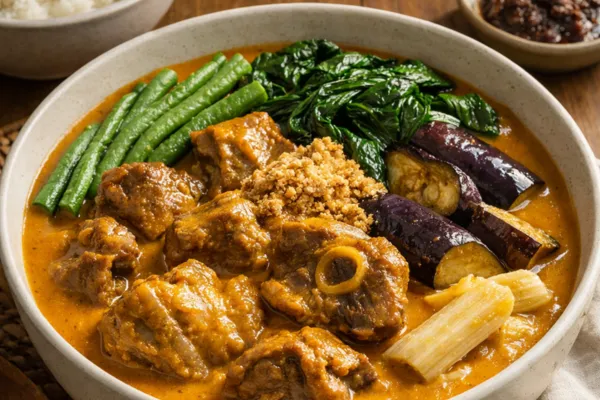
What it is: Arich Filipino stew of slow-cooked oxtail in a thick peanut sauce, colored golden-orange by annatto seeds and thickened with toasted ground rice.
Key ingredients: Oxtail(or tripe/pork hock), ground peanuts, peanut butter, annatto, eggplant, string beans, banana blossom, and bok choy.
The essential pairing: Alwaysserved with bagoong (fermented shrimp paste) on the side — without it, the dish is considered incomplete.
Origin: Disputed— leading theories trace it to Indian sepoys in 1762 Manila, the Kapampangan people of Pampanga, or pre-colonial Moro traders from Southeast Asia.
Name meaning: Likely from "kari,"the Tamil word for curry or sauce; the Filipino reduplication implies thoroughness or intensification.
When it's served: Abeloved fiesta and Sunday family dish throughout the Philippines — a meal that signals the occasion matters.
What Is Kare-Kare? A Warm Guide to the Philippines’ Peanut Stew
📜 The Story Behind It (And Why Nobody Agrees)
🫙 The Peanut Sauce — and Why Bagoong Changes Everything
👅 What Does Kare-Kare Taste Like?
🗺️ Regional Variations Across the Philippines
🗣️ What Is Kare-Kare Made Of? - Learn the Tagalog
What kind of kare-kare are you?
🌍 How Kare-Kare Connects Filipinos Everywhere
❓ FAQ — Everything You Need to Know About Kare-Kare
Where did kare-kare originate?
What does kare-kare taste like?
Why is bagoong served with kare-kare?
Can you make kare-kare at home?
Ask where kare-kare comes from and you will start an argument. Ask how it tastes and everyone will stop arguing — because the answer is exactly the same.
There is a dish in the Philippines that has been feeding families at fiestas, birthdays, and Sunday lunches for hundreds of years, and nobody can agree on where it came from. Some say it traveled from India. Some say it was born in Pampanga. Some say the Moro people of the south brought a version of it long before the Spanish ever arrived. And some say it emerged from the improvised kitchens of Indian soldiers who were left behind after a colonial war most Filipinos barely remember.
The dish is kare-kare. And its origin story is one of the most fascinating puzzles in all of Filipino food.
What everyone agrees on is what it is: a rich, slow-simmered stew built on a thick peanut sauce, colored deep gold by annatto seeds, full of tender oxtail and vegetables, and served alongside a spoonful of bagoong — the salty, funky, fermented shrimp paste that transforms everything it touches. Kare-kare and bagoong are one of Filipino cuisine's most beloved and irreplaceable pairings. Without the bagoong, there is no kare-kare. Not really.
At Studio Tributes, we love dishes that carry more than flavor. They carry history, debate, identity, and memory. Today we are going deep on kare-kare — what it is, where it likely came from, what every element tastes like, and why it remains one of the most important dishes in the entire Filipino culinary tradition.
🥜 What Is Kare-Kare?
Kare-kare is a Filipino stew built around a thick, savory peanut sauce. According to Wikipedia, it is generally made from a base of slow-cooked oxtail, beef tripe, or pork hocks, with vegetables including eggplant, string beans, banana blossom, and leafy greens. The sauce is made from ground roasted peanuts or peanut butter, colored with annatto seeds, and thickened with toasted ground rice.
It is a dish that asks patience of whoever makes it. Oxtail — the traditional protein — needs several hours of simmering before it becomes fall-off-the-bone tender and releases its gelatin into the broth, giving the sauce that particular silky, clinging quality that no shortcut can replicate. When it is done right, the sauce coats everything: the meat, the vegetables, the rice.
A classic kare-kare includes:
Oxtail (buntot ng baka)— the traditional protein; slow-simmered for hours until tender and gelatinous
Ground peanuts + peanut butter— the soul of the sauce; ground peanuts for texture, peanut butter for smooth body
Annatto seeds (atsuete)— gives the stew its unmistakable deep golden-orange color
Toasted ground rice (pinipig gilik)— a uniquely Filipino thickener, adding subtle smoky depth
Eggplant (talong)— absorbs the sauce beautifully; soft and savory when cooked through
String beans / long beans (sitaw)— adds snap and green freshness
Banana blossom (puso ng saging)— tender and meaty; a hallmark ingredient unique to Filipino stews
Bok choy or pechay— leafy greens added near the end for texture and color
Garlic and onion— sautéed as the aromatic base
Bagoong (shrimp paste)— served on the side, not in the pot; the salty, funky counterpart that makes the dish complete
Ready to cook it?The full recipe with quantities, timings, and ginisang bagoong instructions is one click away —print the free recipe card.
Variants exist across every kitchen and every province. Crispy pata (fried pork shank), beef tripe, pork belly, goat, chicken, and even tofu and seafood have all found their way into kare-kare. But oxtail — slow, gelatinous, deeply flavored oxtail — remains the gold standard.
📜 The Story Behind It (And Why Nobody Agrees)
The origin of kare-kare is one of the great unsettled debates in Filipino culinary history — and the fact that it remains unsettled says something important about how Filipino food works.
The most widely circulated story connects kare-kare to the Indian sepoys — soldiers from South India who served under the British during the Battle of Manila in 1762–1764. When the British left after a few years following the Treaty of Paris, many sepoys chose to stay. According to culinary historian Ruston Banal, speaking at KainCon 2024, these soldiers established curry food stalls called "karihan" in Tagalog, which eventually evolved into the carinderias — the small eateries — that feed the Philippines to this day.
The word "kare-kare" itself may trace back to the Tamil wordkari, meaning sauce or curry. Over generations of Filipino adaptation, curry became something else entirely: a peanut stew without the spices, made from local ingredients, colored with local annatto, and thickened in a distinctly Filipino way.
A second theory points to Pampanga — the Culinary Capital of the Philippines — and the Kapampangan people, who had their own version of kari adapted from the Moro people of the southern Philippines. The peanut-based dish bears a striking resemblance to Malaysian satay sauce and Indonesian gado-gado, suggesting the Moro traders may have been the earliest carriers of the peanut-stew tradition across the archipelago.
There is even a theory that kare-kare is pre-colonial. The peanut itself, however, did not arrive in Asia until the Spanish galleon trade brought it from the Americas in the 16th century, which complicates that theory considerably.
What culinary historian Banal found, after searching the archives, was that no definitive documentary evidence places kare-kare's origin anywhere specific. The story is murky in the best possible way — layered with colonial history, trade routes, regional pride, and the quiet creativity of Filipino home cooks who took whatever was available and made something unforgettable.
In that way, kare-kare is deeply, irreducibly Filipino: born from the collision of many worlds, belonging entirely to one.
🫙 The Peanut Sauce — and Why Bagoong Changes Everything
The peanut sauce in kare-kare is not like anything else in Filipino cuisine. It is mild, rich, deeply nutty, and faintly sweet. It does not burn. It does not assault. It wraps.
Ground roasted peanuts form the flavor base. Peanut butter — smooth and unsweetened — gives the sauce its body. Toasted ground rice, a Filipino technique not found in most other peanut-based dishes in the world, acts as the thickener, adding a whisper of smokiness that you cannot quite identify but would immediately miss. Annatto seeds give the sauce that extraordinary deep gold-orange color — one of the most visually distinctive hues in all of Filipino cooking.
And then there is bagoong.
Kare-kare without bagoong is like a sentence without its final word. The peanut sauce is intentionally mild — its richness needs a counterpoint. Bagoong, fermented shrimp paste, provides everything the stew withholds: salt, funk, umami, intensity. One small spoonful stirred into a bite of oxtail and peanut sauce completes the dish in a way that cannot be explained — only tasted. It is one of the most perfect pairings in the entire Filipino table.
Ginisang bagoong — shrimp paste sautéed with garlic, onion, tomato, and sometimes a little pork — is the elevated version, considered by many to be the only proper accompaniment on special occasions. It is served in a small dish beside the stew, not mixed in. You add your own, one bite at a time.
👅 What Does Kare-Kare Taste Like?
Kare-kare tastes like comfort that has been slow-cooked until it became something richer than comfort.
The first thing you notice is the sauce: warm, golden, nutty, and surprisingly gentle. It is not spicy. It does not compete for your attention the way a curry would. It earns it. The oxtail, when properly cooked, is fall-apart tender with a slight gelatinous quality that makes every bite feel substantial.
The vegetables bring relief. String beans snap against the richness of the sauce. Eggplant soaks the peanut broth into itself and becomes silky. Banana blossom — one of the most underappreciated ingredients in Filipino cooking — adds a meaty softness that surprises people who have never eaten it before.
And then bagoong arrives and the whole experience shifts. The salt cuts through the fat. The fermented funk lifts the earthiness. The mild becomes vivid.
Kare-kare tastes like Sunday. Like the kind of meal that takes all morning to make and is gone in twenty minutes because everyone at the table keeps going back for more. Rich but not heavy. Mild but not plain. The bagoong makes it brilliant. The rice makes it a meal. The memory of it makes you want to make it again before the week is over.
🗺️ Regional Variations Across the Philippines
Kare-kare adapts to every corner of the archipelago. The peanut sauce and the bagoong remain — but what goes into the pot changes depending on where you are, and whose kitchen you are in.
Pampanga (Central Luzon)— Classic oxtail kare-kare, considered the national gold standard. Often richer and more deeply seasoned; Kapampangans are regarded as the Philippines' master cooks.
Manila / Metro Manila— Mixed cuts including oxtail, tripe, and pork hock. Restaurant chains like Barrio Fiesta helped popularize a refined version that spread nationally.
Ilocos Region (Northern Luzon)— Goat kare-kare. Goat is more common than oxtail here, producing a stronger, gamier flavor with the same peanut sauce base.
Bicol Region— Spicy kare-kare. Bicolanos are known for their love of chili; bird's eye chilis are added directly to the sauce or the bagoong.
Sulu / Tawi-Tawi (Southern Philippines)— Seafood kare-kare with fish, shrimp, or crab in a peanut sauce — connecting the dish to its possible Moro origins in the south.
Diaspora / Modern— Vegan and vegetarian kare-kare with tofu, jackfruit, or mushroom. The peanut sauce carries the dish even without oxtail.
🗣️ What Is Kare-Kare Made Of? - Learn the Tagalog
Filipino food vocabulary is not only about ingredients. It is about the rituals around the table, the instructions passed from one generation to the next, and the particular satisfaction of knowing the words for the things that nourish you.
The dish and the ritual:
Kare-kare (kah-rehkah-reh) — the dish itself; a reduplication possibly derived fromkari, meaning curry or sauce
Nilaga (nee-lah-gah)— boiled / slow-cooked; describes the cooking method central to kare-kare
Haluin mo na (hah-loo-inmoh nah) — go ahead and mix it now
Huwag kalimutan ang bagoong (hoo-wahgkah-lee-moo-tahn ang bah-goh-ong) — don't forget the shrimp paste
The ingredients:
Buntot ng baka (boon-totnang bah-kah) — oxtail; literally "tail of the cow"
Mani (mah-nee)— peanuts
Atsuete (at-soo-eh-teh)— annatto seeds
Bagoong (bah-goh-ong)— fermented shrimp paste
Talong (tah-long)— eggplant
Puso ng saging (poo-sohnang sah-ging) — banana blossom
Sitaw(see-tao) — long beans / string beans
At the table:
Ang sarap!(ang sah-rahp) — so delicious!
Luto ng lola (loo-tohnang loh-lah) — grandma's cooking; the highest standard any kare-kare is measured against
Paborito ko ito(pah-boh-ree-toh koh ee-toh) — this is my favorite
🎨 Color It!
Bring Filipino food to life in a whole new way — through art.
Kare-kare is one of the most visually extraordinary dishes in all of Filipino cuisine — and one of the most deeply satisfying to color. Because kare-kare is not one golden-orange. It is every warm shade at once. The deep amber of the annatto oil as it steeps. The burnished gold of the peanut sauce as it thickens. The dark, almost mahogany richness of ginisang bagoong beside it. The bright green of string beans and pechay against that warm sauce. The translucent purple-brown of banana blossom after it has simmered. The glossy ivory of oxtail bone.
When you sit with a kare-kare coloring page from our Filipino Food Coloring Book and begin choosing your colors — how deep to make the sauce, how much brown to let into the bagoong, how vivid the vegetables — something happens. You start thinking about whose kare-kare you grew up with. The clay pot on the stove that took all morning. The smell of peanuts and annatto and bagoong filling the whole house before the guests arrived. The Sunday table that somehow felt more like a Sunday table when kare-kare was on it.
You think about the color of patience. About what slow-cooked, unhurried love looks like on a plate.
Our Filipino Food Coloring Book on Amazon was built from exactly that belief: that every dish is a memory, and every coloring page is an invitation to remember. Kare-kare — with its gold-orange visual identity and its deep roots in Filipino family life and celebration — is one of the richest conversations it can open.
This makes it especially meaningful for:
🌼 Filipino families who want to talk about fiesta foods, Sunday meals, and what made kare-kare special in their household
🌼 Parents raising children abroad who grew up with kare-kare but want to make sure the next generation knows what it is and what it means
🌼 Non-Filipino friends and partners who have just tasted kare-kare for the first time and want to understand the culture behind it
🌼 Anyone in the Filipino diaspora who has tried to recreate lola's version and knows it has never been quite the same
🌼 Teachers, homeschoolers, and cultural groups celebrating Filipino heritage through art
Each page can open a question worth asking: Who made kare-kare in your family? Was the bagoong ginisang or plain? Did the sauce have to be thick enough to coat the back of a spoon? Which part did you always eat first — the oxtail, the eggplant, or the bagoong on its own?
If you would like to explore Filipino food through art, memory, and family connection, download our FREE Filipino Food Coloring pages — they are ready for you now.
👉Get your FREE Filipino Coloring pages here.
🤩 Fun Facts About Kare-Kare
1. The name may encode an entire colonial history. Theword "kare-kare" is believed by many historians to be a reduplication ofkari— the Tamil word for curry brought to the Philippines by Indian sepoys after the 1762 British occupation of Manila.
2. Kare-kare may have invented the carinderia. Accordingto culinary historian Ruston Banal, the small curry stalls established by Indian sepoys who stayed in the Philippines after 1764 eventually grew into the carinderias — the small roadside eateries that still feed millions of Filipinos every single day.
3. It has no definitive recipe — and never will. Everyfamily has a version. Every province has a variation. Every cook has an opinion about whether the bagoong should be plain or ginisang, whether goat or oxtail is superior, and how thick the sauce should be. All of them are right.
4. The peanut itself is a Spanish import. Peanutsarrived in the Philippines via the Spanish galleon trade from the Americas in the 16th century. The defining ingredient of modern kare-kare was once an exotic import — absorbed, naturalized, and made indispensable by Filipino cooks over centuries.
5. Toasted ground rice is the secret the world doesn't know. Theuse of toasted ground rice as a thickener is a specifically Filipino contribution to the form — and it is almost never mentioned when the dish is described to outsiders.
6. Kare-kare is a fiesta dish — which means it is a love language. Tobe served kare-kare at a Filipino family gathering is to be seen as someone worth the effort. That has not changed.
7. It may have African cousins. Thedish most similar to kare-kare in method and ingredients is Mafé — a peanut stew from West Africa — suggesting a possible global network of peanut stew traditions connected through the Indian Ocean trade routes.
8. Banana blossom makes it unfakeable. Pusong saging — banana blossom — is uniquely meaty and absorbent. When it soaks the peanut sauce after a long simmer, it becomes something that has no equivalent in any other cuisine.
9. Barrio Fiesta helped make it a national icon. Thebeloved Filipino restaurant chain Barrio Fiesta is widely credited with popularizing kare-kare beyond the fiesta table — setting a standard that generations of Filipino diners still measure every other kare-kare against.
10. The debate about its origins is still actively happening.AtKainCon 2024, scholars and food historians dedicated an entire session to the origins of kare-kare — because in the Philippines, food is never just food.
Studio Tributes · Filipino Food
What kind of kare-kare are you?
🌍 How Kare-Kare Connects Filipinos Everywhere
Kare-kare travels differently than most Filipino dishes.
Adobo is easy to make anywhere. Sinigang is adaptable. But kare-kare asks for things that are harder to source: oxtail, banana blossom, the right bagoong, annatto seeds. Making it abroad requires intention. And for many Filipinos in the diaspora — the estimated 12 million living outside the Philippines — that intention is exactly the point.
To make kare-kare in a foreign city is to choose your culture. It is to spend a Saturday sourcing ingredients from the Filipino grocery store across town, to spend several hours at the stove, and to fill an apartment with a smell that belongs to a kitchen somewhere else, in a house you may not be able to visit as often as you want.
Filipino restaurants abroad have recognized what kare-kare means to the diaspora. In Los Angeles, New York, London, and Dubai, kare-kare now appears on menus as one of the dishes that introduces non-Filipino diners to the depth of the cuisine. The golden sauce, the soft oxtail, the small bowl of bagoong on the side: it looks unlike anything else. It tastes unlike anything else. And for the Filipino sitting at the same table, it tastes exactly like home.
The origin of kare-kare may never be settled. But whatever kare-kare borrowed from India, from the Moro south, from the Kapampangan north, it became entirely and permanently Filipino. That transformation is the dish. And that dish feeds a nation.
❓ FAQ — Everything You Need to Know About Kare-Kare
What is kare-kare?
Kare-kare is a popular Filipino stew made with a thick, savory peanut sauce colored with annatto seeds. According to Wikipedia, it is generally made from slow-cooked oxtail, beef tripe, or pork hocks, with vegetables including eggplant, string beans, banana blossom, and leafy greens, thickened with toasted ground rice. It is always served with bagoong — fermented shrimp paste — on the side.
What does "kare-kare" mean?
The name is widely believed to derive fromkari, the Tamil word for curry or sauce. The reduplication is a Filipino linguistic pattern. Some historians believe the doubling was originally a Kapampangan term suggesting a lesser imitation of kari; others believe it simply intensifies the meaning. The word is both a name and a compressed history lesson.
Where did kare-kare originate?
The origin is genuinely disputed. The leading theories involve Indian sepoys who remained in the Philippines after the British occupation of Manila in 1762–1764; the Kapampangan people of Central Luzon, who had their own curry tradition; and the Moro people of the southern Philippines, who traded extensively across Southeast Asia. No single documentary origin has been established.
What does kare-kare taste like?
Kare-kare tastes rich, nutty, and deeply savory, with a mildness that is intentional rather than plain. The peanut sauce is earthy and warming. The oxtail is gelatinous and tender. The vegetables absorb the sauce and become soft and flavorful. The bagoong — served on the side — adds the salt, funk, and intensity that transforms the dish from mild to magnificent.
Why is bagoong served with kare-kare?
Bagoong is the essential counterbalance to the rich, mild peanut sauce. Bagoong — fermented shrimp paste — provides saltiness, umami, and a fermented depth that makes each bite vivid. The pairing is considered one of the great flavor combinations in Filipino cuisine. Kare-kare without bagoong is incomplete.
Can you make kare-kare at home?
Yes, though it requires time. The oxtail needs several hours of slow simmering before it becomes tender. Most ingredients — unsweetened peanut butter, annatto seeds or powder, bagoong, banana blossom, and eggplant — are available at Filipino grocery stores or Asian supermarkets. A pressure cooker can shorten the oxtail cooking time significantly.
Is kare-kare similar to other Asian peanut dishes?
It shares a peanut base with Malaysian satay sauce and Indonesian gado-gado, which may reflect shared Austronesian and Moro culinary roots. But the use of toasted ground rice as a thickener, annatto for color, and the specific combination of oxtail, banana blossom, and bagoong make kare-kare distinctly and irreducibly Filipino.
💛 Closing
Kare-kare did not become extraordinary when food writers in New York started writing about Filipino cuisine.
It was extraordinary in Pampanga centuries before anyone outside the archipelago had heard of it, simmering in clay pots over open fires, thickened with toasted rice, colored gold with annatto seeds that generations of Filipino farmers had learned to harvest and use. It was extraordinary at every fiesta where a family hauled oxtail from the market and spent all morning making a sauce that could not be rushed. It was extraordinary at every Sunday lunch where someone — usually the person who cared most — started cooking before anyone else was awake, so that the meal would be ready when the family gathered.
It was extraordinary in the hands of every lola who knew exactly how thick the sauce had to be, who could tell by the smell when the peanuts were toasted just right, who served the bagoong on the side in a specific small dish without anyone needing to ask — because that was how it was done, and how it had always been done, and how it would continue to be done long after she was gone.
The world's growing interest in Filipino food does not make kare-kare more than it was. It simply confirms what Filipinos have always known: that the dishes they grew up eating — the slow ones, the complicated ones, the ones that required an entire day and cost more effort than any other dish on the table — are extraordinary. They just needed more people to taste them.
At Studio Tributes, we celebrate Filipino food because it carries more than flavor — it carries the whole story of a people. Kare-kare carries that story in its golden sauce, its contested origins, its insistence on bagoong, and in every kitchen where someone still makes it the slow way because that is the only way it has ever truly worked.
Explore more Filipino food, art, and memory with us:
🎨Get our Filipino Food Activity Book on Amazon
📚Read more Filipino food stories on our blog
💭 A Memory to Hold Onto
Did kare-kare bring someone to mind?
Maybe the clay pot on the stove and the smell of peanuts and annatto filling the whole house before the guests arrived. Maybe the bagoong in a small dish to the side — the one you always stirred in immediately, even when someone told you to wait. Maybe a Sunday lunch that somehow felt like a Sunday lunch in a way that no other dish quite managed. Maybe the moment you tried to make it yourself, far from the Philippines, and realized how long oxtail actually takes — and how much patience your lola must have had every single time.
Maybe you are in another country right now, and kare-kare is the dish you make when you need to feel like home. Not because it is quick. Because it is not. Because the hours at the stove are part of it.
What kare-kare memory do you carry? Whose version are you still trying to recreate? What did the kitchen smell like when it was cooking?
If a memory came back — share it with us.
Tag@StudioTributeson Facebook or Instagram with your kare-kare story or a photo of your colored kare-kare page using#StudioTributesand#FilipinoFoodMemories.
We read every single one. 🇵🇭
Read Next
📚 References & Further Reading
Wikipedia — Kare-Kare— Primary reference for ingredient list, name etymology, protein variations, and cultural significance.
Philippine Information Agency — "Kari Kari Takes Over Filipino Cuisine" (April 2024)— Coverage of culinary historian Ruston Banal's KainCon 2024 presentation on kare-kare's origins, the sepoy theory, and the carinderia connection.
Rassa — "Kare-Kare: The Philippine Curry with a Confused Past"— Analysis of the Moro origins theory and the connection to Southeast Asian peanut-based dishes.
AmusingMaria — "History of Kare Kare"— Deep-dive research into the Moro elite theory, the galleon trade, peanut origins, and the possible connection to West African Mafé.
Fila Manila — "A Brief History of Kare Kare"— Overview of the Kapampangan vs. Tagalog origin debate.
Panlasang Pinoy — Kare-Kare Recipe— Reference for traditional cooking method, ingredient rationale, and serving context.
Kawaling Pinoy — Kare-Kare— Reference for ingredient breakdown, annatto use, and broth technique.
Ajinomoto Philippines — "Pampanga's Heritage Dish"— Cultural context for kare-kare as a Pampanga signature dish and the significance of the bagoong pairing.
Jules (Substack) — "The Story of the Philippines Through Kare-Kare"— Cultural and diaspora perspective connecting kare-kare to Filipino identity and history.
Encyclopaedia Britannica — Philippine Cuisine— Supporting cultural context for Filipino culinary history and traditions.
Kare-kare is more than a beloved Filipino dish. For many families, it is memory served in a bowl — celebrations, Sunday lunches, grandparents in the kitchen, and stories shared over rice. In Filipino homes around the world, dishes like kare-kare help the next generation remember where they come from.
This article blends Studio Tributes storytelling with cultural and culinary research to create a warm, family-friendly learning experience.