
What Is Lumpia? Filipino Spring Rolls, History & Types
Studio Tributes / Filipino Food / What Is Lumpia?
Quick Answer — What Is Lumpia?
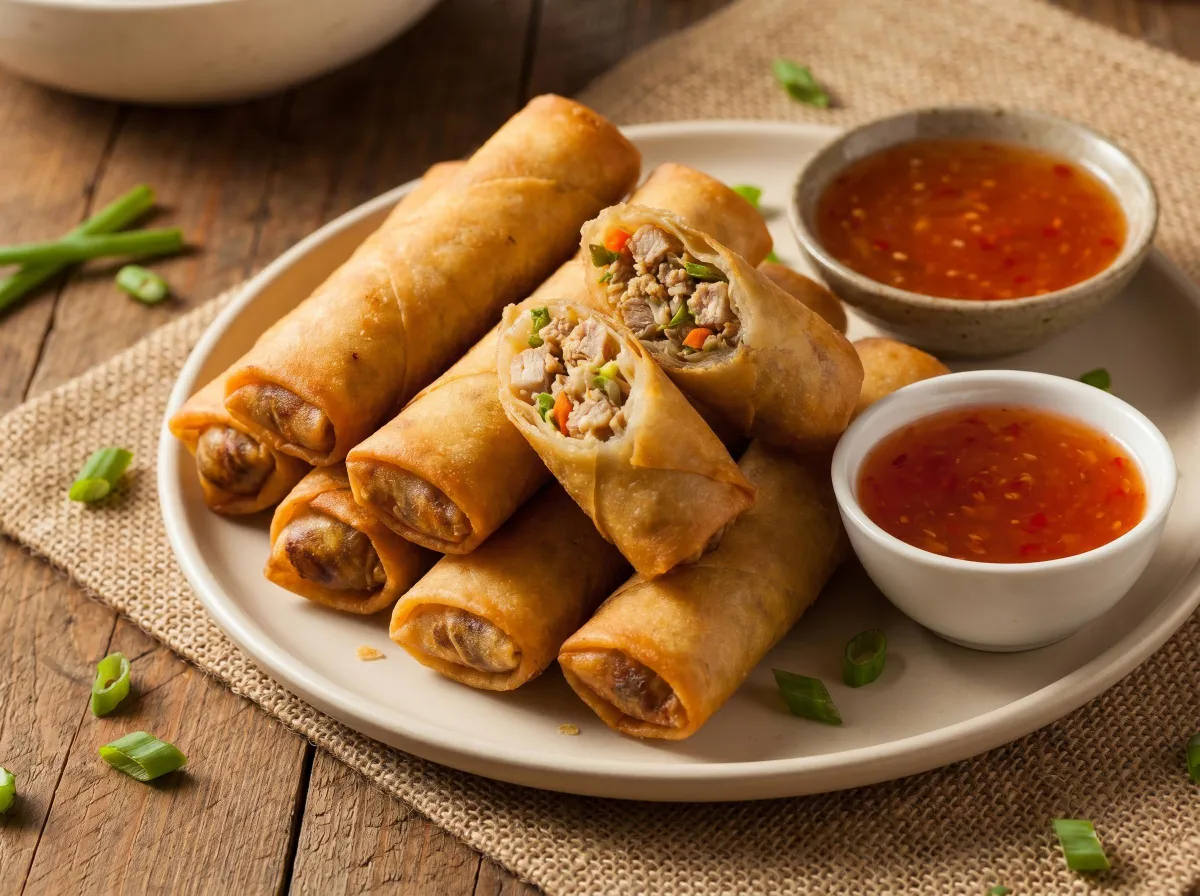
🥢 What it is: The Filipino spring roll — a thin, crispy wrapper filled with seasoned meat and vegetables, deep-fried golden and eaten immediately. One of the most universally loved Filipino foods, present at every celebration from birthday parties to barangay fiestas to potlucks in Filipino communities on every continent.
📖 Name meaning: From two Hokkien words — lun (moist, soft) and pia (cake or pastry). Introduced to the Philippines by Hokkien-speaking traders from China's Fujian province, absorbed into Filipino culinary identity so completely that most Filipinos have never thought of it as anything but their own.
🕰️ How old is it: Hokkien and Fujianese traders introduced a version of lumpia to the Philippines as early as 900 AD through maritime trade. The Filipino lumpia as it exists today — the crispy fried version wrapped in a thin crepe — evolved over centuries of cultural exchange between Filipino, Chinese, and Spanish culinary traditions.
🥩 What's inside: Ground pork, garlic, carrots, onions, and soy sauce in the most classic version. But the filling is only the starting point — lumpia has a dozen variations, from the fresh lumpiang sariwa filled with heart of palm to the sweet turon stuffed with banana and caramelized sugar.
🎉 When it's served: Always. At every birthday. At every fiesta. At the potluck where you arrive late and the lumpia is already gone. At the Noche Buena table. At the reunion. At the first meal someone cooks for you when you arrive abroad and they want to make you feel at home. Lumpia is how Filipinos say welcome and I love you and you belong here — all at once.
✨ The golden rule: Lumpia is always served immediately after frying. Never wait. The moment of peak crispiness lasts approximately four minutes. Anyone who has had lumpia knows exactly what we mean.
There is a tray of lumpia in almost every memory.
It is on the table before everything else — before the rice, before the lechon, before the pancit that someone always brings because pancit means long life and birthday parties require long life. The lumpia comes first because it fries fast and disappears faster, and because everyone in the room has been waiting for it without saying so.
You hear the oil before you see the food. That specific sound — the sizzle that sharpens when the wrapper hits the hot pan — travels through the house and into every room, and everyone who hears it knows what it means. Someone is frying lumpia. The party has actually started.
Lumpia is the Filipino spring roll. That sentence is accurate and completely insufficient. Lumpia is the food that non-Filipino friends try once and ask about for the rest of their lives. It is the dish that Filipinos living abroad make for potlucks because it is guaranteed to be gone before the party ends. It is the thing your lola made in the kitchen for hours — rolling, sealing, stacking — while you sat at the table and watched, and she handed you one still hot from the oil and told you to blow on it first.
Lumpia is a wrapper around seasoned pork and vegetables, deep-fried until golden, served immediately with a sweet dipping sauce. That is what it is, technically. But technically is not the whole story.
At Studio Tributes, we celebrate Filipino food because it carries more than flavor — it carries the whole story of a people. Today we are going deep on lumpia: where it came from, why it has a dozen versions, what lumpiang Shanghai has to do with the Spanish galleon trade, why the freshly fried lumpiang sariwa and the crispy fried Shanghai are two completely different philosophies in the same family, and why the tray of lumpia is always the first thing that disappears at every Filipino gathering on earth.
🥢 What Is Lumpia?
Lumpia is the Filipino term for spring rolls — thin, crepe-like wrappers filled with a seasoned mixture of meat, vegetables, or both, and either fried until crisp or served fresh. It is not one dish but a family of dishes, united by the wrapper and divided by everything inside it.
The name comes from two Hokkien words: lun, meaning moist or soft, and pia, meaning cake or pastry. Lumpia is derived from two Hokkien words — lun meaning moist and pia meaning pastry. The Hokkien-speaking traders and settlers who brought this food tradition to the Philippines came primarily from China's Fujian province, and their culinary influence on Filipino food is so deep and so old that most Filipinos experience lumpia as purely and completely Filipino.
Which it now is. That is the nature of cultural absorption done over a thousand years.
The basic lumpia formula is simple: a thin wrapper (made from flour, water, and egg), filled with a seasoned mixture, rolled tight, and cooked. But the variables within that formula have produced a remarkable range of dishes, each with its own character, occasion, and devoted following.
Lumpia is primarily made with a thin crepe-like wrapper filled with a variety of ingredients, which can include vegetables, meat, and seafood. Its adaptability allows it to be served as an appetizer or main dish, depending on the filling and preparation method.
The wrapper itself is worth understanding. Filipino lumpia wrappers are thinner and more delicate than Chinese egg roll wrappers — almost translucent when uncooked, crispy and light rather than thick and bready when fried. This thinness is not incidental. It is the defining quality that separates lumpia from its relatives in other culinary traditions, and it is why lumpia achieves a particular crackling crispiness in the first seconds after frying that cannot be reproduced by any other spring roll wrapper on earth.
The dipping sauce is not optional. Sweet chili sauce, banana ketchup, or the classic Filipino sawsawan of vinegar, soy sauce, garlic, and chili — these do not dress the lumpia so much as complete it. Lumpia without its dipping sauce is like a sentence without a period: it ends, but not properly.
📜 The History: From Hokkien Traders to Every Filipino Table on Earth
The history of lumpia is the history of the Philippines itself — a story of trade, contact, absorption, and transformation so complete that the thing being transformed becomes genuinely new.
The Chinese origin. Lumpia is a symbol of Southeast Asia's rich history and cultural interaction. Its transformation from a Chinese pastry to a beloved Filipino dish is proof of the enduring legacy of cultural fusion and adaptation. The earliest version of what would become lumpia arrived with Hokkien and Fujianese traders who established communities in the Philippines beginning around 900 AD. They brought with them a tradition of thin-wrapped parcels filled with vegetables and cooked during the Spring Festival — a food that was already ancient in China by the time it reached Philippine shores.
The Filipino transformation. What the Hokkien traders brought and what became Filipino lumpia are related but distinct. The Filipino version developed its own wrapper, its own fillings, its own frying technique, and its own set of cultural meanings that have nothing to do with Spring Festival and everything to do with every birthday party, fiesta, and family reunion in the Philippine archipelago. For centuries, Chinese traders and settlers have influenced the culinary scene in the Philippines, and immigrants from China's Fujian province brought over the egg roll, which metamorphised into lumpia Shanghai to befit the palates of the locals.
The Spanish and Mexican chapter. Lumpiang Shanghai's history is more complex than it first appears. Despite its etymology, the development of lumpiang Shanghai is not necessarily of Mainland Chinese culinary origin, but is of combined Mexican Hispanic and Filipino-Chinese culinary origin. It can be considered as part of Mexican Hispanic culinary influences in Filipino cuisine brought over from the Spanish galleon trade. The thin, tight roll of lumpiang Shanghai — smaller and more uniform than other lumpia — bears a resemblance to the Mexican taquito that arrived in the Philippines through the galleon trade between Manila and Acapulco. Filipino cuisine absorbed both influences and produced something that belongs entirely to neither.
The aristocratic phase. Historically, lumpia was a food of the aristocracy, often reserved for special occasions and feasts. It became more widely available as the Philippines underwent agricultural and economic changes, allowing families to create their own versions at home. By the 20th century, lumpia was a common offering at Filipino gatherings, birthdays, and holidays, solidifying its place in Filipino culture.
The diaspora chapter. Lumpia's journey across the globe began with Filipino migration, particularly to the United States, where it was embraced by local communities. Over time, it assimilated into the culinary landscape of various countries, leading to unique adaptations. Today, lumpia is made and served in Filipino communities in Los Angeles, Toronto, London, Dubai, Sydney, and every other city where Filipinos have built lives outside the archipelago. It is the dish most consistently named as the first thing non-Filipinos fall in love with when they encounter Filipino food. It requires no translation. The first crispy bite does all the explaining.
🌯 A Guide to the Types of Lumpia
Lumpia is a family with many members. Understanding the varieties is understanding a significant part of Filipino culinary culture.
🥢 Lumpiang Shanghai — The Classic
The most recognizable lumpia internationally, and the one most Filipinos mean when they say "lumpia" without any modifier. Lumpiang Shanghai is a Filipino deep-fried appetizer consisting of a mixture of giniling (ground pork) with vegetables like carrots, chopped scallions or red onions and garlic, wrapped in a thin egg crêpe. Lumpiang Shanghai is regarded as the most basic type of lumpia in Filipino cuisine, and it is usually smaller and thinner than other lumpia variants.
The "Shanghai" in the name is its own mystery. As for why Shanghai is in the name of this dish when it's not from Shanghai, we can only venture a guess. Given the dish's Chinese origins and Shanghai's status as one of China's most glitzy, renowned, and historically significant cities — the name likely attached itself as a way of signaling the dish's sophisticated, cosmopolitan origins in a Philippine context where "Shanghai" connoted something modern and desirable.
Lumpiang Shanghai is rolled tightly and thin, deep-fried until the wrapper is a uniform golden-brown, and served in large quantities because a party never has enough. Designed for communal dining and as the perfect finger food, lumpia Shanghai encourages guests to enjoy multiple pieces rather than just one or two. This is the lumpia that converts non-Filipinos. This is the lumpia that disappears from the tray in minutes. This is the lumpia that children are given first, because it is the most forgiving and the most universally loved.
What makes it Filipino: The thinness of the wrapper. The pork-forward filling that is seasoned with soy sauce and garlic in proportions that are specifically, distinctly Filipino. The sweet dipping sauce alongside. And the fact that it is always, always made in enormous batches — because a tray of twelve is never enough.
🥬 Lumpiang Sariwa — The Fresh One
Sariwa means fresh in Tagalog — and lumpiang sariwa is the lumpia that is never fried. Also known as "fresh lumpia," this type of lumpia features a freshly cooked crepe instead of a fried one, and the filling can be vegetables alone, or vegetables with pork or shrimp.
The wrapper for lumpiang sariwa is soft and slightly eggy, made fresh rather than pre-packaged, and the filling is a warm sauté of vegetables, sometimes with ubod (heart of palm), pork, and shrimp. The whole thing is wrapped and served at room temperature or slightly warm, drizzled with a thick, sweet garlic sauce and garnished with crushed peanuts.
Lumpiang sariwa is the lumpia that requires the most labor and produces the most conversation. It is the lumpia that older Filipinos associate with special occasions and patient hands. The wrapper must be made fresh, the filling must be cooked with care, and the assembly is done at the moment of serving. It cannot be made ahead and reheated. It requires presence — someone in the kitchen, making it as you eat it.
This is also the lumpia that best expresses the fresh, vegetable-forward side of Filipino cooking — a reminder that Filipino food is not only rich and fried, but also light and herbal and full of the specific flavors of the Philippine kitchen garden.
🌴 Lumpiang Ubod — The Heart of Palm Lumpia
Lumpiang ubod is the lumpia of the Visayas, and it is its own thing entirely. Lumpiang ubod, also known as heart of palm spring rolls, is a Filipino appetizer consisting of julienned ubod (heart of palm) with various meat and vegetables in a thin egg crêpe. It is commonly served fresh (as lumpiang sariwa), but it can also be deep-fried.
Ubod — the tender inner core of the coconut palm — has a delicate, slightly sweet flavor and a texture somewhere between water chestnut and artichoke. It requires effort to source and prepare, which is exactly why lumpiang ubod signals a certain level of occasion: this is a lumpia someone made with care, for a day that mattered.
The original Silay lumpiang ubod is sometimes differentiated as lumpiang Silay, lumpiang Ilonggo, lumpiang ubod de Silay, or lumpiang Bacolod. Unlike the versions in other islands, it is always made fresh. It is originally smaller and thinner in comparison (approximately finger-sized). It traditionally included ubod, sautéed meat and shrimp, an entire sprig of green onion, and crushed chicharon in a bed of lettuce.
🥦 Lumpiang Gulay — The Vegetable Lumpia
Gulay means vegetable in Filipino, and lumpiang gulay is the version where vegetables take the lead. Lumpiang gulay is a Filipino appetizer consisting of julienned or cubed vegetables with ground meat or shrimp in a thin lumpia wrapper made from rice flour that is deep-fried. A notable variant of lumpiang gulay is lumpiang togue, which is made mostly with togue (mung bean sprouts).
Lumpiang gulay uses cabbage, carrots, green beans, tofu, bean sprouts, and sometimes a small amount of ground pork or shrimp — but the ratio of vegetables to meat is reversed from lumpiang Shanghai. The result is lighter, less rich, and often the lumpia that people reach for on their third or fourth piece when the Shanghai is already gone.
Lumpiang togue — the mung bean sprout variation — is a subcategory worth naming separately. The bean sprouts give a particular texture and freshness that makes lumpiang togue its own experience: crunchier, lighter, and with a slightly different flavor profile from any other lumpia on the table.
🌶️ Lumpiang Dinamita — The Fiery One
Also called dynamite lumpia, lumpiang dinamita is exactly what it sounds like. Dinamita is a long green pepper filled with pork and cheese filling, then wrapped in a wrapper and fried until crisp — kind of like a jalapeño popper, but crispier.
A whole long green chili pepper is stuffed with seasoned ground pork and melted cheese, then wrapped in a lumpia skin and fried. The result is a lumpia that bites back — the heat of the pepper contained and amplified by the hot filling inside, released only when you bite through the crispy wrapper. Lumpiang dinamita has become one of the most shareable lumpia varieties in the social media era because it photographs dramatically and because the first-timer's reaction to the heat is always worth witnessing.
🍌 Turon — The Sweet Lumpia
Turon is the lumpia of dessert, and it occupies a specific emotional territory that is entirely its own. In an extremely delicious dessert version of lumpia called turon, a banana is sometimes combined with ube or other sweet fruit, wrapped, then fried until crisp. The turon is then covered in a caramel and served.
Ripe saba banana — the Philippine cooking banana, shorter and starchier and more flavorful than a standard banana — is sliced, wrapped in a lumpia skin with a strip of jackfruit, dusted with brown sugar, and deep-fried until the sugar caramelizes into a crackling amber shell.
Turon is the lumpia that children ask for specifically. It is the merienda lumpia, the after-school lumpia, the lumpia sold by street vendors in every city in the Philippines. It is humble, inexpensive, and completely irreplaceable. No other dessert in the Filipino canon occupies exactly the same space: sweet but not too sweet, crispy but yielding, familiar but always slightly better than you remembered.
👅 What Does Lumpia Taste Like?
The first thing you notice is the sound. The crunch of freshly fried lumpia is one of the most satisfying sounds in food — a thin, clear crack rather than the dull crunch of a thick-walled egg roll. This is the wrapper announcing itself: I am thin, I am hot, I am ready.
The second thing is the contrast. The crispy exterior gives way immediately to the savory, fragrant filling — ground pork with garlic and soy sauce, the carrots adding a slight sweetness, the onions adding depth. The filling is never dry because of the pork fat. It is never bland because of the garlic. It is seasoned in the specifically Filipino way that is hard to define and easy to recognize: a balance of salt, umami, sweetness, and the particular warmth of sautéed garlic that is one of the most comforting flavors in any cuisine.
The dipping sauce is the third act. Sweet chili sauce cuts through the richness of the pork. Banana ketchup — the specifically Filipino condiment made from banana rather than tomato — adds a fruity sweetness that pairs with lumpia in a way that no other sauce quite matches. A simple sawsawan of vinegar and soy sauce with garlic and fresh chili resets the palate for the next piece.
And there will be a next piece. This is the universal truth about lumpia: one is never enough. The crispiness of the wrapper begins to soften within minutes of frying, which means the best version is always the first bite, still too hot to eat comfortably, taken anyway because patience and lumpia are incompatible.
🎉 Lumpia and the Filipino Life Calendar
Lumpia does not wait for a specific season or holiday. It shows up everywhere, for everything, at every stage of Filipino life.
The Birthday Party. In Filipino culture, the birthday party host is responsible for the food — and lumpia is never optional. A birthday spread without lumpia is incomplete in a way that guests will notice but be too polite to mention. The birthday lumpia is always made in quantity: two trays, three trays, however many it takes. It will all be gone. This is guaranteed.
The Fiesta. The barrio fiesta table runs deep with lechon and pancit and rice — but the lumpia is always there too, rolled by the women of the barangay in the kitchen the night before, fried in batches as guests arrive. Fiesta lumpia is communal lumpia: made by many hands, eaten by everyone, carrying the flavor of the specific gathering in a way that a restaurant lumpia never quite replicates.
The Potluck. Lumpia is often served during celebrations, such as birthdays, weddings, and holidays. Its presence signifies happiness and togetherness. During these festivities, families prepare large batches of lumpia and share them with friends and loved ones. At the Filipino potluck, the person who brings lumpia is respected. The person who brings homemade lumpia — rather than store-bought — is revered. The tray arrives covered in foil and disappears before the foil is fully removed.
The Noche Buena. The Christmas Eve feast includes lumpia in its most festive form — sometimes made larger, sometimes with premium fillings, sometimes alongside turon for the children. Lumpia on the Noche Buena table is the everyday made celebratory: the same dish, the same rolling technique, the same sizzle of oil, but this time in the middle of the night, surrounded by everyone.
The First Thing You Cook for Someone New. In the Filipino diaspora, lumpia is frequently the first dish made for a non-Filipino partner, friend, or colleague who expresses curiosity about Filipino food. It is the ambassador dish — the one chosen because it requires no explanation, no acquired taste, no culinary context. You bite it and you understand immediately.
🗣️ Learn the Tagalog
The dish and its family:
🥢 Lumpia (loom-pyah) — spring roll; the whole family of Filipino wrapped and fried or fresh dishes
🍳 Lumpiang prito (loom-pyahng pree-toh) — fried lumpia; prito means fried
🥬 Lumpiang sariwa (loom-pyahng sah-ree-wah) — fresh lumpia; sariwa means fresh
🌿 Lumpiang gulay (loom-pyahng goo-lai) — vegetable lumpia; gulay means vegetables
🌴 Lumpiang ubod (loom-pyahng oo-bod) — heart of palm lumpia; ubod is the inner core of the coconut palm
🌶️ Dinamita (dee-nah-mee-tah) — dynamite lumpia; named for the explosive heat of the stuffed green chili
🍌 Turon (too-ron) — sweet banana lumpia; the merienda and street food version
The kitchen vocabulary:
🥩 Giniling (gee-nee-ling) — ground meat; the primary filling ingredient in lumpiang Shanghai
🧅 Bawang (bah-wang) — garlic; appears in almost every lumpia filling and is the source of the characteristic fragrance
🥕 Karot (kah-rot) — carrot; the vegetable most consistently present in lumpia fillings for sweetness and color
🌯 Balot ng lumpia (bah-lot nang loom-pyah) — lumpia wrapper; the thin crepe that holds everything together
🔥 Prito (pree-toh) — fried; the cooking method that transforms the raw roll into what lumpia actually is
🥣 Sawsawan (saw-sah-wan) — dipping sauce; the essential companion to all fried lumpia
At the table:
😋 Ang sarap! (ang sah-rap) — so delicious!
🔥 Mainit pa! (mah-ee-nit pah) — it's still hot! — the warning always given and always ignored
🥢 Kumuha ka na (koo-moo-hah kah nah) — go ahead and take some — the phrase that starts every lumpia eating session
🍽️ Mauubos na! (ma-oo-oo-bos nah) — it's almost gone! — the urgent announcement at every Filipino party
🤩 Fun Facts About Lumpia
1. The word "lumpia" is Hokkien, not Filipino — but the dish is completely Filipino. The name comes from Hokkien lun (moist) and pia (pastry). Hokkien-speaking traders from China's Fujian province introduced a version of this food to the Philippines as early as 900 AD. In the 1,100 years since then, Filipinos transformed it so thoroughly — different wrapper, different fillings, different frying technique, different cultural meaning — that calling it Chinese today would confuse both Chinese and Filipino people.
2. Lumpiang Shanghai may have more to do with Mexico than with Shanghai. Food historians have noted that the thin, tight roll of lumpiang Shanghai closely resembles the Mexican taquito, which arrived in the Philippines through the Manila-Acapulco galleon trade that operated from 1565 to 1815. Shanghai may be in the name, but the shape of the roll may owe as much to Acapulco as to any Chinese city.
3. The lumpia wrapper and the egg roll wrapper are not the same thing. Filipino lumpia wrappers are thinner, lighter, and more delicate than Chinese-American egg roll wrappers. This difference produces a fundamentally different texture when fried — the lumpia wrapper becomes a crackling, almost translucent crisp shell, while the egg roll wrapper produces a thicker, doughier crunch. Anyone who has had both knows they are different food experiences.
4. Turon's caramelized sugar coating is a specific technique. The brown sugar that coats turon is added directly to the banana and lumpia wrapper before frying. As the oil reaches temperature, the sugar melts and caramelizes against the wrapper, creating the amber crackling shell that makes turon texturally distinct from every other fried dessert in Filipino cuisine. The timing has to be precise: too early and the sugar burns; too late and it doesn't caramelize at all.
5. Lumpiang ubod is one of the most labor-intensive dishes in Filipino cuisine. Ubod — the heart of palm — must be extracted from a freshly cut coconut palm, a process that destroys the tree entirely. This irreversibility was once what made lumpiang ubod a special-occasion food: you did not cut a coconut palm casually. The ubod was reserved for a feast that warranted the sacrifice. The Silay version from Negros Occidental is considered the definitive version and has been named a traditional dish of Bacolod City.
6. The disappearing tray is a documented phenomenon. Ask any Filipino who has brought lumpia to a potluck: the tray empties faster than any other dish. This is not anecdote. This is consistent, predictable, cross-cultural behavior. The lumpia tray is always the first empty tray at the party, regardless of how many trays were brought. Planning for a Filipino gathering requires calculating lumpia in multiples of what you think you need.
7. Rolling lumpia is a form of intergenerational transmission. In Filipino households, the rolling of lumpia is not a solo task. It is done together — at the kitchen table, across generations, over conversation. Children learn by watching and then by doing. Grandmothers correct technique without words: they simply reach over and adjust the roll. The recipe is not written down. It lives in the hands.
8. Lumpiang dinamita became a social media phenomenon. The visual drama of a bright green chili pepper wrapped in lumpia skin — the contrast of colors, the implied heat, the surprise of the cheese inside — made lumpiang dinamita one of the most photographed and shared Filipino dishes of the social media era, introducing lumpia to new audiences who might not have encountered it otherwise. It is the lumpia that surprised the internet.
9. Lumpia is the dish most often credited with converting non-Filipinos. In surveys and community conversations across the Filipino diaspora, lumpia is consistently named as the first Filipino dish that non-Filipinos loved — the gateway food that opens the door to the rest of Filipino cuisine. Growing up in Surrey, I had many friends from different countries and cultures, not familiar with Filipino food, and they all fell in love with Filipino cuisine through my mom's spring rolls. This story is repeated, with local variations, in Filipino communities around the world.
10. Lumpia can be frozen, unfried, and cooked to order. One of the practical realities of lumpia in Filipino households abroad is the freezer tray: lumpia rolled and frozen raw, pulled out and fried as needed. This makes lumpia the most reliable emergency food in the Filipino diaspora pantry. You can always have lumpia ready. You just need oil and five minutes.
🌍 How Lumpia Connects Filipinos Everywhere
Lumpia travels. This is the single most important practical fact about it, and it is part of why lumpia became the face of Filipino food internationally.
Pancit is complex to explain to people who have never had it. Sinigang requires a context — sourness as soup base — that can take a moment to absorb. Lechon is unforgettable but not portable. Lumpia requires no translation, no acquired taste, no explanation. You hand someone a piece. They bite it. The crispy wrapper, the savory filling, the dipping sauce — the information is complete before they finish chewing.
The fusion of lumpia with other cuisines reflects the dynamism of Filipino cooking, continuously evolving while honoring its traditional roots. In Filipino-American communities, lumpia has been adapted with local ingredients — American-grown pork, locally available vegetables, sweet chili sauces from Asian grocery stores — while maintaining the essential Filipino technique. In Filipino communities in the Middle East, in Europe, in Australia, lumpia is made on weekends and brought to community gatherings with the same intention it has always carried: I made this for you. We are together. This is what that means.
Having lumpia at celebrations not only provides nourishment but also creates a sense of nostalgia and belonging.
For Filipinos living far from the archipelago, making lumpia is an act of cultural maintenance. The process — sourcing the right wrapper, making the filling from memory, rolling with the technique absorbed by watching someone else do it, frying until golden — is a rehearsal of identity. You are not just making food. You are practicing being Filipino in a place where being Filipino requires practice.
The tray of lumpia at the overseas Filipino party is never just an appetizer. It is a flag. It says: we came from somewhere specific. We remember what that somewhere tastes like. We are passing it forward.
❓ FAQ — Everything You Need to Know About Lumpia
What is lumpia?
Lumpia is the Filipino spring roll — a thin crepe-like wrapper filled with seasoned meat, vegetables, or both, typically deep-fried until golden and served with a sweet dipping sauce. The name comes from the Hokkien words lun (moist) and pia (pastry), introduced to the Philippines by Hokkien-speaking traders from China's Fujian province. Over centuries, Filipinos transformed it into something entirely their own — a dish present at every birthday, fiesta, potluck, and family gathering in the Philippine archipelago and in Filipino communities worldwide.
What is lumpiang Shanghai?
Lumpiang Shanghai is the most common type of lumpia — small, thin, tightly rolled, filled primarily with ground pork, garlic, onions, and carrots, then deep-fried until golden. It is the lumpia most international audiences encounter first and the one most consistently named as the gateway dish that introduces non-Filipinos to Filipino cuisine.
What is the difference between lumpia and egg rolls?
Filipino lumpia uses a thinner, more delicate wrapper than the Chinese-American egg roll. When fried, lumpia achieves a lighter, crispier texture — almost translucent rather than thick and bready. The filling is also different: lumpiang Shanghai is pork-forward and garlic-heavy in a distinctly Filipino way, while egg rolls typically have a higher vegetable ratio and a different flavor profile. They are related dishes from a shared historical root, but they taste different and feel different in your hand.
What is lumpiang sariwa?
Lumpiang sariwa is "fresh lumpia" — the version that is never fried. It uses a freshly made soft crepe wrapper and is filled with a warm sauté of vegetables, sometimes with heart of palm (ubod), pork, and shrimp. It is drizzled with a thick garlic sauce and garnished with crushed peanuts. Lumpiang sariwa is lighter, more delicate, and more labor-intensive than the fried versions, and is often associated with special occasions.
What is turon?
Turon is the dessert version of lumpia. A slice of ripe saba banana — sometimes with jackfruit — is wrapped in a lumpia skin, dusted with brown sugar, and deep-fried. The sugar caramelizes during frying, creating a crackling amber shell around the banana. Turon is sold by street vendors throughout the Philippines and is one of the most beloved Filipino merienda foods.
What do you dip lumpia in?
The classic Filipino dipping sauce for lumpia is sweet chili sauce. Banana ketchup — made from banana rather than tomato — is another common pairing. A simple sawsawan of vinegar, soy sauce, minced garlic, and fresh chili rounds out the options. No dipping sauce is wrong; all are good; choosing is a matter of personal history.
Can lumpia be made ahead and frozen?
Yes. Lumpia is one of the most freezer-friendly Filipino dishes. Rolled, unfried lumpia can be frozen raw on a tray, then transferred to a container or bag and stored for weeks. Fry directly from frozen in hot oil, adding a few minutes to the frying time. The result is nearly identical to fresh-rolled lumpia and is the reason Filipino households in the diaspora are never truly without lumpia available.
Why is lumpia always the first thing to disappear at Filipino parties?
This is one of the most reliably observed facts in Filipino food culture, and the reason is threefold: lumpia is served immediately after frying, when it is at peak crispiness; it is finger food that requires no plate and no utensil; and it is genuinely delicious enough that restraint is difficult. The combination of immediacy, accessibility, and flavor creates a dish that is gone before the rest of the food is arranged. Always bring more lumpia than you think you need. This is not a suggestion.
💛 Closing
Did lumpia bring back a memory?
Maybe it is the sound of the oil — that specific sizzle that travels through the house and tells everyone that the party has actually started now. Maybe it is the tray, appearing from the kitchen covered in foil, the steam still rising when the foil comes off. Maybe it is sitting at the kitchen table as a child, watching someone's hands roll the wrapper tight and seal the edge and set it aside and pick up another, over and over, making something that would be gone in minutes but whose making took hours.
Maybe you are somewhere far from the Philippines now. No tray of lumpia appears at your door without effort. Someone has to make it — has to source the wrappers, make the filling, roll each piece with the technique learned from watching someone who learned it from watching someone else. When lumpia arrives in your life abroad, it arrives as a gift of time and intention, and it tastes like all of that on top of the pork and garlic.
Which lumpia carries the clearest memory for you? The Shanghai at the birthday party? The turon from the street vendor? The sariwa that someone made by hand for a specific occasion? The moment you handed a piece to a non-Filipino friend and watched their face change?
Tag @StudioTributes on Facebook or Instagram with your lumpia memory and the hashtag #LumpiaMemory and #FilipinoFoodMemories.
We read every single one. 🇵🇭
💛 A Final Thought
Lumpia survived everything.
It survived the Spanish colonial period, absorbing the egg and the refined sugar they introduced while keeping the wrapper and the filling philosophy entirely its own. It survived the American occupation and the industrialization of Philippine food, remaining stubbornly handmade when almost everything else moved to factories. It survived the mass migration of Filipinos to every corner of the earth, traveling in memory and in freezer bags and in the hands of people who learned to make it by watching rather than by reading.
Lumpia survived because it is too good to let go of. Because the combination of a thin crispy wrapper and savory pork filling and sweet dipping sauce is, at some fundamental level, a correct combination — one that humans across cultures recognize immediately as right. Because it is easy to share, easy to make in quantity, easy to love at first bite.
But lumpia also survived because Filipino families passed it forward. Because grandmothers stood at kitchen tables and rolled and rolled while grandchildren watched. Because someone in every generation decided that the technique was worth keeping, the flavor was worth reproducing, the memory was worth carrying.
At Studio Tributes, we believe Filipino food carries more than flavor. Lumpia carries five hundred years of trade, transformation, and tenacity. It carries the specific sound of oil in a hot pan on a weekend morning. It carries the rolling technique in someone's hands, passed from hands that are gone now.
Every tray of lumpia is all of that. And it is gone in minutes. And that is exactly right.
Keep exploring Filipino food and culture with us:
👉 Get your FREE Filipino coloring pages here.
🎨 Get our Filipino Food Activity Book on Amazon
📚 Read more Filipino food stories on our blog
💭 A Memory to Hold Onto
Did lumpia bring back a table, a kitchen, a tray covered in foil?
Maybe the sound of the oil before the food appears. Maybe the rolling — watching someone's hands move faster than yours ever could. Maybe the first bite, still too hot, taken anyway.
Which lumpia is yours? Was it the crispy Shanghai at the party? The fresh sariwa someone made by hand? The turon from the street? What do you hear, smell, or see when the word lumpia arrives?
If a memory came to mind, share it on Facebook or Instagram and tag @StudioTributes — we celebrate every single one.
Read Next
Together, these foods tell the story of Filipino life — from everyday merienda to the biggest celebration of the year.
📚 References & Further Reading
Tasting Table — "Lumpia Shanghai: The History Behind the Filipino Egg Roll"
Love Lumpia — "The Cultural Significance of Lumpia in Filipino Celebrations"
This article blends Studio Tributes storytelling with cultural and culinary research to create a warm, family-friendly learning experience.
#LumpiaMemory #FilipinoFoodMemories #StudioTributes #FilipinoFood #WhatIsLumpia #LumpiangShanghai #FilipinoSpringRolls