
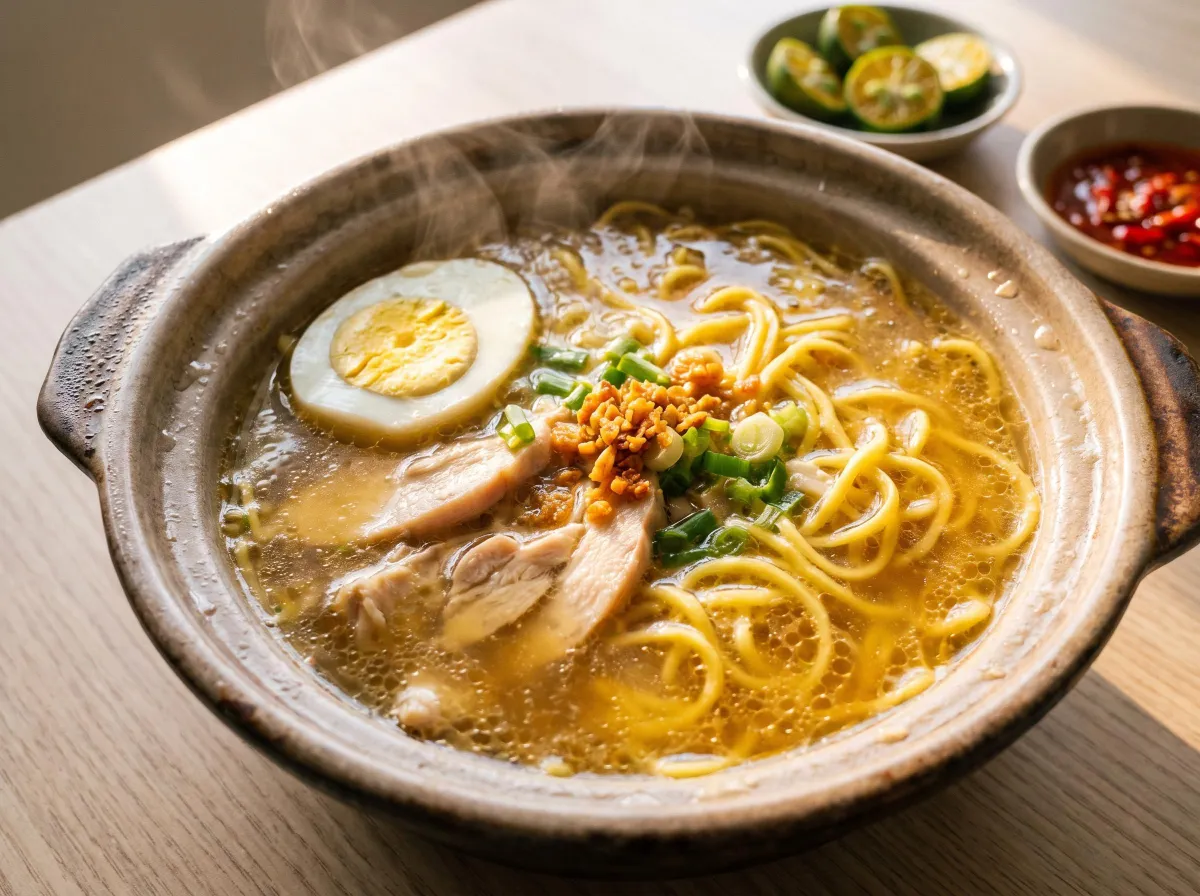
What is Pancit Mami? The Filipino Chicken Noodle Soup That Feels Like a Warm Hug
Imagine it's pouring rain in Manila—the kind of downpour that turns streets into rivers and keeps everyone huddled indoors. The air carries that distinctive petrichor mixed with the smell of wet concrete. In moments like these, there's one dish that countless Filipinos instinctively crave: a steaming bowl of Pancit Mami.
Or picture this: you're a Filipino living halfway across the world, navigating a cold winter in a country that will never quite feel like home. Your throat feels scratchy, your body aches, and you're desperately homesick. What you need isn't just chicken soup—you need that chicken soup. You need Mami.
But what exactly is Pancit Mami? Why does it hold such a special place in Filipino hearts? And how did a dish with clear Chinese origins become so distinctly Filipino that it's now inseparable from the Philippine culinary identity?
Grab your spoon (and chopsticks, if you're feeling traditional), because we're about to dive deep into the warm, comforting world of the Philippines' favorite noodle soup.
The Basics: What Exactly is Pancit Mami?
Pancit Mami is a Filipino noodle soup made with egg noodles (mami noodles) served in a clear, savory chicken or beef broth, typically topped with sliced meat, vegetables, hard-boiled eggs, green onions, and fried garlic.
Let's break down the name:
Pancit (or Pansit) is the Filipino term for noodles, derived from the Hokkien phrase "pian i sit" (便意食), meaning "something conveniently cooked"
Mamirefers specifically to this noodle soup style, and also to the type of egg noodles used
The dish represents the beautiful collision of Chinese culinary tradition and Filipino adaptation—noodles and cooking techniques brought by Chinese immigrants, transformed through Filipino tastes, ingredients, and the particular cultural role it came to occupy.
The Essential Elements
A proper bowl of Pancit Mami contains:
Fresh egg noodles (miki or mami noodles—yellow, slightly thick, and pleasantly chewy)
Clear, flavorful broth (usually chicken-based, though beef and pork versions exist)
Protein (sliced chicken, beef, or pork; sometimes wonton dumplings called siomai)
Vegetables (typically bok choy, cabbage, or other Chinese greens)
Hard-boiled egg (usually halved and placed on top)
Aromatics (green onions, fried garlic, sometimes cilantro)
Condiments (calamansi, soy sauce, fish sauce, and chili sauce served on the side)
The result is a harmonious bowl where the noodles soak up the flavorful broth, the meat adds substance, the vegetables provide freshness, and the aromatics bring everything together.
The Ma Mon Luk Legacy: How Mami Became Filipino
To understand Pancit Mami, you need to know about Ma Mon Luk, the Chinese immigrant who essentially gave this dish to the Philippines.
The Origin Story That Actually Happened
Ma Mon Luk arrived in the Philippines from Guangdong, China, in 1918. Like many Chinese immigrants of that era, he started small—with a food cart in Manila's Chinatown (Binondo) selling noodle soup and siopao (steamed buns).
What made Ma Mon Luk's noodle soup special wasn't revolutionary cooking techniques or exotic ingredients. It was consistency, quality, and adaptability. He served good, honest noodle soup at affordable prices, and he paid attention to what Filipino customers wanted.
The name "Mami" itself reportedly came from how Ma Mon Luk was called by customers—a respectful term combining "Ma" (his surname) and "mi" (noodles in Chinese). Though some food historians debate whether he invented the term or simply popularized it, what's undeniable is that "Mami" became synonymous with his establishment and eventually with this style of noodle soup throughout the Philippines.
By the 1920s and 1930s, Ma Mon Luk had moved from a cart to an actual restaurant, and Ma Mon Luk Restaurant became a Manila institution. The restaurant survived World War II, multiple location changes, family management transitions, and the test of time—it still operates today, nearly a century later.
Why This Origin Matters
Ma Mon Luk's story represents a crucial chapter in Filipino-Chinese culinary history. This wasn't cultural appropriation or fusion for fusion's sake. It was organic cultural evolution—Chinese immigrants bringing their food traditions, adapting to local tastes and ingredients, and Filipino diners embracing these dishes until they became part of the national cuisine.
Pancit Mami is as Filipino as adobo now, despite its Chinese roots. This is the nature of Philippine cuisine: a beautiful, delicious accumulation of influences that have been localized, adapted, and claimed.
The Great Noodle Debate: Pancit Mami vs. Other Filipino Noodle Dishes
Here's where things get interesting and occasionally contentious among Filipino food enthusiasts. The Philippines has a dizzying array of noodle dishes—all called "pancit" with various modifiers—and the distinctions between them matter to the people who grew up eating them.
Understanding the Pancit Universe
The word "pancit" is an umbrella term covering all Filipino noodle dishes, but they're incredibly diverse:
Pancit Canton- Stir-fried egg noodles with vegetables and meat, served dry (no soup)
Pancit Bihon- Stir-fried thin rice noodles, also served dry
Pancit Palabok- Rice noodles with a thick orange shrimp sauce, topped with eggs, chicharrón, and tinapa (smoked fish)
Pancit Sotanghon- Stir-fried glass noodles (mung bean noodles)
Lomi- A thick, starchy noodle soup (different from Mami in consistency and preparation)
Pancit Mami- The egg noodle soup we're discussing
Pancit LomiandPancit Mamiare both noodle soups, but they're distinctly different in execution and regional association.
The Mami vs. Lomi Distinction
This is where passionate debates emerge. Some argue the differences are minor; others see them as completely separate dishes deserving distinct recognition.
Pancit Lomiis:
Thicker, starchier broth (often thickened with cornstarch)
Associated primarily with Batangas province
Usually served in a more viscous, gravy-like consistency
Often includes liver, kikiam (bean curd rolls), and various toppings
Eaten more with a spoon due to the thick broth
Pancit Mamiis:
Clear, clean broth (not thickened)
Associated with urban Manila and Chinese-Filipino establishments
Lighter, more soup-like consistency
Typically simpler in toppings (chicken/beef, egg, vegetables)
Eaten with both spoon and chopsticks/fork
Why the Distinction Matters (And Why It's Worth Defending)
Some food writers and casual observers lump all Filipino noodle soups together, treating regional and preparation differences as trivial variations. This dismissive approach erases important cultural and regional identities.
The stance worth taking: These are distinct dishes that deserve individual recognition. Here's why:
Regional identity is real and important: Lomi is a source of pride for Batangueños. It's part of their regional culinary identity. Calling it "just another version of Mami" dismisses that specific cultural connection.
Preparation methods differ significantly: The techniques for making Lomi versus Mami are different. One requires starch thickening and different timing; the other emphasizes clear broth clarity. These aren't trivial differences—they're fundamental to the dish's character.
Eating experiences are different: The viscosity of Lomi creates a different mouth-feel and eating experience than the lighter Mami. They serve different comfort food needs and contexts.
Culinary history matters: Mami's connection to Ma Mon Luk and Chinese-Filipino urban culture is a different story than Lomi's provincial Batangas roots. Both stories deserve preservation and recognition.
Treating all Filipino noodle soups as interchangeable contributes to the homogenization that threatens regional food diversity. In an era where McDonald's and Jollibee are everywhere, maintaining these distinctions helps preserve culinary biodiversity.
The Anatomy of a Perfect Bowl of Pancit Mami
What elevates Pancit Mami from ordinary noodle soup to the comfort food that Filipinos dream about abroad?
The Broth: The Foundation of Everything
The broth makes or breaks Mami. Unlike instant noodles or quick soups, proper Mami broth requirestime and attention.
Traditional preparation involves:
Simmering chicken or beef bones for hours to extract maximum flavor and collagen
Aromatics like ginger, garlic, onions, and sometimes star anise
Light seasoning with salt, pepper, and sometimes a touch of soy sauce
Skimming impurities to maintain clarity
The final broth should be flavorful enough to sip on its own, crystal clear, with a slight sheen from natural fats
The clarity of the broth is crucial—it shouldn't be cloudy or murky. That clear, golden appearance signals proper technique and care.
The Noodles: Mami's Special Character
Mami noodles (also called miki noodles) are fresh, thick egg noodles with a distinctive yellow color and springy texture. They're different from:
The thinner, dried egg noodles used in Canton
Rice noodles used in Bihon
Glass noodles used in Sotanghon
Fresh mami noodles have a pleasant chew and absorb broth beautifully without getting mushy quickly. Finding authentic fresh mami noodles outside the Philippines can be challenging, which is one reason homesick Filipinos abroad crave proper Mami—the packaged alternatives don't quite capture the same texture.
The Toppings: Building Layers of Flavor
A well-composed bowl of Mami includes:
Protein: Sliced chicken breast or thigh, beef slices, or pork. The meat should be tender, well-seasoned, and substantial enough to make the dish filling.
Egg: A halved hard-boiled egg (sometimes soft-boiled for those who prefer jammy yolks) adds richness and makes the dish more nutritious.
Vegetables: Bok choy or Chinese cabbage, often added at the last minute so they remain slightly crisp and bright green.
Aromatics: Generous amounts of sliced green onions and crispy fried garlic. These aren't garnishes—they're essential flavor components.
Optional additions: Some versions include wontons (siomai), chicharrón, or kikiam (bean curd rolls).
The Condiment Station: Personalization is Key
Part of Mami's appeal is the ability to customize each bowl to personal taste. Traditional Mami establishments provide:
Calamansi (Philippine lime) - for brightness and acidity
Soy sauce- for additional saltiness and umami
Fish sauce (patis)- for funky, savory depth
Chili sauce or fresh chilies- for heat
Sometimes vinegar- for tang
The ritual of adjusting your bowl—squeezing calamansi, adding a dash of soy sauce, stirring in chili—is part of the Mami experience.
Where and When Filipinos Eat Pancit Mami
The Comfort Food Context
Pancit Mami occupies several important niches in Filipino food culture:
The Sick Day Staple: Like chicken soup in Western cultures or congee in many Asian traditions, Mami is what Filipino parents and grandparents turn to when someone's feeling under the weather. The warm broth soothes sore throats, the steam helps clear sinuses, and the easily digestible noodles provide energy without taxing the stomach. The ginger in the broth helps with nausea and provides warmth.
The Rainy Day Go-To: Philippine rainy seasons can be intense, with typhoons bringing days of continuous rain and flooding. On these wet, gray days, Mami becomes a natural craving. Something about hot noodle soup just hits differently when you're damp and chilled.
The Affordable Meal: Mami is filling, nutritious, and relatively inexpensive. A bowl typically costs ₱50-₱100 (roughly $1-$2 USD), making it accessible across economic classes. This democratic quality—that a tricycle driver and a business executive might eat at the same Mami counter—reflects important Filipino cultural values.
The Late-Night/Early-Morning Fuel: Many Mami establishments operate extended hours or 24/7, serving shift workers, students pulling all-nighters, market vendors starting their day at 3 AM, and everyone in between.
The Mami House Experience
Mami houses specialized eateries serving primarily noodle soups. These establishments range from humble street-side stalls to more established restaurants, but they share certain characteristics:
Fast service (you rarely wait long for your bowl)
No-frills atmosphere (function over form)
Communal seating (often shared tables)
Visible cooking (you can usually see your noodles being prepared)
Reasonable prices
Consistent quality
Some beloved Mami houses have operated for decades, becoming neighborhood institutions where multiple generations have eaten. The original Ma Mon Luk location (now with several branches) remains a pilgrimage site for Mami enthusiasts.
The OFW Connection: Mami as Cultural Anchor
For the millions of Overseas Filipino Workers scattered globally, Pancit Mami carries profound emotional weight beyond its ingredients.
Why Mami Resonates with Filipinos Abroad
It's harder to replicate than you'd think: While the ingredient list seems simple, getting authentic mami noodles, the right balance of broth seasonings, and especially the Filipino-specific condiments (calamansi, proper fish sauce) proves challenging in many countries. This scarcity amplifies the longing.
It's associated with specific care: Mami is what mothers and grandmothers make when you're sick. It's connected to being cared for, to home, to a time when someone else worried about you. When you're abroad, independent and self-reliant by necessity, that memory of being nurtured becomes especially precious.
It's distinctly Filipino: Unlike adobo (which has Spanish and Latin American cousins) or even pancit canton (which resembles various Asian stir-fried noodles), Mami in its specific Filipino preparation feels unmistakably local. Eating it abroad becomes an act of cultural connection.
It represents affordable comfort: In countries where Filipino workers often do difficult, undervalued work, finding or making Mami becomes a small, affordable luxury—a taste of home that doesn't require a special occasion or significant expense.
The Filipino Restaurant Litmus Test
When Filipino restaurants open abroad, their Mami often becomes a litmus test for authenticity. Filipino customers evaluate:
Are the noodles the right kind?
Is the broth properly clear and flavorful, or shortcuts taken?
Are the portions generous?
Are the condiments available and authentic?
Does it taste like memory?
A good bowl of Mami abroad can build a restaurant's reputation in the Filipino community. A mediocre one gets quietly noted and shared: "The Mami isn't quite right there."
How to Eat Pancit Mami Like a Local
There's an art to maximizing your Mami experience.
The Proper Approach
Step 1: Assess your bowl
When your Mami arrives, take a moment to appreciate the presentation—the clear broth, the neatly arranged toppings, the steam rising invitingly.
Step 2: Adjust the seasonings
Before your first bite, customize to your preference:
Squeeze calamansi (half to a whole fruit, depending on size and your taste)
Add a small amount of soy sauce or fish sauce if you want more depth
Add chili if you like heat
Start conservatively—you can always add more, but you can't take it back.
Step 3: Mix gently
Stir gently to distribute the seasonings and aromatics without splashing the hot broth. The goal is even distribution while maintaining the bowl's visual appeal.
Step 4: The first sip
Before diving into the noodles, sip the broth. This lets you assess if you need any final adjustments and honors the care that went into making that flavorful base.
Step 5: The noodle technique
Use chopsticks (or a fork) to lift a portion of noodles, usually with some toppings, and bring them to your mouth. Take some broth in your spoon simultaneously if you want—the combination of slurping noodles and sipping broth is traditional and acceptable.
Step 6: Pace yourself
Don't rush. Let the warmth seep into you. Mami is comfort food—it deserves mindful enjoyment, not rushed consumption.
Step 7: Finish the broth
In Filipino culture, finishing your soup signals appreciation and satisfaction. If the broth is good, finishing it entirely is a compliment to the cook.
The Etiquette Notes
Slurping is perfectly acceptable in Filipino noodle-eating culture—it's not considered rude as it might be in Western formal dining
Sharing is common if you're with others—ordering different variations and letting people taste from each other's bowls
Using the spoon and fork combination (instead of chopsticks) is completely normal and acceptable
Asking for extra condiments is fine—staff expect it
Making Pancit Mami at Home: Real Talk
Can you make authentic Pancit Mami at home? Yes. Is it easy? That depends on your definition of easy.
The Honest Difficulty Assessment
What's genuinely simple:
The actual cooking technique isn't complicated
You don't need specialized equipment
The ingredient list is relatively short
Basic cooking skills are sufficient
What's actually challenging:
Getting authentic mami noodles outside the Philippines (substitutes exist but aren't quite the same)
Achieving the proper broth clarity and flavor (it requires time and attention)
Finding the right balance of seasonings (too much or too little ruins the delicate flavor profile)
Patience (good broth can't be rushed)
The Practical Home Version
For Filipinos abroad craving Mami, here's the reality:
Noodle substitutes that work reasonably well:
Fresh Chinese egg noodles from Asian grocery stores (look for thick, yellow varieties)
Japanese udon (different texture but acceptable in a pinch)
Fresh ramen noodles (thinner but closer than dried noodles)
Broth shortcuts that don't completely sacrifice quality:
Using good-quality store-bought chicken stock as a base, then enhancing with aromatics
Pressure cooker or Instant Pot methods (faster than traditional simmering but still effective)
Roasting bones before simmering (adds depth even with shorter cooking time)
The approach worth taking: Make Mami at home when you have time to do it properly and enjoy the process. When you need quick comfort, support Filipino restaurants if they're available in your area, or make a simplified version knowing it's not quite authentic but still provides comfort.
When to Just Order Out
Sometimes the best approach is leaving it to the experts:
When you're actually sick (the last thing you need when unwell is to spend hours cooking)
When you're specifically craving the restaurant experience of Mami
When you want to support Filipino food businesses
When you don't have access to fresh noodles (dried noodles in Mami are disappointing)
There's no shame in recognizing that some food experiences are better purchased than homemade.
Pancit Mami Across the Philippines: Regional Variations
While Ma Mon Luk's version represents the Manila standard, Mami has evolved differently across Philippine regions.
Notable Regional Styles
Batchoy (Iloilo): Visayan noodle soup with pork organs, crushed chicharrón, and a distinctive flavor profile. Some argue it's a different dish entirely; others see it as Mami's Western Visayan cousin.
La Paz Batchoy (specifically La Paz, Iloilo City): The most famous batchoy variant, rich with pork, liver, and intestines, topped with crushed chicharrón and sometimes raw egg.
Beef Mami variations: While chicken is classic, many establishments offer beef versions with tender beef slices or brisket.
Siopao with Mami combos: Many Mami houses serve the pairing of Mami and Siopao (steamed buns), creating a combo meal that's deeply satisfying and very Filipino-Chinese in spirit.
Vegetarian Mami (modern): Contemporary versions catering to vegetarians, using vegetable broth and tofu or mushrooms instead of meat—a newer development reflecting changing dietary preferences.
The Franchise Factor
Modern Philippine fast-food culture includes Mami King, Goto King, and similar chains that serve standardized Mami. These franchises make Mami accessible in malls and commercial centers but represent a different experience from traditional Mami houses:
Chain advantages: Consistency, cleanliness, accessibility, air-conditioning
Traditional advantages: Character, connection to history, often better depth of flavor, personal service
Both have their place in the Filipino food ecosystem.
The Health Question: Is Pancit Mami Good for You?
Let's address the nutritional reality.
The Nutritional Profile
Potential benefits:
Protein-rich from the chicken or beef
Hydrating from the broth
Provides vegetables (though often modest amounts)
Easier on digestion than heavy, fried foods
Ginger benefits (anti-inflammatory, aids digestion, may help with nausea)
Comfort benefits (stress reduction and emotional well-being count)
Nutritional considerations:
High sodium from the broth seasoning (especially if you add more soy sauce or fish sauce)
Refined carbohydrates from white noodles (limited fiber)
Variable vegetable content (some bowls have minimal vegetables)
Depends heavily on preparation (how much oil, quality of ingredients)
The Balanced Perspective
Like most traditional foods, Mami exists in a cultural context where it wasn't meant to be analyzed purely through nutritional metrics.
When Mami shines nutritionally:
Recovery from illness (easily digestible, hydrating)
Cold weather fuel (warmth and energy)
Occasional comfort meal (mental health matters too)
Made with quality ingredients and moderate sodium
When to be mindful:
If watching sodium intake (ask for less salt, use fewer condiments)
If managing diabetes (noodle portion matters)
If eating it daily (variety in diet is important)
The warmth, comfort, and cultural connection Mami provides might offer health benefits that don't appear on nutrition labels—stress relief, community connection, and emotional wellbeing are legitimate health factors.
Pancit Mami in the Global Noodle Soup Family
Mami belongs to a vast family of Asian noodle soups, each reflecting its culture's palate and history.
The Noodle Soup Cousins
Vietnamese Phở: Rice noodles in aromatic beef or chicken broth with fresh herbs. Lighter, more herb-forward than Mami.
Japanese Ramen: Wheat noodles in rich, complex broth (shoyu, miso, tonkotsu, etc.). More intensely flavored, often richer than Mami.
Chinese Noodle Soups (various regional styles): The direct ancestor of Mami. Countless regional variations across China.
Korean Kalguksu: Hand-cut noodles in clear anchovy or seafood broth. Simpler, focusing on noodle texture.
Thai Boat Noodles (Kuay Tiew Ruea): Intensely flavored pork or beef noodle soup. Darker, spicier, more complex than Mami.
Singaporean/Malaysian Prawn Mee: Noodles in rich prawn broth. Seafood-forward compared to Mami's chicken/beef base.
What Makes Mami Distinctly Filipino
Among this global noodle soup family, Mami stands out for:
The specific Filipino-Chinese fusion: Not purely Chinese, not attempting to be—comfortably Filipino-Chinese
The condiment culture: The specific combination of calamansi, fish sauce, and Filipino soy sauce creates a unique flavor adjustment profile
The cultural role: How it functions in Filipino culture (sick food, rainy day comfort, late-night fuel) is specifically Filipino
The emotional weight: What Mamimeansto Filipinos—especially OFWs—goes beyond the bowl itself
Mami represents how the Philippines takes outside influences and transforms them into something unmistakably local—a pattern repeated throughout Philippine history and culture.
The Future of Pancit Mami: Evolution and Preservation
Like all living food traditions, Mami exists in the tension between preserving tradition and allowing evolution.
Modern Innovations Emerging
Gourmet Mami: High-end restaurants offering premium versions with organic chicken, artisanal noodles, and elevated presentations. Prices that would shock traditional Mami house patrons.
Fusion experiments: Mami-inspired dishes that incorporate non-traditional elements—truffle oil, sous-vide proteins, molecular gastronomy techniques.
Health-conscious adaptations: Whole wheat noodles, reduced sodium broths, extra vegetables, leaner proteins.
Vegan/vegetarian Mami: Plant-based versions using mushroom broths and meat substitutes, responding to changing dietary preferences.
Instant Mami products: Packaged versions (like Lucky Me! Instant Mami) that bring convenience at the cost of authenticity.
The Preservation Movement
Simultaneously, there's strong interest in preserving traditional preparation:
Documentation projects: Food historians and bloggers recording traditional recipes and techniques before older generation cooks pass away
Ma Mon Luk's continued operation: The original restaurant maintaining traditional methods
Culinary schools: Including traditional Filipino-Chinese dishes like Mami in curricula
Family recipe preservation: Younger generations learning from elders to maintain family traditions
Finding the Balance
The healthiest approach might beboth/and rather than either/or:
Celebrate innovation while maintaining spaces for traditional preparation
Support both high-end restaurants reimagining Mami and humble Mami houses preserving tradition
Encourage home cooking while also supporting Mami businesses
Welcome new eaters and flavors while respecting the dish's history and cultural significance
What matters most is maintaining the connection to Mami's cultural roots and the communities it serves, even as it evolves.
Why Pancit Mami Matters Beyond Being Delicious
Food is never just food, and Pancit Mami is no exception.
A Living Example of Cultural Fusion
Mami demonstrates how cultural exchange works at its best—not appropriation or erasure, butgenuine fusion where both source cultures remain visible and honored. You can taste the Chinese origins in the noodles and clear broth technique. You can taste the Filipino adaptation in the condiments, the specific toppings, and the flavor balance. Neither culture is diminished; both are celebrated.
In an era of increasing cultural tensions and anti-immigrant sentiment in many countries, Mami tells a different story—one where immigrants bring gifts that enrich their adopted homes, creating something new and valuable that belongs to everyone.
Economic Livelihood and Social Mobility
For many Filipino-Chinese families, Mami houses represented (and continue to represent) economic opportunity and social mobility. Ma Mon Luk's journey from cart vendor to restaurant owner to established business echoes the broader story of Chinese-Filipino entrepreneurship and integration.
Today, Mami houses provide livelihoods for cooks, servers, suppliers, and small business owners throughout the Philippines. These aren't just restaurants; they're economic ecosystems supporting families and communities.
Comfort Across Borders
For OFWs sending money home while living in often difficult conditions abroad, Mami represents more than nostalgia. It's a connection to identity, to the people and places that made them who they are.
The Filipino diaspora—one of the world's largest and most widespread—maintains cultural identity partly through food. When Filipino nurses in London, caregivers in Hong Kong, engineers in Dubai, or seafarers in international waters seek out or make Pancit Mami, they're engaging in an act of cultural preservation and resistance against homogenization.
The Democratic Bowl
In a society with significant economic inequality, Mami houses remain democratic spaces where different social classes mix. A good bowl of Mami costs roughly the same whether you're a minimum-wage worker or a corporate executive. Everyone sits at similar tables, seasons their bowls from the same condiment bottles, and receives the same quality of food.
This democratizing quality reflects important Filipino values around food—that satisfying, dignifying meals should be accessible, that food spaces should welcome everyone, that comfort shouldn't be reserved for the wealthy.
Ready to Try Pancit Mami? Here's Your Action Plan
If you've made it this far, you're clearly intrigued. Here's how to actually experience Pancit Mami:
For Those in the Philippines
Seek out established Mami houses: Ask locals for their favorite spot. Look for places with longevity and steady customers—both signals of quality.
Try the original: Visit one of the Ma Mon Luk branches to taste the Mami that started it all. It's a piece of living culinary history.
Go when you're genuinely hungry: Mami is best appreciated when you're ready for a substantial, satisfying meal—not as a small snack or experiment.
Start with chicken Mami: If you're new to the dish, chicken is the most approachable introduction. Once you know you like it, explore beef or combination versions.
Embrace the condiments: Don't be shy about customizing your bowl. That's part of the authentic experience.
For Those Abroad
Find Filipino restaurants: Search for Filipino eateries in your area and call ahead to ask if they serve Mami (not all do, as it requires fresh noodles).
Connect with Filipino communities: Community events, church gatherings, and cultural organizations sometimes feature home-cooked Mami.
Consider making it: If you have access to Asian grocery stores with fresh egg noodles, homemade Mami is achievable and rewarding.
Be patient with adaptations: If you can't find every authentic ingredient, get as close as you can. The spirit of Mami—warm, comforting, nourishing—transcends perfect authenticity.
For the Truly Curious
Learn the cultural context: Understanding Mami's place in Filipino culture enriches the eating experience beyond just taste.
Try the variations: Sample different regional styles—batchoy, different meat versions, various Mami houses—to appreciate the diversity within the category.
Share it: Introduce friends to Mami, support Filipino food businesses, talk about it. Traditional foods survive through community support and sharing.
Document your experience: Whether through photos, journaling, or simply being mindful, capture your first Mami experience. It's a food memory worth preserving.
The Last Slurp
Pancit Mami is more than egg noodles in chicken broth. It's a bowl of immigrant success, cultural fusion done right, comfort across continents, and democratic deliciousness accessible to anyone with a few pesos or dollars.
In a world that often feels fractured and complicated, there's something profoundly comforting about a bowl that's remained essentially unchanged for nearly a century—still serving the same fundamental purpose of warming bodies, lifting spirits, and connecting people to place and culture.
Whether you're Filipino savoring a taste of home, an OFW fighting homesickness thousands of miles away, or a curious food explorer discovering Pancit Mami for the first time, you're participating in something larger than a meal. You're connecting with history, honoring cultural exchange, and experiencing the simple magic of noodle soup done exceptionally well.
The next time you see Pancit Mami on a menu, or pass a Mami house with its steaming pots and inviting aroma, you'll know exactly what you're looking at. More importantly, you'll understand why it matters.
So go ahead—order that bowl. Squeeze the calamansi. Add the fried garlic. Take that first warm, savory, noodle-filled bite.
Welcome to the comforting world of Pancit Mami. It's been waiting to warm you up.
Keep the Filipino Food Journey Going
Want to share the joy of Filipino food culture with the little ones in your life?
Our Filipino Food Coloring Book brings beloved dishes like Pancit Mami, Goto, Taho, Halo-Halo, and more to life through beautiful illustrations that kids (and kids at heart) can color and learn from. It's a fun, creative way to introduce Filipino culinary heritage to the next generation while celebrating the foods that connect us to our roots.
Each page features a different iconic Filipino dish with educational tidbits that make learning about culture delicious and engaging. Perfect for Filipino families wanting to pass down food traditions, educators teaching about diverse cuisines, or anyone who loves Filipino food and wants to celebrate it in a creative way.
Get your Filipino Food Coloring Book here and start a colorful conversation about the foods that make Filipino culture so special.
Have you tried Pancit Mami? What's your favorite Mami house or home recipe? Do you prefer chicken or beef? Share your Mami memories and recommendations in the comments below!
For more deep dives into Filipino food culture, check out our explorations of Taho and Goto, and subscribe to stay updated on future posts celebrating the foods that connect us to home, history, and each other.
References and Further Reading
To ensure accuracy and depth in exploring Pancit Mami and Filipino noodle culture, this article drew from various sources on Filipino culinary traditions, Chinese-Filipino history, and food culture:
On Ma Mon Luk and Mami History:
Fernandez, Doreen G.Tikim: Essays on Philippine Food and Culture. Anvil Publishing, 1994.
Chua, Amy. "Ma Mon Luk: A Chinese Immigrant Success Story in Philippine Culinary History."Chinese-Filipino Studies Journal, 2008.
"The Ma Mon Luk Story: How a Chinese Immigrant Changed Filipino Food Forever."Spot.ph, various articles.
On Filipino Noodle Traditions:
Alejandro, Reynaldo.The Philippine Cookbook. Penguin Books, 1985.
"Pancit: A Guide to Filipino Noodles."Panlasang Pinoy, comprehensive noodle documentation.
Guzman, Hope Centeno. "The Many Faces of Pancit: Regional Variations Across the Philippines."Philippine Food Illustrated, 2019.
On Chinese-Filipino Culinary History:
Hau, Caroline S.The Chinese Question: Ethnicity, Nation, and Region in and Beyond the Philippines. NUS Press, 2014.
Chu, Richard T.Chinese and Chinese Mestizos of Manila. Brill, 2010.
Wickberg, Edgar.The Chinese in Philippine Life, 1850-1898. Yale University Press, 1965.
On Filipino Comfort Food Culture:
Matejowsky, Ty.Fast Food Globalization in the Provincial Philippines. Lexington Books, 2018.
"Filipino Comfort Foods and What They Mean."Positively Filipino, various cultural articles.
Manalansan, Martin F. "Beyond Authenticity: Rerouting the Filipino Culinary Diaspora."Eating Asian America: A Food Studies Reader, NYU Press, 2013.
On OFW Experience and Food:
Philippine Statistics Authority."2022 Survey on Overseas Filipinos."
Parreñas, Rhacel Salazar.Servants of Globalization: Migration and Domestic Work. Stanford University Press, 2015.
"Food as Cultural Anchor: How OFWs Maintain Filipino Identity Abroad."Migrant Forum in Asia, research papers.
On Noodle Soup Traditions Across Asia:
Lin-Liu, Jen.On the Noodle Road: From Beijing to Rome. Riverhead Books, 2013.
"A Brief History of Noodle Soups Across Asia."Smithsonian Magazine, 2017.
Dunlop, Fuchsia.Invitation to a Banquet: The Story of Chinese Food. W.W. Norton & Company, 2023.
Nutritional Information:
United States Department of Agriculture (USDA)FoodData Central. Nutritional profiles for chicken, egg noodles, and broth.
"Health Benefits and Concerns of Traditional Asian Soups."Healthline, evidence-based nutrition articles.
Cultural and Contemporary Sources:
Field observations and documentation of Mami houses in Metro Manila
Contemporary Filipino food blogs and community forums
Social media documentation of Filipino food culture and diaspora experiences
Interviews and narratives from Filipino food community members (aggregated, no fabricated personal quotes)
This article represents a synthesis of published research, documented history, and ongoing conversations within Filipino and Filipino-Chinese food communities both in the Philippines and globally. As with all living food traditions, practices and perspectives continue to evolve.