
What Is Taho? The Filipino Street Drink That Wakes You Up
Studio Tributes / Filipino Food / What Is Taho?
There is a sound that every Filipino who grew up in the Philippines knows before they can name it.
It is a long, rising call — held for a second longer than feels necessary, like someone trying to reach every corner of the neighborhood at once. It starts deep, lifts at the end, and hangs in the morning air before the city wakes up fully. It is not a song, exactly. But it is not nothing. It is the sound of the magtataho — the taho vendor — walking through the streets with two aluminum buckets balanced on a bamboo pole across his shoulders, and it means breakfast has arrived.
TAHOOOO.
For some Filipinos, that call is the sound of childhood mornings. It is running to the gate with coins, returning with a small plastic cup of something warm and sweet, eating it before school on the front step in the particular light of a Philippine morning. For others it is the sound of a neighborhood being itself — the rhythm of a specific kind of daily life that feels irreplaceable once you no longer have access to it. For Filipinos living abroad — in Toronto, Los Angeles, Dubai, London, or Sydney — the memory of that call can arrive without warning, triggered by something completely unrelated, and it carries an entire world inside it.
That is taho. Three ingredients. One call. An entire geography of memory.
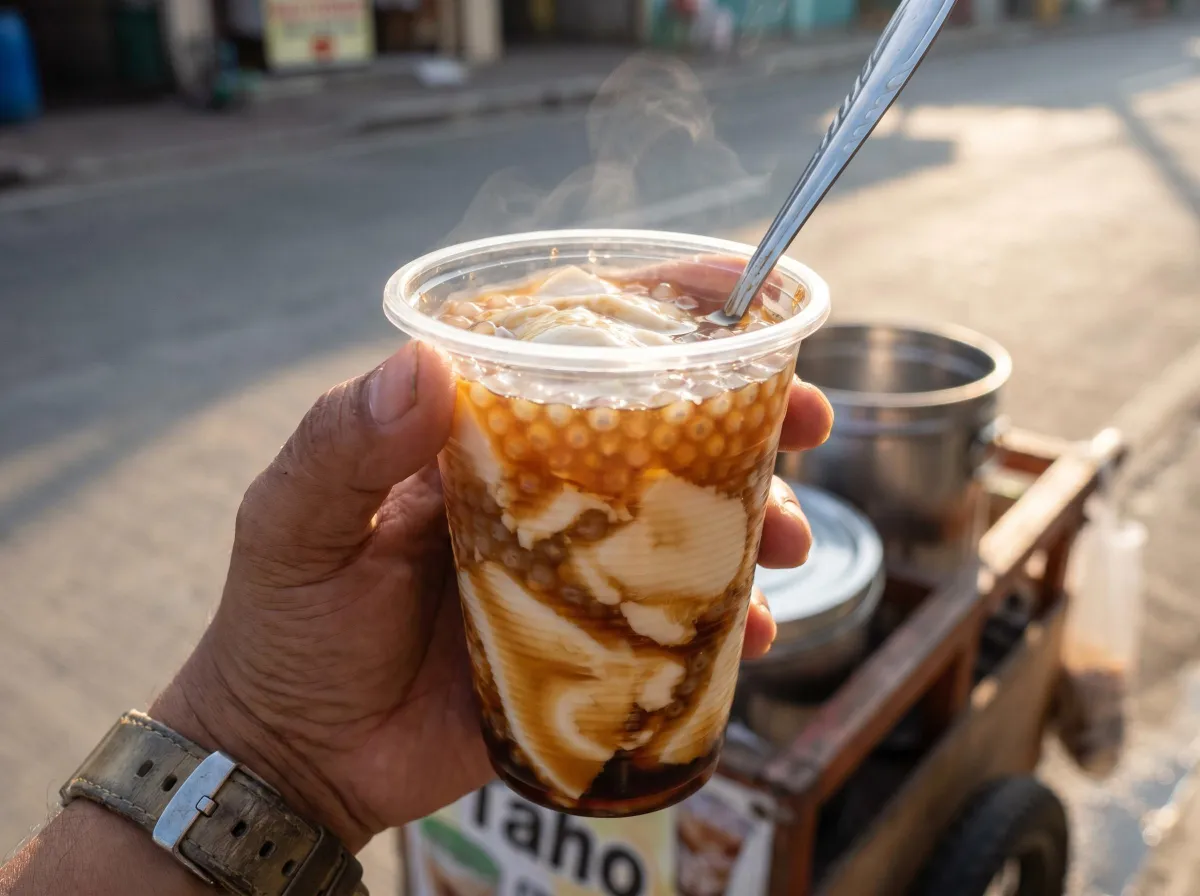
Taho (tah-hoh) is a Filipino street food made of three layers: fresh warm silken tofu at the base, sweet brown sugar syrup called arnibal poured over, and small soft sago pearls spooned on top. It is sold warm, in small plastic cups, by vendors who carry it through residential neighborhoods in the early morning. According to Wikipedia, taho is one of the most popular street foods and merienda snacks in the Philippines, with roots in Chinese culinary tradition that Filipino culture absorbed and made entirely its own.
At Studio Tributes, we believe Filipino food is worth understanding deeply — not just eating. Today we are going all the way into taho: what it is, where it comes from, what every layer tastes like, why the magtataho is one of the most beloved figures in Filipino street food culture, and why this simple cup of warm tofu and syrup carries so much more than its ingredients suggest.
🥛 What Is Taho?
Taho is deceptively simple. It is three things — silken tofu, brown sugar syrup, sago pearls — assembled in a plastic cup and handed to you warm, usually before 9am, by someone who has been carrying it through your neighborhood since before you woke up.
But simplicity, in Filipino food, is never the whole story.
The tofu in taho is not regular tofu. It is fresh, unpressed, soft silken tofu — made that morning, carried in the vendor's bucket while still warm, scooped gently with a flat ladle called a sandok so it does not break. Its texture is somewhere between a very soft custard and a cloud. It has no flavor of its own to speak of — which is the point. It is a vehicle. A canvas. The softest possible thing to pour sweetness over.
The arnibal is the soul of taho. It is a brown sugar syrup — sometimes made with muscovado sugar, which gives it a deeper, more molasses-rich flavor — simmered in water until it thickens just enough to pour but not so much that it sets. When it hits the warm tofu, it sinks in slightly, coats everything, and turns the whole cup golden-brown. The arnibal is what transforms plain silken tofu into something worth running to the gate for.
The sago pearls are the texture layer — small, soft, slightly chewy tapioca spheres that have been cooked until translucent and then soaked in arnibal so they carry sweetness into every bite. In taho, the sago is not an afterthought. It is the detail that makes the dish complete: the chew against the silk, the small pops of sweetness in a cup that would otherwise be entirely smooth.
A classic taho assembly:
🥛 Taho — fresh warm silken tofu, scooped from the bucket with a flat ladle
🍯 Arnibal — brown sugar syrup, poured generously over the tofu
⚫ Sago — soft tapioca pearls, spooned over the arnibal
Some regional and modern variations also include:
Ube arnibal — purple yam-flavored syrup, turning the taho violet
Strawberry taho — popular in Baguio, where fresh strawberries grow, the syrup made with local fruit
Pandan-flavored tofu — in some Visayan and Mindanao variations, the tofu itself carries a subtle pandan aroma
Brown rice or black sago — healthier modern variations with different sago colors
You eat taho with a small plastic straw or spoon, sometimes just drinking it from the cup when it is still warm enough to do so. There is no wrong way to eat taho. But there is a right time: early in the morning, when it is still warm, before the tofu cools and the arnibal thickens. Taho is a dish that belongs to a specific hour.
📜 The Story Behind It
Taho's origin is one of the most interesting in Filipino food — because it is both clearly Chinese in origin and completely, unmistakably Filipino in character.
The dish traces its roots to Chinese douhua (豆花) — a soft tofu dessert popular throughout China and Southeast Asia, made by coagulating fresh soy milk into a silken curd and serving it with sweet syrup. Chinese immigrants, known in the Philippines as the Tsinoy community, brought this tradition to the archipelago centuries ago through the same trade contact that shaped so much of Filipino cuisine: the proximity to Fujian province across the South China Sea, the Manila Chinese quarter called the Parian, and the generations of Chinese settlers who married into Filipino communities and whose food traditions became inseparably woven into Philippine culture.
What Filipino street vendors did with the Chinese douhua tradition was what Filipino cooks have always done with outside influences: they took it, made it local, and gave it a life that the original no longer contained.
The fresh silken tofu became a street food rather than a restaurant dish. The syrup became arnibal — made specifically with Filipino brown sugar and muscovado, which carry the particular flavor of Philippine sugarcane. The sago pearls, already a feature of Filipino desserts for centuries, were incorporated as the textural element that makes taho feel distinctly Filipino rather than Chinese. And the whole thing was placed on the shoulders of a vendor and walked through neighborhoods every morning, meeting people where they were — at the gate, at the door, in their slippers, still waking up.
The magtataho as a cultural institution became part of Philippine urban life in the twentieth century and has remained one of its most enduring features. Unlike most street food vendors, the magtataho does not wait at a fixed stall. He comes to you. He announces himself with a call that every Filipino in the neighborhood recognizes. He knows his regulars. He knows which houses want more sago, which children always ask for extra arnibal, which lola has been waiting since the call was still half a block away.
That relationship between vendor and community is inseparable from what taho is. The cup is warm. The call is familiar. The whole transaction takes thirty seconds. And it sets the tone for the entire day.
👅 What Does Taho Taste Like?
Taho tastes like a morning that is going to be fine.
That is not poetry — it is the most accurate description available, because the flavor itself is gentle enough that the context does almost as much work as the ingredients. But let us be specific.
The silken tofu, warm from the vendor's bucket, tastes like almost nothing on its own — a barely-there soy note, a gentle softness that dissolves almost before you have fully registered it. This is intentional. The tofu is not meant to declare itself. It is meant to receive.
The arnibal hits next: sweet, warm, brown-sugar forward, with a slight caramel depth that comes from the muscovado's natural molasses content. Filipino brown sugar and muscovado have a more complex, darker flavor than refined white sugar — they carry hints of cane and earth that elevate what might otherwise be a simple sweet syrup into something with actual character. The arnibal is warm too, adding to the overall sensation of being fed something that was prepared with attention.
Then the sago: small, yielding, slightly bouncy, carrying the arnibal's sweetness deeper into the texture of each bite. The sago is what makes taho feel like more than sweetened soft tofu — it is the counterpoint, the thing your tongue finds unexpectedly and is glad for.
Together, taho is sweet but not cloying, warm but not hot, soft but not insubstantial. It is light enough to eat before breakfast without feeling guilty and satisfying enough that children run for it when they hear the call. It is one of those rare foods that manages to feel both everyday and special at the same time.
And cold taho — taho that has sat too long, that the arnibal has pooled at the bottom of the cup — is not the same thing. Taho is a dish of the moment. It is best in the sixty seconds after it was assembled, still warm from the vendor's bucket, still together as a unified cup rather than separated layers settling in different directions. The time pressure is part of the pleasure.
If I had to describe it simply:
Taho tastes like the first warm thing you ate on a day that turned out well.
🗺️ Regional Variations Across the Philippines
The Philippines is an archipelago of over 7,641 islands, and while taho is one of the most consistent foods in the country — the basic formula is universal — it varies in the ways that Filipino food always varies: through local ingredients, regional preferences, and the specific creativity of whoever is making it.
Metro Manila and Luzon — The classic version: warm silken tofu, brown sugar arnibal, regular white sago pearls. The magtataho is a fixture of residential neighborhoods across the capital region, arriving in the early morning with his aluminum timbas and bamboo pingga. Manila taho is the benchmark version that most Filipinos outside the Philippines remember.
Baguio City — Perhaps the most famous regional variation. Baguio, the Philippines' highland city and strawberry-growing capital, produces a version of taho where the arnibal is replaced or supplemented with fresh strawberry syrup — bright red, slightly tart, made from locally grown Benguet strawberries. Baguio strawberry taho has become so iconic that it is one of the most sought-after street food experiences in the country, drawing visitors who specifically make the trip to Baguio for it.
Visayas — Taho in the Visayan region sometimes incorporates pandan in the tofu preparation, adding a subtle floral note to the silken base. The sago pearls in Visayan taho are sometimes larger, giving the cup a more substantial texture profile. The arnibal in some versions uses local muscovado sugar from Negros, which is among the finest muscovado in the Philippines and produces a particularly complex, deep syrup.
Mindanao — Regional variations in Mindanao sometimes reflect the broader flavors of Southern Philippine cooking — coconut sugar appears as an arnibal ingredient in some versions, and the tofu preparation may incorporate local soy varieties. In some communities, taho is eaten at different times of day rather than exclusively in the morning.
Modern and diaspora versions — Contemporary taho has expanded into ube-flavored arnibal (bright purple, deeply sweet), brown rice sago (a healthier alternative with a nuttier flavor), matcha arnibal (in Filipino cafes and bubble tea shops), and fully vegan versions using organic cane sugar muscovado. Filipino restaurants abroad serve taho as a heritage dessert, introducing it to non-Filipino diners alongside an explanation of what a magtataho is and why the call matters.
🗣️ Learn the Tagalog
Taho has its own vocabulary — the words of a morning ritual, a street transaction, and a memory that travels across decades and oceans.
The dish and the people:
Taho (tah-hoh) — the dish; also used as a verb: "Meron bang taho?" (Is there taho?)
Magtataho (mag-tah-tah-hoh) — the taho vendor; the person who sells it; from the root word taho plus the actor focus prefix magta-
TAHOOOO — the vendor's call; the sound that means morning, that means home, that means run to the gate
Timbas (tim-bahs) — the aluminum buckets the vendor carries, one holding fresh tofu, the other holding arnibal and sago
Pingga (ping-gah) — the bamboo shoulder pole that balances the two timbas
Sandok (san-dok) — the flat ladle used to scoop the silken tofu without breaking it
The ingredients:
Taho (tah-hoh) — the dish and the tofu at once; the same word names both
Arnibal (ar-nee-bahl) — the brown sugar syrup; the sweet, warm heart of the dish
Sago (sah-goh) — the tapioca pearls; soft, chewy, present in Filipino sweets for centuries
Muscovado (mus-koh-vah-doh) — the unrefined cane sugar used in the best arnibal; darker, richer, from Philippine sugarcane fields
Toyo (toh-yoh) — soy sauce; notably the opposite of what taho's tofu is for (silken and sweet, not savory)
At the gate:
Magtataho! (mag-tah-tah-hoh) — the call that means the vendor is nearby; shouted toward the street or through the window
Pabili ng taho! (pah-bee-lee nang tah-hoh) — I'd like to buy taho, please
Dagdag na sago! (dag-dag nah sah-goh) — extra sago, please
Dagdag na arnibal! (dag-dag nah ar-nee-bahl) — extra syrup, please; a request that reveals something important about a person's character
Mainit pa ba? (mah-ee-nit pah bah) — Is it still warm?
Oo, sariwa pa! (oh-oh, sah-ree-wah pah) — Yes, it's still fresh!
That last exchange — mainit pa ba? / oo, sariwa pa — is one of the most Filipino conversations in existence. It is a transaction, but it is also a reassurance. Yes, the world still works. Yes, the vendor came this morning. Yes, it is still warm.
🎨 Color It!
Bring Filipino food to life in a whole new way — through art.
Taho is deceptively beautiful to color. Where some Filipino dishes arrive in bold, saturated colors — the deep purple of ube, the mahogany of adobo — taho lives in warmth and softness. The pale cream of fresh silken tofu. The amber and deep brown of arnibal pooling in layers. The translucent grey-white of sago pearls sitting at the rim of the cup. The thin plastic cup catching the morning light. And in the Baguio version, the unexpected deep red of fresh strawberry syrup turning the whole cup into something jewel-like.
When you sit with a taho coloring page and choose those warm, gentle tones — how deep to make the arnibal, how pale the tofu, how to capture the particular quality of something warm in a plastic cup held by two hands in the early morning — something opens up. You start thinking about the sound of the call. You start thinking about the vendor. You start thinking about who was holding the cup, and where, and what the morning looked like from there.
Our Filipino Food Coloring Book on Amazon was built from exactly that instinct. Every page is a dish with a story. Every coloring session is an invitation to remember something that deserved to be remembered.
Taho is a page that opens a very specific conversation. Not about recipes or ingredients, but about mornings. About the ritual of the call and the run to the gate. About what it meant to be a child in the Philippines and have this particular thing show up in your morning without fail.
That makes it especially meaningful for:
🌼 Families who want to explore Filipino street food culture together through art
🌼 Filipino parents and grandparents introducing the next generation to everyday heritage
🌼 Adults and seniors who find nostalgic, mindful creativity deeply satisfying
🌼 Anyone in the Filipino diaspora who wants to hold onto the specific texture of home
🌼 Teachers, homeschoolers, and community groups exploring Philippine street food and culture
Each page can open a question worth asking: Did you ever hear the magtataho's call in the morning? Did you always ask for extra sago or extra arnibal? Did your lola send you to the gate with coins, or did she go herself?
Those questions are how a coloring page becomes a family story.
Share your completed taho coloring on Facebook or Instagram and tag @StudioTributes — we would love to see your version and celebrate it with the community.
👉 What Filipino Food Are You? Take the quiz →
👉 Get your FREE Filipino Coloring pages here.
🤩 Fun Facts About Taho
1. The word "taho" comes from the Hokkien Chinese word for soft tofu. Taho traces directly to the Chinese douhua tradition — soft tofu dessert — brought to the Philippines by Hokkien-speaking Chinese immigrants, primarily from Fujian province. The Tagalog word taho is a phonetic adaptation of the Hokkien tāu-hū, the same root that gives us tofu in English.
2. The magtataho's call is one of the most recognizable sounds in Philippine life. Ask any Filipino who grew up in the Philippines to imitate the magtataho's call and they will do it immediately — the long, rising TAHOOOO that carries through closed windows and gates at 7am. It is the sound of a functioning neighborhood, of daily life working the way it should, of a city that still runs on human-scale transactions.
3. Taho is carried entirely on one person's shoulders. The traditional magtataho carries two aluminum buckets — timbas — suspended from a bamboo pole — pingga — balanced across his shoulders. One bucket holds the freshly made silken tofu. The other holds the arnibal and sago. The entire operation travels with one person on foot, through residential streets, before most businesses open.
4. The tofu is made fresh every single morning. Unlike most tofu sold commercially, taho tofu is made fresh the morning of each sale — coagulated from hot soy milk into a silken curd and kept warm in the bucket. This is why taho tastes different from supermarket silken tofu: it is genuinely fresh, genuinely warm, and has not been chilled, firmed, or packaged. The freshness is the whole point.
5. Muscovado sugar from Negros is considered the gold standard for arnibal. The island of Negros Occidental in the Visayas is the sugarcane heartland of the Philippines, producing some of the finest muscovado in the world. Muscovado arnibal — made with this unrefined, mineral-rich brown sugar — has a depth and complexity that white sugar syrup cannot match. The difference is noticeable in every cup.
6. Baguio's strawberry taho has become a bucket-list Filipino food experience. The highland city of Baguio is the only place in the Philippines where strawberries grow at scale — and the local taho made with fresh Benguet strawberry syrup has become so famous that it appears on nearly every list of Filipino street foods worth traveling for. The combination of the familiar silken tofu and sago with the unexpectedly bright, tart strawberry syrup is one of the most charming regional food innovations in the country.
7. The magtataho is a disappearing profession in many cities. Urbanization, changing morning routines, and the rise of convenience stores and cafes have reduced the number of active magtataho vendors in Metro Manila and other large cities. In provincial towns and quieter neighborhoods, the tradition persists strongly — but food writers and cultural observers have noted with some sadness that the morning taho call is becoming rarer in the urban soundscape.
8. Taho has gone viral on Filipino social media for one specific reason: the pour. The magtataho's technique of scooping fresh tofu into the cup and then pouring arnibal in a long, amber stream has become a popular video subject on TikTok and Instagram — the close-up of dark syrup hitting white silken tofu, the sago pearls following. It is a small, domestic, completely un-dramatic moment that stops the scroll anyway, because it is specific and warm and real in a way that processed food content rarely is.
9. Taho is one of the foods most consistently described by the Filipino diaspora as "the thing I miss most." Food surveys and cultural essays about Filipino immigrant experience regularly place taho near the top of foods that cannot be adequately replicated abroad — not because the ingredients are unavailable, but because the experience of the magtataho's call, the run to the gate, and the warm cup at the door is inseparable from what taho actually is.
10. Taho is eaten as breakfast, merienda, and dessert — but belongs to none of those categories exclusively. Unlike most Filipino street foods that have a clear meal-time identity, taho floats across categories. It is eaten before breakfast as a sweet first thing. It is eaten as a mid-morning merienda snack. It is served as dessert after a meal. And it is sometimes eaten at odd hours simply because the vendor appeared and the answer to "Do you want taho?" is almost always yes.
11. Modern taho has entered Filipino cafes and bubble tea culture. Contemporary Filipino cafes and dessert shops now serve taho variations — ube arnibal, matcha tofu, brown sugar boba-style taho — that blend the traditional dish with newer trends. Overseas Filipino communities have created taho-inspired café menus that introduce the dish to non-Filipino diners, often alongside a story about the magtataho and the morning call.
12. A cup of taho costs almost nothing — and is worth everything. Historically, taho has been one of the most affordable foods in the Philippines — priced for everyday people, children with small coins, families on ordinary budgets. That affordability is part of its cultural weight. Taho is not a special occasion food. It is the food of ordinary mornings. And ordinary mornings, accumulated across a childhood, become the texture of a life.
🌍 How Taho Connects Filipinos Everywhere
Taho travels differently from almost every other Filipino food.
Most Filipino comfort foods can be recreated abroad with varying degrees of success. Adobo can be cooked in any kitchen in the world from ingredients available in any supermarket. Lugaw requires only rice and ginger. Even halo-halo can be assembled, imperfectly but recognizably, from an Asian grocery store. But taho — the version that matters, the version people miss — cannot really be recreated. Because taho is not just silken tofu and brown sugar syrup. It is the call. It is the vendor. It is the aluminum bucket and the bamboo pole and the specific sound of a neighborhood waking up in a particular way.
For the estimated 12 million Filipinos living outside the Philippines, taho belongs to a category of memories that food alone cannot fully carry: the experiences that are so embedded in a specific place and ritual that eating the food elsewhere produces only an echo of the original feeling. You can make arnibal. You can find silken tofu. You can cook sago pearls. But the assembled cup, held at 7am after running to the gate with coins, in a neighborhood where the magtataho is expected and known — that is not reproducible.
Which is precisely why taho means so much.
The diaspora relationship with taho is often one of longing rather than recreation. Filipino-American, Filipino-Canadian, and Filipino-Australian communities describe taho in essays, in social media posts, in recipe blogs that always begin with the same admission: it will not taste the same. And yet they make it anyway. Because the attempt is its own form of connection — a way of reaching toward a specific morning, a specific sound, a specific version of yourself that existed before the distance.
Filipino restaurants abroad have begun serving taho as a heritage dessert — partly to introduce non-Filipino diners to the dish, and partly to give the diaspora a taste of something they cannot easily make at home. The reception from non-Filipino diners is consistently surprised warmth: this is simpler than expected, and more comforting than expected, and why does warm sweet tofu feel like it means something?
The answer is not in the ingredients. It is in the history. Taho is the dish of ordinary mornings — of a childhood unfolding at the normal pace, of a neighborhood functioning the way neighborhoods are supposed to, of a country going about its daily life with its particular sounds and smells and rituals intact. When Filipinos abroad eat taho, they are not eating silken tofu. They are eating all of that.
And the call — TAHOOOO — is still the loudest part of the cup, even when it comes from a kitchen in a different hemisphere.
❓ FAQ — Everything You Need to Know About Taho
What is taho? Taho is a Filipino street food and snack made of three layers: soft silken tofu at the bottom, sweet brown sugar syrup called arnibal in the middle, and soft sago pearls on top. It is sold warm by vendors called magtataho who carry it in large aluminum buckets and call out TAHOOOO as they walk through neighborhoods each morning.
What does taho taste like? Taho tastes warm, sweet, and gently comforting. The silken tofu is soft and mild — almost custard-like. The arnibal adds deep brown sugar sweetness with a slight caramel note. The sago pearls bring a soft, chewy texture. Together the three layers create something that is sweet but not heavy, warm but not hot, and deeply associated with Filipino mornings.
What is arnibal? Arnibal is the sweet brown sugar syrup poured over the tofu in taho. It is made by dissolving brown sugar — ideally muscovado — in water and simmering until syrupy. The muscovado version has a deeper, more molasses-like flavor. Arnibal is what transforms plain silken tofu into the sweet, satisfying snack Filipinos know as taho.
What are sago pearls? Sago in taho are small tapioca pearls — soft, slightly chewy spheres made from starch, cooked until translucent and soaked in arnibal. They provide the textural contrast that makes taho more than just sweetened soft tofu.
Who is the magtataho? The magtataho is the taho vendor — from the Tagalog magta- prefix plus taho, meaning "one who sells taho." He carries two aluminum buckets (timbas) on a bamboo shoulder pole (pingga) through residential neighborhoods each morning, announcing himself with the long call TAHOOOO.
What time do taho vendors come? Typically between 6am and 9am, before school and work hours. The magtataho's call is a reliable part of the morning soundscape in many Philippine neighborhoods — almost an alarm clock for the community.
Is taho the same as tofu? Taho uses a specific type — fresh, unpressed silken tofu that is much softer than firm cooking tofu. It is made fresh daily, eaten warm and sweet rather than savory. Regular supermarket tofu is not a substitute.
What is Baguio strawberry taho? A celebrated regional variation from Baguio City, where the arnibal is replaced with fresh strawberry syrup made from locally grown Benguet strawberries. The combination of pale silken tofu with bright red strawberry syrup has become one of the most iconic Filipino street food experiences.
Can you make taho at home? Yes. You need fresh silken tofu (the softest available), arnibal made from brown sugar simmered in water until syrupy, and cooked sago pearls. Gently warm the tofu, assemble in a cup, pour arnibal, add sago. It will not taste exactly like the magtataho's version — their tofu is made fresh that morning — but it is achievable and satisfying.
Does taho have Chinese origins? Yes. Taho traces to Chinese douhua — soft tofu dessert — brought to the Philippines by Hokkien Chinese immigrants. Over centuries, Filipino vendors transformed it with local brown sugar arnibal, sago pearls, and the street vendor tradition, making it entirely Filipino in character while retaining its Chinese-derived silken tofu foundation.
💛 Closing
Taho does not look like much in the cup.
Pale white, amber-brown, a few small pearls at the top — it is not a dramatic food. It does not photograph the way halo-halo does, with its vivid layers and towering ice. It does not announce itself the way lechon does, bronze and glistening on a table. It arrives in a small plastic cup, warm and humble, handed through a gate by a man who has been walking since before the sun was fully up.
And yet it is one of the foods Filipinos miss most.
Not because of what it tastes like, exactly — though it does taste like something genuinely good. But because of what it is attached to. The morning ritual. The familiar call. The neighborhood that works. The childhood that was happening around you without you fully understanding that it was something you would one day want to return to.
At Studio Tributes, we tell the stories of Filipino food because Filipino food carries Filipino life inside it. Taho carries a very specific kind of life — the ordinary kind, the morning kind, the kind that only becomes precious once the distance between you and it grows large enough that you cannot hear the call anymore.
We hope this gave you a warmer, more complete way to understand one of the Philippines' most beloved morning rituals.
Keep exploring Filipino food and culture with us:
🎨 Get our Filipino Food Activity Book on Amazon
📚 Read more Filipino food stories on our blog
💭 A Memory to Hold Onto
Did taho bring a morning back?
Maybe the sound of the call reaching you through a closed window, and your feet already moving toward the gate.
Maybe the particular warmth of the cup in both hands, standing on a front step before school.
Maybe arguing with a sibling about who got to ask for the extra sago.
Maybe a lola who always sent the kids out with the coins because she wanted them to have that specific morning moment.
Did you always ask for extra arnibal, or extra sago — and which does that say about you?
Who called you to the gate when the magtataho came?
What did the morning sound like from where you were?
If a memory came to mind, share your taho story on Facebook or Instagram and tag @StudioTributes — we would love to hear it and celebrate it with the whole community.
Read Next
📚 References & Further Reading
Wikipedia — Taho — Primary reference for ingredient overview, Chinese douhua origins, the magtataho vendor tradition, regional variations, and cultural context. Includes the Hokkien etymology of the word taho and the timbas/pingga carrying setup.
Wikipedia — Douhua — Reference for the Chinese soft tofu dessert tradition that preceded and informed Filipino taho. Documents earliest records of douhua from the Han dynasty and its spread across Southeast Asia.
TasteAtlas — Taho — Global culinary database entry for Filipino taho. Taho ranked 25th on TasteAtlas' Top 50 Best Street Food Sweets in the World with a 4.2 out of 5 rating, and 74th on the Top 100 Best Southeast Asian Street Foods list.
PhilStar Life — Taho, Maruya, Espasol Among TasteAtlas Best Street Food Sweets — Philippine news coverage of taho's 25th-place ranking and 4.2-star rating on TasteAtlas' global street food sweets list.
Rappler — Taho, Maruya, Espasol Labeled Best Street Food Sweets in the World — Supporting coverage of the TasteAtlas recognition with additional cultural context and community notes.
Kawaling Pinoy — Taho Recipe — Trusted Filipino home cooking resource with full recipe details, arnibal preparation, sago pearl cooking method, and community notes on recreating taho at home.
Kitchen Confidante — Homemade Taho Recipe — Filipino-American food writer's recipe and personal narrative about the magtataho call and the diaspora experience of taho; useful cultural and personal context.
GMA News Online — Filipino Street Foods in TasteAtlas Top 100 Southeast Asia — Coverage of taho's placement at 74th in TasteAtlas' Top 100 Best Southeast Asian Street Foods, alongside other Filipino street food rankings.