
What Is Adobong Puti? Filipino White Adobo — The Original Dish | Studio Tributes
Studio Tributes / Filipino Food / What Is Adobong Puti?
What Is Adobong Puti?
Filipino White Adobo — The Oldest Version of the Dish That Started Before History Wrote It Down
Before the soy sauce. Before the Spanish arrived. Before anyone called it adobo at all.
There was a pot. There was vinegar. There was garlic. And there was pork or chicken, simmered low and slow until the liquid had done its quiet, preserving work.
That is adobong puti — Filipino white adobo. And if you want to understand where Filipino adobo truly comes from, this is the version that takes you there.
Most Filipinos grow up eating the darker, soy-sauce-based version and thinking that is the whole story. The mahogany glaze, the rich brown sauce, the soy and vinegar balance — that is the adobo they know. But adobong puti is older. Simpler. And in many ways, more honest. According to Wikipedia's documentation on Philippine adobo, adobong puti is often regarded as the closest version to the original prehispanic adobo — the one Filipino ancestors made long before Chinese traders introduced soy sauce to the archipelago.
It is the taste of the Philippines before the Philippines was named.
At Studio Tributes, we love adobong puti because it carries something rare: a direct, almost unbroken thread back to the way Filipino families cooked before colonization, before trade routes changed the pantry, before the dish had a name anyone outside the islands would recognize. Today we are going deep into white adobo — what it is, why it matters, what it tastes like, and why it belongs in every Filipino food conversation.
🍲 What Is It?
Adobong puti (ah-doh-bong poo-tee) literally means "white adobo" in Tagalog. It is the version of Filipino adobo made without soy sauce — relying instead on vinegar, salt, garlic, bay leaves, and black peppercorns as its core ingredients. The absence of soy sauce is not a shortcut or a substitution. It is the point.
According to Encyclopaedia Britannica, adobo is widely considered the unofficial national dish of the Philippines, and the term refers both to the finished dish and to a specific indigenous method of cooking — a method that predates Spanish colonization entirely. Adobong puti is the purest surviving expression of that original method.
Wikipedia's entry on Philippine adobo describes adobong puti as a rarer version without soy sauce, which uses salt instead — contrasted with adobong itim, or "black adobo," the more prevalent soy sauce-based version most people know today.
A classic adobong puti includes:
🥩 Karne — meat, most commonly pork belly, pork shoulder, or chicken
🧄 Bawang — garlic, crushed generously
🍶 Suka — vinegar, the absolute backbone and the dish's defining character
🧂 Asin — salt, which replaces the seasoning role of soy sauce
🌿 Laurel — dried bay leaves
⚫ Paminta — whole black peppercorns
💧 Tubig — water, for braising
🍚 Kanin — steamed rice, always
Some regional and family variations also include:
Patatas — potato chunks, to make the dish more filling
Itlog na pinakuluan — hard-boiled eggs, added toward the end of cooking
Coconut vinegar or cane vinegar — for different regional acidity profiles
A pinch of sugar — in some modern versions, to round the sharpness
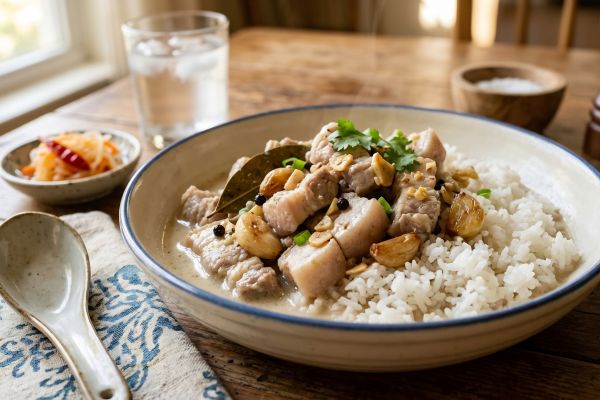
What makes adobong puti immediately different from the adobo most people know is the color. Without soy sauce, the sauce stays pale — a soft, creamy golden-white depending on how much fat renders from the meat. It looks nothing like what you might expect from the word "adobo." But it tastes unmistakably, specifically Filipino.
📜 The Story Behind It
To understand adobong puti, you have to understand what Filipino cooking looked like before the world arrived at its shores.
Encyclopaedia Britannica documents that the term "adobo" first appeared in 1613 in a Tagalog-Spanish dictionary compiled by Franciscan missionary Pedro de San Buenaventura, who recorded the dish as adobo de los naturales — the adobo of the native people. He named it for its similarities to a Spanish marinade used in braising; the dish's original Tagalog name was likely never recorded.
But what San Buenaventura was documenting had already existed for generations. Adobong puti uses most of the ingredients pre-colonial Filipinos would have used prior to colonization and contact with other countries — which is precisely why many food historians and Filipino cooks consider it the truest form of adobo.
The story of soy sauce's entry into Filipino cooking is the story of trade. Soy sauce was directly introduced to the Philippines via Chinese traders and settlers in the islands, which is how Filipino cuisine began to use it in their dishes. Over time, as soy sauce became widely available and deeply embedded in Filipino kitchens — particularly in Luzon — it replaced salt as the standard seasoning agent in adobo. The sauce darkened. The flavor deepened. And the original white version gradually became the less common one.
Cookbooks and Filipino historians cite the addition of soy sauce as only recent to the recipe — a relatively modern development in a dish with centuries of history behind it.
Historian Ambeth Ocampo notes that while Philippine adobo might have a very Spanish-sounding name, its origins go back to before Portuguese explorer Ferdinand Magellan first set foot on the archipelago in 1521. Adobong puti is the closest we can get to what those original versions tasted like.
The geography of white adobo is also telling. The Visayan Islands are considered home to the original adobo — the version made without soy sauce, described as adobong puti, or "using only vinegar." In the northern regions of Luzon, vinegar-forward adobo traditions also persist, particularly using local cane or coconut vinegars that produce a white or clear sauce. These regional variations are not accidents of geography — they are living archives of pre-colonial Filipino cooking.
It may actually be closer to the original pre-colonial Filipino adobo, which was cooked using only vinegar and salt as natural preservatives. This method allowed food to last longer in a tropical climate, where refrigeration was not available. The vinegar did its quiet work — slowing bacterial growth, extending the shelf life of meat, and making it possible to cook ahead for days without a refrigerator. In a tropical archipelago, that practicality was everything.
What emerged from that practical necessity was something remarkable: a dish so flavorful, so perfectly balanced, and so deeply satisfying that it survived centuries of change, trade, colonization, and globalization — and is still being made, and still being loved, today.
👅 What Does Adobong Puti Taste Like?
If soy-sauce adobo is bold and dark and deeply savory, adobong puti is bright and clean and quietly complex.
The first thing you notice is the vinegar — forward, tangy, immediate. Without soy sauce to balance and deepen it, the acidity is more present, more pronounced. But it is not harsh. Good adobong puti is never harsh. The vinegar softens as it simmers, mellowing into something gentler than its raw form while keeping its essential brightness.
Then comes the garlic. In white adobo, garlic is not a background note — it is a full character. Without the dark richness of soy sauce, the garlic's sweetness and warmth come through more clearly. Many cooks use a generous amount, letting it soften completely into the broth until it is almost creamy.
The salt provides seasoning without color, letting the natural flavors of the meat, the vinegar, and the aromatics lead. Bay leaves and black peppercorns work in the same quiet way they do in any adobo — you feel their presence without always identifying them individually.
The sauce itself is pale — almost ivory or soft gold — and lighter in consistency than soy-based adobo. Adobong puti tends to be more tangy and salty, highlighting the core flavors of the vinegar, salt, and spices rather than the savory depth that soy sauce provides.
In texture, the meat is fork-tender after a proper braise. Pork belly becomes silky. Chicken thighs soften completely. The sauce clings lightly — less glossy than adobong itim, more like a flavorful cooking broth that the rice absorbs completely.
And then there is the next day. Like all adobo, adobong puti improves with rest. The meat continues to absorb the vinegar and salt, the garlic deepens, and the flavors become more unified. Cold, over garlic fried rice, the morning after — it may be the best version of all.
If I had to describe it simply:
Adobong puti tastes like the original. Clean. Honest. Older than anything on your grocery shelf.
🗣️ Learn the Tagalog
The language around adobong puti is the language of memory and simplicity. These are the words of a kitchen where nothing unnecessary was added — because nothing unnecessary was needed.
The dish:
Adobong puti (ah-doh-bong poo-tee) — white adobo; literally "white adobo"
Adobong itim (ah-doh-bong ee-teem) — black adobo; the soy sauce-based version, for contrast
Prehispaniko (preh-ees-pah-nee-koh) — pre-Hispanic, pre-colonial; describes the origins of this dish
The ingredients:
Suka (soo-kah) — vinegar; the soul of the dish
Asin (ah-seen) — salt; the seasoning that replaced toyo in the original
Toyo (toh-yoh) — soy sauce; notably absent from adobong puti
Bawang (bah-wahng) — garlic; a dominant flavor in the white version
Laurel (lah-oo-rel) — bay leaf
Paminta (pah-min-tah) — peppercorns
Puti (poo-tee) — white; the defining color description of this dish
Sarsa (sar-sah) — sauce; the pale, tangy broth that soaks the rice
Phrases at the table:
Walang toyo? (wah-lang toh-yoh) — No soy sauce? (the question every first-timer asks)
Mas maliwanag ang kulay. (mahs mah-lee-wah-nahg ang koo-lai) — The color is lighter/brighter.
Mas maasim pero masarap. (mahs mah-ah-seem peh-roh mah-sah-rahp) — More sour but delicious.
Ito ang tunay na adobo. (ee-toh ang too-nai nah ah-doh-boh) — This is the real adobo.
Ang galing ng luma. (ang gah-ling nang loo-mah) — The old way is great.
That last phrase carries something deeper than a compliment about food. It is a small act of cultural preservation — an acknowledgment that the way things were done before is not inferior just because it came first.
🤩 Fun Facts About Adobong Puti
1. It is considered the closest surviving version of pre-colonial Filipino adobo.
Wikipedia's entry on Philippine adobo notes that adobong puti is often regarded as the closest to the original version of the prehispanic adobo — the dish Filipino ancestors cooked before soy sauce, before colonization, and before the word "adobo" existed.
2. The original Tagalog name of the dish was likely never recorded.
Encyclopaedia Britannica notes that when Pedro de San Buenaventura documented the dish in 1613, the dish's original Tagalog name was likely never recorded — meaning we know the Spanish name, but the indigenous name that Filipino people used for centuries before colonization is lost to history.
3. Soy sauce was not part of the original recipe — it came from Chinese trade.
Soy sauce was directly introduced to the Philippines via Chinese traders and settlers in the islands, which gradually led to its adoption into adobo. Before that, salt and vinegar alone carried all the flavor.
4. Adobong puti is the adobo of the Visayas.
The Visayan Islands are home to the original adobo — the version made without soy sauce, described as adobong puti, "using only vinegar." While it exists across the Philippines, its strongest regional heartland is in the Visayas, where the tradition of vinegar-based cooking without soy sauce has been maintained the longest.
5. White adobo can last even longer than soy-sauce adobo.
Because it relies more heavily on the natural preservative properties of vinegar — without the additional moisture that soy sauce sometimes introduces — adobong puti is exceptionally shelf-stable. Stored properly in a pyrex container in the refrigerator, white adobo can keep for up to two weeks.
6. It inspired a related dish called pinatisan.
Adobong puti is similar to another dish known as pinatisan, where patis (fish sauce) is used instead of vinegar — a variation that gives a deeper, more umami-forward result while keeping the same soy-free spirit.
7. The word "puti" means more than a color.
In Tagalog, puti means white — but in this context it carries cultural weight. Calling this adobo "white" contrasts it explicitly with adobong itim ("black adobo"), a naming convention that quietly maps the history of an ingredient — soy sauce — changing the dish's entire character.
8. It is experiencing a quiet culinary revival.
As Filipino food gains international recognition and Filipino chefs look to pre-colonial traditions for inspiration, adobong puti has become a dish of cultural interest — not just at home but in Filipino restaurants abroad that want to offer something beyond the familiar soy-sauce version.
🌍 How Adobong Puti Connects Filipinos Abroad
There is a particular kind of connection that adobong puti offers that the more familiar dark adobo cannot — a direct line to something that predates the Philippines as a colonial entity. And in a diaspora community where questions of identity run deep, that connection carries real weight.
For many Filipino-Americans, Filipino-Australians, Filipino-Canadians, and Filipinos living across Europe and the Middle East, cultural identity is not a fixed thing. It is something built and rebuilt constantly — through food, through language, through the stories passed down at family tables. Adobong puti is a dish that anchors those stories further back than most people realize.
There is a special charm in revisiting this version of adobo. Its simplicity and bright flavor are a beautiful reminder of the way our ancestors may have enjoyed this dish, long before other ingredients were added to the Filipino pantry.
For second and third generation Filipinos abroad — people who grew up eating their parents' dark adobo and considered that the standard — discovering adobong puti can feel like finding a door that was always there but never noticed. It is the same dish. But older. And quieter. And somehow, because of that, more profound.
Filipino chefs describe adobo as more of a "way of cooking" than a dish — and nowhere is that more evident than in adobong puti, where the method itself is the message. Vinegar. Salt. Garlic. Time. Heat. That is all. And from that simplicity, something extraordinary has been feeding Filipino families for centuries.
❓ FAQ — Adobong Puti (Filipino White Adobo)
What is adobong puti?
Adobong puti is the white, soy-sauce-free version of Filipino adobo. Braised in vinegar, salt, garlic, bay leaves, and peppercorns, it is widely regarded as the closest surviving version of the original pre-colonial Filipino adobo. Encyclopaedia Britannica documents adobo as widely considered the unofficial national dish of the Philippines and notes that the cooking method is indigenous to the archipelago, predating Spanish colonization.
Why is it called "white" adobo?
The name refers to the color of the sauce. Without soy sauce — which gives standard adobo its dark brown color — the braising liquid stays pale and clear, ranging from soft ivory to golden white depending on how much fat renders from the meat. Wikipedia contrasts it explicitly with adobong itim, "black adobo," the soy sauce-based versions that are most commonly known today.
Is adobong puti the original Filipino adobo?
It is widely considered to be the closest to the original. Some regard adobong puti as the "true" recipe of adobo since it utilizes most of the ingredients pre-colonial Filipinos would have used prior to colonization and contact with other countries.
What does adobong puti taste like?
It tastes tangy, garlicky, and savory — but lighter and brighter than soy-sauce adobo. The vinegar is more present, the garlic sweeter and more prominent, and the overall flavor profile cleaner and more acidic. Adobong puti tends to be more tangy and salty, highlighting the core flavors of vinegar, salt, and spices rather than the deep savory richness that soy sauce provides.
What vinegar is best for adobong puti?
Traditional Filipino white adobo uses coconut vinegar or cane vinegar — both native to the Philippines and both producing a gentler, slightly sweet acidity compared to distilled white vinegar. Coconut vinegar gives the most authentic flavor and is increasingly available in Asian grocery stores worldwide.
What meat works best for white adobo?
Pork belly, pork shoulder, and chicken thighs are the most common choices. Pork belly is especially good because the fat renders into the sauce, giving it a gentle richness that balances the vinegar's acidity. Some versions use both pork and chicken together.
How is adobong puti different from regular Filipino adobo?
The core difference is the absence of soy sauce. This changes the color (pale instead of dark), the flavor profile (brighter and more vinegar-forward instead of deep and savory), and the dish's historical positioning — white adobo is pre-colonial; dark adobo evolved after Chinese trade introduced soy sauce to Filipino kitchens.
Can I add potatoes or eggs to adobong puti?
Yes — and many families do. A common technique used by Filipinos to make a dish more filling is by adding chunks of potatoes and boiled eggs, both of which absorb the tangy sauce beautifully and extend the dish to feed more people.
Does adobong puti taste better the next day?
Absolutely. Like all Filipino adobo, the white version improves significantly with rest. The meat continues to absorb the vinegar and salt, the garlic deepens, and the flavors unify. Most Filipino cooks consider leftover adobong puti — especially served cold over garlic fried rice the next morning — one of the great simple pleasures of Filipino home cooking.
💛 Closing
Adobong puti does not announce itself.
It does not have the dark, glossy drama of a well-reduced soy-sauce adobo. It does not photograph in the bold, immediately recognizable way that makes Filipino food go viral on social media. It is pale and quiet and simple — a braise of vinegar and salt and garlic and time.
And yet it carries more history than almost any other dish in the Filipino kitchen.
It is the version that existed before the Spanish named it. Before Chinese traders changed it. Before fast food, before balikbayan boxes, before Jollibee and Goldilocks and all the layers of food culture that Filipinos around the world carry in their memories. Adobong puti is what came first. The original. The honest one.
At Studio Tributes, we celebrate Filipino culture through food, art, and the stories that travel with both. Whether you are discovering white adobo for the first time or rediscovering a dish your grandparents made before you knew what to call it, we hope this gave you something deeper to bring to the table.
Keep exploring Filipino food and culture with us:
👉 What Filipino Food Are You? Take the quiz →
👉 Get your FREE Filipino Coloring pages here.
🎨 Get our Filipino Food Activity Book on Amazon
📚 Read more Filipino food stories on our blog
💭 A Memory to Hold Onto
Did adobong puti bring someone to mind?
Maybe a lola who made her adobo different from everyone else's — lighter, more sour, without the dark sauce — and you never understood why until now.
Maybe a tita who insisted her version was "the old way" and could never quite explain what that meant.
Maybe a memory of vinegar and garlic without the soy sauce smell, from a kitchen you have not been in for years.
Who made white adobo in your family?
Did you know it was the older version?
What does it taste like in your memory?
If a memory came back while you were reading this — we would love to hear it.
Share your adobong puti story on Facebook or Instagram and tag @StudioTributes. And if you would like more warm Filipino food stories, cultural memories, and creative inspiration, come spend time with us on social media.
Read Next
📚 References & Further Reading
Encyclopaedia Britannica — Adobo | Description, History, Variations & Uses — The authoritative reference on adobo's history, indigenous origins, and naming by Spanish missionaries. Documents the 1613 first written record by Franciscan friar Pedro de San Buenaventura, who described the dish as adobo de los naturales — "the adobo of the native people" — and the dish's pre-colonial roots in tropical food preservation.
Wikipedia — Philippine Adobo — Comprehensive overview of adobo's relationship to pre-Hispanic cooking methods, the full spectrum of regional variations, and the contrast between adobong puti (vinegar and salt only) and adobong itim (with soy sauce). Includes documentation of pre-colonial Visayan terms for adobo-like dishes: guinamus, dayok, and danglusi.
Panlasang Pinoy Meaty Recipes — Adobo sa Puti Recipe — Recipe and cultural context for white adobo's pre-colonial origins. Notes that soy sauce replaced salt only with the arrival of Chinese traders, and that the vinegar-and-salt method is the most historically authentic form of the dish.
The Quirino Kitchen — Adobong Puti — Filipino Old Style White Adobo — Heritage recipe adapted from Atching Lillian Borromeo's heirloom Kapampangan recipes, with historical background on the white adobo tradition. Notes that the absence of soy sauce in white adobo is documented across both Visayan and Kapampangan culinary traditions, predating any Chinese trade influence on the dish.
Kawaling Pinoy — Adobong Puti (White Pork Adobo) — Trusted Filipino home cooking resource with full recipe details and community notes. Explicitly identifies adobong puti as "the closest version of the pre-colonial adobo" and notes that early Filipinos stewed meat in vinegar and salt as a preservation method before soy sauce entered the Philippine pantry.
Tasting Table — How Adobo Became a Filipino Staple — Historical overview featuring historian Ambeth Ocampo on adobo's pre-Magellan origins. Ocampo confirms that Philippine adobo predates Ferdinand Magellan's 1521 arrival and that the dish's original indigenous name was never recorded — leaving the dish defined by a Spanish word applied to a Filipino method. Includes Ocampo's estimate of "at least 21.8 million adobo recipes and variants" across Philippine households.
This article blends Studio Tributes storytelling with cultural and culinary research to create a warm, family-friendly learning experience.