
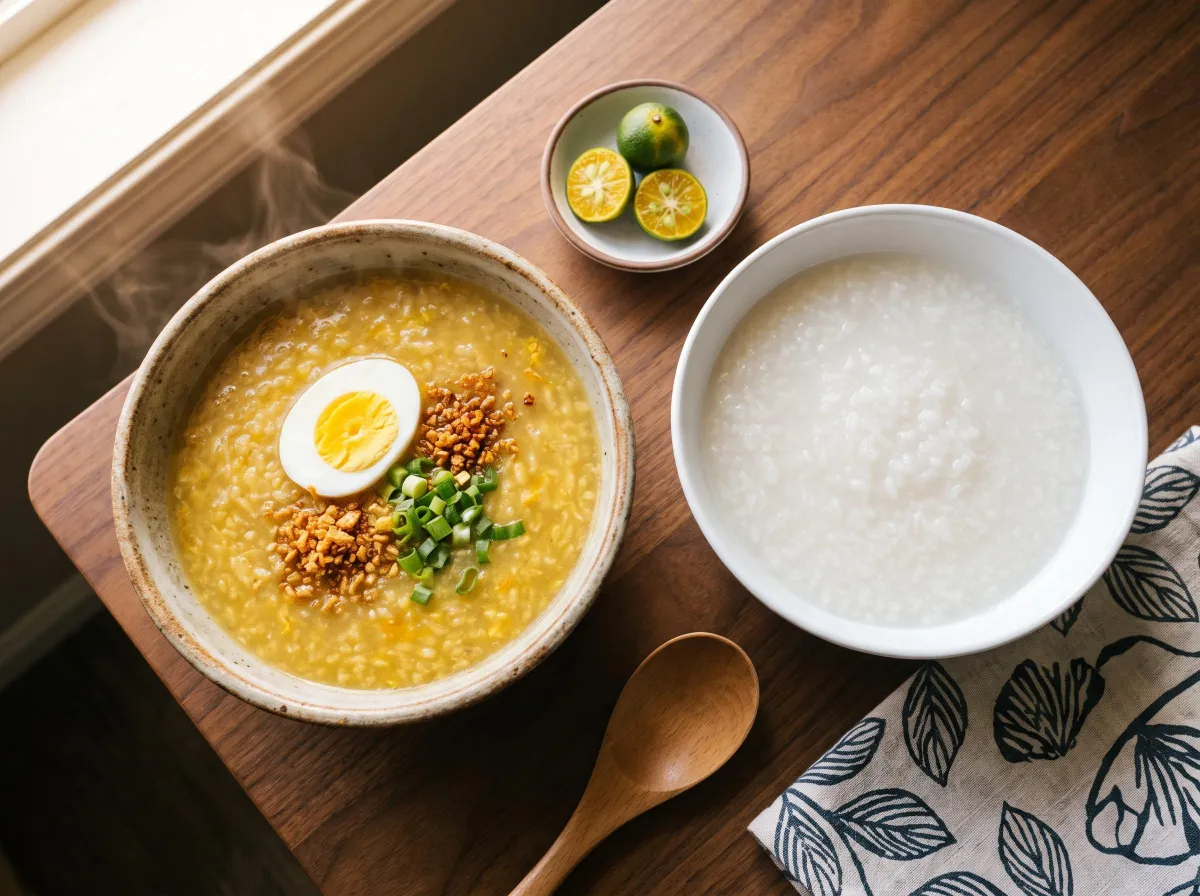
Arroz Caldo vs. Lugaw: What's the Real Difference?
Ask ten Filipinos to explain the difference between arroz caldo and lugaw, and you'll get ten confident, completely different answers — usually followed by "well, they're basically the same thing, except..."
That "except" is doing a lot of work. Arroz caldo and lugaw are two of the most beloved comfort foods in the Philippines, they're often served in the exact same carinderia stall, and they both start from the exact same idea: rice, simmered low and slow, until it breaks down into something soft enough to eat when you don't have the appetite for much else. And yet ask for one and get served the other, and most people will immediately notice something's off — even if they couldn't tell you exactly why.
So what actually separates them? Is arroz caldo just fancier lugaw? Is lugaw just arroz caldo without the good stuff? Or are they, as some cooks insist, genuinely two different dishes that happen to share a family tree? Let's settle it properly — with the history, the ingredients, and the honest answer to the question everyone Googles right before ordering.
🍚 Before we go any further — we made something for you.
Find out which rice porridge actually matches your comfort-food soul. Takes about a minute.
At Studio Tributes, we've noticed that "what's the difference between arroz caldo and lugaw" is one of those questions people ask constantly but rarely get a satisfying answer to — mostly because the honest answer involves a Chinese trading ship, three hundred years of Spanish colonization, and a safflower substitution that changed everything. So let's actually walk through it.
🥣 What Is the Difference Between Arroz Caldo and Lugaw?
Here's the short version, before we get into the long one: lugaw is the base dish, and arroz caldo is a specific, more developed descendant of it.
Lugaw is the umbrella term Filipinos use for savory rice porridge in general — and at its most basic, it's just glutinous rice simmered in water or a plain broth until it thickens, seasoned lightly with fish sauce (patis) and a bit of ginger, and topped with garlic, spring onions, and sometimes chicharon. It is, quite literally, rice cooked down until there's nothing left to do to it.
Arroz caldo is what happens when that basic formula gets a serious upgrade: a proper homemade chicken stock instead of plain water, whole or shredded chicken pieces cooked directly in the pot, a much heavier hand with ginger, and — in most versions — a golden-yellow color from kasubha (safflower), saffron, or turmeric. It's served with a hard-boiled egg, toasted garlic bits, scallions, and a squeeze of calamansi, which turns it from a simple gruel into what many Filipino households consider a full, satisfying one-bowl meal.
Here's the comparison side by side:
🍚 Lugaw
Base: glutinous rice simmered in water or light broth
Meat: often none, or minimal
Seasoning: fish sauce, a little ginger
Color: plain white or pale
Toppings: garlic, scallions, chicharon
Role: the foundation dish; also the umbrella term for the whole category
🍗 Arroz Caldo
Base: glutinous rice simmered in a from-scratch chicken stock
Meat: whole or shredded chicken pieces, cooked in the pot
Seasoning: heavy ginger, garlic, onion
Color: golden yellow, from kasubha, saffron, or turmeric
Toppings: hard-boiled egg, toasted garlic, scallions, calamansi
Role: a specific, named variation of lugaw
If you can make lugaw, you're most of the way to arroz caldo — the technique is nearly identical, it's the ingredients layered on top that turn one into the other. And if you're wondering where goto fits into all this: goto is a third variation, built on the same lugaw foundation but made with beef, typically ox tripe, instead of chicken.
📜 The Story Behind It
To really understand why arroz caldo and lugaw feel so different despite sharing a foundation, you have to go back roughly 400 years — and through two separate waves of outside influence that shaped this dish into what it is today.
Lugaw's history is old — genuinely old. It's considered one of the earliest documented dishes in the Philippines, with a written reference dating back to 1613, when friar and historian Fr. Pedro de San Buenaventura recorded "logao" as rice mixed with milk, water, or broth. That predates most of what we think of as "classic" Filipino cuisine by centuries. Lugaw's roots are widely traced to Chinese congee, brought to the islands through long-standing trade relationships between Chinese merchants and early Filipino communities, well before Spanish colonization began.
Arroz caldo entered the story later, during Spanish colonization. As the Spanish settled into the Philippines, they took a liking to lugaw and began adapting it with ingredients and techniques more familiar to their own cuisine — most notably a pinch of saffron, which gave the dish a golden hue reminiscent of paella. Saffron, however, was an extraordinarily expensive imported spice, out of reach for most households. Filipino cooks substituted it with kasubha, a locally grown safflower that produced a similar yellow tint at a fraction of the cost — a substitution so successful that kasubha remains the standard coloring ingredient in arroz caldo today, with saffron treated as the "fancier" version rather than the default.
Over time, this Hispanicized version of lugaw picked up its own name — "arroz caldo," Spanish for "rice broth" — and its own identity: whole chicken, a real stock, heavier ginger, and those now-signature yellow tones. What started as one term for all rice porridge in the Philippines split into two: the humble, foundational lugaw, and the more elaborate, named-and-branded arroz caldo that grew out of it.
It's worth sitting with that origin for a second, because it explains almost everything about how these two dishes are perceived today — including a debate that's still worth having.
🤔 Our Take: Does Calling Arroz Caldo the "Upgraded" Version Get Something Wrong?
You'll see this framing everywhere, including in food writing we trust and in the plain historical record: arroz caldo is consistently described as the more "elevated," more "developed," more "befitting" version of lugaw — a dish that, as one food writer put it, drifted away from its "simple indigenous origins" toward something more suited to Spanish taste. It's not an inaccurate description of what happened historically. But it's worth asking what that language quietly implies.
If arroz caldo is the dish that got "elevated" by Spanish ingredients and techniques, the unspoken flip side is that lugaw — the older, Sino-Filipino original — gets cast as the thing that needed elevating in the first place. That's a familiar pattern in colonial food history, not unique to the Philippines: the version closest to European influence gets treated as more refined, while the indigenous or immigrant-rooted original gets filed under "humble" or "basic," even when it's the dish with the longer, more historically significant lineage.
We think that framing deserves a second look. Lugaw isn't an unfinished arroz caldo waiting for someone to add chicken stock and saffron substitute to it — it's a dish with a nearly 400-year documented history, a direct line to Chinese congee traditions, and a cultural role that arroz caldo doesn't fully share: lugaw is still the dish most associated with sickness, recovery, and the specific kind of care that comes from someone making you plain, gentle food when you can't handle anything else. Arroz caldo, by contrast, has become the fuller, heartier version people reach for as an actual meal, not just something easy to keep down. Those are two different jobs, done by two different dishes — and "which one is better" is arguably the wrong question. The more useful one is what each dish was actually built to do, and for whom.
That's our stance, offered honestly rather than definitively — food historians and home cooks are welcome to disagree, and plenty of people happily use "lugaw" and "arroz caldo" interchangeably without thinking about any of this at all, which is a perfectly valid way to eat, too.
🍳 How to Actually Tell Them Apart at the Table
If you're standing in front of a carinderia counter or a pot on the stove and need the fast, practical version, here's what to check:
Color. Lugaw is typically plain white or pale beige. Arroz caldo is golden yellow. This is usually the fastest visual tell.
What's floating in it. Plain lugaw often has little to no visible meat — maybe a few small bits, maybe none at all. Arroz caldo almost always has visible chicken pieces or shredded chicken throughout.
The topping lineup. Lugaw is commonly finished with just garlic, scallions, and sometimes chicharon. Arroz caldo's full toppings lineup — hard-boiled egg, toasted garlic, scallions, and a wedge of calamansi on the side — is a strong signal you're looking at arroz caldo specifically, not a plain lugaw.
The smell. Ginger is present in both, but arroz caldo's ginger presence is usually much more assertive and immediate, since it's simmered directly into a proper chicken stock rather than added lightly to water.
What you'd call it if pressed. A useful rule of thumb from Filipino home cooks: if you know how to make lugaw, you already know most of what you need to make arroz caldo — the techniques overlap almost entirely, and the differences are additive (better stock, more ginger, chicken, color) rather than a totally different cooking method.
🍲 Meet the Rest of the Rice Porridge Family
Arroz caldo and lugaw don't exist in isolation — they're part of a small, related family of Filipino rice porridge dishes that people mix up constantly, so it's worth placing them in context.
Goto is lugaw's beef cousin, built on the same base but made with ox tripe (tuwalya) as the primary protein, sometimes along with other beef innards. It's often called "beef lugaw" for exactly that reason, and shares arroz caldo's habit of being topped with toasted garlic, scallions, and chicharon.
Congee is the term most people outside the Philippines use for Chinese-style rice porridge, and it's the dish lugaw is historically descended from. Congee in a Chinese restaurant context tends to be thinner and topped with things like century egg, shredded meat, or wonton chips — a different topping culture from lugaw's garlic-and-scallions approach, even though the base cooking method is nearly identical.
Pospas is the Visayan regional name for arroz caldo, used in place of the Tagalog-rooted term in that part of the country, though the ingredients can vary slightly by region.
Champorado deserves an honorable mention here even though it's not part of the savory lineup — it's the sweet, chocolate version of rice porridge made with glutinous rice and cocoa, usually paired with dried salted fish for a salty-sweet contrast. In late 2025, arroz caldo, lugaw, and champorado were all recognized on TasteAtlas's list of the Top 100 Porridges in the World, with arroz caldo landing an impressive second place overall and lugaw taking the tenth spot — solid international proof of what Filipino households have known for centuries.
🗣️ Learn the Tagalog
The vocabulary around this dish family carries its own layered history — Chinese-rooted, Spanish-rooted, and distinctly Filipino, all in one bowl.
The dishes:
Lugaw (loo-gow) — rice porridge; also the umbrella term for the category
Arroz caldo (ah-ROS kal-doh) — chicken rice porridge; Spanish for "rice broth"
Goto (GOH-toh) — beef/ox tripe rice porridge
Pospas (pos-pas) — the Visayan regional name for arroz caldo
Champorado (cham-poh-RAH-doh) — sweet chocolate rice porridge
Key ingredients:
Kanin (kah-nin) — cooked rice
Malagkit (mah-lag-kit) — glutinous or sticky rice
Luya (loo-yah) — ginger
Kasubha (kah-soob-hah) — safflower, used to color arroz caldo yellow
Patis (pah-tis) — fish sauce
Sabaw (sah-bow) — broth or stock
Manok (mah-nok) — chicken
Baboy na tuwalya (bah-boy nah too-wal-yah) — ox tripe (goto's key ingredient)
Toppings and finishing touches:
Bawang (bah-wang) — garlic
Sibuyas na dahon (see-boo-yas nah dah-hon) — scallions/spring onions
Chicharon (chee-chah-ron) — crispy pork cracklings
Itlog na pula (it-log nah poo-lah) — hard-boiled egg (literally "red egg," referring to the yolk)
Kalamansi (kah-lah-MAN-see) — calamansi, the small citrus squeezed on top
At the table:
Mainit pa ba? (mah-ee-nit pah bah) — Is it still hot? The most-asked question before anyone eats lugaw or arroz caldo, since both are served scalding on purpose
Ang sarap, kahit simple lang (ahng sah-rap, kah-hit sim-ple lang) — It's delicious, even though it's simple. A phrase that captures lugaw's entire reputation in five words
🎨 Color It!
Bring Filipino food to life in a whole new way — through art.
Our Filipino Food Coloring Book on Amazon was built from exactly that kind of question. Every page is a dish with a story. Every coloring session is an invitation to remember.
That makes it especially meaningful for:
🌼 Families who want a creative activity that naturally opens a conversation about Filipino food heritage
🌼 Filipino parents and grandparents sharing their regional food traditions with the next generation
🌼 Adults and seniors who find nostalgic, mindful creativity deeply satisfying
🌼 Anyone in the Filipino diaspora who wants a quiet, beautiful way to hold onto what home tastes like
🌼 Teachers, homeschoolers, and community groups exploring Filipino food and culture through art
👉 Get your FREE Filipino Coloring pages here.
👉 What Filipino Food Are You? Take the quiz →
🤩 Fun Facts About Arroz Caldo and Lugaw
1. Lugaw has one of the longest documented food histories in the Philippines. A written reference to "logao" appears as far back as 1613, in the notes of friar and historian Fr. Pedro de San Buenaventura — making it one of the earliest specific dishes recorded in Philippine written history.
2. Arroz caldo's yellow color exists because saffron was too expensive. When Spanish colonizers introduced saffron to add color to lugaw, most households couldn't afford the imported spice regularly. Kasubha, a locally grown safflower, became the practical substitute — and it's still the standard coloring ingredient in arroz caldo today.
3. The name "arroz caldo" originally meant something broader. The term was first used to refer to rice gruels in general before narrowing over time into the specific chicken-and-ginger dish we recognize today, distinct from plain lugaw.
4. Goto isn't named after the tripe by accident. "Goto" is understood to derive from a term referencing ox tripe, and the dish is sometimes casually called "beef lugaw" because it follows the same base recipe with a different protein.
5. Arroz caldo ranked second in the world. In a TasteAtlas ranking of the Top 100 Porridges in the World published in 2025, arroz caldo placed second overall internationally, with lugaw ranking tenth and champorado placing nineteenth — a strong showing for a single country's rice porridge family.
6. Pospas is arroz caldo's other name — but not identical. In the Visayas region, arroz caldo is commonly called pospas, though the ingredient list can shift slightly depending on the region making it.
7. The technique overlap between lugaw and arroz caldo is almost total. Home cooks widely describe arroz caldo as "lugaw with a few tweaks" — the base simmering technique is essentially identical; what changes is the stock, the added chicken, the ginger quantity, and the color.
8. Champorado is lugaw's sweet sibling. Made from glutinous rice and cocoa rather than a savory broth, champorado is typically excluded when people use "lugaw" as an umbrella term, since it belongs to a completely different flavor category despite sharing the same rice-porridge cooking method.
9. Turmeric is a modern substitute for kasubha. While kasubha remains the traditional choice for arroz caldo's yellow color, some contemporary cooks reach for turmeric instead, particularly outside the Philippines where kasubha can be harder to find.
10. Lugaw is specifically associated with illness recovery in a way arroz caldo isn't quite as strongly. While both dishes are considered comfort food, lugaw in its plainest form is the specific dish most Filipino households reach for when someone is sick — prized for being easy to digest and gentle on an upset stomach, a role arroz caldo's heartier, meat-forward version doesn't occupy in quite the same way.
🌍 How These Bowls Connect Filipinos Everywhere
For a lot of people in the Filipino diaspora, arroz caldo and lugaw occupy a very specific emotional register that's different from celebration dishes like lechon or fiesta desserts like buko pandan. These are sick-day foods, rainy-day foods, and "I don't have the energy to cook anything complicated" foods — which means the memories attached to them tend to be quieter, but no less significant: a parent making a pot of lugaw because you had a fever, a grandmother insisting on real homemade chicken stock for arroz caldo because the boxed version "doesn't count," a version of both dishes that tastes slightly different in every household because there was never one official recipe to begin with.
That's part of why the arroz caldo versus lugaw question resists a single tidy answer. These aren't dishes standardized by a restaurant chain or codified in a single cookbook — they're dishes that evolved differently in nearly every Filipino kitchen, shaped by what stock was on hand, how much ginger a household liked, and whether kasubha was in the pantry that week. For Filipino families abroad, recreating either dish is often less about hitting an exact recipe and more about getting close enough to the specific version that means "home" to that particular household.
For newcomers trying either dish for the first time, the entry point advice is simple: if you want the fuller, more filling experience, start with arroz caldo — chicken, ginger, egg, garlic, all working together. If you want to understand where the whole tradition comes from, and why Filipinos reach for it specifically when they're sick or exhausted, order a plain bowl of lugaw and notice how much comfort a handful of simple ingredients can actually deliver.
❓ FAQ — Everything You Need to Know About Arroz Caldo vs. Lugaw
What is the difference between arroz caldo and lugaw? Lugaw is the base rice porridge dish and the general umbrella term for the category, made simply from glutinous rice simmered in water or light broth with fish sauce and ginger. Arroz caldo is a specific, more developed variation made with a proper homemade chicken stock, whole chicken pieces, heavier ginger, and typically a golden-yellow color from safflower (kasubha), served with a hard-boiled egg, toasted garlic, scallions, and calamansi.
Is arroz caldo just fancy lugaw? In practical terms, yes — arroz caldo is widely understood as lugaw with added chicken stock, chicken, more ginger, and coloring. But arroz caldo has its own name, history, and cultural role distinct from plain lugaw, so many Filipino cooks treat them as related but separate dishes rather than one being simply a "better" version of the other.
Why is arroz caldo yellow? Arroz caldo's yellow color traditionally comes from kasubha (safflower), a local, affordable substitute for the expensive saffron the Spanish originally introduced to color the dish. Some modern recipes use turmeric or annatto (atsuete) instead.
Is lugaw the same as congee? They're closely related but not identical. Lugaw descends from Chinese congee, brought to the Philippines through trade with Chinese merchants, but the two have developed different topping traditions — lugaw is typically finished with garlic, scallions, and chicharon, while congee served in a Chinese restaurant context often includes toppings like century egg, shredded meat, or wonton chips.
What is goto, and how is it different? Goto is another variation in the same rice porridge family, made with beef, typically ox tripe, in place of arroz caldo's chicken or lugaw's minimal meat. It's sometimes called "beef lugaw."
Which one is eaten when someone is sick? Lugaw, in its plainest form, is the dish most strongly associated with sickness and recovery in Filipino households, prized for being gentle and easy to digest. Arroz caldo, being heartier and more filling, is more commonly eaten as a full meal, though both are considered classic Filipino comfort food.
💛 Closing
Arroz caldo and lugaw aren't really rivals, whatever the "which one is better" debates online might suggest. They're two points on the same lineage — one older and simpler, carrying nearly four centuries of documented history and a direct line back to Chinese congee; the other a specific, Spanish-influenced descendant that grew its own name, its own signature color, and its own place at the Filipino table as a heartier, fuller meal.
Knowing the difference isn't just trivia. It's a small window into how Filipino food actually gets made: not through a single fixed recipe handed down unchanged, but through centuries of trade, colonization, substitution, and household improvisation, all simmered — quite literally — into the same pot. The next time someone hands you a steaming bowl and you're not sure whether to call it lugaw or arroz caldo, you'll know exactly what to look for, and exactly what four hundred years of history it took to get there.
At Studio Tributes, we tell the stories of Filipino food because Filipino food is worth knowing deeply — right down to the difference between two bowls of rice porridge that look almost identical until you know exactly what to look for.
Keep exploring Filipino food and culture with us:
🎨 Get our Filipino Food Activity Book on Amazon 📚 Read more Filipino food stories on our blog
💭 A Question for You
In your house growing up, was it "lugaw" or "arroz caldo" that showed up when you were sick — or did your family use the words interchangeably for both?
Kasubha, turmeric, or saffron — what's actually in your family's arroz caldo pot?
And now that you know the real difference: does knowing the history change how you'll order it next time, or were you already a loyalist to one over the other?
Share your answer on Facebook or Instagram and tag @StudioTributes — we would love to hear it.
Read Next
📚 References & Further Reading
Wikipedia — Arroz caldo — Reference for arroz caldo's ingredients, regional pospas naming, and classification as a type of lugaw.
Wikipedia — Lugaw — Reference for lugaw's alternative names, place of origin, and relationship to arroz caldo and goto.
SBS Filipino — Lugaw, congee, goto, and arroz caldo: How are they different? — Reference for the 1613 written record of "logao" and the Spanish-era saffron-to-kasubha substitution.
Yummy.ph — The Difference Between Arroz Caldo and Lugaw — Reference for the practical ingredient and preparation differences between the two dishes.
Recepedia — Lugaw, Congee, Goto and Arroz Caldo: What's the Difference? — Reference for goto's ox tripe base and shared topping traditions across the dish family.
The Adobros — Knowing Filipino Food: Lugaw — Reference for the historical framing of arroz caldo as an "elevated" descendant of lugaw.
The Filipino Times — Arroz Caldo, Lugaw, and Champorado Among Top 100 Porridges in the World — Reference for the 2025 TasteAtlas international rankings of arroz caldo, lugaw, and champorado.