
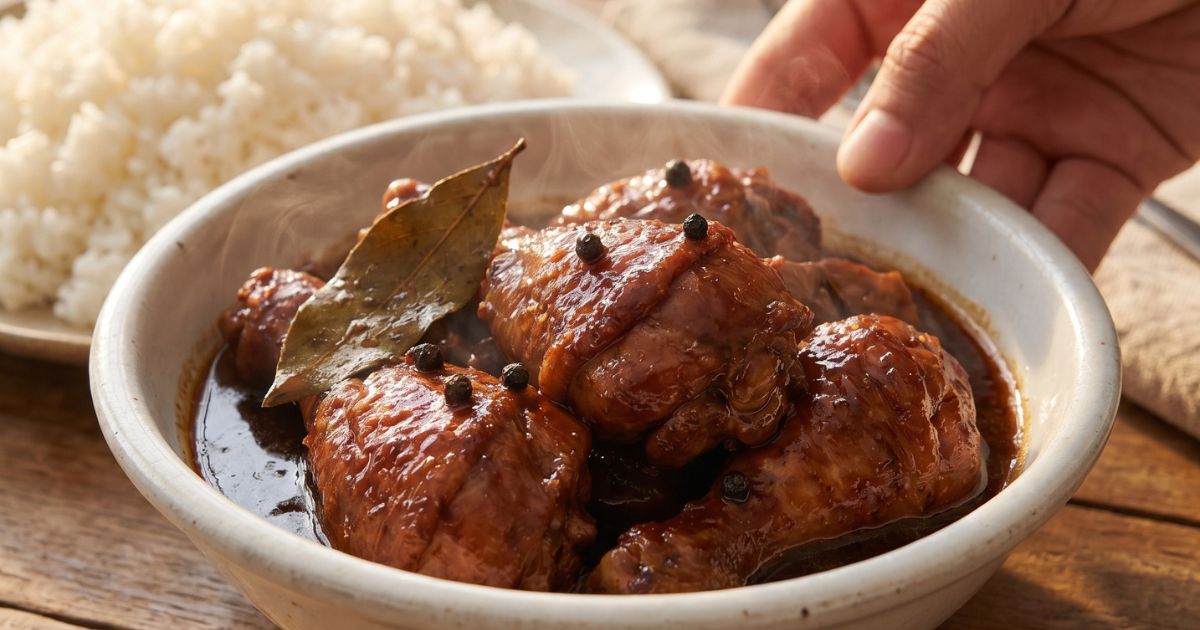
What Is Filipino Adobo? 2026 Guide (The Dish Every Family Makes Differently)
Studio Tributes / Filipino Food / What Is Adobo?
What Is Adobo?
The Unofficial National Dish of the Philippines — and the Dish Every Filipino Family Makes Differently, On Purpose
If you ask ten Filipino families about adobo, you may get ten different answers — and somehow, they can all still be right
For some, adobo is the taste of an ordinary weekday dinner that never felt ordinary at all. For others, it is the dish that always seemed to taste even better the next day, spooned over hot rice from a pot that still carried the scent of garlic and vinegar. For many Filipino Americans and Filipinos living far from home — in Los Angeles, Toronto, London, Dubai, or Sydney — adobo can feel like one of the fastest ways to return to the kitchen of childhood without buying a plane ticket.
That is part of what makes adobo so enduring. It is deeply familiar, but never exactly the same from one table to another.
Filipino adobo is most often a braised dish made with vinegar, garlic, black peppercorns, bay leaves, and usually soy sauce, though older and regional versions vary significantly. According to Encyclopaedia Britannica, adobo is widely considered the unofficial national dish of the Philippines, and the term refers both to the finished dish and to a specific indigenous method of cooking. Wikipedia describes Philippine adobo as a popular Filipino dish and cooking process in which meat, seafood, or vegetables are first browned in oil, then marinated and simmered in vinegar, salt and/or soy sauce, and garlic.
At Studio Tributes, we love dishes like adobo because they carry more than flavor. They carry routine, memory, migration, and family identity. Today we are going deep — what adobo is, where it comes from, what every regional version tastes like, and why it continues to hold such a profound place in Filipino culture everywhere in the world.
🍲 What Is Adobo?
Adobo is one of the foundational dishes of Filipino cuisine — not just because it is famous, but because it teaches you something essential about how Filipino cooking works.
At its core, adobo is a vinegar-based braise. The most familiar versions use chicken or pork, though adobo can also be made with seafood, vegetables, and other proteins. As Encyclopaedia Britannica notes, in the Philippines the word adobo refers not only to the finished dish but also to a specific style of cooking. That distinction matters, because adobo is less a rigid recipe and more a culinary language — a method that belongs to every household that uses it.
Wikipedia confirms that the cooking method for Philippine adobo is indigenous to the Philippines. The various precolonial peoples of the Philippine archipelago cooked and preserved their food with vinegar and salt long before any outside influence arrived. That means the technique you taste in every pot of adobo today has been alive in the Philippines for centuries.
A classic home-style adobo typically includes:
🍗 Manok o Baboy — chicken or pork, the two most beloved proteins
🧄 Bawang — garlic, one of the dish's defining aromas
🍶 Suka — vinegar, the absolute backbone of the dish
🥣 Toyo — soy sauce in the most common modern versions
🌿 Laurel at paminta — bay leaves and whole black peppercorns
🍚 Kanin — steamed rice, because adobo and rice are inseparable
What makes adobo especially beloved is its range. Some families like it more sour. Some want a darker, saltier, soy-forward version. Some simmer it until the sauce is glossy and reduced. Others keep it looser, with more sabaw (broth) to spoon generously over rice. There are also older forms — including white adobo — that rely on vinegar and salt rather than soy sauce. Encyclopaedia Britannica specifically notes these older styles and explains that soy sauce entered Filipino adobo later, through Chinese trade.
So if you have ever wondered why people talk about "their" adobo like it is personal — the answer is simple: it is. Adobo belongs to the household as much as it belongs to the country.
📜 The Story Behind It
Adobo's story is a perfect example of why Filipino food becomes more interesting the deeper you go.
The name adobo comes from Spanish, from adobar, which relates to marinating or seasoning. But the Filipino dish itself predates Spanish colonization entirely. According to Encyclopaedia Britannica, the term first appeared in 1613 in a Tagalog-Spanish dictionary compiled by Franciscan missionary Pedro de San Buenaventura, who described a tangy Filipino dish as "adobo de los naturales" — the adobo of the native people. He named it for its similarity to a Spanish marinade, but Britannica is clear: the dish's original Tagalog name was likely never recorded, and the cooking method was already there, fully formed, when the Spanish arrived.
That means Filipino adobo is not a cousin of Mexican adobo or Spanish adobo. It is its own thing, with its own indigenous logic, its own ingredient set, and its own centuries of history.
Wikipedia makes this distinction precisely: while Filipino adobo and Spanish-style adobo both use vinegar and garlic, they are culturally distinct dishes with different ingredients and culinary traditions. Unlike Spanish and Latin American adobos, the main ingredients of Philippine adobo are native to Southeast Asia — including vinegar made from palm sap or sugarcane, soy sauce introduced by Chinese traders, black peppercorns, and local bay leaves. Philippine adobo does not traditionally use chilis, paprika, oregano, or tomatoes.
Adobo has also gone global in ways that confirm its cultural reach. In April 2026, TasteAtlas — the world's most respected traditional food ranking platform — included adobong manok (chicken adobo) in its global rankings of the best dishes in Southeast Asia. Tourism Secretary Dita Angara-Mathay noted that the recognition benefits not only chefs and restaurants but also farmers, food producers, and small businesses across the Philippines.
Adobo travels exceptionally well across time and geography. It holds up in the refrigerator. It reheats beautifully. It fits just as easily in a home kitchen in Manila as it does in Los Angeles, Toronto, Dubai, or London. A child can grow up eating adobo before they fully understand the language around it. An adult can leave home, taste it years later, and suddenly remember the exact sound of a kitchen pot lid lifting.
That is the story of adobo too: not only where it came from, but how it keeps coming with people.
🗺️ Regional Variations Across the Philippines
One of the most important things to understand about adobo is that there is no single correct version. The Philippines is an archipelago of over 7,641 islands — and adobo adapts to every one of them.
This table is a reminder that when someone says "my lola's adobo was the best," they are almost certainly right — because their lola's version was shaped by her region, her family, her available ingredients, and her specific understanding of what balance means.
👅 What Does Adobo Taste Like?
Adobo tastes like contrast in balance.
The first thing you notice is usually the tang. Vinegar gives adobo its brightness and lift, keeping the dish from ever feeling flat or overly heavy. Then comes the savory depth — from soy sauce or salt, depending on the version — followed by the warmth of garlic and the subtle fragrance of bay leaves and peppercorns. Together, those elements make a sauce that feels bold without being loud.
Wikipedia describes Philippine adobo as characteristically salty and sour, and often sweet — a balance that stands in direct contrast to the spicier or herb-forward profiles of Spanish and Mexican adobos.
In texture, adobo can shift entirely depending on the cook. Some versions are tender and brothy. Others are dark, sticky, and reduced until the sauce clings to every piece of meat. Some families fry the meat in its own rendered fat after braising — giving a crunchy exterior that transforms the dish into something else entirely.
What is remarkable is that adobo rarely needs complexity to feel complete. It tastes layered, but not fussy.
If I had to describe it simply:
Adobo tastes like comfort sharpened by memory. Homey, but not bland. Deep, but not heavy. Tangy, but not harsh. And when it is poured over rice — especially when the rice catches the sauce — it becomes one of those dishes that feels immediately satisfying in both body and spirit.
🗣️ Learn the Tagalog
One of the most meaningful ways to connect with adobo is through the words that live around it.
Filipino food vocabulary is not only about ingredients. It is also about family habits, preferences, kitchen routines, and the way people talk across the table. With adobo, the language gets surprisingly personal very quickly.
The dish and cooking:
Adobo (ah-doh-boh) — the dish and the cooking method
Mag-adobo (mag-ah-doh-boh) — to cook adobo
Adobong manok (ah-doh-bong mah-nok) — chicken adobo
Adobong baboy (ah-doh-bong bah-boy) — pork adobo
Mahilig sa adobo (mah-hee-leeg sah ah-doh-boh) — someone who loves adobo
The ingredients:
Suka (soo-kah) — vinegar; the backbone
Toyo (toh-yoh) — soy sauce
Bawang (bah-wahng) — garlic
Dahon ng laurel (dah-hon nang lah-oo-rel) — bay leaf
Paminta (pah-min-tah) — pepper / peppercorns
Sarsa (sar-sah) — sauce / gravy
Ulam (oo-lam) — the main dish
At the table:
Anong klaseng adobo ang gusto mo? (ah-nong klah-seng ah-doh-boh ang goos-toh moh) — What kind of adobo do you like?
Kain tayo ng adobo! (kah-in tah-yoh nang ah-doh-boh) — Let's eat adobo!
Ang sarap ng adobo mo! (ang sah-rahp nang ah-doh-boh moh) — Your adobo is delicious!
Mas gusto ko ang maasim na adobo. (mahs goos-toh koh ang mah-ah-seem nah ah-doh-boh) — I like adobo that's more sour.
Mas masarap bukas. (mahs mah-sah-rahp boo-kahs) — It'll taste even better tomorrow.
These words do not float above the dish — they live inside it. Suka matters because vinegar defines adobo's edge. Bawang matters because you smell it before you taste it. And the question "Anong klaseng adobo ang gusto mo?" matters because adobo is never only one thing.
🎨 Color It!
Bring Filipino food to life in a whole new way — through art.
Adobo may not be the brightest dish on the table, but that is part of what makes it so deeply satisfying to color. Its beauty is in its richness: the deep mahogany-brown glaze of the sauce, the golden garlic softened by heat, the green bay leaves floating at the surface, the warm white rice beside it, and the small details that make it feel instantly familiar to anyone who has ever seen it served at home.
When you sit with an adobo coloring page and take your time with it — choosing the depth of the sauce, the color of the pork or chicken, the sheen on the rice — something happens. You start thinking about your family's version. How dark the sauce was. How much garlic your lola used. Whether it was saucier or drier, brothy or glossy. Whether it was always better the next day.
Our Filipino Food Coloring Book on Amazon was built from exactly that idea. Every page is a dish with a story. Every coloring session is an invitation to remember.
That makes it especially meaningful for:
🌼 Families who want a calm, shared activity that naturally opens a real conversation
🌼 Parents and grandparents introducing Filipino heritage to the next generation
🌼 Adults and seniors who find nostalgic, mindful creativity deeply satisfying
🌼 Anyone in the Filipino diaspora who needs a quiet way to hold onto home
🌼 Teachers, homeschoolers, and community groups exploring multicultural learning through art
Each page can open a question worth asking: Who made adobo in your family? Was it sweeter, tangier, darker, or saucier? Did your household use chicken, pork, or both? Did it taste better the next day?
Those are the kinds of questions that make creativity feel like connection.
Share your completed adobo coloring on Facebook or Instagram and tag @StudioTributes — we would love to celebrate your version with the community.
If you would like to explore Filipino food through art, memory, and family connection, download our FREE Filipino Food Coloring pages — they are waiting for you now.
👉 What Filipino Food Are You? Take the quiz →
👉 Get your FREE Filipino Coloring pages here.
🤩 Fun Facts About Filipino Adobo
1. Adobo is the unofficial national dish of the Philippines — without a single law making it official. Adobo is widely regarded as the Philippines' national dish, but there is no government decree behind it. It earned that title by consensus — through millions of family tables, shared meals, and the quiet agreement of a nation that this dish represents them best.
2. The first written record of Filipino adobo dates to 1613. According to Encyclopaedia Britannica, the term first appeared in a Tagalog-Spanish dictionary compiled by Franciscan missionary Pedro de San Buenaventura, who described it as "adobo de los naturales" — the adobo of the native people. The cooking method already existed. He only gave it a name.
3. No two families make adobo exactly the same way. Some like it more sour. Some darker and saltier. Some simmer it down until the sauce turns thick and glossy. Some fry the meat afterward until it is caramelized and almost crispy. Some add potatoes, hard-boiled eggs, or a splash of pineapple juice. All of them are right.
4. Adobo is both a dish and a cooking method. In Filipino cooking, "adobo" describes not only what is on the plate but the vinegar-based technique used to prepare it. The word covers the method before it covers the meal.
5. It almost always tastes better the next day. The meat continues to absorb the sauce after cooking. The vinegar softens. The garlic deepens. The fat redistributes. Most Filipino cooks make adobo intentionally the day before, knowing that patience makes it better. This is not a myth — it is culinary science.
6. Vinegar was chosen for preservation, not just flavor. Before refrigeration, vinegar's acidity slowed bacterial growth and extended the shelf life of meat in the tropical heat. Adobo was practical long before it was beloved. That practicality is still baked into every pot.
7. Filipino adobo is fundamentally different from Mexican adobo. They share a Spanish-derived name but are entirely different dishes. Encyclopaedia Britannica notes that while both use vinegar and garlic, Philippine adobo evolved independently and does not use the chili, paprika, or oregano common in Mexican and Spanish versions. The main ingredients of Philippine adobo are native to Southeast Asia.
8. In 2021, a government proposal to "standardize" adobo caused nationwide debate. The Bureau of Philippine Standards announced plans to create a standard definition for adobo, and the public reaction was immediate and impassioned. Filipinos were insulted by the idea that anyone could or should standardize a dish that belongs to every household differently. The reaction itself says everything about what adobo means.
9. Adobo has inspired poetry, music, and art. Wikipedia documents that poets have celebrated adobo's comforting qualities in spoken word and verse. Noel Aquino's 2025 bilingual collection "This Adobo Life: A Poetic Autobiography" uses adobo to explore immigrant experiences and ancestral roots. In 2023, Google released a Philippine Adobo doodle — making it the first Filipino dish honored that way.
10. Adobo has gone global through Michelin-starred Filipino kitchens. High-profile chefs like JP Anglo, whose Sarsa Kitchen+Bar earned a Michelin Bib Gourmand in 2025, incorporate innovative takes on adobo in fine-dining contexts — blending tradition with modern technique and bringing the dish to international food audiences who are only just beginning to discover Filipino cuisine.
🌍 How Adobo Connects Filipinos Everywhere
Adobo has a special kind of reach.
Some dishes are strongly tied to a region, a season, or a specific celebration. Adobo certainly can be celebratory, but it is also portable. Practical. It stores well, reheats well, and makes sense in a busy modern life on any continent.
For many in the Filipino diaspora — the estimated 12 million Filipinos living outside the Philippines — adobo becomes one of the earliest and strongest taste memories to survive distance. It is often one of the first Filipino dishes taught in households abroad, one of the most commonly shared with non-Filipino friends, and one of the easiest dishes to explain and replicate. Because its ingredients are broadly accessible — vinegar, soy sauce, garlic, bay leaves, pepper — it can be made almost anywhere on Earth.
That accessibility gives adobo a different kind of cultural power. It does not just stay in the homeland. It travels well enough to keep becoming home, wherever home currently is.
Wikipedia notes that adobo is commonly packed for Filipino mountaineers and travelers because it keeps well without refrigeration — a quality rooted in the same vinegar science that makes it the ideal diaspora dish. The same property that helped preserve meat in pre-colonial tropical Philippines now helps preserve Filipino identity in kitchens from New York to Riyadh to Melbourne.
Adobo is like the Filipino: adaptable. The name itself was borrowed and made Filipino. The technique was indigenous and never lost. The result belongs to everyone who has ever eaten it at a table that mattered.
❓ FAQ — Everything You Need to Know About Filipino Adobo
What is Filipino adobo? Filipino adobo is a dish and indigenous cooking method in which meat, seafood, or vegetables are braised in a sauce of vinegar, garlic, and usually soy sauce, often with bay leaves and black peppercorns. According to Encyclopaedia Britannica, it is widely considered the unofficial national dish of the Philippines, and the term refers to both the dish and the cooking technique.
What does adobo taste like? Adobo tastes savory, tangy, garlicky, and comforting — with a balance of acidity and depth. Wikipedia describes it as characteristically salty and sour, and often sweet. Different households make it more sour, more salty, or more reduced depending on family preference. It is bold without being loud.
Is Filipino adobo spicy? No. Filipino adobo is tangy and savory, not spicy. The whole black peppercorns add a mild, background warmth rather than pronounced heat. Some regional versions — like adobo sa gata from Bicol — add chili, but spice is not a defining characteristic of standard Filipino adobo.
Why does adobo taste better the next day? As the dish rests, the meat continues to absorb the sauce, the vinegar mellows, and the flavors unify. Most Filipino cooks consider day-two adobo superior to freshly cooked. It is one of those rare dishes where patience is genuinely, measurably rewarded.
Is Filipino adobo the same as Mexican adobo? No. As Encyclopaedia Britannica explains, while similar cooking methods and spice blends appear in Spanish and Latin American cuisines, Filipino adobo evolved independently. Philippine adobo uses ingredients native to Southeast Asia — particularly vinegar from palm sap or sugarcane, and soy sauce from Chinese trade — and does not include the chilis, paprika, or oregano common in Mexican adobo.
What is adobong puti (white adobo)? Adobong puti is the older, pre-soy sauce version of Filipino adobo — made with vinegar and salt only, without soy sauce. Britannica specifically notes this as the original form, before soy sauce was introduced through Chinese trade. It is lighter in color, more sharply acidic, and widely considered the version closest to the pre-colonial original.
What are the main regional variations of adobo in the Philippines? There are dozens of regional versions. The most widely known include: adobong puti (white, no soy sauce), adobo sa gata (with coconut milk, from Bicol), adobong dilaw (with turmeric, from Batangas), adobong tuyo (dry-cooked, meat fried in its own fat), and adobo sa atsuete (with annatto, from the Visayas). Each reflects the local ingredients and flavor traditions of its region.
What vinegar is best for Filipino adobo? Traditional Filipino adobo uses cane vinegar or coconut vinegar — both native to the Philippines. These produce a gentler, slightly sweet acidity compared to distilled white vinegar. Brands like Datu Puti and Silver Swan are the standard for most Filipino households. White or apple cider vinegar work as substitutes but produce a different flavor profile.
What meat is used in adobo? The two most common proteins are chicken (adobong manok) and pork (adobong baboy). Wikipedia notes that beef (adobong baka) is more popular among Muslim Filipinos. Adobo can also be made with seafood (fish, shrimp, squid), vegetables (kangkong, eggplant, bamboo shoots), and in modern versions, tofu and mushrooms.
What do you eat with adobo? Adobo is almost always served with steamed white rice — the rice soaking up the sauce completely. Garlic fried rice (sinangag) is a popular pairing for leftover adobo the next morning, often served as part of the classic Filipino breakfast combination called silogs. Some tables also include atchara (pickled green papaya) as a bright, sweet contrast to the savory dish.
Is adobo healthy? Adobo made with vinegar, garlic, and lean protein is relatively nutritious. Vinegar's acidity provides antimicrobial properties. Garlic has well-documented health benefits. Pork belly versions are higher in fat, while chicken versions are leaner. The dish is naturally free of processed additives in its traditional home-cooked form.
Can adobo be made vegan? Yes. Vegan adaptations of adobo using tofu, mushrooms, kangkong (water spinach), banana flowers, or bamboo shoots have become increasingly common in the Philippines and in Filipino communities abroad — braised in the same soy-vinegar method as the meat-based original. The sauce technique remains the same. Only the protein changes.
💛 Closing
Adobo is more than a famous Filipino dish. It is one of those meals that carries everyday life inside it — the sound of a pot simmering, the sharp comfort of vinegar and garlic in the air, the familiarity of rice waiting on the side, and the quiet confidence of a recipe that many families never had to measure exactly to get right.
It survived centuries of history, multiple waves of colonial influence, the introduction of new ingredients from Chinese traders and Spanish galleons, and ended up more Filipino than ever. It traveled to every corner of the world where Filipinos have gone and became, in each new kitchen, a version of home.
At Studio Tributes, we celebrate Filipino culture through food, art, and the stories that travel with both. Whether you are discovering adobo for the first time or remembering it from your own family table, we hope this gave you a warmer, deeper way to connect with one of the Philippines' most beloved classics.
Keep exploring Filipino food and culture with us:
🎨 Get our Filipino Food Activity Book on Amazon
📚 Read more Filipino food stories on our blog
💭 A Memory to Hold Onto
Did adobo bring someone to mind?
Maybe a parent who cooked it often without ever using a written recipe. Maybe a grandparent whose kitchen always smelled like garlic and vinegar on Sunday mornings. Maybe a lunchbox, a balikbayan visit, a school lunch, or a dinner that somehow tasted even better the next day. Maybe eating it cold, standing at the kitchen counter at midnight, over leftover rice.
Who made adobo in your life? Did your family like it more sour, more savory, or darker and richer? What memory comes back when you picture that sauce over rice?
If a memory came to mind, share your adobo story on Facebook or Instagram and tag @StudioTributes — we would love to celebrate it with you. And if you would like more warm Filipino food stories, cultural memories, and creative inspiration, come spend time with us on social media.
Read Next
📚 References & Further Reading
Encyclopaedia Britannica — Adobo | Description, History, Variations & Uses — Authoritative reference on adobo's history, 1613 first documentation, indigenous origins, and distinctions from Spanish and Mexican adobo. Cited 4× in this article.
Wikipedia — Philippine Adobo — Comprehensive entry on regional variations, indigenous origins, vinegar traditions, and cultural significance.
TasteAtlas — 100 Best Dishes — April 2026 — Global culinary database that included adobong manok in its April 2026 regional rankings.
DitoSaPilipinas — Chicken Inasal, Sinigang, Adobo Recognized in Global Food List — April 2026 news coverage of TasteAtlas recognition and Philippine Tourism Secretary's response.
Grokipedia — Philippine Adobo — Extended documentation including adobo in art, literature, film, and global diaspora culture; references Noel Aquino's 2025 collection and JP Anglo's Michelin recognition.
Panlasang Pinoy — Pork Adobo Recipe — Widely used Filipino home cooking reference with cultural context.
Culture Trip — A Brief History of Adobo, the Philippines' National Dish — Cultural history overview.
This article blends Studio Tributes storytelling with cultural and culinary research to create a warm, family-friendly learning experience.