
What Is Balut? The Filipino Fertilized Duck Egg Explained
Filipino Food · Studio Tributes
Studio Tributes / Filipino Food / What Is Balut?
Somewhere in the Philippines, after dark, you hear it before you see it.
A voice, carrying down the street: "Baluuuuuuut!"
It is a vendor, walking through the neighborhood with a basket of warm eggs wrapped in cloth to keep them hot. The call is one of the most recognizable sounds in Philippine street life — the particular drawn-out syllable that means someone is selling balut, that it is still warm, and that you have approximately thirty seconds to wave them down before they round the corner and disappear into the night.
For Filipinos who grew up hearing that call, it is comfort. It is late-night hunger satisfied for almost nothing. It is cracking an egg on the sidewalk, adding a pinch of salt, sipping the broth, and being completely, unceremoniously fed. It is one of those foods that belongs to a specific time — after dark, slightly warm from the vendor's basket, eaten standing up — and that carries that time inside it no matter where in the world you eat it.
For people who did not grow up in the Philippines, balut is the food they have most likely heard of in the context of a reality television show or a "world's most extreme foods" listicle — presented as something to be endured, challenged, or conquered. That framing is wrong. And the purpose of this post is to correct it.
Balut is a fertilized duck egg, incubated for 17 to 18 days and then boiled and eaten warm directly from the shell. Its name comes from the Tagalog phrase balut sa puti — meaning "wrapped in white" — a reference to the white membrane that surrounds the partially developed embryo inside. According to Wikipedia, balut has been documented across multiple Southeast Asian countries but is most strongly associated with the Philippines, where it is one of the most beloved and culturally significant street foods in the national culinary tradition.
It is not a challenge. It is breakfast, or dinner, or a late-night snack. It is nutrition and culture and community and street food philosophy all in one small shell. And when you understand what balut actually is — where it comes from, what it tastes like, what it means — the reaction to it changes completely.
At Studio Tributes, we celebrate Filipino food because Filipino food carries Filipino life inside it. Today we are going all the way into balut — the full story, the how-to, the taste, the history, the cultural weight, and why this small egg is the most argued-about food in Filipino culinary representation abroad.
🥚 Before we go any further — we made something for you. 🌙
Find out what your balut choices say about you. Takes about a minute.
🥚 What Is Balut, Really?
Let's start with the facts, clearly and without drama.
Balut is a duck egg that has been fertilized, incubated for a controlled period, and then boiled fully and eaten warm. The incubation period — typically 17 to 18 days — allows the embryo to partially develop. By day 17 or 18, the egg contains three distinct components:
🫙 Sabaw — the broth: a warm, savory liquid that fills the air pocket in the shell, tasting like a concentrated duck or chicken broth
🟡 Pula — the yolk: larger and richer than a regular egg yolk, deeply flavored from the incubation process
🐣 Sisiw — the embryo: the partially developed duckling, soft and tender, with the texture of very tender meat rather than anything like what the word "embryo" might suggest to someone unfamiliar with the dish
The egg is always eaten warm — never cold. The vendor keeps them insulated in cloth-lined baskets or containers, and a cold balut is a sign that it is past its moment. You eat it hot, immediately, off the shell, the way every street food in the Philippines is intended to be eaten: quickly, standing up, in the company of whoever is around.
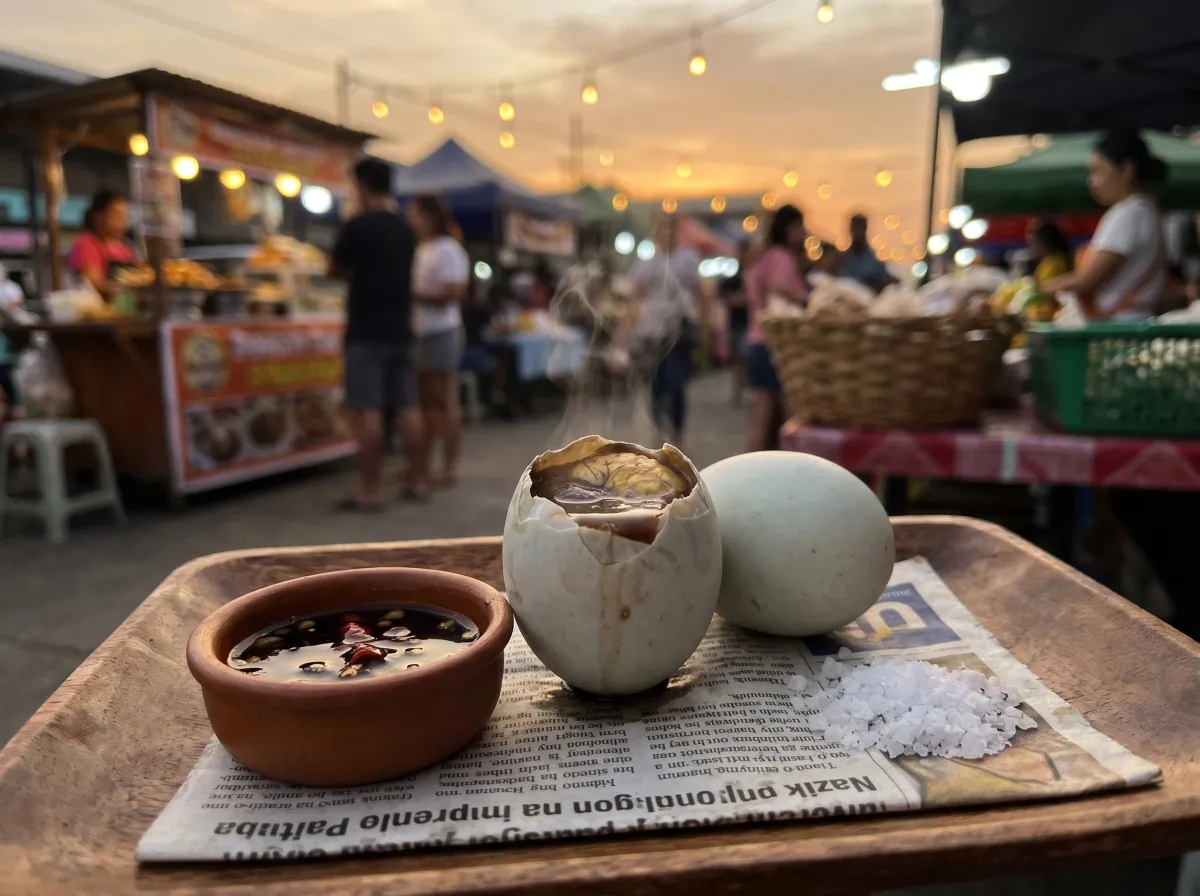
The classic way to eat balut is this: crack a small opening at the wider end of the egg, peel back the shell, add a pinch of salt or a splash of spiced vinegar, sip the broth first — that warm, savory sabaw is the first reward — and then peel the rest of the shell and eat the yolk and embryo together. The seasonings are typically salt (asin) and spiced vinegar (suka), though soy sauce is also common. The white albumen (bato, or "stone") is often rubbery in older, more developed eggs and many people choose not to eat it.
Balut vs. Penoy: Both are incubated boiled duck eggs, but penoy contains an unfertilized or non-developing egg — no embryo, just a yolk and white that have been changed by incubation into something creamier and smoother than a regular hard-boiled egg. Penoy is often described as the beginner's version, and vendors typically sell both side by side. The call you hear in the street — "Baluuuut, Penoy!" — usually advertises both.
Is it safe? Completely. Balut is a fully cooked food — boiled for 20 to 30 minutes, which fully cooks everything inside including the embryo. It is not raw. The incubation process is controlled. The boiling process is thorough. Balut has been eaten safely by millions of Filipinos for well over a century, and the nutritional profile is genuinely impressive: high in protein, calcium, iron, and omega-3 fatty acids. It is not exotic nutrition. It is good food.
📜 The Story Behind It
Balut's origin story begins in China, travels to the Philippines, survives a world war, and ends up in a reality television show. It is a story about food preservation, colonial trade routes, a municipality of duck farmers, and the strange journey a food takes when it moves from its home culture into the world's gaze.
The Chinese origins. The practice of eating fertilized duck eggs is documented across multiple Asian countries — Vietnam, Cambodia, China — and the weight of historical evidence suggests it originated in China as a food preservation technique. Before refrigeration, fermenting or incubating eggs extended their shelf life. The fertilization and incubation process transformed the egg into something denser and more nutritious, making it a practical and economical food source. Chinese traders brought the practice to Southeast Asia through their trade networks.
Arrival in the Philippines. According to multiple historical sources, balut was introduced to the Philippines by Chinese traders around 1885 — though some researchers point to Chinese settlements near Laguna de Bay in the 16th century as an earlier point of introduction. In the Philippines, the practice was adopted and adapted, the incubation period refined to the 17-to-18-day standard that most closely reflects Filipino taste preferences for the texture and development stage of the embryo.
Pateros and the Balut Capital. The municipality of Pateros, just southeast of Manila in Metro Manila, became the undisputed center of Philippine balut production. Pateros's very name comes from the Spanish phrase criadores de patos — duck raisers. In the 1950s, at the peak of the local duck industry, Pateros was home to approximately 400,000 ducks producing eggs that became balut. Wikipedia notes that Pateros is officially nicknamed the "Balut Capital of the Philippines" — a distinction the municipality carries with genuine civic pride, and which has included annual balut festivals featuring live music, cooking competitions, and significant quantities of balut.
World War II and the food supply. The Tasting Table documents that food scarcity during World War II raised balut's appeal among Filipinos as a cheap, accessible, and nutritionally dense food. At a time when conventional protein sources were scarce and expensive, balut — abundant, affordable, filling, and requiring minimal preparation — provided genuine sustenance. The war years embedded balut more deeply into Filipino food culture as a practical necessity, and that connection to affordability and accessibility has remained part of its identity ever since.
Fear Factor and the problem with representation. In 2002, the American reality television show Fear Factor featured balut as a food challenge — contestants competing to eat as many as possible in a context deliberately framed around disgust, revulsion, and endurance. This introduced balut to an enormous American audience as an ordeal rather than a food, a spectacle rather than a tradition, a test rather than a meal.
The academic scholar Dr. Margaret Magat, in her book Balut: Fertilized Eggs and the Making of Culinary Capital in the Filipino Diaspora (Bloomsbury, 2019), analyzed this phenomenon in detail, documenting how Filipino communities responded to this decontextualization by organizing their own balut-eating contests that promoted the food with cultural pride and proper context. Filipino restaurants in New York hosted the Annual Balut Eating Contest at the Hester Street Fair as a form of cultural reclamation — turning the "challenge" framing back into a celebration. The framing of balut as a gross-out food belongs to Fear Factor. The actual food belongs to the Philippines.
👅 What Does Balut Taste Like?
Here is the honest answer, and it consistently surprises people who try balut for the first time expecting something extreme: balut tastes familiar.
The broth (sabaw) is the first thing you encounter, and it tastes like a rich, warm, savory duck or chicken broth — concentrated and deeply flavored, the kind of broth you would describe as masustansya (nourishing) in Tagalog. It is not gamey. It does not taste strange. It tastes like good soup in the most fundamental sense: warm, savory, filling.
The yolk (pula) is denser and richer than a regular hard-boiled egg yolk. The incubation process concentrates the fat and flavor, resulting in a yolk that is more intense in every dimension — creamier, more savory, more substantial. If you have eaten a very good, very fresh egg from a farm, you have a partial reference point. The balut yolk goes further in the same direction.
The embryo (sisiw) is where first-timers expect the most resistance — and where they are most often surprised. The texture is soft and tender, similar to very young meat. The flavor is mild duck, not the strong gamey flavor that word "duck" can suggest in other contexts. It is subtle. The embryo is also small — far less substantial-looking in the mouth than the concept of it suggests.
What the whole package tastes like together — broth, yolk, and embryo seasoned with salt and vinegar — is something between a very rich egg experience and a very light warm protein snack. It is satisfying in a concentrated way. The vinegar cuts through the richness and brightens everything. The salt brings the savory notes forward. It is a complete flavor experience in a small shell.
The one component that lives up to some of the more challenging descriptions is the bato — the white albumen in more developed eggs, which can be rubbery, firm, and cartilaginous. Many Filipinos do not eat the bato and set it aside without ceremony. This is accepted practice. You are not required to eat every component. The broth, yolk, and embryo are the main event.
If I had to describe balut simply:
Balut tastes like the most honest and concentrated version of an egg — warm, savory, rich, and genuinely nourishing. The concept is more confronting than the experience.
🗺️ Balut Across the Philippines and Beyond
Balut is not exclusively Filipino — versions of fertilized incubated duck eggs exist in Vietnam (hột vịt lộn), Cambodia (pong tea khon), and China — but the Philippines has made it most fully its own.
Within the Philippines, balut is most associated with Metro Manila and the surrounding Luzon provinces where duck farming is practiced. Street vendors carry baskets through residential neighborhoods in Quezon City, Makati, Pasig, and Manila proper, calling "Baluuuut!" from late afternoon through midnight. Bus terminals, jeepney stops, and MRT stations are prime balut locations for commuters who want a hot, filling snack for the ride home.
Pateros remains the symbolic heart of balut culture, though the local duck industry has declined significantly since the 1980s due to pollution of the Pateros River that once supported the duck-raising community. At its peak, over 50 duck raisers and balut manufacturers operated in the municipality. Today Pateros still holds balut festivals and maintains its title, but much of the balut supply comes from provinces outside Metro Manila.
The stage matters. Within the Philippines, balut eaters have specific preferences for the incubation stage of their egg. The most common preference is the 17-to-18-day stage, which produces the balut sa puti — the embryo still partially covered by a white membrane, the bones still soft, the overall texture tender. Younger eggs (around 16 days) are called mamatong — the embryo is smaller and less defined. More developed eggs (19 to 21 days) have more pronounced bone structure and a more fully formed duckling. Regular balut eaters often have specific preferences about stage.
Balut in haute cuisine. Wikipedia notes that balut has entered Philippine haute cuisine in recent decades — served as appetizers at upscale restaurants, prepared adobo-style, fried in omelettes, used as filling in baked pastries. Philippine celebrity chefs and food writers have reclaimed balut as an ingredient with cultural depth and culinary versatility, stripping away the novelty framing and treating it with the same respect given to any ingredient that has been part of a food culture for over a century.
Balut in the Filipino diaspora. Filipino grocery stores in the United States, Canada, the Middle East, and Australia carry frozen balut, allowing diaspora communities to access the food outside the Philippines. Filipino restaurants that serve balut in the United States — particularly in areas with large Filipino populations like Los Angeles, New Jersey, and the New York tristate area — tend to be community gathering points. Balut is one of the foods that most strongly signals cultural pride in Filipino diaspora communities: serving it is a statement of comfort with Filipino identity, and ordering it in a Filipino restaurant is a statement of belonging.
🗣️ Learn the Tagalog
Balut has its own vocabulary — the words of the street, the egg, and the nighttime Filipino experience that balut belongs to.
The food itself:
Balut (bah-loot) — fertilized duck egg; from balut sa puti, meaning "wrapped in white"; the complete dish
Penoy (peh-noy) — unfertilized or non-developing incubated duck egg; smoother than balut, no embryo inside; often sold alongside balut by the same vendors
Sabaw (sah-baw) — broth; the warm savory liquid inside the shell, the first thing you drink; also the general word for soup or broth in Filipino cooking
Pula (poo-lah) — yolk; in balut context, the rich, dense yolk that is the second component you eat; pula also means red or orange in Tagalog
Sisiw (see-sew) — embryo; the partially developed duckling inside the egg; sisiw is also the everyday Tagalog word for chick or baby bird
Bato (bah-toh) — stone; the informal name for the firm, rubbery white albumen in more developed balut eggs; bato literally means stone or rock, describing the texture
Mamatong (mah-mah-tong) — younger stage balut (around 16 days); embryo is smaller and less defined, floating on the white
The experience:
Suka (soo-kah) — vinegar; the most common balut condiment; spiced vinegar (sukang may sili) with bird's eye chili is the preferred version
Asin (ah-sin) — salt; the other essential balut condiment; rock salt (asin na bato) is traditional
Mainit (mah-ee-nit) — hot, warm; mainit na balut is the only acceptable kind; a cold balut is a problem
Naglalako (nag-lah-lah-koh) — selling while walking; the vendor who carries their goods through the streets; naglalako ng balut means someone going door to door selling balut, the most traditional distribution method
Saan po may naglalako ng balut? (sah-ahn poh may nag-lah-lah-koh nang bah-loot) — Where is there someone selling balut? The question you ask a tricycle driver or a sari-sari store owner when you cannot hear the call
Itim (ee-tim) — black, dark; the nighttime context of balut, as in sa itim ng gabi (in the darkness of night) — the specific time when balut vendors are most active and balut tastes best
🎨 Color It!
Bring Filipino food to life in a whole new way — through art.
Balut is one of the most visually striking subjects in Filipino food — not despite its reputation but because of the specificity of its imagery. The egg in the vendor's hand, slightly warm. The crack at the top, revealing the dark amber of the broth inside. The steam that rises when you first break the shell. The yolk's deep golden color. The white cloth lining the vendor's basket, keeping the eggs warm through the night.
When you sit with a balut coloring page and choose those colors — the warm cream of the shell, the amber of the broth, the deep yellow-orange of the yolk, the warm darkness of a Manila night behind a street vendor's lantern — something happens. You start thinking about when you first had balut, or when you first watched someone else have it. You think about the vendor's call and whether you knew it from childhood or discovered it as an adult. You think about what the experience of eating it for the first time actually felt like, without the performance around it.
Our Filipino Food Coloring Book on Amazon was built from exactly that kind of question. Every page is a dish with a story. Every coloring session is an invitation to remember.
That makes it especially meaningful for:
🌼 Families who want a creative activity that opens a real conversation about Filipino food culture and heritage
🌼 Filipino parents introducing street food traditions to children who grew up outside the Philippines
🌼 Adults and seniors who find nostalgic, mindful creativity deeply satisfying
🌼 Anyone in the Filipino diaspora who wants a quiet, beautiful way to hold onto what Philippine nights felt like
🌼 Teachers, homeschoolers, and cultural educators exploring Filipino daily life through art
Each page can open a question worth asking: Did you grow up hearing the balut vendor's call? What did it feel like the first time you tried it — or the first time you watched someone try it? What do you tell non-Filipino friends when they ask about it?
Those questions are how a coloring page becomes a family story.
Share your completed balut coloring on Facebook or Instagram and tag @StudioTributes — we would love to see it and celebrate it with the whole community.
👉 Get your FREE Filipino Coloring pages here.
👉 What Filipino Food Are You? Take the quiz →
🤩 Fun Facts About Balut
1. The name means "wrapped." Balut sa puti means "wrapped in white" in Tagalog — a reference to the white membrane that surrounds the partially developed embryo at the 17-to-18-day incubation stage. This is the preferred incubation period for Philippine balut: early enough that the embryo is still wrapped and tender, developed enough that the broth has fully formed and the yolk is at its richest.
2. Balut was introduced by the Chinese, not invented by Filipinos. The practice of eating fertilized incubated duck eggs originated in China as a food preservation technique developed before refrigeration. Chinese traders brought the practice to Southeast Asia through trade routes. The Philippines adapted and refined it — developing the specific incubation period, the seasoning traditions, the street vendor culture — until it became something distinctly and inseparably Filipino.
3. Pateros is officially the Balut Capital of the Philippines. The municipality of Pateros in Metro Manila takes its name from the Spanish criadores de patos (duck raisers) and was home to over 400,000 ducks at the height of its balut industry in the 1950s. Over 50 duck raisers and manufacturers operated there at the industry's peak. River pollution in the 1970s began a decline that has continued, but Pateros still holds balut festivals and its identity remains inseparable from the egg.
4. Fear Factor did not introduce balut to Filipinos. It introduced Filipinos to how balut looks from outside their culture. The 2002 Fear Factor episode featuring balut as a challenge introduced the egg to millions of non-Filipinos in a context of performed disgust and competitive endurance. For Filipino viewers, the experience was something else entirely: watching a food that is ordinary, nutritious, and culturally meaningful be treated as an extreme ordeal. Academic scholar Dr. Margaret Magat documented the Filipino response — including community-organized balut-eating contests that recontextualized the food with cultural pride.
5. Balut is genuinely nutritious. The protein, calcium, iron, and omega-3 fatty acids in balut are real and substantial. The egg contains more nutrients than a standard hard-boiled egg because the embryo adds additional protein and minerals. Filipino workers on overnight shifts ate balut for its energy and sustenance. Pregnant women were encouraged to eat it for calcium and iron. These practical nutritional uses existed alongside the cultural and social dimensions.
6. Balut has an aphrodisiac reputation. Across Filipino popular culture, balut is considered an aphrodisiac — particularly beneficial for male virility. The scientific basis for this claim is not established, but the belief is deeply embedded in Filipino food culture and contributes to balut's identity as a food for strength, endurance, and vitality. The warm, protein-dense, nourishing character of balut makes the association intuitive even without pharmacological evidence.
7. The vendor's call is one of the most iconic sounds in Philippine street life. "Baluuuuuuut!" — the long, drawn-out call of the nighttime balut vendor walking through residential neighborhoods — is as recognizable in Philippine soundscape as the jeepney's engine or the bells of an ice cream cart. Vendors typically operate from late afternoon to midnight, carrying insulated baskets that keep the eggs warm. The call serves the same function as a food truck horn or a dinner bell: it announces availability before you can see the source.
8. The darkness is practical, not theatrical. Balut is a nighttime food partly because of practical nutritional demand — workers on late shifts, nightlife participants, commuters arriving home — and partly because the lack of clear visibility under low light makes the eating experience more comfortable for those who prefer not to examine their food closely. This is openly acknowledged in Filipino food writing without embarrassment: the darkness is helpful. It is a practical accommodation, not a cultural secret.
9. Balut has entered haute cuisine. Wikipedia notes that balut has entered Philippine restaurant culture at the fine dining level — served as appetizers, prepared adobo-style, fried in omelettes, used as pastry fillings. The same egg sold for a few pesos on the street has found its way into restaurant tasting menus where it is presented with full cultural and culinary context. Philippine food culture is comfortable with this: balut is the same food regardless of the setting.
10. Balut eating contests are a form of cultural pride in the Filipino diaspora. Filipino restaurants in New York City hosted the Annual Balut Eating Contest at the Hester Street Fair as a deliberate act of cultural reclamation and celebration. The undefeated champion Wayne Algenio ate 40 balut in 5 minutes in 2014. Thomas Canaria, 61 years old and visiting from Manila, said: "I'm very proud that there's an organization promoting Filipino culture." Competitive eating, in this context, was not about spectacle. It was about pride.
11. Not everyone eats the whole egg. The bato — the white albumen in more developed balut eggs — can be rubbery, firm, and cartilaginous in texture. Many Filipinos who eat balut regularly do not eat the bato and set it aside without comment. There is no shame in this. The broth, yolk, and embryo are the main event. The bato is optional. Knowing this makes the eating experience significantly more pleasant for first-timers who were bracing for something they did not need to brace for.
12. Balut is eaten across Southeast Asia, but the Philippines made it its own. Vietnam has hột vịt lộn. Cambodia has pong tea khon. China has its own versions. But the specific culture of balut — the nighttime vendor call, the Pateros production tradition, the balut festivals, the aphrodisiac reputation, the eating contests, the diaspora pride — belongs specifically and irreversibly to the Philippines. The practice traveled. The culture grew around it in a way that is Filipino in character and completely its own.
🌍 How Balut Connects Filipinos Everywhere
Balut travels differently from most Filipino foods.
It does not travel in its original form easily — fresh balut needs to be eaten warm, and the logistics of keeping fertilized eggs at the right temperature across international distances are complicated. But it travels in two other ways: frozen, in Filipino grocery stores from Los Angeles to Dubai; and in memory, more powerfully than almost any other Filipino food.
The balut vendor's call — "Baluuuuuuut!" — is one of the sounds most consistently cited by Filipinos abroad when asked what they miss about the Philippines. Not because balut is the most delicious Filipino food, or the most elaborate, or the hardest to find. But because that specific sound, in the specific darkness of a Philippine night, is attached to a whole sensory world that does not fully reconstruct itself outside the Philippines.
For Filipino children who grew up in other countries and are encountering balut for the first time as teenagers or adults, the food carries a different weight. It is presented to them as evidence of where they are from — something that their parents or grandparents ate without thinking twice, something that required no explanation in its original context. Eating balut for the first time as a Filipino-American or a Filipino-Canadian or a Filipino-Australian is a specific experience: a connection made through flavor and discomfort and curiosity and pride, all at once.
Non-Filipino people who encounter balut through Filipino friends or Filipino restaurants often report the same arc: the initial resistance to the concept, the sensory experience of the broth which immediately makes the concept irrelevant, and the realization that the food is genuinely good. The balut is unchanged. The reaction is what changes.
This is the larger point about balut and Filipino food culture. Filipino food is not extreme. It is not for shock value. It is not a test of bravery. It is food that developed in a specific place, for specific practical and cultural reasons, over a specific history — and it carries all of that inside it. Understanding that history is how the reaction changes. Understanding is the whole point.
❓ FAQ — Everything You Need to Know About Balut
What is balut? A Filipino street food made from a fertilized duck egg incubated for 17 to 18 days and boiled. It contains a savory broth, a rich yolk, and a partially developed embryo. Eaten warm from the shell with salt and spiced vinegar. One of the most culturally significant street foods in the Philippines.
What does balut taste like? The broth tastes like rich savory duck broth. The yolk is denser and richer than a regular egg yolk. The embryo is soft, tender, and mildly flavored. The overall experience is more familiar than the concept suggests. Most first-time eaters are surprised that the taste is not extreme.
Is balut safe to eat? Yes. It is fully cooked — boiled for 20 to 30 minutes. The incubation is controlled and the boiling is thorough. Balut has been eaten safely by millions of Filipinos for over a century. Buy from vendors with high turnover and eggs kept warm.
How do you eat balut? Crack a small hole at the wider end, add salt or vinegar, sip the broth first. Peel the rest of the shell and eat the yolk and embryo together, seasoned to taste. The white albumen (bato) in older eggs is often rubbery and many people do not eat it.
Where did balut come from? Introduced to the Philippines by Chinese traders, believed to be around 1885, from a Chinese food preservation tradition predating refrigeration. The Philippines adapted and refined the practice into the distinct street food culture it is today.
What is the difference between balut and penoy? Penoy is an incubated but unfertilized or non-developing duck egg — no embryo inside, just a creamier, smoother yolk and white. Balut contains the embryo. Both are sold warm from the same vendor. Penoy is often preferred by first-timers.
Why is balut sold at night? High protein for overnight workers and nightlife. The nighttime vendor culture and the call of "Baluuuuuuut!" have become inseparable from the food's identity. The darkness also makes the contents of the egg less visible for those who prefer not to look closely.
Is balut an aphrodisiac? It has this reputation in Filipino popular culture, particularly regarding male virility. No scientific evidence supports this, but the belief is embedded in Filipino food culture. The nutritional benefits — high protein, calcium, iron, omega-3 fatty acids — are real and documented.
💛 Closing
Balut is not a challenge. It is not a test. It is not proof that someone is brave, adventurous, or open-minded.
It is a warm egg with broth inside, sold by someone walking through a neighborhood after dark, calling a word that people who grew up in the Philippines know how to hear before they are fully awake. It is nutrition and culture and community in a small shell. It is one of the things that makes Philippine street food culture specific and extraordinary.
The framing that has attached itself to balut outside the Philippines — the reality TV disgust performances, the "world's most extreme food" classifications, the challenge videos — says nothing about the food. It says something about how different cultures process unfamiliarity. And that processing is worth understanding, because balut deserves to be understood on its own terms.
At Studio Tributes, we tell the stories of Filipino food because Filipino food is worth knowing deeply — not as curiosity, not as challenge, but as culture. Balut is one of the oldest, most nutritionally honest, most culturally embedded foods in the Philippine tradition. It is the kind of food that tells you something real about the people who eat it: that they are practical, resourceful, communal, and completely unbothered by the idea that nourishment does not always have to look like what someone else expects.
"Baluuuuuuut."
Keep exploring Filipino food and culture with us:
🎯 What Filipino Food Are You? Take the quiz → 🎨 Get our Filipino Food Activity Book on Amazon 📚 Read more Filipino food stories on our blog
💭 A Memory to Hold Onto
Did balut bring a moment back?
Maybe the first time you heard "Baluuuut!" and ran to the door with five pesos. Maybe the first time you tried to explain balut to a non-Filipino friend and watched their face go through every stage.
Maybe eating it in the dark on a sidewalk somewhere and realizing that the darkness actually was helpful, a little.
Maybe the specific pride of finishing one and asking for another while someone next to you was still trying to work up to the first.
First time or longtime regular? Salt only, or vinegar and chili? Do you eat the bato or set it aside — and do you judge people who do it differently from you?
If a memory came to mind, share your balut story on Facebook or Instagram and tag @StudioTributes — we would love to hear it.
Read Next
📚 References & Further Reading
Wikipedia — Balut (food) — Primary reference for ingredient overview, incubation stages, the broth-yolk-embryo structure, regional Southeast Asian variations, and the note that balut has entered Philippine haute cuisine as appetizers and pastry fillings.
Tasting Table — Balut: The Fascinating History Behind Filipino Fertilized Duck Eggs — Reference for Pateros's role in balut production history, the World War II food scarcity connection, the industry decline in the 1970s, and the aphrodisiac reputation.
Atlas Obscura — Balut, Duck Embryo Philippines — Reference for the eating process, the balut sa puti etymology, the nighttime street vendor culture, and the bato albumen texture description.
Food Republic — What Is Balut And How Did It Become A Popular Street Food? — Reference for the nutritional profile (protein, calcium, iron, omega-3 fatty acids), the Chinese origin and introduction around 1885, and the late-night worker and partier cultural context.
New Books Network — Margaret Magat, "Balut: Fertilized Eggs and the Making of Culinary Capital in the Filipino Diaspora" (Bloomsbury, 2019) — Academic reference for the Fear Factor decontextualization analysis, the Filipino community response through eating contests, and the concept of balut as culinary nationalism and identity-making in the diaspora.
NBC News — On A Mission to Spread Filipino Food, Balut Takes Center Stage — Documentation of the Annual Balut Eating Contest at Hester Street Fair in New York City, including the 40-balut-in-5-minutes record and the cultural pride framing expressed by participants.
Wikipedia — Pateros — Reference for Pateros's official nickname as "Balut Capital of the Philippines," the etymology of the municipality's name from the Spanish criadores de patos, and the municipal government context.