
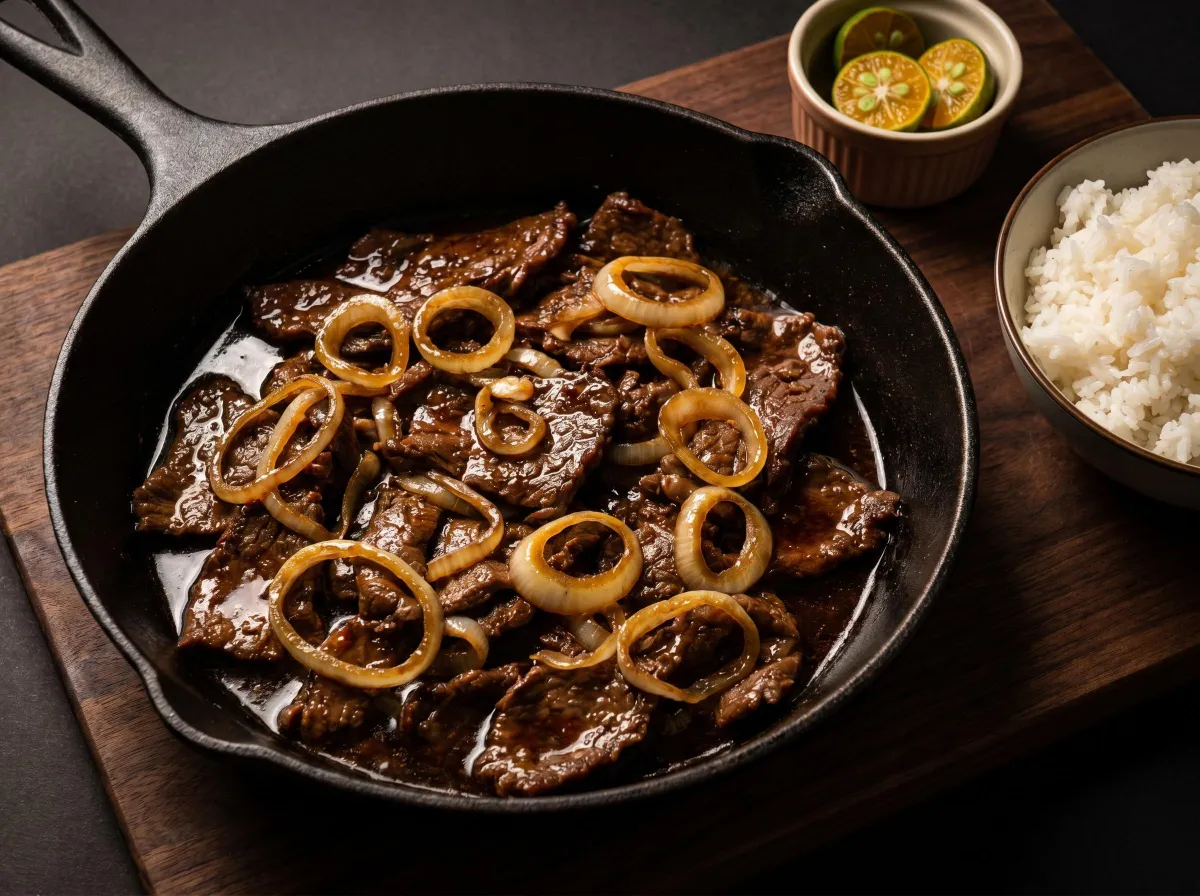
What Is Bistek Tagalog? Filipino Beef Steak With Soy & Calamansi
Here is the thing about Western beef steak: it is about the beef.
The thickness matters. The cut matters. The internal temperature matters. The marble pattern matters. The entire experience of a steakhouse meal is built around honoring the beef itself—serving it with minimal interference, letting the quality of the meat speak for itself, arriving at the table with grill marks and a small cup of sauce on the side that you may or may not use.
Filipino bistek Tagalog is not about the beef.
The beef is there, absolutely—thin slices of sirloin or tenderloin, browned in a hot pan. But the reason you make bistek Tagalog, the reason you cook extra rice before you even start, and the reason the whole kitchen fills with a smell that stops everyone in their tracks—is the sauce. The dark, glossy, almost lacquered sauce of soy and calamansi and browned garlic is reduced over heat until it has concentrated into something so deeply savory and so sharply bright that it needs a full plate of steamed white rice underneath it just to make sense.
Bistek Tagalog is the dish that understands what rice is for.
And if you have been searching for "beef steak" and landed here—welcome. You are about to find out that the beef steak you already love has a Filipino cousin that does something completely different with the same idea, and that the Filipino version is going to make you seriously reconsider how you eat beef.
Bistek Tagalog (also written "bistek" or "bistik," also called "karne frita" in some regions) is a Filipino dish of thinly sliced beef braised in soy sauce, calamansi juice, garlic, and black pepper, topped with rings of softened onion. According to Wikipedia, it originated as a Filipino adaptation of the Spanish bistec encebollado—beef steak with onions—and was localized in the Tagalog region by substituting indigenous calamansi for European citrus and incorporating soy sauce from Chinese culinary influence. The result is a dish that is simultaneously familiar in concept and completely its own in execution.
At Studio Tributes, we celebrate Filipino food because Filipino food carries Filipino life inside it. Today we are going all the way into Bistek Tagalog—where it came from, why it tastes the way it does, what makes it different from every other beef steak dish in the world, and why the sauce is the whole point.
🥩 Before we go any further — we made something for you. 🍋
Build your perfect bistek — and find out what your choices say about you. It takes about a minute.
🥩 What Is Bistek Tagalog?
Let's talk about what is actually in this dish — because bistek Tagalog is deceptively simple, and the simplicity is the point.
The beef. Thinly sliced — this is non-negotiable. Bistek Tagalog uses beef cut to about 1 to 2 centimeters thick, sometimes thinner, pounded slightly to tenderize further. This is not a thick, center-cut steakhouse steak. It is beef designed to cook fast, absorb the marinade deeply, and become part of the sauce rather than the centerpiece independent of it.
The most common cuts:
🥩 Sirloin / tapandera — the everyday choice at most Filipino home kitchens and carinderias; affordable, flavorful, tenderized by the calamansi-soy marinade
🥩 Tenderloin / solomilyo — the premium version; the most tender result, used for special occasions or when someone wants to show they went the extra step
🥩 Top round or flank — budget-conscious alternatives that take well to longer marinating
The marinade — and this is where bistek becomes bistek:
🍋 Calamansi juice — the defining acid; small, round citrus fruit native to the Philippines, tasting like a cross between lime and orange with a sharper, more floral sourness than either alone; this is the ingredient that makes bistek taste like nothing else
🫙 Soy sauce — the salt and the umami; not a light touch but a generous pour, because the saltiness of bistek is structural
🧄 Garlic — minced or crushed; it goes into the marinade and into the pan, and the browned garlic is part of the sauce's depth
🌶️ Black pepper — ground, into the marinade; the heat is subtle but present
The onion rings. This is the component that people sometimes underestimate and that bistek regulars know is as important as the beef. Large onions, sliced into thick rings, cooked in the same pan after the beef — either until soft and just caramelized, or left slightly raw and laid raw over the hot beef to let residual heat soften them. The onions absorb the soy-calamansi sauce. They become sweet against the salty. They are not a garnish. They are a co-protagonist.
The sauce. After the beef is browned, the marinade goes into the pan — and this is the moment bistek happens. The soy sauce and calamansi reduce slightly, picking up the browned bits from the beef, concentrating into something dark and glossy and deeply flavored. The sauce is the reason you made extra rice. It goes over everything.
What makes it different from Western beef steak, directly:
Western SteakBistek Tagalog Thick cut, beef is the featureThin cut, sauce is the featureCooked to internal temperature (rare, medium, well-done) Braised in marinade until tenderServed with sauce on the sideServed in sauce, sauce over rice Wine, butter, herbs Soy sauce, calamansi, garlic No rice required Cannot be properly eaten without riceThe beef is the pointThe sauce-and-rice combination is the point
📜 The Story Behind It: Spain, China, the Philippines, and a Small Sour Citrus
Bistek Tagalog's origin story is a perfect case study in how Philippine food was built — through colonial encounter, culinary trade, and Filipino creativity that took what arrived and made it irreversibly its own.
The Spanish source. According to Wikipedia, Grokipedia, and multiple Filipino food historians, bistek Tagalog originated as an adaptation of the Spanish bistec encebollado — "beefsteak with onions." The Spanish bistec itself is a Hispanicized borrowing from the English beefsteak, making bistek Tagalog a dish whose name traveled from English to Spanish to Filipino before the dish itself was transformed. Spain colonized the Philippines from 1565 to 1898 — over three centuries during which Spanish cooking techniques, ingredients, and dish concepts arrived and were absorbed into Filipino culinary tradition.
The original bistec encebollado is a Spanish-Mexican beef dish: thin-sliced beef, garlic, onion, and typically acidulated with vinegar or lemon. It appeared across Spanish colonies as a way to make beef flavorful and tender using acid and aromatics. In Mexico, where the dish also took root, it remains a popular dish called bistec ranchero. In the Philippines, Filipino cooks took this basic concept and transformed it with two key ingredients that Spain did not bring.
The two Filipino transformations:
Calamansi instead of lemon or vinegar. Calamansi (Citrofortunella microcarpa, also spelled kalamansi) is a citrus fruit native to the Philippines — small, round, intensely sour, with a flavor that sits between lime and orange with a floral brightness that neither alone achieves. According to Grokipedia, Filipino cooks substituted indigenous calamansi for European citrus in the bistek adaptation, and this substitution changed the dish's flavor profile fundamentally. The calamansi's specific sourness — brighter, more floral, less harsh than straight vinegar — is what makes bistek Tagalog taste different from its Spanish ancestor.
Soy sauce instead of or alongside the acidic base. Soy sauce arrived in the Philippines through Chinese trade networks that long predated Spanish colonization. By the time Filipino cooks were adapting bistec encebollado, soy sauce was already a familiar ingredient in Filipino cooking — appearing in adobo, in braised dishes, in marinades. Adding soy sauce to the bistek brought a deep umami saltiness that the Spanish version never had. The combination of soy sauce saltiness and calamansi sourness — that specific salty-tangy duo — is the flavor signature of bistek Tagalog and of Filipino cooking more broadly.
The result: a dish that is recognizably descended from a Spanish original but tastes completely Filipino. The Tagalog in bistek Tagalog identifies where this specific version crystallized — in the Tagalog-speaking region of central Luzon and Manila, where the soy-calamansi combination became the definitive standard. In other regions, particularly the Visayas, the dish is sometimes called karne frita (fried meat), reflecting the same Spanish influence through a different regional lens.
The dish became a Filipino everyday staple. Bistek Tagalog is not a fiesta or celebration dish in the way that lechon or caldereta are. It is a weekday lunch, a family dinner, and a carinderia menu item. It is the dish you make when you have good beef and rice for thirty minutes, and you want something that will make the rice disappear. Panlasang Pinoy notes that it appears in homes, carinderias, and family gatherings across the country — it is everyday food with the flavor punch of something special.
👅 What Does Bistek Tagalog Taste Like?
Bold. Salty. Bright. Savory in a way that is almost aggressive — on purpose.
The first thing you taste in bistek Tagalog is the soy sauce: deep, umami, salty. Then the calamansi arrives — a bright, sharp sourness that cuts through the saltiness and lifts it. Then the browned beef, which has absorbed both flavors through the marinade and added its own caramelized savoriness from the pan. And then the onion rings, which have softened into sweetness and absorbed the sauce, providing a counterpoint that is mild and gentle against everything around them.
The overall flavor profile is: salty-sour-savory-sweet, in that order, in that balance.
Here is the important part: bistek Tagalog is intentionally bold because it is designed to be eaten with rice. The sauce is more intensely flavored than you would ever eat on its own, because on its own is not how it is meant to be eaten. The steamed white rice underneath the bistek is not a side dish — it is a structural component. The rice absorbs the sauce and softens its intensity, and the combination of salty-sour-savory beef sauce and plain rice is one of the most satisfying flavor combinations in Filipino cooking.
This is the concept that most surprises non-Filipino eaters encountering bistek Tagalog for the first time: the sauce is the main event, and the rice is what makes the main event work. Filipino food culture has developed many dishes built on exactly this logic — salty, savory, boldly flavored dishes that are calibrated for the specific neutrality of white rice — and bistek Tagalog is one of the clearest examples of that principle in action.
The calamansi is irreplaceable. This is worth its own paragraph. The specific sourness of calamansi — floral, bright, slightly sweet, more complex than lime — is what makes bistek Tagalog taste the way it does. Lime juice is the best substitute and produces very good results. Lemon juice works. But neither produces the exact flavor of calamansi bistek, because neither has calamansi's specific floral quality. For Filipinos living abroad who cook bistek with lime, the dish tastes close enough to produce the memory. Close enough is not the same as exactly right.
If I had to describe bistek Tagalog simply:
Bistek Tagalog tastes like what happens when salty and sour decide to work together instead of competing — and the result is so deeply satisfying over rice that you will need to make more rice than you thought.
🗺️ Bistek Tagalog Across the Philippines
Bistek Tagalog as a concept is genuinely national — the soy-calamansi-onion approach to braised beef appears across the Philippines — but the Tagalog in the name correctly identifies where the specific standard version crystallized.
In Tagalog provinces (Batangas, Laguna, Quezon, Cavite, Rizal) and in Metro Manila, bistek is a staple home-cooked dish and carinderia standard. The version here is the canonical one: beef sirloin or tenderloin, soy sauce and calamansi marinade, browned beef, onion rings on top, sauce over everything, rice beside all of it. Every family has a version and considers it correct.
In the Visayas, the equivalent dish is more commonly called karne frita (from the Spanish carne frita, fried meat). The flavor profile is similar but the name reflects the different linguistic history of the region. The Visayan version sometimes leans more on garlic and black pepper and less on the soy-calamansi balance, producing a slightly different character.
The onion question divides families across all regions. How many onions, how they are cooked, and whether they go on top raw or are softened in the pan first — these are the bistec debates that run across regions and within families. Panlasang Pinoy describes one cook's family where most members used one or two onions but the aunt used three or four, sliced thick, piled high. The onion quantity is, in every Filipino household, someone's specific aesthetic.
Regional additions and variations include:
🥔 Potatoes — added to the sauce and stewed or separately fried, then arranged around the beef; a common variation that extends the dish and adds starchiness to the already-saucy plate
🍊 Worcestershire sauce — added to the marinade by some cooks for an additional savory-tangy depth; a British condiment that arrived during the American colonial period and found its way into Filipino pantries
🌶️ Patis (fish sauce) instead of or alongside soy sauce — a regional substitution that produces a more complex, slightly more pungent umami base
Bistek with other proteins. The bistek preparation — thin slices, soy-calamansi marinade, pan-fried, onion rings on top — has been applied to nearly every protein in the Filipino repertoire. Pork bistek (usually pork chops or pork belly) is extremely common and in many households is the default weekday version because pork is more affordable than beef. Chicken bistek, fish bistek (tilapia and milkfish are popular), and even eggplant bistek all exist and are eaten regularly. The word bistek in Filipino cooking now refers as much to the preparation method as to the protein.
Bistek Tagalog in the diaspora. Filipino home cooks abroad make bistek Tagalog with readily available alternatives: lime or lemon juice for calamansi, any good soy sauce, sirloin or whatever thin-cut beef is available. The dish requires no specialty ingredients beyond calamansi, which Filipino grocery stores in diaspora communities often stock. Filipino restaurants internationally carry bistek Tagalog as a menu staple — one of the dishes that travels most faithfully because its core ingredients are available anywhere.
🗣️ Learn the Tagalog
Bistek Tagalog has its own vocabulary — the words of a marinade, a hot pan, and a dish that has been calibrated over generations to make rice disappear.
The dish and its name:
Bistek (bis-tek) — the dish; from the Spanish bistec, from the English beefsteak; the journey of this word — English to Spanish to Filipino — mirrors the journey of the dish itself through colonial history
Karne Frita (kar-neh free-tah) — fried meat; the Visayan regional name for the same dish, from the Spanish carne frita; both names are used in different parts of the country, both are correct
Solomilyo (soh-loh-mil-yoh) — beef tenderloin; from the Spanish solomillo; the premium cut choice for bistek, producing the most tender result
Tapandera (tah-pan-deh-rah) — beef sirloin or a similar affordable cut; the everyday bistek choice at carinderias and most Filipino home kitchens
The ingredients:
Kalamansi (kah-lah-mahn-si) — calamansi; the small Filipino citrus fruit that is the defining acid in bistek Tagalog; impossible to fully substitute because its floral sourness is unique; also spelled calamansi in English-language Filipino cooking writing
Toyo (toh-yoh) — soy sauce; the salty, umami backbone of bistek's marinade and sauce; from the Japanese/Chinese word for soy sauce; one of the most fundamental ingredients in Filipino cooking
Sibuyas (see-boo-yas) — onion; the rings of sibuyas on top of bistek are non-negotiable; there is a sub-debate within every Filipino family about how many sibuyas is the correct amount
Bawang (bah-wahng) — garlic; into the marinade and into the pan; the browned bawang adds depth to the sauce
Paminta (pah-min-tah) — black pepper; ground, into the marinade; from the Spanish pimienta
Asukal (ah-soo-kal) — sugar; some recipes add a small amount to balance the saltiness and sourness; the presence or absence of asukal is another family debate point
At the table:
Kanin (kah-nin) — cooked white rice; the essential partner of bistek Tagalog; without kanin, bistek's bold sauce has nothing to anchor to
Sawsawan (saw-sah-wahn) — dipping sauce; some bistek eaters add a side of spiced vinegar or extra calamansi
Sarsa (sar-sah) — sauce; the bistek sarsa is the whole reason you made the dish; ang sarap ng sarsa! (the sauce is so delicious!) is the highest compliment
Kain na! (kah-in nah) — Let's eat! The words that signal the bistek is ready and the rice is going fast
These are the words of a quick weeknight dinner that makes the whole kitchen smell like something worth coming home for. Kain na is the sound of bistek Tagalog being done.
🎨 Color It!
Bring Filipino food to life in a whole new way — through art.
Our Filipino Food Coloring Book on Amazon was built from exactly that kind of question. Every page is a dish with a story. Every coloring session is an invitation to remember.
That makes it especially meaningful for:
🌼 Families who want a creative activity that opens a conversation about Filipino food heritage
🌼 Filipino parents sharing everyday cooking traditions with children who grew up outside the Philippines
🌼 Adults and seniors who find nostalgic, mindful creativity deeply satisfying
🌼 Anyone in the Filipino diaspora who wants a quiet, beautiful way to hold onto what home-cooked Filipino food tasted like
🌼 Teachers, homeschoolers, and cultural educators exploring Filipino daily life through art
👉 Get your FREE Filipino Coloring pages here.
👉 What Filipino Food Are You? Take the quiz →
🤩 Fun Facts About Bistek Tagalog
1. The name traveled from English to Spanish to Filipino. Beefsteak (English) became bistec (Spanish) became bistek (Filipino). The Spanish borrowed the English word while colonizing other territories; the Filipinos borrowed it from the Spanish while being colonized by them. The dish that resulted from this linguistic journey is fundamentally Filipino — the name is the only borrowed thing about it.
2. Calamansi is doing things that lime and lemon cannot. Calamansi is not just a substitute for lime — it is a specific citrus with its own flavor profile: intensely sour, with a floral quality that sits between the lime's sharpness and the orange's sweetness. This specific flavor is what makes bistek Tagalog taste the way it does. Filipino cooks abroad who use lime produce excellent bistek. But they know, quietly, that it is not exactly the same.
3. The soy sauce in bistek came from Chinese trade, not Spanish colonialism. Spain introduced the beef steak concept to the Philippines. The soy sauce that defines bistek Tagalog came from Chinese merchants and traders who had been doing business with the Philippines long before Spain arrived. Bistek Tagalog is therefore a three-way fusion: a Spanish dish concept, Filipino indigenous citrus, and Chinese soy sauce — all assembled in the Tagalog region into something completely its own.
4. Bistek Tagalog is designed for rice in a way Western steak is not. The sauce of bistek Tagalog is calibrated for the specific neutrality of steamed white rice. It is boldly salty and sour on its own because the rice will absorb and moderate those intensities. A Western steakhouse steak served with the same sauce philosophy would be far too aggressive. Bistek Tagalog makes no sense without the rice. The rice makes it make complete sense.
5. The onion is not a garnish — it is a structural component. The encebollado in bistec encebollado (the Spanish original) means "with onions," and the onions have remained central to the dish through every adaptation. They soften during cooking and absorb the soy-calamansi sauce, becoming sweet against the saltiness, providing a texture and flavor counterpoint that makes bistek more interesting than the beef alone would be. The correct amount of onion in bistek is always: more.
6. Every Filipino family has a bistek and considers it the correct one. There is no authoritative bistek Tagalog recipe. There are thousands of family versions: more calamansi or less, more soy sauce or less, sugar or no sugar, potatoes added or not, Worcestershire or not, onions raw on top or softened in the pan first. All of them are bistek Tagalog. The family who makes it is the authority on their own version.
7. Bistek has been applied to almost every protein in Filipino cooking. The bistek method — thin slices, soy-calamansi marinade, pan-fried, onion rings — works with pork, chicken, fish (tilapia, milkfish), and even vegetables like eggplant. Pork bistek is in many homes the weekday default because pork is more affordable. Fish bistek is lighter and faster. The word bistek in Filipino cooking now describes a preparation as much as a dish.
8. The carinderia version is often better than the home version. This is a controversial statement within Filipino food culture, and not everyone agrees. But Filipino carinderias — the small, affordable local eateries serving home-cooked Filipino food — that specialize in bistek develop a specific technique over thousands of servings: the right pan temperature, the right marinade balance, the right moment to add the onions. Regular carinderia bistek regulars know which specific stall has the best version in their area and return to it specifically.
9. The sauce left in the pan after bistek is its own reward. Filipino home cooks who make bistek Tagalog know that the sauce remaining in the pan after the beef is plated is one of the most flavorful things in the kitchen. Some pour every drop over the rice. Some dip bread into it. Some eat it directly from the pan with a spoon while no one is watching. This is accepted practice.
10. Bistek Tagalog is one of the best entry points into Filipino beef cooking for non-Filipinos. Unlike some Filipino beef dishes that require multiple hours of braising or specialty ingredients, bistek Tagalog can be on the table in 30 to 40 minutes (plus marinating time), uses ingredients available at most Asian grocery stores, and produces a result that is immediately, accessibly delicious in a way that resonates with people who have never eaten Filipino food before. The soy-calamansi flavor combination is bold but familiar enough — salty-sour-savory — to feel approachable rather than challenging.
11. The dish reflects the Philippines' position as a crossroads of culinary history. Bistek Tagalog contains traces of Spanish colonial influence (the bistec concept, the onions), Chinese trade (soy sauce), indigenous Filipino ingredient knowledge (calamansi), and the Filipino tendency to adapt foreign dishes to rice-centered eating. In a single plate of bistek, you can taste four hundred years of Philippine culinary history.
12. Leftover bistek Tagalog reheats into something arguably better than fresh. The soy-calamansi sauce deepens overnight as the beef absorbs more of it, the onions fully soften, and everything comes to a more integrated flavor. Leftover bistek warmed in the same pan the next morning, served over sinangag (garlic fried rice) with a fried egg, is the bistek experience at its most completely Filipino — and it is difficult to improve on.
🌍 How Bistek Tagalog Connects Filipinos Everywhere
Bistek Tagalog travels well because it is built from ingredients that travel well.
Soy sauce is globally available. Lime juice (the most practical calamansi substitute) is at every grocery store. Beef sirloin exists in every country with a beef supply. The technique — marinate, pan-fry, build the sauce, top with onions — requires nothing more than a pan and twenty minutes of active attention.
What this means for Filipino cooks living outside the Philippines is that bistek Tagalog is one of the most reliably reproducible Filipino home recipes anywhere in the world. Filipino home cooks in Los Angeles, in Toronto, in Dubai, in London, in Sydney can make bistek Tagalog tonight with ingredients from their regular grocery store. The only thing that changes is the calamansi — fresh calamansi is available at Filipino grocery stores in most diaspora cities, and lime juice is always the backup.
The dish travels in memory as well as in practice. For Filipino adults who grew up with bistek Tagalog as a regular weekday dinner, the smell of soy sauce and calamansi hitting a hot pan is one of the most immediate sensory triggers in the Filipino food experience. It is the smell of a carinderia on a Tuesday. The smell of coming home from school to find something already cooking. The smell of someone who loves you making dinner.
For non-Filipino people who encounter bistek Tagalog — at a Filipino restaurant, through a Filipino friend, through a search for "beef steak recipe" that landed them in the right place — the dish is one of the most genuinely accessible entry points into Filipino cooking. The concept is familiar (beef, cooked in a pan, with sauce). The execution is different enough to be interesting. The result is good enough to convert people into regular makers of the dish.
This is the particular gift of bistek Tagalog: it is straightforward enough to cook on a weeknight, interesting enough to introduce to people unfamiliar with Filipino food, and deeply rooted enough in Filipino home cooking culture to carry real emotional weight for the people who grew up eating it.
❓ FAQ — Everything You Need to Know About Bistek Tagalog
What is bistek Tagalog? Thinly sliced beef braised in soy sauce, calamansi juice, garlic, and black pepper, topped with softened onion rings. Adapted from the Spanish bistec encebollado with indigenous calamansi and Chinese-influenced soy sauce. A Filipino everyday staple served with steamed white rice.
What is the difference between bistek Tagalog and Western beef steak? Western steak prioritizes beef quality and thickness, served with sauce on the side. Bistek Tagalog prioritizes the sauce — bold, salty-sour soy-calamansi — with thin beef slices as the vehicle. It is designed to be eaten with rice; the sauce is the point.
What is calamansi and can I substitute it? A small Filipino citrus with sharp, floral sourness between lime and orange. The defining acid in bistek Tagalog's marinade. Best substitute: fresh lime juice. Lemon juice also works. Neither exactly replicates calamansi's specific flavor, but lime is very close.
What cut of beef is best for bistek Tagalog? Beef sirloin (tapandera) for the everyday version — affordable and flavorful when marinated. Tenderloin (solomilyo) for the premium version. Top round and flank also work with proper marinating. The key is slicing thin and marinating long.
Why are there onion rings on bistek Tagalog? Inherited from the Spanish bistec encebollado (bistec with onions). The onions soften and absorb the soy-calamansi sauce, becoming sweet against the saltiness. They are a structural component, not a garnish.
Can bistek be made with pork or chicken? Yes. The bistek preparation — thin slices, soy-calamansi marinade, pan-fried, onion rings — applies to pork, chicken, fish, and even eggplant. Pork bistek is a common everyday variation in many Filipino homes.
What does bistek Tagalog taste like? Salty, sour, savory, and deeply satisfying — bold enough to need white rice to make sense, and perfectly calibrated once the rice is there. The sauce is what you will reach for with a spoon.
What does bistek mean? From the Spanish bistec, from the English beefsteak. The Tagalog identifies the region where this specific soy-calamansi version crystallized.
💛 Closing
Bistek Tagalog understands something that a lot of beef dishes do not.
The beef is not the point. The sauce is the point. The rice is how the sauce makes sense. The onions are what the sauce soaks into. The calamansi is the brightness that keeps the whole thing from being too heavy. The soy sauce is the depth that keeps it from being too thin. All of it works together, and all of it was designed for exactly one purpose: to make a bowl of steamed white rice disappear faster than you expected to eat it.
This is not a compromise. It is not a simpler or lesser version of the idea of beef steak. It is a completely different philosophy about what beef steak can be, built from three centuries of culinary exchange between Spanish colonists, Chinese traders, and Filipino cooks who took what arrived and made it into something new — something that tasted like nowhere else, that smelled like home when it hit a hot pan, that needed extra rice every single time.
At Studio Tributes, we tell the stories of Filipino food because Filipino food is worth knowing deeply. Bistek Tagalog is a dish that carries four hundred years of Philippine history in a single sauce. It is also a dish you can make tonight in thirty minutes with a bottle of soy sauce and a lime. Both of those things are true simultaneously, and that is exactly what makes it Filipino.
More rice. More sauce. Kain na.
Keep exploring Filipino food and culture with us:
🎯 What Filipino Food Are You? Take the quiz → 🎨 Get our Filipino Food Activity Book on Amazon 📚 Read more Filipino food stories on our blog
💭 A Memory to Hold Onto
Did bistek Tagalog bring a kitchen back?
Maybe the specific smell of soy sauce and calamansi hitting a hot pan on a Tuesday evening that meant dinner was almost ready.
Maybe the family argument — still unresolved — about how many onions is too many onions. (The correct answer is: there are not too many.)
Maybe pour the sauce over your rice before the beef even gets to your plate, because the sauce was the reason you were there.
Maybe making it for the first time in a foreign city with lime juice instead of calamansi and feeling almost exactly, but not quite, like you were home.
Sirloin or tenderloin—and does the cut actually matter if the sauce is right? How many onions? And do you cook them soft or leave them slightly raw? Do you pour the sauce over your rice first, or do you pace yourself?
If a memory comes to mind, share your bistek Tagalog story on Facebook or Instagram and tag @StudioTributes—we would love to hear it.
Read Next
📚 References & Further Reading
Wikipedia — Bistek — Primary reference for the dish overview, Spanish bistec etymology, the dish's main ingredients (soy sauce, calamansi, garlic, black pepper, and onion rings), and regional names, including karne frita.
Grokipedia—Bistek—A reference for the three-way culinary fusion (Spanish dish concept, indigenous calamansi, and Chinese soy sauce from trade networks); the Tagalog regional origin; and the comparative analysis of global bistec variations in Spain, Mexico, and the Mariana Islands.
Panlasang Pinoy — Bistek Tagalog Beefsteak Recipe — Reference for cut recommendations (sirloin as everyday, solomillo as premium), the onion quantity debate (including the aunt who used three to four onions), and the dish's presence in homes, carinderias, and family gatherings.
Kawaling Pinoy — Bistek — Reference for the salty-tangy-savory flavor description, the dish's calibration for steamed rice, and the adaptation from Spanish bistec encebollado using local tastes and native ingredients.
Ang Sarap — Bistek Tagalog — A reference for the Mexican bistec encebollado connection, the specific substitutions (soy sauce for adobo sauce, calamansi for lemon/vinegar, omission of oregano), and the flavor characterization of strong salt-sour notes intended for rice pairing.
Foxy Folksy — Bistek — Reference for the culinary history discovery (Spanish origin via bistec encebollado) and the evolution of bistek as a preparation method applied to multiple proteins beyond beef.
Meta description: Thin beef, soy sauce, calamansi, and a mountain of onion rings. Bistek Tagalog is the Filipino beef steak that beats the Western version at the rice game — every single time.