
What Is Tocino? The Filipino Sweet Cured Pork Breakfast
Filipino Food · Studio Tributes
Studio Tributes / Filipino Food / What Is Tocino?
There is a specific kind of morning in the Philippines — maybe it is a Saturday, maybe it is a school day when someone got up extra early — where the smell hits you before you even open your eyes.
Before we get into the history — we made a little game for you.
It is sweet and savory at the same time. It is warm and slightly caramelized and unmistakably pork. And for a few seconds between sleep and waking, before anything else registers, you already know exactly what is happening in the kitchen.
Someone is frying tocino. And that means breakfast is going to be good.
If you grew up in the Philippines, you know that smell. You know it the way you know your lola's laugh or the sound of rain on a metal roof — immediately, completely, before your brain has fully caught up. And if you are reading this from another country, from a city where no carinderia is around the corner and Pampanga's Best is not on the shelf at the nearest grocery store, you probably know it too — from memory, from the kitchen your family made wherever they landed, from the specific ache of missing a breakfast that no other breakfast has managed to replace.
Filipino tocino is a sweet cured pork breakfast dish — thinly sliced pork marinated in sugar, garlic, and salt, then fried until the edges caramelize into a sticky, slightly charred glaze that makes the whole pan smell like the best possible version of morning. According to Wikipedia, the term tocino comes from the Spanish word for cured meat, though the Filipino version — sweeter, stickier, and uniquely its own — bears little resemblance to its Spanish ancestor.
At Studio Tributes, we celebrate Filipino food because Filipino food carries Filipino life inside it — the mornings, the families, the particular comfort of a plate that someone woke up early to make for you. Today we are going all the way into tocino: what it is, where it came from, what it actually tastes like, and why this one breakfast dish has been feeding Filipino hearts — at home and abroad — for over half a century.
🥓 What Is Tocino?
Okay, let's get into it. At its core, tocino is cured pork — but calling it just that is like calling halo-halo "sweetened ice." Technically true, emotionally incomplete.
Filipino tocino is made from thin slices of pork shoulder or belly, marinated in a cure that is dominated by sugar — brown sugar, white sugar, or a combination — mixed with garlic, salt, and often a small amount of soy sauce. Some recipes include vinegar for a bit of tang. Many include annatto powder (achuete) or red food coloring, which gives tocino its signature pink-to-red hue. The pork sits in this cure for anywhere from overnight to five days, absorbing the sweetness and beginning to break down slightly at the surface in a process that tenderizes the meat and infuses it all the way through.
When it hits a hot pan, the sugar in the cure does something magical. It caramelizes. The edges of the pork darken and become sticky, slightly charred, almost candied. The interior stays tender and juicy. The whole thing smells like sweetness and pork fat and garlic all at once, and if you have eaten Filipino tocino even once in your life, that smell will stop you dead every single time you encounter it again.
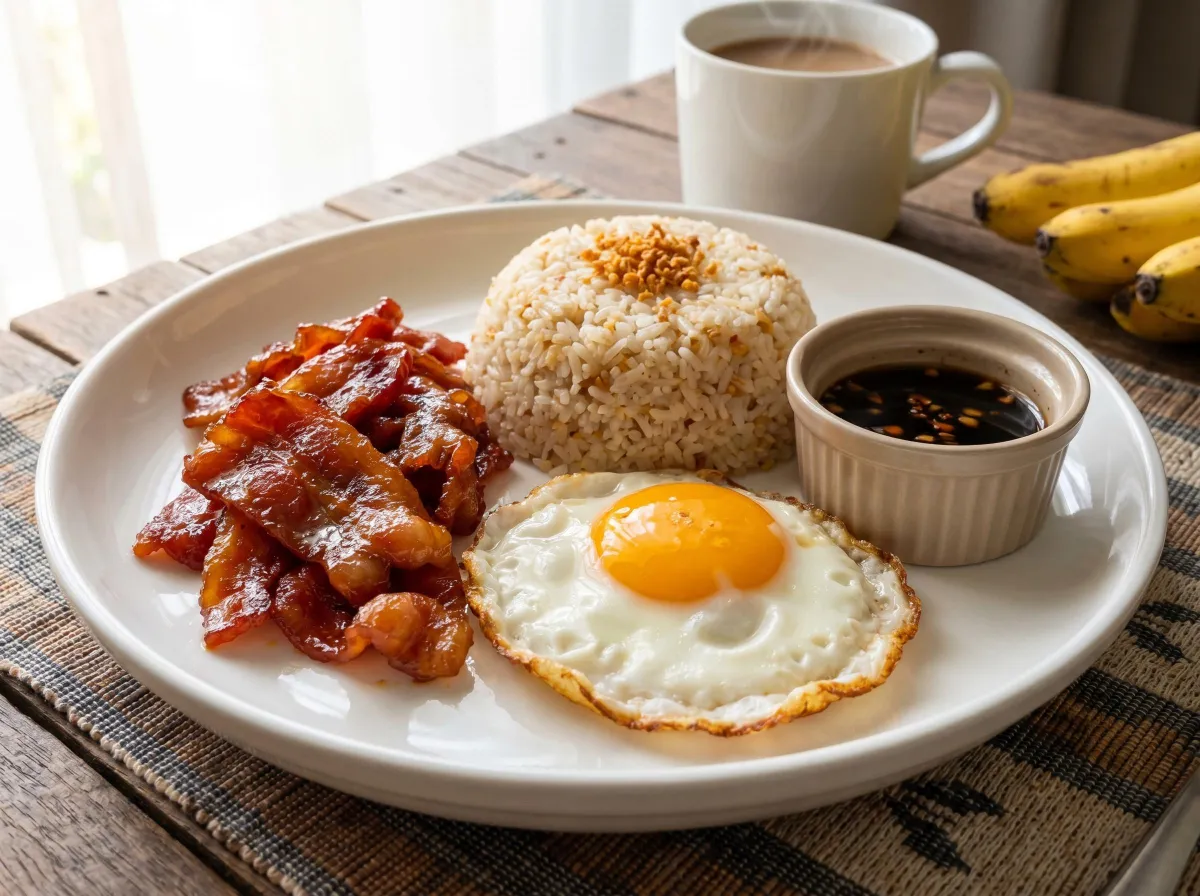
The classic tocino plate is almost never served alone. It arrives as part of tocilog — a portmanteau that Filipinos invented because they needed one word to capture three perfect things:
🥓 Tocino — the sweet cured pork, caramelized and sticky
🍚 Sinangag — garlic fried rice, fragrant with browned garlic bits
🍳 Itlog — a fried egg, almost always sunny-side up, yolk still runny
This trio — tocino, sinangag, itlog — is one of the most complete and comforting breakfast combinations in Filipino cuisine. The sweet pork, the savory garlicky rice, the rich yolk that breaks over everything when you pierce it: each element balances the others, and together they create a plate that is genuinely greater than the sum of its parts.
Tocilog belongs to the broader silog family — a category of Filipino breakfast plates where the sinangag and itlog stay constant and the protein changes. Tapsilog has beef tapa. Longsilog has longganisa sausage. Bangsilog has milkfish. Spamsilog — yes, really — has Spam. But tocilog is consistently one of the most popular in the family, because the sweetness of the tocino does something that none of the other proteins do: it makes the plate feel a little like a treat, even at seven in the morning.
📜 The Story Behind It
Here is something that not everyone knows: Filipino tocino as we eat it today was essentially invented by one woman. In 1967. And we know her name.
The concept of curing meat — what the Spanish called tocino — came to the Philippines during colonization, introduced as a method of preserving pork for long sea voyages along the Manila Galleon trade routes between Mexico and Manila. The Spanish version was savory and salty, designed for durability rather than pleasure. Filipino cooks, working with the abundant sugarcane that had been cultivated in the archipelago since pre-colonial times, began sweetening the cure — transforming a preservation technique into something that was genuinely delicious to eat.
But the modern Filipino tocino that ended up in grocery stores, carinderia menus, and breakfast plates across the country? That has a specific origin story.
Her name was Leticia "Apung Lolet" Olalia Hizon — a schoolteacher from Pampanga. In 1967, a neighbor who sold pork at the market found himself with a large quantity of unsold meat that was at risk of spoiling. He asked her for help. She turned to an old method of preserving pork called pindang — a traditional Filipino fermented pork technique — and began experimenting with it, adding her own proportions of sugar and salt until she arrived at something with a sweet-and-salty flavor profile that was unlike anything else on the market.
People loved it. She and her husband refined the recipe and commercialized it, eventually founding Pampanga's Best, Inc. — now a multi-million dollar Filipino meat processing corporation whose tocino is still sold in supermarkets across the Philippines and in Filipino grocery stores worldwide. Apung Lolet's face appears on the packaging to this day, a rare and deserved tribute to the woman whose kitchen experimentation created an entire category of Filipino breakfast food.
She passed away in October 2021. The Philippines lost her — but her recipe remains on every Filipino breakfast table, in every tocilog plate, in every morning that smells like caramelized sugar and pork in a pan.
The Spanish gave the Philippines the word tocino and the concept of curing meat. But Leticia Hizon gave the Philippines the Filipino tocino — sweeter, stickier, more vivid in color, and completely, unmistakably its own.
👅 What Does Tocino Taste Like?
Sweet. Savory. Sticky in the best possible way. And slightly smoky at the edges where the sugar has gone just a little dark.
Let's break it down, because tocino's flavor is layered in a way that is worth paying attention to.
The first thing you taste is the sweetness — and it is not shy about it. Filipino tocino leans into its sugar in a way that distinguishes it from most savory breakfast meats. The cure is sugar-dominant, and the frying process intensifies that sweetness through caramelization, meaning the cooked tocino is noticeably sweeter than the raw marinated pork. This is intentional and wonderful.
Underneath the sweetness is the savory — the garlic that permeated the meat during curing, the salt that balances the sugar, the slight depth from soy sauce in recipes that include it. The savory component is what keeps tocino from being candy and makes it instead one of the most satisfying breakfast proteins in Filipino cooking.
Then there is the texture. The thin slices of pork become tender from the cure but develop a slightly sticky, almost chewy quality during frying — particularly at the caramelized edges, which have a resistance and then a give that is deeply pleasurable. The interior stays juicy.
Food writers frequently compare Filipino tocino to Chinese char siu (Cantonese sweet barbecued pork), and the comparison makes sense: both use sugar as a dominant flavor, both develop caramelization through heat, and both have a distinctly red-pink color from their curing process. But Filipino tocino is sweeter, fries flat rather than roasting, and is served as a breakfast plate rather than a noodle topping or dim sum component. Similar logic, different result, completely Filipino execution.
And then there is what tocino does to the rest of the plate. The sweet, slightly sticky pork juices mingle with the garlic rice. The runny yolk from the egg breaks over everything and ties the sweetness and the savory together into something unified. A splash of spiced vinegar on the side — a classic accompaniment — cuts through the richness with just enough sharpness to reset your palate for the next bite.
If I had to describe it simply:
Tocino tastes like the best possible reason to wake up before you are ready.
🗺️ Tocino Across the Philippines
One of the things that makes Filipino food so endlessly interesting is that the same dish can taste completely different depending on where in the country it was made — and tocino is a perfect example.
Pampanga is considered the heartland of Filipino tocino, and for good reason: it is where the modern recipe was developed, and the Kapampangan culinary tradition has long prized sweet-savory flavor combinations. Pampanga's Best remains the benchmark commercial brand, but countless Kapampangan home recipes exist alongside it, many passed down through families.
Cebu has its own tocino tradition with a slightly different flavor profile — often less sweet than the Pampanga standard, with more garlic and sometimes a touch more acidity. Cebuano tocino reflects the Visayan preference for bolder, less-sweetened flavors compared to Tagalog and Kapampangan cooking.
Batangas produces a version called longganisang Batangas that blurs the line between tocino and longganisa — cured, garlicky, and slightly sour from the vinegar in the cure. It is technically its own dish, but it sits in the same family.
Ilocos Region in northern Luzon makes bagnet alongside its own versions of cured pork, and the regional market tocino tends to be less sweet and more herbal than the Pampanga style, reflecting the Ilocano preference for more restrained sweetness.
Beyond the Philippines, overseas Filipino communities have created their own tocino traditions. In the United States, Canada, and the Middle East — wherever a large Filipino diaspora has settled — Filipino grocery stores stock multiple brands of frozen tocino, and Filipino-American home cooks have developed their own recipes using whatever pork is available locally. The longing for a specific taste from a specific morning has made tocino one of the most actively recreated Filipino dishes outside the Philippines.
And then there is the innovation. Tocino pizza. Tocino in a pandesal. Tocino ice cream (yes, really — it has happened). Filipino food creativity has taken Apung Lolet's original recipe and run with it in directions she probably never imagined, and somehow, the essential character of the dish — that sweet-savory-caramelized soul — survives every format.
🗣️ Learn the Tagalog
Tocino has its own vocabulary — the words of a morning ritual, a breakfast plate, and the particular warmth of being fed something someone made for you before the day started.
The dish and the breakfast:
Tocino (toh-see-noh) — the sweet cured pork; from the Spanish tocino meaning bacon or cured meat, transformed into something entirely Filipino
Tocilog (toh-see-log) — the breakfast combination: tocino + sinangag + itlog; one of the great Filipino portmanteaus
Silog (see-log) — the category of Filipino breakfast plates with sinangag and itlog; the framework that tocino belongs to
Sinangag (see-nah-ngag) — garlic fried rice; the savory, fragrant companion that completes the tocilog plate
Itlog (eet-log) — egg; in tocilog context, almost always sunny-side up
Ulam (oo-lahm) — the main dish or protein served with rice; tocino is one of the most beloved ulam choices for breakfast
The ingredients and technique:
Baboy (bah-boy) — pork; the foundational protein of Filipino tocino
Asukal (ah-soo-kahl) — sugar; the dominant ingredient in the cure and the source of the caramelization that defines tocino's texture
Bawang (bah-wahng) — garlic; woven through the cure and indispensable to the flavor
Asin (ah-sin) — salt; the balance to the sweetness
Achuete (ah-chweh-teh) — annatto; the natural coloring used in many tocino recipes to achieve the signature pink-red hue
Sawsawan (saw-sah-wahn) — dipping sauce; for tocilog, typically spiced vinegar or calamansi-soy
At the breakfast table:
Magagaling na umaga! (mah-gah-gah-ling nah oo-mah-gah) — Good morning! (a formal way to greet the day — though most Filipino mornings begin more casually)
Kain na! (kah-in nah) — Let's eat! / Come eat! The most important two words at a Filipino breakfast table
May tocino tayo ngayon! (may toh-see-noh tah-yoh ngah-yon) — We have tocino today! An announcement that qualifies as good news
Ano ang gusto mo, sunny side up o scrambled? (ah-noh ang goos-toh moh, sunny side up oh scrambled) — What do you want, sunny side up or scrambled? The question that determines the morning
Dagdag na sinangag! (dag-dag nah see-nah-ngag) — More garlic rice, please! The request that means the tocino was good
Masustansya! (mah-soos-tahn-syah) — Nutritious! / Hearty! — what someone's nanay always said about a full tocilog plate, making it sound both comforting and responsible at the same time
These words do not just describe the dish — they describe the experience around it. Kain na is the sound of a morning that is working. May tocino tayo ngayon is small news that makes the whole day lighter.
🤩 Fun Facts About Tocino
1. One woman invented it — and we know exactly who she was. The modern Filipino tocino recipe is credited to Leticia "Apung Lolet" Hizon of Pampanga, who created the dish in 1967 while helping a neighbor preserve unsold pork. She turned that act of neighborly help into Pampanga's Best, Inc. — now a multi-million dollar Filipino meat processing company. Her face is still on the packaging.
2. The Spanish introduced curing. Filipinos introduced the sweetness. The word tocino is Spanish for cured meat, and the concept of salt-curing pork arrived in the Philippines during colonization via the Manila Galleon trade routes. But the distinctive sweetness of Filipino tocino — the sugar-dominant cure, the caramelized edges — is a Filipino adaptation that took a preservation technique and transformed it into a pleasure.
3. Tocilog is one of the most searched Filipino recipes in the world. The silog breakfast family — tocilog, tapsilog, longsilog — consistently ranks among the top searched Filipino food terms internationally. Among them, tocilog is one of the most popular, driven by both Filipinos recreating it abroad and non-Filipinos discovering Filipino breakfast culture.
4. The pink-red color of tocino has a history. The characteristic color of Filipino tocino traditionally came from saltpeter (potassium nitrate) used in the curing process. Today, most commercial and home recipes use annatto powder (achuete) as a natural alternative, or red food coloring. The bright color is now inseparable from tocino's identity — you recognize it on the plate before you taste it.
5. Filipino tocino is compared to Chinese char siu. Food writers and culinary historians frequently draw the parallel between Filipino tocino and Cantonese char siu (sweet BBQ pork) — both use sugar as a dominant flavor, both develop caramelization during cooking, and both have a reddish color. The similarities are not coincidental: Chinese culinary influence in the Philippines runs deep, and the sweet-savory flavor profile that tocino exemplifies reflects that long exchange.
6. Tocino is eaten for breakfast, merienda, pulutan, and pandesal filling. While tocilog is the canonical breakfast form, Filipino tocino shows up across the whole day. It is eaten as a merienda snack. It is served as pulutan — bar food — alongside a cold San Miguel beer. It is sliced and stuffed into pandesal for a sweet-savory sandwich that requires no additional condiments. It has appeared as a pizza topping, a burrito filling, and — in a moment of creative genius or madness — as an ice cream flavor.
7. There are chicken tocino and beef tocino too. While pork is the traditional and most popular tocino, both chicken and beef versions exist and are widely eaten. Chicken tocino tends to be slightly leaner and cooks more quickly; beef tocino has a deeper, more savory base that the sugar plays against differently. But if a Filipino says "tocino" without specifying, they almost certainly mean pork.
8. Sinangag makes tocilog possible. The garlic fried rice of a tocilog plate is not just a side — it is an essential flavor carrier. Sinangag is made from leftover cooked rice (day-old rice works better than freshly cooked because it is drier and fries more cleanly), fried in oil with generous amounts of garlic until the garlic is golden and the rice is slightly crispy at the edges. Its savory, garlicky intensity is exactly the right counterpoint to the sweetness of the tocino, and the crispy garlic bits that get scattered on top of a well-made sinangag are a secondary pleasure all their own.
9. The OFW connection is real and powerful. Filipino Overseas Workers (OFWs) and the broader diaspora consistently name tocilog among the dishes they miss most from home. Unlike some Filipino dishes that require specific or hard-to-find ingredients, tocino is reproducible almost anywhere — the cure ingredients are available at any supermarket — but that does not make it easier to eat. What OFWs miss is not just the tocino. It is the morning it belongs to: the specific hour, the specific kitchen, the specific people around the table.
10. Pampanga is to tocino what Bologna is to bolognese. The province of Pampanga is the culinary capital of the Philippines and the birthplace of modern Filipino tocino. Kapampangan cuisine is considered one of the most technically sophisticated in the country, and the Kapampangan tradition of sweet-savory flavor balance is directly reflected in tocino's flavor profile. When Filipinos want the best tocino, they think of Pampanga — not because it is the only place that makes it, but because it is where the recipe was perfected.
11. The caramelized edges are the point. The sweet spots of tocino — the darkened, sticky, slightly charred edges where the sugar has caramelized in the hot pan — are the most prized bites of the dish. A tocilog plate where the tocino has not been cooked long enough to develop those caramelized edges is a tocilog plate that is not quite finished yet. The edges are why the whole thing works.
12. Tocino is sold in grocery stores worldwide. Pampanga's Best, Magnolia, Hormel's Filipino range, and numerous other brands sell frozen tocino in Filipino grocery stores across the United States, Canada, the Middle East, Australia, and the United Kingdom. The existence of a Filipino grocery store in a city is often measured, informally, by whether you can find frozen tocino on its shelves.
🌍 How Tocino Connects Filipinos Everywhere
Tocino is one of the foods that travels farthest.
Not in terms of cuisine influence or global recognition — that distinction probably belongs to adobo or lechon. But in terms of pure, immediate, personal portability, tocino travels in a way that few other Filipino foods do. Because the morning it belongs to — the specific combination of sweet pork, garlic rice, and runny egg, eaten quickly at a kitchen table before the day started — is a morning that Filipinos carry with them everywhere they go.
For the estimated 12 million Filipinos living outside the Philippines, the tocilog breakfast is one of the most actively recreated Filipino experiences in diaspora kitchens. It requires no special equipment. The cure ingredients — sugar, garlic, salt — exist everywhere on earth. The pork is available at any butcher. The sinangag can be made from whatever leftover rice is in the refrigerator. The egg is the egg. And yet, assembled together on a plate, it produces something that is unmistakably Filipino — a flavor combination that exists nowhere else in quite the same proportion and character.
This is why tocilog shows up consistently in essays, blog posts, social media captions, and community cookbooks about the Filipino diaspora experience. It is the breakfast that OFWs make on Sunday mornings to feel, briefly and completely, like they are home. It is the plate that Filipino-American children eat as their first specifically Filipino breakfast memory. It is the meal that Filipino parents teach their kids to cook not because it is complicated — it is not — but because knowing how to make it is a form of cultural inheritance.
Filipino restaurants abroad almost universally serve tocilog. It appears on menus from Los Angeles to London to Riyadh, because any Filipino restaurant that wants to serve the full breadth of Filipino food culture needs to have a breakfast plate, and the breakfast plate is tocilog. Non-Filipino diners who encounter it for the first time almost always respond to the sweetness with surprise — sweet pork for breakfast? — and then with the slightly wider eyes of someone who has just discovered something that should have been obvious all along.
The sweetness of tocino is the key to its portability. Sugar is universal. The specific way Filipino tocino uses it — the dominant cure, the caramelized finish, the sweet-savory balance that makes a complete breakfast plate possible in three components — is distinctly, traceable Filipino. It is a flavor that carries history: Spanish curing, Filipino sugarcane, a Kapampangan woman's kitchen experiment in 1967, and six decades of breakfast tables from Pampanga to Riyadh.
❓ FAQ — Everything You Need to Know About Tocino
What is Filipino tocino? Filipino tocino is sweet cured pork — thinly sliced pork shoulder or belly marinated in sugar, garlic, and salt, then fried until the edges caramelize into a sticky, golden glaze. It is one of the most popular Filipino breakfast dishes, typically served as part of tocilog (tocino, sinangag, and itlog).
What does tocino taste like? Sweet, savory, and deeply satisfying. The sugar caramelizes during frying, creating sticky, slightly charred edges on tender, juicy pork. It is often compared to Chinese char siu in its sweet-savory profile. Served with garlic rice and a runny egg, it is one of the most complete Filipino breakfast experiences.
Who invented Filipino tocino? The modern recipe is credited to Leticia "Apung Lolet" Hizon of Pampanga, who created it in 1967 while helping a neighbor preserve unsold pork. Her recipe became Pampanga's Best, Inc., now a major Filipino food company whose tocino is sold across the Philippines and in Filipino grocery stores worldwide.
What is tocilog? Tocilog is a portmanteau of tocino (sweet cured pork), sinangag (garlic fried rice), and itlog (fried egg). It is one of the most popular breakfast combinations in Filipino cuisine, served from humble carinderias to hotel breakfast buffets across the Philippines and in Filipino communities worldwide.
What is the silog breakfast? Silog is a category of Filipino breakfast plates combining sinangag (garlic fried rice) and itlog (fried egg) with a protein. Tocilog uses tocino. Tapsilog uses beef tapa. Longsilog uses longganisa. Bangsilog uses milkfish. The silog format is one of the defining structures of Filipino breakfast culture.
Why is tocino pink or red? The color traditionally came from saltpeter used in curing. Many recipes now use annatto (achuete) powder as a natural coloring alternative. The pink-red hue is part of tocino's visual identity — you recognize it immediately in Filipino markets, grocery stores, and on breakfast plates.
How is tocino different from longganisa? Tocino is sweet cured pork, flat-sliced and pan-fried. Longganisa is Filipino pork sausage, stuffed into casings and linked. Both are popular silog proteins, but they are different in texture, shape, and flavor. Tocino is sweeter and chewier; longganisa is more savory with regional variations.
Can you make tocino at home? Yes — it is one of the most accessible Filipino dishes to make at home. Thinly slice pork, mix a cure of sugar, garlic, and salt, coat the pork thoroughly, and refrigerate for at least 24 hours (3–5 days for deeper flavor). Fry with a little water initially, then allow the sugar to caramelize the edges. The result is recognizably tocino even in a foreign kitchen.
💛 Closing
Tocino is not trying to be complicated.
It is thin slices of pork, cured in sugar and garlic, fried until the edges turn sticky and golden. It sits on a plate next to garlic rice and a runny egg, and together the three of them make one of the most comforting, satisfying, and quietly meaningful breakfasts in Filipino cuisine.
But tocino also carries the story of one woman in Pampanga who turned a neighbor's problem into a recipe, and turned that recipe into a company, and turned that company into something that now appears on breakfast tables from Manila to Los Angeles to Dubai. It carries the history of Spanish colonization and Filipino sugarcane and the way a culture absorbs outside influences and produces something completely its own.
Most of all, it carries the smell of a specific kind of morning — a morning where someone woke up early and put pork in a pan and let the sugar start to caramelize, and the whole house filled up with something warm and sweet, and you knew before you even opened your eyes that the day was already off to a good start.
At Studio Tributes, we celebrate Filipino food because Filipino food is worth knowing deeply — not just eating. Tocino is a dish that rewards knowing. The next time a plate of tocilog is in front of you — whether it is from a carinderia in Pampanga or a Filipino restaurant in your city or a Sunday kitchen in your own apartment — you will know where it came from, who made it possible, and exactly why it tastes the way it does.
And you will probably ask for extra sinangag. Everyone does.
🎯What Filipino Food Are You? Take the quiz → 👉 Get your FREE Filipino Coloring pages here.
Keep exploring Filipino food and culture with us:
🎨 Get our Filipino Food Activity Book on Amazon 📚 Read more Filipino food stories on our blog
💭 A Memory to Hold Onto
Did tocino bring a morning back?
Maybe the Saturday when someone made tocilog and it was still dark outside and the kitchen was the warmest room in the house.
Maybe the first time you made it yourself in a foreign city from ingredients that were almost right but not quite, and it tasted close enough to make you feel something you could not fully name.
Maybe a nanay or a lola who always made the eggs sunny-side up because that was how everyone liked them, and you have never ordered scrambled eggs for breakfast since.
Was your tocino from the market or from a packet in the freezer? Did you always eat it with vinegar, or do you think that is wrong? Who made sinangag in your house — and did they use leftover rice or cook fresh?
If a memory came to mind, share your tocino story on Facebook or Instagram and tag @StudioTributes — we would love to hear it and celebrate it with the whole community.
Read Next
📚 References & Further Reading
Wikipedia — Tocino — Overview of the dish's Spanish colonial origins, Philippine adaptation, and the sweetened Filipino version as distinct from other tocino traditions in Cuba and Puerto Rico.
Wikipedia — Silog — Reference for the silog breakfast family, the sinangag and itlog components, and the portmanteau naming system (tapsilog, tocilog, longsilog) that defines Filipino breakfast culture.
Yale SEASIA — Inventor of Filipino Tocino Leticia Hizon Passes Away — Obituary and historical record documenting Leticia "Apung Lolet" Hizon's role in creating the modern Filipino tocino recipe in 1967 and co-founding Pampanga's Best, Inc.
Manila Sun — Tocino: Sweet Cured Pork for Breakfast — Cultural overview of Filipino tocino including the origin story, the tocilog combination, and the role of the dish in Filipino breakfast culture and bar snack culture.
TasteAtlas — Tocino — Global culinary database entry for Filipino tocino, documenting its sweet-cured meat profile and its place in Filipino breakfast and food culture internationally.
Grokipedia — Tocino — Detailed reference for the Spanish colonial introduction of curing, the role of Philippine sugarcane in sweetening the cure, and the 1967 commercialization of the modern recipe by Leticia Hizon and Pampanga's Best.