
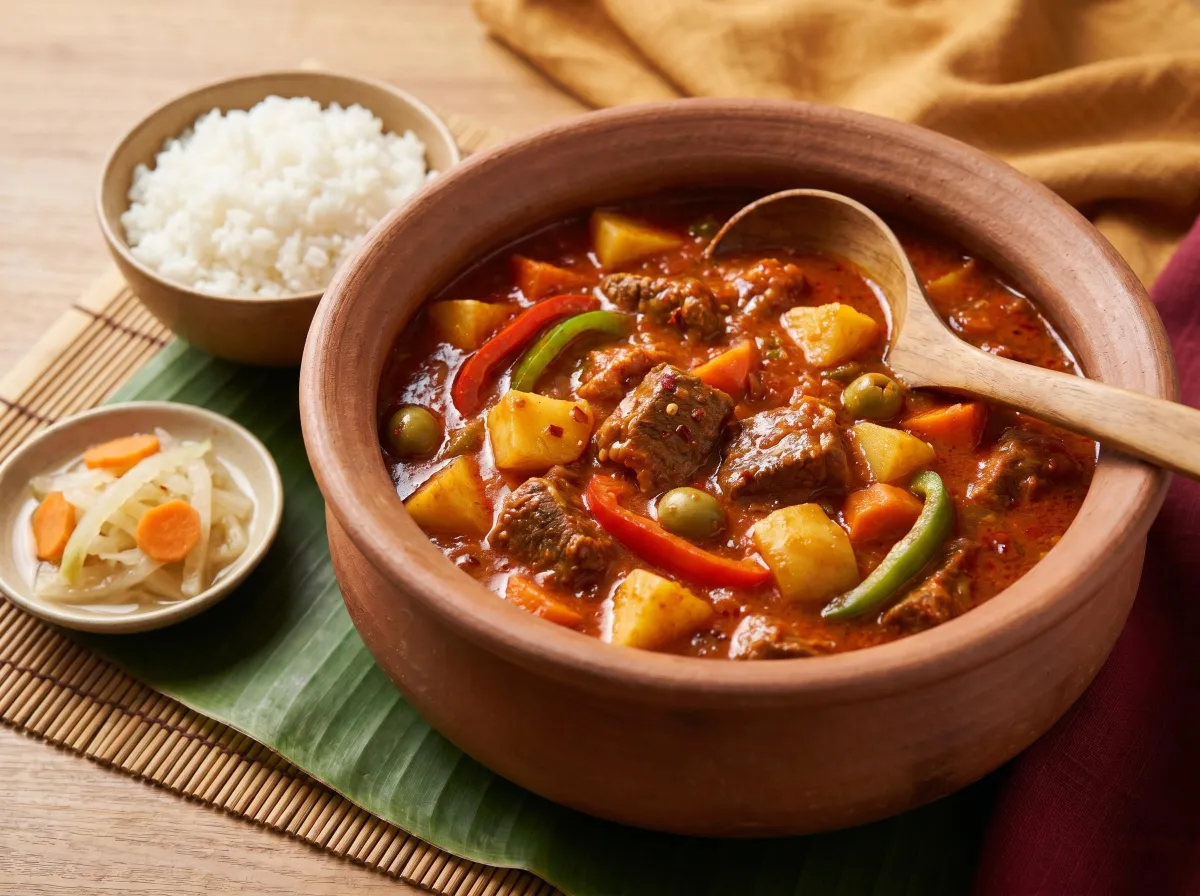
What Is Caldereta? The Filipino Spicy Tomato Meat Stew
Filipino Food · Studio Tributes
Studio Tributes / Filipino Food / What Is Caldereta?
At a Filipino fiesta, there is always one pot that people crowd around before the meal even officially starts.
It is not the rice. It is not the lechon, though the lechon will get its moment. It is the large clay pot or heavy casserole sitting in the center of the table, lid still on, steam gathering at the edges — and from it comes a smell that is tomato and chili and slow-braised meat all at once, deep and rich and warm, the kind of smell that tells you immediately that whoever made this took their time.
That is caldereta. And the moment the lid comes off, everyone reaches.
Caldereta is the fiesta stew. The reunion dish. The birthday-party centerpiece that every Filipino family has a version of and every Filipino cook has strong opinions about. It is also — and this is the thing about caldereta that surprises people who encounter it for the first time — a stew with a secret ingredient that changes everything. An ingredient that most people do not expect, that sounds strange on paper, and that makes the sauce so rich and deep and satisfying that once you know about it you cannot imagine the dish without it.
We will get to that ingredient. But first — what is caldereta, really?
Filipino caldereta (also written kaldereta) is a rich meat stew simmered in a tomato-based sauce with liver spread, chili peppers, and vegetables that typically include potatoes, carrots, and bell peppers. According to Wikipedia, the name comes from the Spanish caldera, meaning cauldron — and the dish itself traces back to the Spanish colonial period, when Iberian stew traditions arrived in the Philippines and were absorbed, adapted, and made entirely Filipino over the course of centuries.
It is one of the four great Filipino tomato stews — alongside mechado, afritada, and menudo — and it is the richest, spiciest, and most intensely flavored of them all. It is the one that takes the longest to make and produces the most satisfied sighs when it finally arrives at the table.
At Studio Tributes, we celebrate Filipino food because Filipino food carries Filipino life inside it. Today we are going all the way into caldereta: the story behind it, the secret ingredient, what distinguishes it from every other Filipino tomato stew, and why every Filipino family insists their version is the correct one.
🥩 Before we go any further — we made something for you. 🍲
Build your perfect caldereta — and find out what it says about you. Takes about a minute.
🍲 What Is Caldereta?
Let us start with the basics, because caldereta deserves a proper introduction.
At its core, caldereta is a Filipino meat stew — slow-braised, tomato-based, spiced with chili, and enriched with a flavor ingredient that takes it to a completely different level than other stews you might know. The most traditional version uses goat meat (kalderetang kambing), and in many provincial towns across Luzon, this is still the version that appears at fiestas. But today's most commonly cooked version uses beef — specifically tough, collagen-rich cuts like chuck, brisket, short ribs, or shanks that become impossibly tender after hours of slow braising.
Here is what goes into a caldereta:
🥩 The meat — goat, beef, pork, or chicken, cut into large pieces and usually marinated before cooking
🍅 Tomato sauce or paste — the base of the sauce; rich, slightly acidic, the foundation everything else builds on
🫙 Liver spread — the secret ingredient; canned liver spread (most commonly Reno brand in the Philippines, or any liver pâté) stirred into the sauce to add earthy depth and thickness
🌶️ Chili peppers — red chili or hot sauce; the heat that makes caldereta distinctively spicy among the Filipino stew family
🥔 Potatoes — added in the last stages of cooking, tender but holding their shape
🥕 Carrots — for sweetness and color
🫑 Bell peppers — red and green, adding brightness and a slight sweetness
🫒 Green olives — a Spanish colonial legacy that adds a briny pop to the rich sauce
🧀 Cheese — optional but used in some regional versions, stirred into the sauce for added richness
🌿 Aromatics — garlic, onion, bay leaves, black pepper
The cooking process is patient. The meat is browned first — this is important; browning creates depth that cannot be achieved any other way — and then braised slowly in the tomato-liver sauce until the collagen in the meat breaks down into gelatin and the whole sauce becomes thick, glossy, and unctuous. This takes time. It cannot be rushed without sacrificing the result. And the result, when the time is given, is something spectacular.
A note on the liver spread: This is the ingredient that most distinguishes caldereta from every other Filipino stew, and it is worth saying clearly: if you have not eaten caldereta before and you are hesitant about the liver component, the finished dish does not taste prominently of liver. What the liver spread does is add a layer of earthy, deeply savory richness that is almost impossible to articulate until you taste it alongside a version made without it. It also thickens the sauce in a way that gives caldereta its characteristic texture — thick and coating rather than thin and brothy. The liver is the reason the sauce clings to the meat and the rice the way it does. Without it, caldereta is still a good stew. With it, caldereta is itself.
📜 The Story Behind It
Caldereta's story begins, like so many Filipino dishes, with the Spanish colonial period — and with the long, slow process by which a foreign culinary tradition became something distinctly and irreversibly Filipino.
The Spanish arrived in the Philippines in 1565 and stayed for over three centuries. During that time, Spanish food culture arrived alongside Spanish governance, religion, and language — and some of the most enduring Filipino dishes today bear the marks of that colonial exchange. Caldereta is one of them.
The original Spanish caldereta was a rustic meat stew cooked in a caldera — a large cauldron. In the Iberian Peninsula, the dish was prepared in two main variations: fish and goat. When Spanish settlers arrived in the Philippines, the goat version came with them. Filipino cooks, working with local ingredients and Filipino taste preferences, began adapting the dish. The Spanish goat stew became Filipino goat stew — and then, over generations, became the spicy, liver-enriched, deeply sauced caldereta that Filipino families cook today.
The key Filipino adaptations were significant:
The liver spread is a Filipino addition with no direct Spanish precedent — it transformed a simple braised stew into something richer and more complex.
The chili peppers are indigenous to the Americas but arrived in the Philippines via Spain through the Manila Galleon trade, and Filipino cooks embraced them in caldereta in a way that the Spanish original did not.
The shift from goat to beef happened gradually as Filipinos adapted the dish to available proteins. Goat remained the traditional and ceremonial choice — particularly important for fiestas, where slaughtering a goat was a significant community event — but beef became the everyday alternative that most households could access.
The cheese in some regional versions — particularly in Pampanga, the culinary capital of the Philippines — reflects the Spanish influence on Kapampangan cooking, which has always leaned toward richness and elaborate preparation.
By the American colonial period (1898–1946), caldereta had already become a fixture of Filipino celebration cooking — and when canned liver spread became commercially available mid-century, the dish became even more accessible to home cooks. What had been an elite fiesta dish requiring fresh liver became something any Filipino household could approximate at home with a tin from the pantry.
Today, caldereta is both an everyday comfort food and a celebration centerpiece. It appears at birthdays, fiestas, reunions, Christmas gatherings, and graduation parties — any occasion where someone wants to feed people something that says this meal matters. It is also one of the dishes most strongly associated with regional pride: Batangas kaldereta, the notoriously spicy version without tomato sauce, is a point of genuine cultural identity for Batangueños. Pampanga caldereta with cheese is Kapampangan. And every family version is the correct version to the person who grew up eating it.
👅 What Does Caldereta Taste Like?
Caldereta tastes like the kind of stew that someone made with real intention.
The flavor is layered and complex in a way that builds slowly as you eat. The first thing you notice is the tomato — bright and slightly acidic, the foundational note that everything else is built around. Then comes the richness: the liver spread's contribution, which is not a liver flavor so much as a deep earthiness that makes the tomato sauce taste more substantial, more rounded, more like something that has been cooking for a long time. Then the heat arrives — the chili that warms the back of the throat and keeps each bite interesting. And then the meat itself: slow-braised until it is completely tender, pulling apart with the lightest pressure, carrying the sauce deep into every fiber.
The sauce is thick and glossy. This is the signature of a properly made caldereta: a sauce that coats the meat rather than surrounding it, that clings to a spoon, that is absorbed by the rice underneath it rather than running off the sides. The thickness comes from the slow reduction of the braising liquid and from the gelatin that the collagen in the meat releases over hours of cooking, and from the liver spread working its quiet thickening magic.
The olives are worth mentioning separately. A green olive in a caldereta is a briny, slightly sharp counterpoint to the richness of everything around it — a little surprise that resets your palate and makes you want another bite. Their presence is the Spanish colonial legacy in its most literal form: olives were not native to the Philippines, but they arrived with the Spanish and stayed in caldereta because they belong there.
If I had to describe caldereta simply:
Caldereta tastes like what happens when a Filipino cook decides to be generous — with time, with ingredients, and with the people sitting around the table.
It is rich without being heavy. Spicy without being overwhelming. Deep and complex and completely satisfying in a way that simple stews are not. And it is always, always better the next day, when the flavors have had overnight to deepen and find each other.
🗺️ Caldereta Across the Philippines
One of the things that makes caldereta so interesting as a dish is how dramatically it varies across regions — and how each version is considered definitively correct by the people who grew up eating it.
Batangas kaldereta is the version that surprises people most. According to Panlasang Pinoy, one common myth is that kaldereta always uses tomato sauce — but true Batangas kaldereta does not. The sauce is built from liver spread, chili, and spices without tomato, resulting in a darker, more intensely flavored stew with a serious heat level that Batangueños consider non-negotiable. If you grew up with Batangas kaldereta, the tomato-sauced versions served elsewhere can feel almost mild.
Pampanga caldereta reflects the Kapampangan tradition of cooking that leans toward richness and complexity. Kapampangan cooks sometimes add cheese to the sauce — stirred in near the end of cooking — for a creamier, more indulgent result. Pampanga is considered the culinary capital of the Philippines, and Kapampangan caldereta carries that regional pride.
Kalderetang kambing (goat caldereta) remains the traditional version in provincial areas, particularly in Luzon, where goat is still slaughtered specifically for town fiestas and major celebrations. The goat's slightly gamier, more assertive flavor takes the spicy tomato-liver sauce in a completely different direction from beef, and those who know it well consider it the most authentic expression of the dish.
Peanut butter caldereta appears in some regional recipes — particularly where liver spread is not traditional — and substitutes ground peanuts or peanut butter for the liver, creating a nutty, slightly sweet richness that is genuinely different from the liver-based standard.
Coconut milk caldereta is a Southern Luzon variation where coconut milk is added to the sauce, softening the tomato's acidity and adding a tropical creaminess that changes the whole character of the stew.
And then there is the most universal variation of all: every family's version. The caldereta that your tita makes for every reunion and that no one has ever exactly replicated. The one where the potatoes are a little larger, or the olives are left out because someone does not like them, or there is more cheese than anyone else uses. That version is the correct one. Every Filipino family knows this.
🗣️ Learn the Tagalog
Caldereta has its own vocabulary — the words of a slow cook, a fiesta table, and the specific pride that Filipino cooks bring to dishes they have been perfecting for decades.
The dish and its family:
Kaldereta (kal-deh-reh-tah) — the dish; from Spanish caldereta (stew) and caldera (cauldron); both spellings — kaldereta and caldereta — are correct and used interchangeably
Kaldero (kal-deh-roh) — a cooking pot or cauldron; the vessel the dish is named after, and the word that Filipino kitchens have used for centuries for the pot you cook rice and stews in
Kambing (kahm-bing) — goat; kalderetang kambing is the traditional goat version that remains the ceremonial standard at fiestas
Nilaga (nee-lah-gah) — boiled or braised; the cooking method underlying caldereta
Prito (pree-toh) — fried; as in the browning step that builds the depth of flavor caldereta depends on
Inihaw (ee-nee-haw) — grilled; not the method for caldereta but often sharing a table with it at fiestas
The ingredients:
Kamatis (kah-mah-tis) — tomato; the base of the caldereta sauce
Atay (ah-tie) — liver; the source of the liver spread that defines caldereta
Sili (see-lee) — chili pepper; the heat that makes caldereta distinctive
Patatas (pah-tah-tahs) — potato; from the Spanish patatas; one of the most Spanish-derived words in Filipino cooking
Karot (kah-rot) — carrot; always in caldereta, always slightly sweet against the savory sauce
Olibo (oh-lee-boh) — olive; the briny Spanish colonial addition that Filipino caldereta kept and made its own
Keso (keh-soh) — cheese; from Spanish queso; used in some regional versions and by cooks who want extra richness
At the table:
Lutoin mo nang matagal (loo-too-in moh nang mah-tah-gahl) — cook it for a long time; the instruction every caldereta recipe carries and that every caldereta cook understands intuitively
Ang sarap nito! (ang sah-rahp nee-toh) — This is so delicious! The sound of a good caldereta being eaten
Saan ang kaldero? (sah-ahn ang kal-deh-roh) — Where is the pot? The question asked when someone smells caldereta cooking and wants to know how long until it is ready
Dagdag na kanin! (dag-dag nah kah-nin) — More rice! The inevitable request when the caldereta is good
Sino ang nagluto? (see-noh ang nag-loo-toh) — Who cooked this? The question that precedes a compliment
The words of caldereta are the words of patient cooking and generous feeding. They belong to kitchens where someone has been standing over a pot for two hours and the whole house smells like something worth waiting for.
🎨 Color It!
Bring Filipino food to life in a whole new way — through art.
Our Filipino Food Coloring Book on Amazon was built from exactly that kind of question. Every page is a dish with a story. Every coloring session is an invitation to remember.
That makes it especially meaningful for:
🌼 Families who want a creative activity that naturally opens a conversation about Filipino food heritage
🌼 Filipino parents and grandparents sharing their regional food traditions with the next generation
🌼 Adults and seniors who find nostalgic, mindful creativity deeply satisfying
🌼 Anyone in the Filipino diaspora who wants a quiet, beautiful way to hold onto what home tastes like
🌼 Teachers, homeschoolers, and community groups exploring Filipino food and culture through art
Each page can open a question worth asking: Which Filipino family member makes the best caldereta in your family? Is it the kind with olives or without? Beef or goat? And is the version your family makes the correct one — or do you secretly think someone else's is better?
(The answer is your family's is the correct one. Everyone's answer is the same.)
👉 Get your FREE Filipino Coloring pages here.
👉 What Filipino Food Are You? Take the quiz →
🤩 Fun Facts About Caldereta
1. The name literally means "the thing cooked in a cauldron." Caldereta comes from the Spanish caldera (cauldron or large cooking pot), and the dish's name is essentially a descriptor of its cooking vessel. In Tagalog, that same cooking vessel is called a kaldero — a word that Filipino kitchens have used for centuries, borrowed from Spanish, and applied to the pot you use for rice and stews to this day.
2. It was originally a goat stew. The traditional caldereta is kalderetang kambing — goat caldereta. The Spanish original was also a goat stew, and in provincial Philippines, particularly in Luzon, goat remains the ceremonial protein. Slaughtering a goat for a fiesta is a significant event. In many communities, kalderetang kambing is the dish that announces the occasion is important enough to warrant it.
3. The liver spread is the secret everyone eventually tells you. Liver spread — typically Reno brand canned liver spread in the Philippines, or any liver pâté — is the ingredient that makes caldereta caldereta. It adds earthy depth, a slightly rich umami that no tomato sauce alone produces, and it thickens the sauce in a way that gives caldereta its characteristic texture. The liver flavor itself is subtle in the finished dish — but its contribution is irreplaceable. Most people who learn about it cannot imagine leaving it out once they understand what it does.
4. Caldereta is one of the "Big Four" Filipino tomato stews. Filipino cooking has four great tomato-based meat stews with Spanish origins: caldereta, mechado, afritada, and menudo. They share many ingredients — tomatoes, potatoes, carrots, bell peppers — but each has a distinct character. Caldereta is the richest and spiciest, distinguished by liver spread. Mechado uses soy sauce and has a tangier profile. Afritada is the lightest and most straightforward. Menudo uses smaller-cut pork with liver and chickpeas. They are frequently confused by those unfamiliar with Filipino food, but every Filipino cook knows exactly which is which.
5. Batangas kaldereta does not use tomato sauce. This surprises people who assume all caldereta follows the same template. Batangas kaldereta builds its sauce from liver spread, chili, and aromatics — no tomato. The result is darker, richer, and significantly spicier than the tomato-based standard version. It is one of the regional variations most strongly associated with local identity: Batangueños are proud of their version and would not make it any other way.
6. Caldereta always tastes better the next day. This is not a myth. The overnight rest allows the flavors to deepen and integrate in a way that even the best caldereta cannot achieve in its first serving. The sauce thickens further as it cools and then gently reheated. The meat absorbs more of the sauce. Everything becomes more cohesive. Filipino cooks often make caldereta the day before a celebration for exactly this reason — the version reheated gently on the morning of the party is better than the version fresh off the stove.
7. Browning the meat before braising is essential — not optional. The step that many first-time caldereta cooks skip because it seems unnecessary is actually the step that creates the flavor depth that distinguishes great caldereta from adequate caldereta. When beef is browned in a hot pan before braising, the Maillard reaction creates hundreds of flavor compounds that cannot be achieved any other way. Skipping this step and just adding raw meat to the sauce produces a technically correct caldereta that tastes flat. The browning is where the character lives.
8. Cheese in caldereta is a real thing. Particularly in Kapampangan versions and in some Metro Manila recipes, melted cheese is stirred into the caldereta sauce near the end of cooking. This adds creaminess and a slight savory richness that is different from the liver spread's contribution but compatible with it. The combination of liver spread and cheese in a caldereta sauce is not excessive — it is Kapampangan — and the result is something that justifies the reputation of Pampanga as the culinary capital of the Philippines.
9. Canned liver spread made caldereta a household dish. Before canned liver spread was commercially available, making caldereta at home required fresh liver, which needed to be cleaned, minced, and worked into the sauce — a process that added time and complexity. The mid-century arrival of affordable canned liver spread (particularly Reno brand, which became the Philippine standard) democratized caldereta, allowing home cooks to produce the rich liver-enriched sauce without the labor of fresh liver preparation. Caldereta went from celebration-only to something any household could make for a Sunday family lunch.
10. The green olives are not optional — they are Spanish history in the pot. Olives are not native to the Philippines. They arrived with the Spanish colonizers and stayed in caldereta because they were part of the original stew tradition that the dish was adapted from. Every green olive in a Filipino caldereta is a direct culinary connection to the Iberian Peninsula — a flavor that traveled across the Pacific in a Spanish ship and was absorbed into Filipino cooking so completely that most people who eat caldereta today do not think about where the olives came from. They just eat them because they belong there.
11. Every family's caldereta is the correct caldereta. This is perhaps the most important thing to understand about caldereta as a dish. There is no single authoritative recipe. There is no version that is objectively right. There are families who add cheese and families who absolutely do not. Families who make it with goat and families who only know the beef version. Families with twelve olives and families with none. Families whose caldereta is mildly spiced and families whose caldereta makes you reach for water. All of them are right. All of them have been arguing about it for years. All of them will make their version for the next reunion and it will be received exactly the way it always has been.
🌍 How Caldereta Connects Filipinos Everywhere
Caldereta travels in luggage, in recipe notebooks, and in memory.
For Filipino families abroad, caldereta is one of the dishes most actively recreated in diaspora kitchens — in Los Angeles, in Chicago, in Toronto, in London, in Dubai. Unlike some Filipino dishes that require specific or hard-to-source ingredients, caldereta is remarkably reproducible anywhere: beef is universally available, liver spread or pâté can be found at most specialty stores, and the other ingredients — tomatoes, potatoes, carrots, bell peppers, olives — are standard supermarket fare in most countries.
What makes the recreation feel meaningful is not the accessibility of the ingredients but the specificity of the memory. Caldereta is a fiesta food, which means it is a memory food — tied to specific celebrations, specific tables, specific people who have since moved, or aged, or passed on. Making caldereta abroad is often an act of recovery: an attempt to produce not just the dish but the occasion the dish belongs to. The smell of the sauce simmering is what people describe most consistently — the garlic and tomato and liver spread all working together into something that fills the kitchen and immediately produces a specific, irreplaceable feeling.
Filipino restaurants in the United States and across the diaspora almost universally serve caldereta. It appears on menus from Manila to Mississauga, from Quezon City to Queens. Non-Filipino diners who encounter it for the first time often respond to the richness of the sauce with surprise — what is in this that makes it taste so deep? — and the answer, when revealed, produces exactly the same reaction every time: skepticism followed immediately by understanding followed immediately by another spoonful.
Caldereta is part of the "Big Four" Filipino tomato stews, but it is the one most associated with celebration — the one that says this is a special day, and I cooked accordingly. In Filipino food culture, where cooking for others is an expression of care, spending three hours over a caldereta pot is a statement. It says: you are worth this.
❓ FAQ — Everything You Need to Know About Caldereta
What is caldereta? Caldereta (also kaldereta) is a rich Filipino meat stew simmered in a tomato-based sauce with liver spread, chili peppers, potatoes, carrots, bell peppers, and olives. The name comes from the Spanish caldera (cauldron). It is traditionally made with goat but most commonly made with beef today, and is a staple at Filipino fiestas and celebrations.
What is the secret ingredient in caldereta? Liver spread — typically canned liver spread such as Reno brand, or any liver pâté. It adds deep earthy umami richness and acts as a thickening agent, giving caldereta its characteristic thick, glossy sauce. This is what separates caldereta from other Filipino tomato stews.
What is the difference between caldereta, mechado, afritada, and menudo? All four are Filipino tomato-based stews. Caldereta uses liver spread and chili — it is the richest and spiciest. Mechado uses soy sauce and tomatoes with a tangy profile. Afritada is lighter with a simpler tomato sauce. Menudo uses smaller-cut pork with liver and chickpeas. Caldereta's liver spread is the defining distinction.
What meat is used in caldereta? Traditionally goat (kalderetang kambing), especially at provincial fiestas. Today, beef is most common for home cooking. Pork and chicken versions also exist. Tough, collagen-rich cuts — chuck, brisket, short ribs, shanks — work best because slow braising transforms them into something tender and deeply flavorful.
Is caldereta spicy? Yes, typically — chili peppers are a defining ingredient. The heat level varies by family and region. Batangas kaldereta is notably bold and spicy. Most caldereta can be adjusted by controlling the amount of chili.
What does caldereta taste like? Rich, savory, and deeply satisfying — tomato brightness, earthy liver depth, chili warmth, and tender braised meat in a thick, glossy sauce. The olives add a briny counterpoint. Always better the next day.
What is caldereta served with? Always with steamed white rice. The thick sauce is poured over the rice. Atchara (pickled green papaya) on the side cuts through the richness. Some regional versions pair well with bread for dipping.
What are the regional variations of caldereta? Batangas kaldereta skips tomato sauce for a pure liver-chili base — darker and spicier. Pampanga versions often add cheese. Northern Luzon traditionally uses goat. Some recipes substitute peanut butter for liver spread. Coconut milk versions exist in Southern Luzon. Every family has its own variation, which it considers authoritative.
💛 Closing
Caldereta is not a quick dish. It is not meant to be.
The browning of the meat. The slow braise until the collagen has completely dissolved into the sauce. The liver spread stirred in at exactly the right moment. The vegetables added in stages so each one finishes at the right texture. The overnight rest that makes tomorrow's caldereta better than today's. All of it is patient work, and all of it is deliberate.
Filipino cooking culture understands this. Caldereta is not made casually. When someone makes caldereta for you — real caldereta, with the time it requires — they are telling you something about how they regard you. The three hours at the stove are part of the gift. The pot of deep, rich, spicy stew that arrives at the table is the completion of a care that started hours before anyone sat down.
At Studio Tributes, we celebrate Filipino food because Filipino food carries Filipino life inside it. Caldereta carries fiesta life — the celebrations, the crowded tables, the specific pride of the cook who lifts the lid and watches the room respond. It carries colonial history, transformed by Filipino creativity into something the original Spanish colonizers would not recognize. It carries every family argument about olives and cheese and goat versus beef and whether tomato sauce belongs in it or not.
And it carries the undeniable, unconditional truth that liver spread in a tomato sauce is not strange at all once you taste what it does.
Keep exploring Filipino food and culture with us:
🍲 What Filipino Food Are You? Take the Quiz → 🎨 Get our Filipino Food Activity Book on Amazon 📚 Read more Filipino food stories on our blog
💭 A Memory to Hold Onto
Did caldereta bring a table back?
Maybe the specific reunion where the caldereta was so good that everyone asked who made it and the answer was someone who had been making it the same way for forty years.
Maybe the debate — still unresolved — about whether the version with cheese is better than the version without, or whether olives belong in it at all.
Maybe the smell of it coming from the kitchen on a Sunday morning, and knowing that meant the afternoon was going to be a good one.
Beef, pork, chicken, or goat — and is that even up for debate in your family? With olives or without? And what do you think about the cheese people? Who makes the best caldereta in your family, and have you ever told them?
If a memory came to mind, share your caldereta story on Facebook or Instagram and tag @StudioTributes — we would love to hear it and celebrate it with the whole community.
Read Next
📚 References & Further Reading
Wikipedia — Kaldereta — Primary reference for dish overview, Spanish colonial origins, the caldera etymology, ingredient classification, and the note that caldereta is most popular in Luzon (Southern Tagalog region). Also notes its similarities to afritada and menudo.
Panlasang Pinoy — Beef Kaldereta Recipe — Authoritative Filipino recipe resource with cultural context on the liver spread distinction, the shift from goat to beef over time, regional variations including Batangas kaldereta, and the peanut butter alternative.
Panlasang Pinoy — Batangas Kaldereta — Documentation of the notable Batangas regional variation, including the clarification that authentic Batangas kaldereta does not use tomato sauce, relying instead on liver spread and chili for the sauce base.
Grokipedia — Kaldereta — Reference for the Iberian Peninsula origin of caldereta as a cauldron-cooked rustic stew, the evolution from goat to beef during the American colonial period, and the democratizing role of canned liver spread in making the dish accessible to home cooks.
Ang Sarap — Kaldereta — Filipino food blog reference for the cultural distinction between goat caldereta (used for special occasions) and beef caldereta (everyday home cooking), and the universality of each Filipino household having its own variation.
Iankewks — Beef Kaldereta — Reference for the liver spread as the key non-negotiable ingredient, including the note on Reno brand as the Philippine standard and liver pâté as an international substitute.