
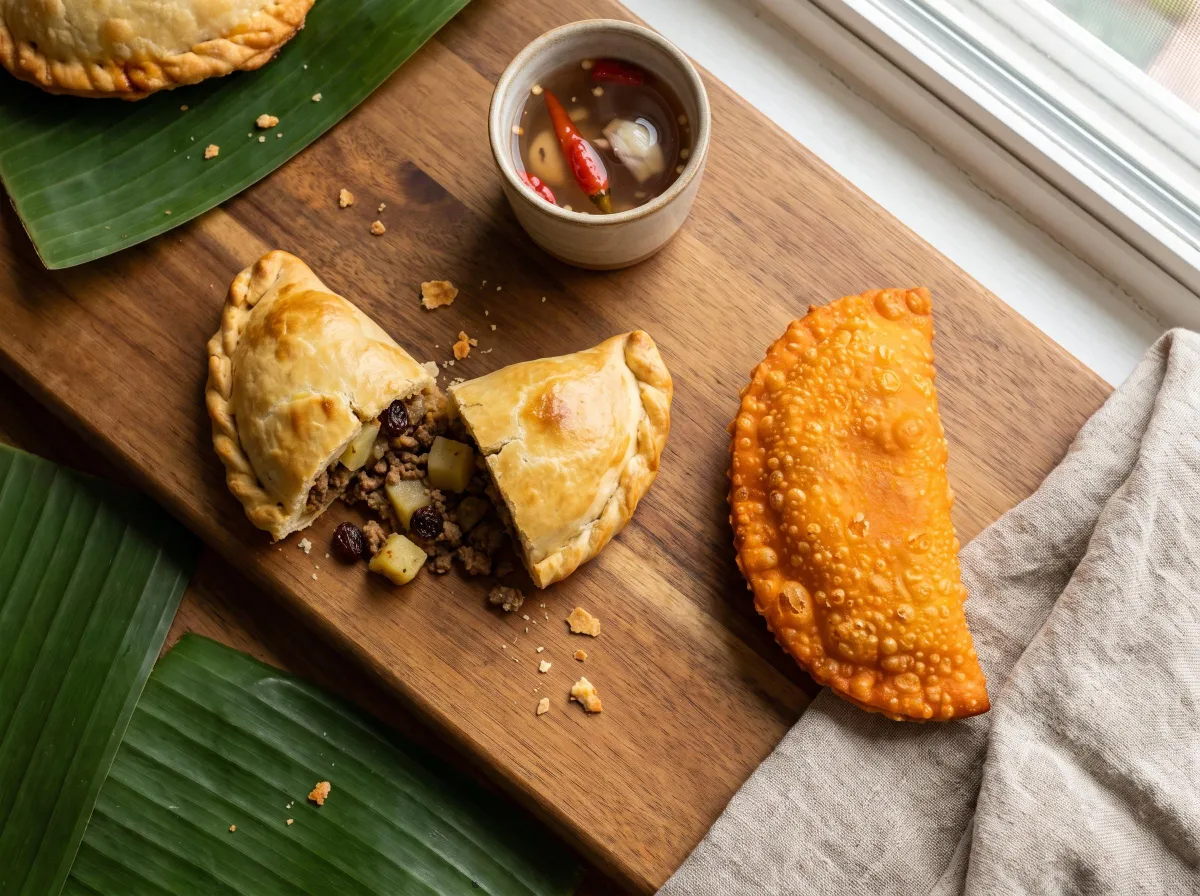
What Is Empanada? The Filipino Turnover Story
Studio Tributes / Filipino Food / What Is Empanada?
You hear it before you taste it.
It's the sound of a wide, blackened pan hissing with oil somewhere along a cobblestone street in Vigan, or outside a public market in Taal, or on a street corner in Manila where a cart has been parked since morning. Something orange — genuinely, almost cartoonishly orange — is floating and bubbling in that oil, and a vendor is turning it with a pair of tongs, watching the color deepen from marigold to amber. When it comes out, it goes onto a small plate or straight into a paper bag, and it gets handed to you still too hot to hold comfortably, which has never once stopped anyone from taking the first bite anyway.
🥟 Before we go any further — we made something for you.
Find out which regional Filipino empanada matches your personality. Takes about a minute.
You already half-know what's coming. A shell that shatters when you bite it. A filling that's been thought through — not just meat, but meat plus something crunchy, something tangy, sometimes an entire egg tucked in like a surprise. And a little cup of spiced vinegar waiting nearby, because nothing in Filipino street food gets served without something to dip it in.
That's the empanada experience in the Philippines, and it is, somewhat remarkably, a completely different dish depending on which province you're standing in. A Manila bakery empanada, golden and slightly sweet, has almost nothing in common with the shatter-crisp orange empanada of Ilocos except the name and the basic idea: dough, folded, filled, cooked. That's the whole story of empanada in the Philippines, actually — one Spanish word that traveled across an ocean and then split into a dozen regional personalities, each one shaped by the province that adopted it.
At Studio Tributes, we tell Filipino food stories because food carries the fingerprints of the people who made it theirs. Empanada is one of the clearest examples in the entire Filipino pantry: a colonial import that Filipinos didn't just accept, but rebuilt, recolored, and made unmistakably their own. Today we're going deep into empanada — where the word comes from, how it got to the Philippines, why Ilocos turned it orange, what a good one should taste like, and why this humble folded pastry has quietly become one of the most talked-about Filipino foods in the world right now.
🍥 What Is Empanada?
At its simplest, an empanada is dough folded over a filling and then cooked — fried or baked — until the shell is sturdy enough to hold everything inside and crisp enough to be satisfying on its own. That's it. That's the entire concept. What makes empanada interesting is everything that happens after that basic definition, because almost every country that adopted the dish changed it into something specific to itself, and the Philippines did exactly that — several times over, in several different provinces, more or less independently.
In the Philippines, "empanada" isn't one dish. It's a category with at least four distinct regional headliners, and understanding empanada in a Filipino context means understanding all of them:
🧡 Ilocos empanada (Vigan / Batac style) — a rice-flour dough dyed vivid orange with achuete, fried until thin and shatter-crisp, filled with garlicky Vigan longganisa, shredded green papaya, mung bean sprouts, and a whole raw egg that finishes cooking inside the shell
🐟 Empanada de Kaliskis (Batangas) — a flaky, layered pastry crust designed to look like overlapping fish scales (kaliskis means "scales" in Filipino), filled with a savory ground meat and vegetable mixture
🍜 Empanadang Taal — Taal, Batangas' own take, distinguished by the addition of sotanghon (glass noodles) mixed into the filling alongside ground meat and vegetables
🥧 Manila-style baked empanada — the version most familiar from bakeries and home kitchens across the country: a slightly sweet, buttery, flaky wheat dough baked (sometimes fried) and filled with ground beef, pork, or chicken, potatoes, carrots, raisins, and sometimes hard-boiled egg
Every one of these is correctly called empanada. None of them looks quite like the others, and that's not a contradiction — it's the whole point. Empanada didn't stay one dish when it reached the Philippines. It became a template, and different provinces filled in that template with whatever they had, whatever they were good at, and whatever their own culinary instincts told them would taste right.
The one detail that separates almost every Filipino empanada from its Spanish and Latin American cousins is a gentle sweetness in the dough. Where a Spanish or Argentine empanada crust stays purely savory, Filipino bakers — following a broader Filipino instinct for balancing salty and sweet — tend to work a little sugar into the empanada dough itself, so that even a beef or pork empanada has a faint sweetness working underneath the savory filling. It's subtle, but it's there, and it's one of the clearest signatures of a Filipino empanada versus any other kind.
📜 The Story Behind It
Empanada's story starts a very long way from the Philippines — and it starts with a word, not a recipe.
The name comes from the Spanish verb empanar, meaning "to wrap in bread" or "to coat in dough." Food historians generally trace the dish itself back to Galicia, in northwestern Spain, sometime around the medieval period, possibly with roots reaching even further back to Middle Eastern stuffed pastries that spread across the Iberian Peninsula centuries earlier. The earliest known written reference to something called an empanada by name shows up in a Catalan cookbook from the 1520s — which means the word, and something resembling the modern dish, had already existed for a good while by the time Spain began sending ships across the world.
That's the important detail for the Philippine story: empanada didn't arrive here directly from Spain in a straight line. It arrived through the Manila Galleon Trade, the centuries-long shipping route that connected Manila to Acapulco, Mexico, and from there back to Spain. Along that route, goods, recipes, and cooking techniques moved in every direction — Mexican, Spanish, and Chinese influences all funneled into the Philippines through the same ports, often blending together before they ever reached a Filipino kitchen. Empanada came in as part of that broader wave of Spanish colonial food influence, alongside dishes like adobo, morcon, and the entire Filipino instinct for stuffing things in dough or wrapping them in leaves.
What happened next is the genuinely interesting part. Rather than staying a straightforward Spanish import, empanada ran into another migration story already unfolding in the Philippines: Chinese trading communities, particularly in the north, had long been working with rice flour in ways Spanish cooking never did. Somewhere in that overlap — Spanish technique, Chinese ingredient know-how, and Filipino regional ingredients — the Ilocos region built something that barely resembles a Spanish empanada anymore. Ilocano cooks swapped the traditional wheat dough for one made primarily of rice flour, which fries up thinner and considerably crispier than wheat ever could. They colored it with achuete, the seed of the annatto tree that Filipino cooks have used for centuries to turn dishes a deep, appetizing orange-red. And they filled it with what the Ilocos region actually had in abundance: garlicky Vigan longganisa, green papaya from local farms, and eggs.
By the time this new version had settled into its final form, it had become something genuinely original — not a copy of a Spanish dish, but a new dish that happened to share a name and a basic structure with one.
Vigan, in particular, became — and remains — ground zero for empanada culture in the Philippines. Along Calle Crisologo, in the city's cobblestoned heritage district, empanada stalls have operated for generations. One of the most famous, Irene's Vigan Empanada, traces its recipe back to a family matriarch's secret method and has been serving empanada in some form since the 1930s, later formalized as a storefront business in the 2000s that has since expanded well beyond Ilocos. Stories like Irene's are common throughout the region — family recipes, passed down, eventually turned into stalls, then storefronts, then, in a handful of cases, into small empires that have opened branches in Metro Manila to serve homesick Ilocanos and curious newcomers alike.
And then, in 2026, something happened to empanada that hadn't happened to a regional Filipino dish in quite some time: it went genuinely viral, internationally. Short-form video content built around the Ilocos empanada's dramatic orange color and audible crunch started circulating widely among Filipino-American food communities and beyond, and home-based sellers in the United States began selling out limited "drops" of empanada within hours of announcing them online. Philippine tourism organizations took notice, pointing to Ilocos empanada as one of the country's most effective culinary ambassadors of the year — a 500-year-old Spanish loanword, reinvented by Ilocano ingenuity, now trending on phones thousands of miles from Vigan.
👅 What Does Empanada Taste Like?
This is a harder question to answer for empanada than for almost any other Filipino dish, precisely because the answer changes so much depending on which regional version lands in your hand. But there's a common thread running underneath all of them, and it's worth naming directly: contrast. Every well-made Filipino empanada is built around some kind of contrast — in texture, in temperature, in flavor — and that contrast is exactly what makes it so satisfying to eat.
Take the Ilocos empanada first, because it's the version generating the most buzz right now. The shell shatters — genuinely shatters, with an audible crack — the moment you bite into it, giving way to a filling that's warm, savory, and faintly funky from the garlic-forward Vigan longganisa. The shredded green papaya inside adds a bright, slightly tangy crunch that keeps the whole thing from feeling heavy, and the whole egg tucked into the center cooks just enough during frying to turn soft and rich, coating everything it touches. Take a bite that gets shell, longganisa, papaya, and egg all at once, dip it in sukang Iloko — Ilocano sugarcane vinegar, often spiked with chili and garlic — and you've got the full experience: crisp, savory, tangy, rich, sharp, all in one mouthful.
The Manila-style baked empanada tastes like a completely different food, in the best way. The dough here is flaky and faintly sweet, more pastry than cracker, closer in spirit to a hand pie. Inside, ground beef or chicken mingles with diced potatoes and carrots, sweet raisins scattered throughout, and sometimes a few slices of hard-boiled egg. It's a gentler, cozier flavor profile — the kind of thing that tastes like a school canteen, a merienda table, or a lunchbox, because for generations of Filipinos, that's exactly what it was.
Empanada de Kaliskis, from Batangas, leans into texture as its main event. The layered, scaled crust creates dozens of thin, crisp edges throughout a single empanada, so that no two bites feel quite the same — some are almost entirely crackly crust, others carry more of the seasoned meat filling underneath. And Empanadang Taal adds its own signature twist with sotanghon noodles woven through the filling, giving it a light, slightly chewy quality that's distinct from any other empanada style in the country.
If there's one sentence that captures empanada across all its Filipino forms, it might be this:
Empanada tastes like whatever a Filipino province decided a good hand pie should taste like — and every province had a slightly different, thoroughly confident answer.
✅ What Makes a Great Filipino Empanada
Empanada is simple in concept and genuinely easy to get wrong in execution, which is exactly why regulars in every empanada-producing region have their one trusted stall and will not be talked into a competitor's. Here's what separates an excellent empanada from a forgettable one.
The shell has to earn its texture. For fried versions like Ilocos empanada, that means a shell that's thin enough to crackle rather than chew, and fried in oil that's genuinely hot enough to crisp the outside quickly without soaking into the dough. A greasy, limp Ilocos empanada is a sign of a rushed fryer or oil that's overdue for changing. For baked versions, the shell should be properly laminated or worked enough to flake apart in distinct layers, not collapse into a single dense crust.
The filling needs balance, not excess. A good empanada filling is generous but not overstuffed to the point that the shell can't seal properly or hold its shape. In Ilocos empanada specifically, the ratio between longganisa, papaya, and egg matters — too much papaya and the empanada turns watery from the vegetable's natural moisture; too little, and you lose the crunch and tang that balances the richness of the meat and egg.
Freshness is everything, and it's easy to spot. The best empanada, in any region, comes fried or baked to order, or very close to it. A stall with a hot pan constantly working, a visible stack of raw dough disks ready to be filled, and a quick turnover of customers is a strong sign you're about to get an empanada at its absolute best — hot, crisp, and not sitting under a heat lamp.
The dipping sauce should be part of the plan, not an afterthought. Ilocos empanada without sukang Iloko is still good; Ilocos empanada with it is the complete experience the dish was designed around. A vendor who takes the sauce seriously — properly spiced, freshly made, not watered down — is usually a vendor who takes the empanada itself seriously too.
For visitors trying empanada for the first time, particularly the Ilocos version: don't let the striking orange color throw you off. It comes entirely from achuete, a natural, mild-flavored seed that Filipino cooks have used safely for generations — it exists purely for color, not heat or strong flavor, so the vivid shell is a visual signature, not a warning label.
🗺️ Empanada Across the Philippines
Empanada's regional map in the Philippines is one of the clearest examples of how thoroughly Filipino provinces make an imported dish their own.
Ilocos Region (Ilocos Norte, Ilocos Sur, La Union, Pangasinan) is empanada's most famous territory, home to the orange rice-flour version now generating international attention. Within the region itself, there's a friendly, long-running rivalry between Batac-style empanada, known for its especially bright orange color and traditional fillings of green papaya or bean sprouts, egg, and longganisa, and Vigan-style empanada, generally described as having a thinner, crispier shell. Vigan's Calle Crisologo and the surrounding Heritage District are essentially empanada pilgrimage sites at this point, with multiple long-established stalls operating within a short walk of each other.
Batangas contributes two distinct empanada traditions of its own. Empanada de Kaliskis, with its fish-scale-patterned flaky crust, is a genuine specialty of the province, prized for a texture unlike anything found elsewhere in the country. Separately, the town of Taal has built its own reputation around Empanadang Taal, distinguished by sotanghon noodles folded into the meat filling — a version so specifically local that ordering "empanada" at the Taal public market gets you something meaningfully different from what you'd get in Ilocos or Manila.
Metro Manila and much of Luzon are where the baked, slightly sweet, bakery-style empanada dominates — the version most likely to show up at a merienda table, a school canteen, or a neighborhood panaderia, filled with ground beef or chicken, potatoes, carrots, and raisins.
Northern Mindanao and the Visayas maintain their own home-style empanada traditions as well, often built around whatever protein and vegetables are locally available — tuna, beef, or vegetable mixes are common, sometimes made in oversized "giant" formats meant to be shared rather than eaten individually, particularly in home-kitchen and small-producer traditions found in cities like Ozamiz.
Empanada has also become a genuine diaspora product. Filipino grocery stores and home-based sellers across the United States, Canada, and the Middle East now regularly sell frozen or made-to-order Ilocos empanada specifically, riding the wave of renewed interest in provincial Filipino dishes rather than generalized "Filipino food." For many Filipino-American entrepreneurs, empanada has become an accessible entry point into food business — the ingredients travel reasonably well, the visual appeal translates instantly on video, and the licensing bar for a home-kitchen operation is considerably lower than opening a full restaurant.
🗣️ Learn the Tagalog and Ilocano
Empanada carries its own small vocabulary — some of it standard Filipino, some of it specifically Ilocano, since so much empanada culture is rooted in that region.
The food and its varieties:
Empanada (em-pah-nah-dah) — the dish itself; a filled, folded pastry, fried or baked
Empanadang Ilocos (em-pah-nah-dahng ee-lo-kos) — Ilocos-style empanada; the orange, rice-flour version
Empanadang Batac (em-pah-nah-dahng bah-tak) — the Batac variety, known for its especially vivid orange color
Empanadang Bigan (em-pah-nah-dahng bee-gahn) — Vigan-style empanada; thinner shell, known for its crisp bite
Empanadang Taal (em-pah-nah-dahng tah-al) — Taal's version, distinguished by sotanghon in the filling
Empanada de Kaliskis (em-pah-nah-dah deh kah-lees-kees) — the fish-scale-crusted Batangas specialty; kaliskis means "scales"
Longganisa (long-gah-nee-sah) — Filipino sausage; Vigan longganisa is the garlicky, slightly sour variety essential to Ilocos empanada
Papaitan-hilaw or more simply papaya hilaw (pah-pah-yah hee-law) — green, unripe papaya; shredded for the filling's crunch and tang
The dough and cooking:
Harina (hah-ree-nah) — flour; in most Filipino empanada, wheat flour, though Ilocos versions use harina de bigas (rice flour)
Achuete (ah-choo-eh-teh) — annatto seeds; the natural coloring that turns Ilocos empanada dough its signature orange
Prito (pree-toh) — fried; the cooking method for Ilocos-style empanada
Hinurno (hee-noor-noh) — baked; the cooking method for Manila-style empanada
At the stall:
Pabili po ng empanada (pah-bee-lee poh nang em-pah-nah-dah) — I'd like to buy an empanada, please
Ilan po? (ee-lahn poh) — How many?
Dagdagan mo po ng suka (dahg-dah-gahn moh poh nang soo-kah) — Please add more vinegar
Ang crispy, ha! (ahng crispy hah) — So crispy! A common exclamation on the first bite
Isa pa po (ee-sah pah poh) — One more, please
If there's a single phrase that defines the empanada stall experience the way "dagdag na suka" defines an isaw cart, it's dagdagan mo po ng suka — the request that always follows the first bite of a truly good Ilocos empanada, because the sauce cup, like everywhere else in Filipino street food, has a way of emptying faster than anyone expects.
🎨 Color It!
Bring Filipino food to life in a whole new way — through art.
Our Filipino Food Coloring Book on Amazon was built from exactly that kind of question. Every page is a dish with a story. Every coloring session is an invitation to remember.
That makes it especially meaningful for:
🌼 Families who want a creative activity that naturally opens a conversation about Filipino food heritage
🌼 Filipino parents and grandparents sharing their regional food traditions with the next generation
🌼 Adults and seniors who find nostalgic, mindful creativity deeply satisfying
🌼 Anyone in the Filipino diaspora who wants a quiet, beautiful way to hold onto what home tastes like
🌼 Teachers, homeschoolers, and community groups exploring Filipino food and culture through art
👉 Get your FREE Filipino Coloring pages here.
👉 What Filipino Food Are You? Take the quiz →
🤩 Fun Facts About Empanada
1. The word "empanada" is over 500 years old. The earliest known written reference to a dish called empanada appears in a Catalan cookbook from the 1520s, meaning the word — and something close to the modern dish — existed in Spain well before it ever reached the Philippines.
2. "Empanada" literally means "wrapped in bread." It comes from the Spanish verb empanar, "to coat or wrap in bread," which itself descends from pan, the Spanish word for bread, tracing all the way back to the Latin panis.
3. Empanada may have Middle Eastern roots. Food historians believe the concept of dough folded around a filling may trace back to Middle Eastern meat pastries that spread into the Iberian Peninsula during the medieval period, long before the Spanish name was ever attached to it.
4. It reached the Philippines through a trade route, not a direct shipment. Empanada arrived via the Manila Galleon Trade, the shipping network connecting Manila to Acapulco and, from there, to Spain — the same route responsible for introducing tomatoes, corn, and chocolate to the Philippines.
5. Ilocos empanada owes its texture to Chinese trading influence. The use of rice flour, rather than the wheat flour used in Spanish and Latin American empanada dough, reflects a Chinese culinary technique that blended with the Spanish import once it reached the Ilocos region.
6. Its orange color comes from a seed, not a dye. Achuete, or annatto, has colored Filipino food for centuries — it appears in everything from kare-kare to hotdogs — and its use in Ilocos empanada dough is what gives the pastry its unmistakable marigold shell.
7. One egg, cooked entirely inside the shell. A whole raw egg is cracked into the filling of a traditional Ilocos empanada before it's sealed and fried — it cooks through completely during frying, adding richness that no pre-cooked egg addition could replicate.
8. Batangas has two entirely different empanada traditions. Empanada de Kaliskis, with its scale-patterned flaky crust, and Empanadang Taal, with its sotanghon-studded filling, both come from the same province but taste and look nothing alike.
9. A famous Vigan empanada shop traces its recipe to the 1930s. Irene's Vigan Empanada, one of the most recognized empanada businesses in the country today, bases its recipe on a family matriarch's method passed down for generations before the storefront business was formally established in the 2000s.
10. Empanada went genuinely viral in 2026. Short-form video content highlighting the dramatic color and audible crunch of Ilocos empanada drove a surge of interest among Filipino-American communities, with home-based sellers in the United States selling out limited batches within hours.
11. Manila-style empanada is a completely different animal. The baked, slightly sweet bakery empanada found across Metro Manila — filled with ground meat, potatoes, carrots, and raisins — shares almost nothing with Ilocos empanada beyond the name and the basic folded-dough concept.
12. Filipino empanada dough is almost always a little sweet. Even savory, meat-filled versions typically carry a faint sweetness in the dough itself — a small but consistent signature of Filipino cooking's broader instinct for balancing salty and sweet in the same bite.
🌍 How Empanada Connects Filipinos Everywhere
Empanada travels better than most Filipino street food, and that's precisely why it has become such an effective ambassador for regional Philippine cuisine abroad. Unlike a dish that has to be eaten hot off a charcoal grill within minutes, empanada can be frozen, shipped, reheated, and still deliver most of what makes it worth eating — which is exactly what Filipino-American entrepreneurs have leaned into over the past several years.
For Filipinos living outside the Philippines, empanada carries a very specific kind of memory, and which memory depends entirely on where you're from. For someone from Ilocos, it might be the smell of hot achuete-dyed oil outside a Vigan stall, or a particular auntie's technique for folding the dough just so. For someone from Batangas, it might be Taal's public market on a weekend, empanada in hand, sotanghon noodles somehow both familiar and surprising in a pastry. For someone from Metro Manila, it's just as likely to be a school canteen memory — the same baked, faintly sweet empanada sold at a snack window every single day, ordinary enough that nobody thought to appreciate it until it was thousands of miles away.
That regional specificity is part of what makes empanada's 2026 viral moment so meaningful. It isn't generic "Filipino food" trending online — it's Ilocos empanada, specifically, by name, with its specific orange color and specific crunch, drawing exactly the kind of attention that sends people looking up where Ilocos actually is and what else the region is known for. Food writers and tourism boards alike have pointed to this as a genuine, if unexpected, engine for cultural curiosity: a snack becoming a small ambassador for an entire province's identity.
For non-Filipinos encountering empanada for the first time — whether at a Filipino grocery store, a food festival, or a friend's kitchen — the advice is simple: ask which regional style you're getting, because the answer changes what you should expect. A Manila bakery empanada and an Ilocos empanada are, for practical purposes, two different foods that happen to share a name. Both are worth trying. Neither should be mistaken for the definitive version, because there isn't one. That's not a flaw in the dish. That's the whole story of what happened when a five-hundred-year-old Spanish word landed in a country with strong, specific, proudly regional culinary instincts of its own.
❓ FAQ — Everything You Need to Know About Empanada
What is empanada? Empanada is a stuffed pastry made by folding dough over a savory or sweet filling and then frying or baking it. In the Philippines, it arrived through Spanish colonization and evolved into several distinct regional versions, the most famous being the bright orange, rice-flour Ilocos empanada filled with longganisa, green papaya, and egg.
Is empanada Filipino or Spanish? Empanada originated in Spain, likely in the Galicia region, with the name coming from the Spanish word empanar, meaning "to wrap in bread." Spanish colonizers introduced it to the Philippines, where Filipinos adapted it with local ingredients, rice flour, and regional techniques to create versions that are now considered distinctly Filipino.
What is Ilocos empanada made of? Ilocos empanada, also called Vigan or Batac empanada, has a thin, crispy orange shell made from achuete-colored rice flour dough. It's typically filled with garlicky Vigan longganisa, shredded green papaya, mung bean sprouts, and a whole raw egg that cooks inside the shell during frying.
Why is Ilocos empanada orange? The vivid orange color comes from achuete (annatto seeds), which are steeped or ground into the rice flour dough. Achuete adds strong color with only a mild flavor, so it doesn't overpower the savory filling.
What's the difference between Filipino empanada and Latin American empanada? Filipino empanada tends to use a slightly sweet dough, and regional versions like Ilocos empanada use rice flour and achuete coloring not typically found in Latin American versions, which are generally wheat-based and savory throughout.
What is empanada de kaliskis? It's a Batangas specialty with a flaky, layered crust designed to resemble overlapping fish scales — kaliskis means "scales" in Filipino — filled with seasoned ground meat and vegetables.
What makes Empanadang Taal different from other empanada? Empanadang Taal, from Taal, Batangas, includes sotanghon (glass noodles) mixed into the meat and vegetable filling, giving it a lighter, slightly chewy quality not found in other Filipino empanada styles.
What sauce do you eat empanada with? Ilocos empanada is traditionally served with sukang Iloko, a sugarcane vinegar often mixed with chili and garlic. Other regional versions are sometimes served with ketchup or eaten plain.
💛 Closing
Empanada didn't stay a Spanish word with a Spanish recipe attached to it. It became raw material — a shape, a technique, a name — and Filipino provinces did what Filipino provinces have always done with raw material like that: they made it specific, they made it local, and they made it better in ways the original never anticipated.
That's really the whole story here. Ilocos took a wheat dough and turned it into rice flour and achuete. Batangas took a plain crust and layered it into fish scales, then took a plain filling and folded noodles through it in Taal. Manila kept things closer to the original shape but softened the dough with sugar until it tasted like a school afternoon. None of these provinces asked permission to change the dish. They just changed it, because that's what happens when a recipe lands in the hands of cooks with strong opinions about what good food should taste like.
For over five hundred years, empanada has been doing exactly that — traveling, landing, adapting, becoming local. It happened in Galicia first, then across Latin America, then in the Philippines, and it's still happening right now, in kitchens across the Filipino diaspora figuring out how to fry a proper Ilocos empanada in an apartment in Los Angeles or Toronto, working from memory and video calls with an aunt back home.
At Studio Tributes, we tell the stories of Filipino food because Filipino food is worth knowing deeply. Empanada deserves that same attention — not as a curiosity or a stop on a food tour, but as a genuine case study in how a Filipino kitchen takes something borrowed and makes it unmistakably its own.
The next time you hear that hiss of hot oil and see that impossible orange color, you'll know exactly how it got there — and exactly why the vinegar cup is going to need a refill.
Get your empanada. Dip it. Eat it hot.
Keep exploring Filipino food and culture with us:
🎨 Get our Filipino Food Activity Book on Amazon
📚 Read more Filipino food stories on our blog
💭 A Memory to Hold Onto
Did empanada bring a memory back?
Maybe it's the specific stall in Vigan or Batac your family always stopped at, and the argument about which one made it better.
Maybe it's a school canteen window, a coin in hand, and the same baked empanada every single recess for years.
Maybe it's the sound of oil hissing outside the Taal public market, sotanghon noodles somewhere inside that golden crust.
Ilocos empanada or Manila bakery empanada — and is this actually a fair fight? Do you dip in sukang Iloko, ketchup, or nothing at all? Where was your empanada stall — and do you still think about it?
If a memory came to mind, share your empanada story on Facebook or Instagram and tag @StudioTributes — we would love to hear it.
Read Next
📚 References & Further Reading
Wikipedia — Empanada — Reference for the general definition of empanada, its likely origin in Galicia, Spain, and its classification as a dish found across Spanish, Latin American, and Filipino cuisine.
Britannica — Empanada — Reference for the etymology of the word from the Spanish empanar and the possible Middle Eastern influence on the dish's origin.
Etymonline — Empanada — Reference for the linguistic root of empanada in the Latin panis (bread) and its adoption into American English by the early 20th century.
Out of Town Blog — Ilocos Empanada — Reference for the regional history of Ilocos empanada, the Batac and Vigan variations, and the Spanish and Chinese influences on the dish's development.
Make Heritage Fun! — A Walk Through History With the Ilocos Empanada — Reference for the regional context of Ilocos empanada and where to find it in Laoag, Batac, and Vigan.
Philippine Primer — Irene's Vigan Empanada — Reference for the story of a family empanada recipe passed down since the 1930s and its later development into a formal storefront business.
Asian Journal News — The Viral Rise of Ilocos Empanada — Reference for the 2026 surge in popularity of Ilocos empanada among Filipino-American communities and home-based sellers in the United States.
PR Newswire / Philippine Department of Tourism — The Orange Crunch: Ilocos Empanada Emerges as 2026's Global Food Darling — Reference for the rice-flour dough, achuete coloring, and the dish's growing role in Philippine culinary tourism.
Sun.Star — Vigan Empanada and the Gastronomic Treats of Ilocos — Reference for traditional Vigan empanada ingredients including cabbage, carrots, green papaya, and mung bean sprouts.
Manila Bulletin — Empanadas, From Mexico to Ilocos — Reference for the historical link between Spanish and Mexican soldiers stationed in Vigan and the development of the local empanada tradition.
Hanap PH — Top 10 Delicious Batangas Delicacies — Reference for Empanada de Kaliskis and its distinctive fish-scale-patterned crust.
Zoy to the World — Bong & Wena's Special Empanada & Food House (Taal, Batangas) — Reference for the sotanghon-based filling that distinguishes Taal's regional Empanadang Taal.
Recipes by Nora — Ilocos Empanada Recipe (Vigan-Style Filipino Empanada) — Reference for the rice flour, achuete, and Vigan longganisa components of a traditional Ilocos empanada.