
What Is Filipino Spaghetti? Why It's Sweet (And We Love It)
Studio Tributes / Filipino Food / What Is Filipino Spaghetti?
There is a specific kind of Filipino birthday party table that you recognize the moment you see it.
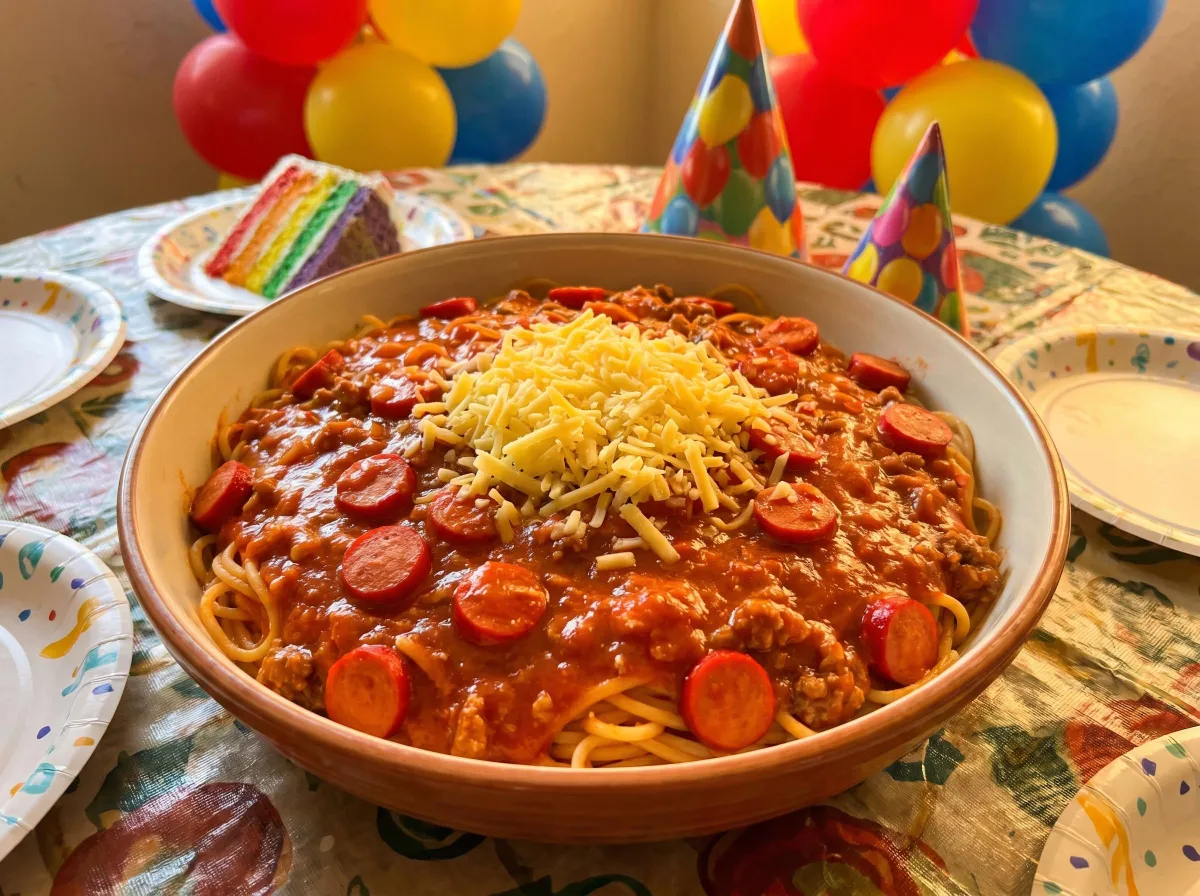
There is the birthday cake with the candles. There are the plastic cups of juice. There are the hotdogs on sticks, threaded next to little marshmallows because this is the Philippines and that is simply what you do. And right in the center of the table, in the biggest bowl, is the spaghetti.
Not Italian spaghetti. Filipino spaghetti. The sauce is bright red and visibly, unmistakably, gloriously sweet. There are sliced hotdogs in it. There is a mountain of cheddar cheese on top. The noodles are cooked all the way through, soft and comforting rather than al dente, and they have absorbed the sauce all the way to the middle. The whole thing smells like a celebration — sweet and savory and warm in a way that is specific and irreplaceable.
You eat it with a spoon and a fork. You mix the cheese into the sauce as you go. You have probably already had one helping and you are eyeing the second.
This is Filipino spaghetti. And if your first reaction to it was wait, why is it sweet? — this blog post is for you. Because the answer to that question is one of the best stories in Filipino food history.
Filipino spaghetti (also called sweet spaghetti, or Pinoy spaghetti, or just espageti) is a Filipino adaptation of Italian spaghetti bolognese. According to Wikipedia, it has a distinctively sweet sauce made from tomato sauce sweetened with banana ketchup, brown sugar, or condensed milk, and is served with sliced hotdogs, ground meat, and grated cheddar cheese on top. It is one of the most beloved comfort foods in the Philippines, the signature birthday party food for generations of Filipino children, and — through Jollibee's international expansion — now one of the most recognizable Filipino dishes in the world.
At Studio Tributes, we celebrate Filipino food because Filipino food carries Filipino life inside it. Today we are going all the way into Filipino spaghetti: where it came from, why it is sweet, what that sweetness actually means, and why this pasta dish is not a mistake or an accident or a "weird version" of something else. It is its own thing, completely, and it is wonderful.
🍝 Before we go any further — we made something for you. 🎂
Find out what your spaghetti choices say about you. Takes about a minute.
🍝 What Is Filipino Spaghetti, Really?
Let's talk about what is in the bowl — because every ingredient in Filipino spaghetti is there for a reason, and the reasons are more interesting than you might expect.
The noodles. Standard spaghetti, but cooked softer than Italian al dente. This is intentional. Filipino spaghetti sauce is thick and sweet and clings to everything, and noodles that are cooked all the way through absorb the sauce and become part of it rather than sitting underneath it. First-time non-Filipino eaters sometimes describe Filipino spaghetti noodles as "overcooked." Regular Filipino spaghetti eaters call them perfectly done. Both are correct for their own context.
The sauce. This is the heart of the dish and the thing that makes it Filipino. The sauce starts with the same bolognese foundation — garlic, onion, ground meat in tomato — but then it goes somewhere Italian pasta would never go: sweet. The sweetness comes from:
🍌 Banana ketchup — the Filipino condiment that changed everything (more on this shortly)
🟤 Brown sugar — added directly to the sauce by home cooks and commercial producers alike
🥛 Condensed milk — the secret ingredient in some family recipes that adds a cream-sweet richness
The result is a sauce that is simultaneously tomatoey, savory from the meat, and noticeably, deliberately sweet in a way that makes it immediately distinct from any Italian pasta you have ever eaten.
The hotdogs. Sliced on a slight diagonal, bright red (Filipino-style hotdogs are dyed a vivid red that is their own category of color), cooked in the sauce so they absorb the sweetness and plump up slightly. The hotdogs are not an afterthought or a budget substitution. They are the point. Their slightly salty, smoky flavor against the sweet sauce is one of the most satisfying contrasts in Filipino comfort food.
The cheese. Not parmesan. Never parmesan. Cheddar — grated or shredded, sometimes the quick-melt processed variety that turns slightly stretchy when it hits the hot sauce. The cheese goes on top, a generous blanket of it, and you stir it in as you eat so that every forkful has a little of the cheese mixed into the sweet red sauce.
What it tastes like: Sweet, savory, slightly salty from the hotdogs, with a rich meaty depth from the ground pork or beef, and a cheesy richness on top. The flavors are bold and unambiguous. Filipino spaghetti does not ask you to detect subtle herb notes or appreciate restrained complexity. It asks you to eat a big bowl of something that tastes like a birthday party, and that is exactly what it delivers.
📜 The Story Behind It: World War II, a Genius Chemist, and a Very Sweet Tomato Shortage
Here is the thing about Filipino spaghetti: it is not just a recipe. It is a piece of Philippine history in a bowl.
The story starts in the 1930s — before the spaghetti itself, with an ingredient that made the spaghetti possible.
Maria Orosa and the invention of banana ketchup. In the 1930s, a Filipino food technologist and chemist named Maria Y. Orosa was working on ways to use the Philippines' abundant local produce to create Filipino versions of international food products. One of her inventions — and arguably her most enduring legacy — was banana ketchup: a condiment made from mashed bananas, sugar, vinegar, and spices that approximated the flavor of tomato ketchup using ingredients the Philippines had in abundance.
According to Wikipedia, banana ketchup was first produced in the Philippines during World War II due to a shortage of tomatoes but a comparatively high production of bananas. The natural color of banana ketchup is brownish-yellow, but it was — and still is — dyed red to resemble tomato ketchup, which is why Filipino spaghetti sauce is that distinctive vivid red-orange.
Maria Orosa was, in addition to being a brilliant food scientist, a genuine hero of Philippine history — she continued working to feed Filipinos throughout the Japanese occupation, was wounded in the Battle of Manila in February 1945, and died from her wounds. Her contribution to Filipino food culture outlasted her by decades, and banana ketchup remains one of the most distinctly Filipino condiments in the world.
The American influence. Spaghetti with bolognese sauce was introduced to the Philippines during the American colonial period. According to Wikipedia, it was tweaked to suit the local Filipino preference for sweet dishes — a preference that runs through the entire Filipino food tradition, from tocino to halo-halo to the condensed milk that sweetened many things during wartime.
There is also a popular story — cited by Esquire Philippines and multiple food historians — that General Douglas MacArthur, who was stationed in the Philippines, once craved spaghetti, and his Filipino staff made it using what was available: banana ketchup instead of tomato sauce, and hotdogs instead of meatballs, because whole ground meat was more expensive and harder to source. Whether this story is precisely true or a compelling origin myth, it captures something real about how Filipino spaghetti came to be: it was created from available ingredients, adapted to Filipino taste, and turned into something completely its own.
The banana ketchup element made the sauce sweeter than Italian bolognese. Filipino home cooks, finding that they liked the sweetness, leaned into it — adding brown sugar, sometimes condensed milk, adjusting the ratio until the sauce tasted specifically Filipino rather than like an approximation of something Italian.
Jollibee made it the national birthday party food. The fast-food chain Jollibee, founded in 1978 in Quezon City as an ice cream parlor, eventually added the Jolly Spaghetti to its menu — and the combination of the sweet sauce, the hotdogs, the cheddar cheese, and Jollibee's birthday party culture turned Filipino spaghetti into the default celebration food for an entire generation of Filipino children. Panlasang Pinoy notes: "It became the default birthday party food across the Philippines. Every kid had it. Most adults still eat it. Jollibee now has locations around the world, and the spaghetti is still on every menu."
Jollibee's version pushes the sweetness further than most home cooks do — their Jolly Spaghetti is notably sweeter than even the sweet home version, the processed cheese on top is non-negotiable, and the whole package in its red box became one of the most powerful food memories in Filipino childhood.
The Jolly Spaghetti is now available in Jollibee locations across the Philippines, the United States, Canada, the Middle East, Southeast Asia, and beyond — bringing Filipino spaghetti to wherever the Filipino diaspora has settled.
👅 What Does Filipino Spaghetti Taste Like?
Sweet. Savory. Rich. Comforting in a specific way that is not subtle about any of it.
The sweetness is the first thing you notice, and it is intentional and significant. Filipino spaghetti sauce is measurably sweeter than Italian bolognese — this is not a matter of taste, it is a matter of ingredients. The banana ketchup and added sugar put Filipino spaghetti in a completely different flavor register than Italian pasta, closer to the sweet-savory combination that appears throughout Filipino cuisine in dishes like tocino (sweet cured pork) and the sweetened barbecue that is a Filipino street food staple.
The meat provides the savory base — ground pork or beef, sautéed with garlic and onion, adding the depth that stops the sweet sauce from being overwhelmingly sugary. The balance is: very sweet, but anchored by savory, and the two work together rather than competing.
The hotdogs are salty and slightly smoky, cooked into the sauce long enough to absorb its sweetness while contributing their own savory salt. Every bite with a hotdog slice in it is a sweet-savory-salty combination that is specific to this dish and completely satisfying.
The cheddar cheese on top adds a creamy, mild richness that sits between the sweet sauce and the slightly sharp cheese flavor without any of the sharpness. Filipino spaghetti uses mild, often processed cheddar — not sharp, not parmesan, nothing with its own strong flavor. The cheese is there to add richness and a creamy texture rather than a cheese flavor per se.
What the noodles taste like: They taste like the sauce, because they have absorbed it. Filipino spaghetti noodles cooked all the way through and then mixed with the sauce for a few minutes before serving are basically a delivery system for the sauce, which is exactly what they are supposed to be. This is one of the cultural flavor differences that confuses Italian food purists and makes perfect sense to everyone who grew up eating Filipino spaghetti.
If I had to describe it simply:
Filipino spaghetti tastes like childhood — specifically, like a Filipino birthday party table. Sweet, generous, completely unpretentious, and the kind of food that you keep eating past when you thought you were full because it is genuinely good and you are having a good time.
🗺️ Filipino Spaghetti Across the Philippines and the World
Filipino spaghetti is everywhere in the Philippines. It appears at birthday parties, which is where most Filipinos first eat it and where it most firmly belongs emotionally. It appears at Christmas and New Year celebrations. At school events and barangay fiestas. At simple weeknight dinners because someone wanted pasta and this is the pasta Filipino families make.
The birthday party connection is the strongest. In the Philippines, a child's birthday party essentially requires spaghetti — sweet, red, with the hotdogs and the cheese, served in the biggest bowl on the table. This tradition runs so consistently across socioeconomic levels and regions that Filipino spaghetti has become virtually synonymous with Filipino childhood celebration. Filipino adults who grew up in the Philippines and now live abroad cite Filipino spaghetti as one of the foods most strongly associated with happy childhood memories, precisely because of the birthday party context.
Jollibee's Jolly Spaghetti standardized the version of Filipino spaghetti that a generation of Filipinos knows as the canonical one. The bright red box, the sweet sauce, the diagonal hotdog slices, the processed cheddar on top — the Jolly Spaghetti is a flavor memory as much as it is a menu item. The Jollibee USA website describes it as "bursting with flavor and nostalgia for people with roots in the Philippines." That is exactly right.
Regional variations exist but are less dramatic than in some other Filipino dishes. Some families make it less sweet; some make it considerably more sweet. Some add bell peppers. Some use pork only, some use beef only, some use both. The hotdogs vary — Filipino red hotdogs are preferred and distinctly different from American-style hotdogs in color and sweetness. The cheese type can vary: some use Eden cheese (the classic Filipino quick-melt processed cheese), some use Kraft, some use straight cheddar. But the fundamental character — sweet, red, hotdog-included, cheese-topped — stays consistent.
Filipino spaghetti in the diaspora is one of the most actively made Filipino home recipes outside the Philippines. The core ingredients — spaghetti noodles, tomato sauce, ground meat, hotdogs — are available at any grocery store worldwide. Banana ketchup and Filipino-style hotdogs can be found at Filipino or Asian grocery stores. Filipino home cooks in the United States, Canada, Australia, the Middle East, and Europe make Filipino spaghetti for the same occasions they would in the Philippines: birthday parties, holidays, and the straightforward desire to eat something that tastes like home.
Non-Filipino reactions to Filipino spaghetti range from surprised to converted. The most common arc: skepticism at the concept (sweet pasta with hotdogs), the first taste, a pause, and then the slightly surprised admission that it is actually very good. The sweetness that seemed wrong before eating is the thing they keep reaching for after eating. Filipino spaghetti has one of the highest conversion rates of any Filipino food introduced to non-Filipinos.
🗣️ Learn the Tagalog
Filipino spaghetti has its own vocabulary — the words of a birthday party, a comfort food, and a dish that is unambiguously, unapologetically itself.
The dish and its components:
Espageti (es-pah-geh-tee) — spaghetti; the Filipinized pronunciation that has been in everyday use for generations; also sometimes just called espag
Matamis (mah-tah-mis) — sweet; the defining characteristic of Filipino spaghetti; matamis na espageti is exactly what it says: sweet spaghetti
Sarsa (sar-sah) — sauce; the sweet red meat sauce that defines the dish; Filipino spaghetti's sarsa is the thing everyone wants more of
Hotdog (hot-dog) — yes, the same word; Filipino food vocabulary absorbed hotdog directly from English during the American colonial period and never looked back
Keso (keh-soh) — cheese; from the Spanish queso; the cheddar on top of Filipino spaghetti is non-negotiable, and keso is one of the first food words Filipino children learn
Banana ketchup (bah-nah-nah ket-chup) — the condiment that made everything possible; sometimes called banana sauce in export markets; usually available as Jufran or UFC brand in Filipino grocery stores
Giniling (gee-nee-ling) — ground meat; the base protein in the spaghetti sauce; giniling can be pork, beef, or a combination
At the birthday party table:
Happy Birthday! — yes, Filipinos say this in English; the birthday song is sung in English at most Filipino birthday parties regardless of what language everyone speaks at home
Kain na! (kah-in nah) — Let's eat! The announcement that makes everyone move toward the table
Dagdag na espageti! (dag-dag nah es-pah-geh-tee) — More spaghetti please! The request that means the cook did well
Ang tamis naman! (ahng tah-mis nah-mahn) — It's so sweet! Said with genuine appreciation, not complaint
Ang sarap ng sarsa! (ahng sah-rahp nang sar-sah) — The sauce is so delicious! The highest compliment for the cook
Saan ang keso? (sah-ahn ang keh-soh) — Where's the cheese? The question asked when the cheese container has been set too far away
These words belong to specific tables and specific celebrations. Kain na is the sound of a birthday party beginning in earnest. Dagdag na espageti is the sound of a party going well.
🎨 Color It!
Bring Filipino food to life in a whole new way — through art.
Filipino spaghetti is one of the most visually distinct and colorful dishes in the Filipino food tradition. The sauce is that particular bright red-orange — vivid, saturated, the red of banana ketchup dye and tomato sauce combined into something more vivid than either alone. The hotdog slices are bright red-pink against the darker red of the sauce. The cheddar cheese on top is a warm yellow-orange, slightly melted at the edges where it meets the hot sauce. The noodles show through the sauce in pale cream.
When you sit with a Filipino spaghetti coloring page and choose those colors — how vivid to make the sauce, how bright the hotdog, how warm and melted the cheese on top — you start thinking about the table where you ate it. Was it always your birthday that meant Filipino spaghetti, or did someone make it for you on an ordinary Tuesday and make that Tuesday feel like a celebration? Did the hotdogs always disappear first? Was there ever enough cheese?
Our Filipino Food Coloring Book on Amazon was built from exactly that kind of question. Every page is a dish with a story. Every coloring session is an invitation to remember.
That makes it especially meaningful for:
🌼 Families who want a creative activity that naturally opens a conversation about Filipino food heritage
🌼 Filipino parents introducing celebration food traditions to children who grew up outside the Philippines
🌼 Adults and seniors who find nostalgic, mindful creativity deeply satisfying
🌼 Anyone in the Filipino diaspora who wants a quiet, beautiful way to hold onto what Filipino birthdays felt like
🌼 Teachers, homeschoolers, and cultural educators exploring Filipino daily life and celebration culture through art
Each page can open a question worth asking: Did you always have Filipino spaghetti at birthdays? Did your family make it at home or was it always Jollibee? Was there ever a dispute about how sweet was too sweet? Did you always put extra cheese on yours?
Those questions are how a coloring page becomes a family story.
Share your completed Filipino spaghetti coloring on Facebook or Instagram and tag @StudioTributes — we would love to see your version.
👉 Get your FREE Filipino Coloring pages here.
👉 What Filipino Food Are You? Take the quiz →
🤩 Fun Facts About Filipino Spaghetti
1. The sweetness is banana ketchup's fault — and that's a compliment. Banana ketchup is a Philippine condiment invented by food technologist Maria Y. Orosa during World War II when tomato supplies were scarce. Made from bananas, sugar, vinegar, and spices, banana ketchup is naturally sweeter and fruitier than tomato ketchup. Dyed red to look like regular ketchup, it became one of the most used condiments in Philippine cooking — and the reason Filipino spaghetti sauce has its signature color and sweetness.
2. Maria Orosa deserves more credit than she gets. The inventor of banana ketchup was a war hero as well as a food scientist. Orosa continued developing food solutions throughout the Japanese occupation of the Philippines, feeding civilians and prisoners of war. She was fatally wounded in the Battle of Manila in February 1945 and died from her injuries. Her banana ketchup — now found in Filipino kitchens from Manila to Ontario to Dubai — is one of the most globally present legacies of any Filipino food scientist.
3. General Douglas MacArthur might be partly to blame. Esquire Philippines and multiple food historians have documented the popular story that MacArthur, stationed in the Philippines, craved spaghetti, and his Filipino staff made it with banana ketchup instead of tomato sauce and hotdogs instead of meatballs. Whether the story is precisely true or a compelling origin myth, it captures the historical moment accurately: American influence, Filipino resourcefulness, and the specific ingredients available in wartime produced something new.
4. Filipino spaghetti noodles are cooked softer than al dente — on purpose. Italian pasta is cooked al dente (firm to the bite). Filipino spaghetti noodles are cooked all the way through, often until they are soft and slightly beyond al dente, specifically so they absorb the sauce. This is not a cooking error. It is a deliberate texture decision reflecting the Filipino preference for noodles that have fully integrated with their sauce rather than sitting separately underneath it.
5. The hotdogs are red for a reason. Filipino-style hotdogs are distinctively brighter red than American-style hotdogs — a vivid, almost artificially intense red that is part of their identity and their charm. This specific redness, combined with the red of the banana ketchup sauce, gives Filipino spaghetti its characteristic bold color. When Filipinos abroad make Filipino spaghetti with American hotdogs, the result is correct in flavor but noticeably paler in appearance.
6. Jollibee's Jolly Spaghetti is a cultural institution, not just a menu item. Jollibee, founded in 1978 in Quezon City, started as an ice cream parlor and grew into one of the largest fast-food chains in the Philippines. The Jolly Spaghetti became its signature pasta item and the defining version of Filipino spaghetti for a generation. Panlasang Pinoy describes it as "the default birthday party food across the Philippines" that "every kid had." For millions of Filipinos, the Jolly Spaghetti in a red box at a Jollibee birthday party is the most emotionally loaded piece of food packaging they have ever encountered.
7. Condensed milk is a legitimate Filipino spaghetti ingredient. Some Filipino family recipes add condensed milk to the spaghetti sauce — a small amount that adds a cream-sweet richness distinct from both the banana ketchup sweetness and the tomato's natural sweetness. This sounds surprising to people who have not encountered it and completely natural to Filipino home cooks who grew up with this version. Filipino cuisine uses condensed milk in multiple savory-adjacent contexts; spaghetti sauce is one of them.
8. The cheese is not a garnish. In Italian pasta, parmesan is a finishing touch — a small amount for seasoning. In Filipino spaghetti, the cheddar cheese is a major structural component of the eating experience. It goes on in a thick blanket, it melts into the sauce, and it gets stirred in as you eat. A bowl of Filipino spaghetti without the cheese is missing a third of its character. Filipino quick-melt cheese brands like Eden are specifically designed for exactly this purpose.
9. Filipino spaghetti converts non-Filipinos at a remarkable rate. One of the most consistent patterns in Filipino food writing and food tourism is the reaction of non-Filipinos to Filipino spaghetti: initial skepticism about sweet pasta with hotdogs, the first bite, a pause, and then repeated eating. The sweetness that seemed wrong before tasting becomes the thing they keep going back to. Filipino spaghetti has among the highest "I was wrong about this" conversion rates of any Filipino dish.
10. It is a completely different dish from Italian spaghetti — and that is the whole point. Filipino spaghetti did not fail to be Italian spaghetti. Filipino spaghetti succeeded at being Filipino spaghetti. The sweet sauce, the hotdogs, the cheddar, the soft noodles — every element is a deliberate choice reflecting Filipino taste preferences, Filipino food history, and Filipino celebration culture. It is not a lesser version of something. It is its own thing, and it is excellent at being that thing.
11. Every Filipino family's recipe is slightly different. Some families make the sauce sweeter. Some families skip the banana ketchup and use only brown sugar. Some families add bell peppers. Some add soy sauce. Some use pork only; some use beef only; some use both. Some families have the recipe their nanay made, which is the same recipe their lola made, which cannot be replicated exactly by anyone else. Filipino spaghetti is one of those dishes where the family version is always the authentic version.
12. The birthday party table also has hotdogs on sticks. A separate plate of hotdogs skewered on sticks, each with a small marshmallow on the other end, is a standard companion to Filipino birthday spaghetti. The hotdog-marshmallow stick is its own Filipino party food category: sweet-salty on a single skewer, eaten as a handheld snack while the spaghetti is the main event. This combination — sweet pasta, skewered hotdogs with marshmallows, birthday cake — is the complete sensory picture of a Filipino birthday party.
🌍 How Filipino Spaghetti Connects Filipinos Everywhere
Filipino spaghetti travels better than almost any other Filipino dish.
Not because it is easy to find outside the Philippines — it is, with Jollibee expanding globally and Filipino grocery stores stocking banana ketchup and Filipino hotdogs in diaspora communities worldwide. But because Filipino spaghetti's core ingredients are available everywhere on earth: spaghetti noodles, ground meat, tomato sauce, hotdogs. The banana ketchup is the main thing that requires a Filipino grocery store trip — but Filipino home cooks who cannot find it have learned to approximate it with tomato ketchup and brown sugar, and the result is close enough to produce the same feeling.
The feeling is the thing Filipino spaghetti carries most reliably: the feeling of a birthday party table. The feeling of being a child in the Philippines with a bowl of sweet red pasta in front of you and a marshmallow hotdog stick in your hand and a birthday cake waiting at the other end of the table. Filipino spaghetti is one of the most potent comfort food triggers in the Filipino diaspora because the emotional associations are so consistent: birthday, celebration, family, joy.
Filipino parents who make Filipino spaghetti for their children born abroad are doing the same thing Filipino parents everywhere do with their food: they are transmitting a specific experience through a specific taste. The children who grow up eating Filipino spaghetti at family birthdays in Los Angeles or Toronto or Dubai will be the ones who make it for their own children someday, and who feel the same thing when the sweet red sauce fills the kitchen with its smell.
Non-Filipino people who encounter Filipino spaghetti through Filipino friends or at Filipino restaurants are encountering one of the most accessible entry points into Filipino food culture: it uses familiar ingredients, it is immediately appealing to most palates because the sweet-savory balance is deeply satisfying, and it comes with a story that is genuinely interesting. The banana ketchup, the World War II origin, Maria Orosa, the Jollibee birthday party culture — all of it is attached to this one sweet bowl of pasta.
❓ FAQ — Everything You Need to Know About Filipino Spaghetti
What is Filipino spaghetti? A Filipino adaptation of Italian spaghetti bolognese with a distinctively sweet sauce made from tomato sauce sweetened with banana ketchup, brown sugar, or condensed milk, served with sliced hotdogs, ground meat, and cheddar cheese on top. The signature birthday party food of the Philippines and one of the most beloved Filipino comfort foods.
Why is Filipino spaghetti sweet? Because of banana ketchup — a condiment invented by Maria Y. Orosa during World War II as a tomato ketchup substitute — and added sugar. The sweetness is deliberate and central, reflecting the Filipino preference for sweet-savory flavor combinations. It is not an accident or an error. It is the whole point.
Who invented banana ketchup? Maria Y. Orosa, a Filipino food technologist and chemist, invented banana ketchup during World War II when tomato supplies were scarce. Wikipedia notes it was first produced due to a tomato shortage and abundant banana supply. Orosa was also a Philippine war hero who died in the Battle of Manila in 1945.
What is in Filipino spaghetti? Spaghetti noodles (cooked softer than al dente), sweet tomato sauce with banana ketchup or sugar, ground pork or beef, sliced bright red hotdogs, and grated or shredded cheddar cheese on top. Some versions include bell peppers, soy sauce, or condensed milk.
What is Jollibee spaghetti? The Jolly Spaghetti from Jollibee, the Filipino fast-food chain founded in 1978. It features a very sweet tomato sauce, ground beef, sliced hotdogs, and a generous topping of creamy shredded cheese. It is one of Jollibee's bestselling items worldwide and the canonical birthday party version for generations of Filipinos.
Why does Filipino spaghetti have hotdogs? Hotdogs became available in the Philippines during the American colonial period and were used as an alternative to meatballs. They became inseparable from the dish's identity — Filipino-style bright red hotdogs are part of what makes Filipino spaghetti Filipino.
How is Filipino spaghetti different from Italian spaghetti? Sweet sauce vs. savory, hotdogs vs. meatballs, cheddar vs. parmesan, softer noodles vs. al dente. Filipino spaghetti is not a lesser version of Italian spaghetti — it is a completely different dish that happens to use the same noodles.
Is Filipino spaghetti only for birthdays? Most strongly associated with birthday parties, but eaten year-round as comfort food, at Christmas, New Year, family gatherings, and weeknight dinners. Jollibee sells it daily. Home cooks make it regularly. The birthday association is real and powerful but Filipino spaghetti belongs to the whole Filipino celebration calendar.
💛 Closing
Filipino spaghetti does not need your permission to be sweet.
It never asked for the approval of Italian culinary tradition or the blessing of bolognese purists or the understanding of anyone who thinks pasta sauce should not contain hotdogs. It was invented from available ingredients by a Filipino staff doing what Filipino cooks have always done: taking what exists and making something new from it, something better than the sum of its parts, something that is unmistakably, unapologetically its own.
Maria Orosa made banana ketchup from bananas because there were no tomatoes. Filipino cooks made the sauce sweet because Filipinos like sweet-savory combinations. Someone added hotdogs because meatballs were expensive and hotdogs were delicious. Jollibee put it in a red box at a birthday party, and an entire generation of Filipino children grew up believing — correctly — that this was what spaghetti was supposed to taste like.
The result is a pasta dish that tastes like childhood, like celebration, like the specific generosity of a Filipino birthday table where there is always more than enough for everyone and the biggest bowl is always in the center.
At Studio Tributes, we tell the stories of Filipino food because Filipino food is worth knowing deeply. Filipino spaghetti deserves to be known on its own terms — not as a quirky deviation from Italian pasta, but as a dish with its own history, its own logic, and its own completely justified deliciousness.
Make it sweet. Add the hotdogs. Put the cheese on top. Make it Filipino.
Keep exploring Filipino food and culture with us:
🎯 What Filipino Food Are You? Take the quiz → 🎨 Get our Filipino Food Activity Book on Amazon 📚 Read more Filipino food stories on our blog
💭 A Memory to Hold Onto
Did Filipino spaghetti bring a birthday back?
Maybe the specific table, the specific bowl, the specific moment when the birthday cake came out and there was still spaghetti left and you took one more helping because you could.
Maybe the debate — every Filipino family has had this debate — about whether Jollibee's version is better than the homemade version. (The answer is: both are correct and different and that is not a contradiction.)
Maybe the first time you explained Filipino spaghetti to a non-Filipino friend and watched their face go from sweet pasta? to can I have more?
Homemade or Jollibee — and do you actually think there is a right answer? How much cheese is too much cheese? (There is no too much.) Who in your family makes the Filipino spaghetti for birthday parties — and have you told them it is the best version?
If a memory came to mind, share your Filipino spaghetti story on Facebook or Instagram and tag @StudioTributes — we would love to hear it.
Read Next
📚 References & Further Reading
Wikipedia — Filipino Spaghetti — Primary reference for dish overview, the sweetened sauce definition, banana ketchup and brown sugar as key ingredients, American colonial period introduction, and the list of main components (spaghetti, tomato sauce, banana ketchup, giniling, hotdogs, cheese).
Wikipedia — Banana Ketchup — Reference for Maria Y. Orosa's invention of banana ketchup, the World War II tomato shortage context, and the condiment's uses across Filipino cooking.
Esquire Philippines — The History of Why Filipino Spaghetti Tastes So Sweet — Reference for the Douglas MacArthur origin story, the vivid red color from banana ketchup dye, and the Esquire characterization of Filipino spaghetti as "a celebration of sweet, salty, and sour flavors."
Panlasang Pinoy — Jollibee Style Spaghetti — Reference for Jollibee's role in making Filipino spaghetti the "default birthday party food across the Philippines," the specific sweetness level of the Jolly Spaghetti vs. home versions, and the one-hour simmer technique.
SBS Food — The Unapologetic Sweet Filipino Spaghetti with Hotdogs — Reference for the Maria Orosa banana ketchup story, the MacArthur spaghetti narrative, and the Jollibee birthday party cultural context.
Jollibee USA — Jolly Spaghetti — Primary source for the official description of Jolly Spaghetti as "bursting with flavor and nostalgia for people with roots in the Philippines."