
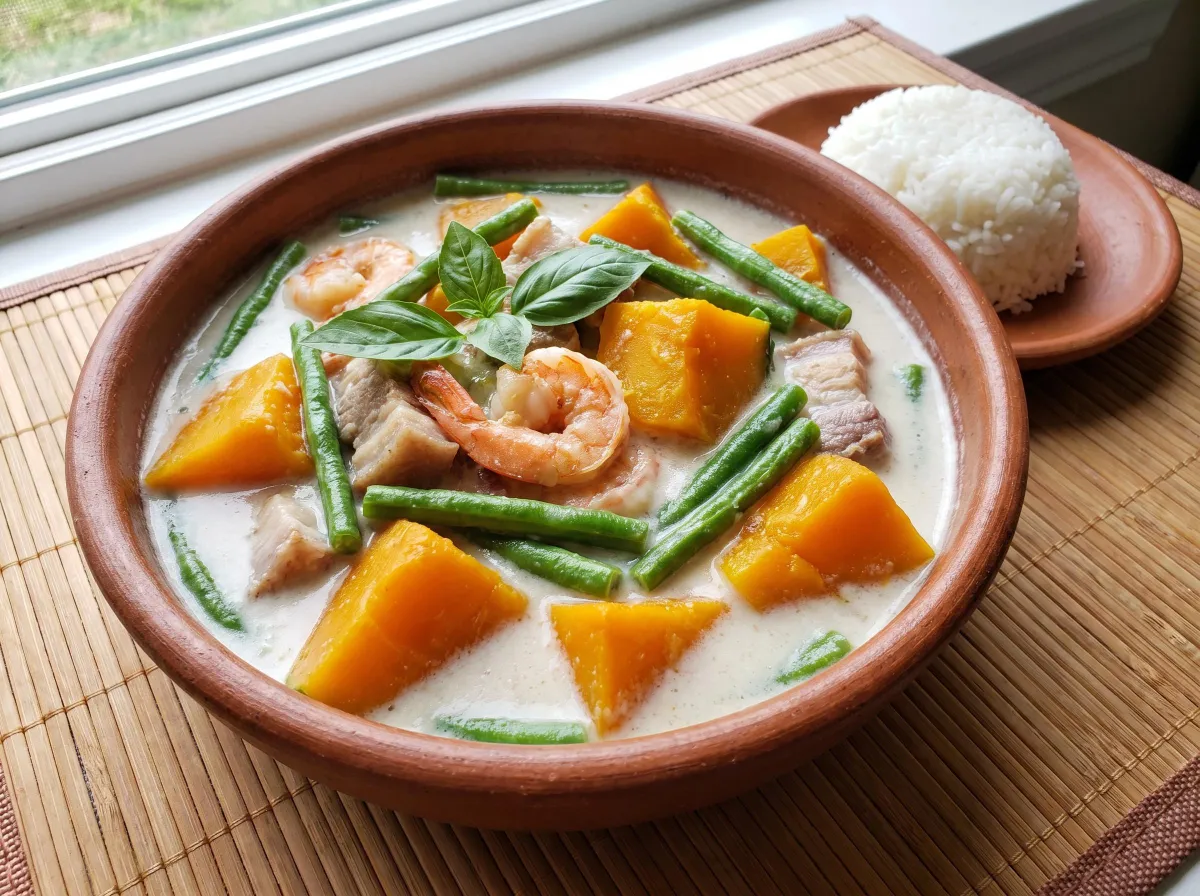
What is Ginataang Kalabasa? The Filipino Coconut Squash Stew That's Creamy Comfort in a Bowl
Imagine opening a pot on the stove to reveal a bubbling, creamy stew—the kind where coconut milk has transformed into liquid silk, bright orange squash cubes have softened to tender perfection, and vibrant green long beans add a pop of color that makes the whole dish look like an edible sunset. The aroma? Sweet squash, fragrant coconut, sharp ginger, and that indefinable something that says "home."
This is Ginataang Kalabasa (pronounced "gee-nah-TAH-ahng kah-lah-BAH-sah"), and it represents Filipino home cooking at its finest—simple ingredients transformed through technique and tradition into something deeply satisfying.
But here's what makes Ginataang Kalabasa particularly special in today's food landscape: it's a dish that accidentally checks almost every modern dietary preference box (gluten-free, dairy-free, can be vegetarian or vegan, whole-food based, nutrient-dense) while having absolutely zero interest in trends. This dish has been feeding Filipino families for generations, completely unbothered by whatever wellness movement is currently popular.
So what exactly is this creamy, comforting, accidentally-healthy Filipino staple? And why should it be on your radar whether you're Filipino reconnecting with heritage foods, a home cook looking for vegetable-forward recipes, or simply someone who believes coconut milk makes everything better?
Let's dive in.
The Basics: What Exactly is Ginataang Kalabasa?
Ginataang Kalabasa is a Filipino vegetable stew made primarily with squash (kalabasa) cooked in coconut milk (gata), typically accompanied by long beans (sitaw), and flavored with aromatics like ginger, garlic, and onion.
Breaking down the name:
Ginataang comes from "gata" (coconut milk/cream) and means "cooked in coconut milk"
Kalabasa is the Tagalog word for squash or pumpkin
So literally, "Ginataang Kalabasa" means "squash cooked in coconut milk"—Filipino food naming tends to be refreshingly literal.
The Essential Components
A traditional Ginataang Kalabasa includes:
The Vegetables:
Kalabasa (squash/pumpkin) - the star, providing sweetness and substance
Sitaw (long beans/yard-long beans) - adding color, texture, and slight crunch
Sometimes malunggay (moringa leaves) or saluyot (jute leaves) for additional nutrition
The Liquid:
Gata (coconut milk) - creating the creamy, rich base
The Aromatics:
Luya (ginger)—essential for warmth and depth
Bawang (garlic)—for savory foundation
Sibuyas (onion) - for sweetness and aroma
Optional Protein:
Shrimp (hipon)—most common protein addition
Pork (usually belly or shoulder, cut into small pieces)
Sometimes dried fish (daing) or bagoong (fermented shrimp paste)
Or nothing—keeping it purely vegetarian
Seasoning:
Salt or patis (fish sauce)
Black pepper
That's it. The beauty of Ginataang Kalabasa lies in its simplicity.
The Ginataan Family: Understanding the Bigger Picture
Ginataang Kalabasa belongs to a broader category of Filipino dishes called "ginataan"or "guinataan"—any dish cooked in coconut milk.
The Ginataan Universe
The ginataan family is vast and varied:
Savory Ginataan:
Ginataang Gulay (mixed vegetables in coconut milk)
Ginataang Langka (jackfruit in coconut milk)
Ginataang Sitaw at Kalabasa (the full name when both vegetables are equally featured)
Ginataang Hipon (shrimp in coconut milk)
Ginataang Manok (chicken in coconut milk)
Bicol Express (technically a spicy ginataan with pork and chilies)
Laing (taro leaves in coconut milk - a Bicolano specialty)
Sweet Ginataan:
Ginataang Bilo-Bilo (sticky rice balls with various fruits and tubers in sweet coconut milk)
Ginataang Halo-Halo (mixed fruits and tubers in sweet coconut milk)
Ginataang Mais (corn in sweet coconut milk)
What unites them all is the cooking method: simmering ingredients in coconut milk until everything is tender and the flavors meld beautifully.
Why Ginataang Kalabasa Stands Out
Among the ginataan family, Ginataang Kalabasa occupies a special niche:
Accessible ingredients- easier to source than langka or specialty leaves
Quick cooking time- squash cooks relatively fast
Naturally sweet- doesn't require sugar or additional seasoning complexity
Vegetarian-friendly- works beautifully with or without meat
Everyday food- not reserved for special occasions
Forgiving recipe- hard to mess up catastrophically
It's the ginataan that home cooks turn to on weeknights, when the budget is tight, when there's squash from the garden, or when everyone needs something comforting without fuss.
The Authenticity Debate: What Makes Ginataang Kalabasa Genuinely Filipino?
Here's where things get interesting. With Filipino cuisine gaining global attention, many recipes appear online claiming to be "authentic" Ginataang Kalabasa. But authenticity isn't just about following a recipe—it's about understanding cultural context, traditional techniques, and regional variations.
What Genuinely Authentic Ginataang Kalabasa Looks Like
Authentic Ingredient Choices:
Native squash varieties: Traditional Filipino recipes usekalabasa(calabaza squash) - the kind with hard, green skin and deep orange flesh. This is different from:
Butternut squash (acceptable substitute but tastes different)
Acorn squash (wrong texture)
Delicata squash (too delicate)
Western pumpkin varieties (often too watery or stringy)
Authentic kalabasa has dense, slightly sweet flesh that holds its shape during cooking without turning mushy.
Sitaw (long beans): Traditional versions useactual long beans(Vigna unguiculata subsp. sesquipedalis), also called yard-long beans or Chinese long beans. These are NOT:
Regular green beans (different flavor and texture)
Snap peas (wrong entirely)
String beans (closer but still not the same)
Sitaw has a slightly beany, almost nutty flavor and maintains some bite even when cooked.
Real coconut milk: Authentic versions use:
Fresh-squeezed coconut milk (kakang gata) from grated coconut - the gold standard
Good quality canned coconut milk from Asian brands (acceptable modern convenience)
NOT coconut milk beverage from cartons (too watery, often sweetened)
NOT coconut cream alone (too thick and rich for this dish)
NOT "light" coconut milk (defeats the purpose)
Fresh ginger: Authentic recipes use generous amounts of fresh ginger (luya), sliced into matchsticks or coins. This is non-negotiable. Powdered ginger doesn't provide the same aromatic punch and slight heat.
Authentic Technique Markers:
Sautéing the aromatics first: Traditional preparation begins with sautéing garlic, onion, and ginger in oil before adding coconut milk. This step develops flavor depth. Recipes that skip this and just dump everything in a pot together miss a crucial flavor-building stage.
Two-stage coconut milk addition: More traditional cooks add coconut milk in two stages:
First, the thinner "second pressing" coconut milk for cooking
Later, the thicker "first pressing" (coconut cream) to finish and enrich
This technique creates better texture and prevents curdling.
Not overcooking: Authentic preparation cooks the squash until tender but still holding shape—not disintegrated into mush. The sitaw should maintain some texture, not be completely soft.
Minimal seasoning: Traditional versions rely on the natural sweetness of squash, the richness of coconut milk, and the aromatics for flavor. They're seasoned simply with salt or a small amount of fish sauce. Recipes that add soy sauce, oyster sauce, or multiple seasoning layers are moving away from the traditional profile.
Authentic Cultural Context:
Paired with rice: Ginataang Kalabasa is always, always served with steamed white rice. The rice absorbs the coconut milk and balances the richness. Serving it as a standalone soup or over quinoa (though trendy) isn't the traditional Filipino approach.
Protein is optional: While many modern recipes include protein (shrimp or pork), traditional versions from areas where meat was expensive or scarce often contain no protein at all. It's a vegetable dish first, with protein as an optional enhancement—not a meat dish with vegetables added.
Regional variations are real: Ginataang Kalabasa in Bicol might include a bit of chili heat and more ginger. Visayan versions might add malunggay leaves. Tagalog versions might lean simpler. All are authentic to their regions.
What Marks a Recipe as "Adapted" or "Fusion"
Not all adaptations are bad, but they should be recognized as departures from tradition:
Common adaptations that move away from authenticity:
Substituting butternut squash or kabocha (acceptable but different)
Adding curry powder or turmeric (delicious but not traditional Filipino)
Using green beans instead of sitaw (changes the flavor profile)
Adding tomatoes (some regional variations do this, but it's not standard)
Making it "cream-based" with dairy (completely misses the point)
Adding multiple vegetables beyond kalabasa and sitaw (becomes ginataang gulay, a different dish)
Heavy use of bagoong/shrimp paste throughout (Bicol Express territory, not standard Ginataang Kalabasa)
The stance worth taking: Adaptations are fine and often necessary when cooking Filipino food outside the Philippines, but they should be acknowledged as adaptations rather than presented as "authentic traditional recipes." Someone in Minnesota making this with butternut squash and regular green beans is doing great work bringing Filipino flavors to their table—but it's not quite the same as the dish made with proper kalabasa and sitaw in a Filipino kitchen.
Authenticity exists on a spectrum, and what matters most is understanding where your version falls on that spectrum and why.
The Coconut Milk Conversation: Fresh vs. Canned
This deserves its own section because coconut milk quality makes or breaks Ginataang Kalabasa.
The Traditional Method: Fresh Coconut Milk
In the Philippines, particularly in provinces with abundant coconut trees, the traditional method involves:
Grating fresh coconut meat (using a manual grater or kudkuran)
Adding water to the grated coconut
Squeezing and pressing through a cheesecloth or strainer to extract the milk
First pressing yields thick coconut cream (kakang gata)
Second pressing (adding more water to the same grated coconut) yields thinner coconut milk
This process creates coconut milk with superior flavor, aroma, and texture compared to anything canned.
The Modern Reality: Canned Coconut Milk
For most people cooking Ginataang Kalabasa outside coconut-growing regions, canned coconut milk is the practical choice.
Quality markers for canned coconut milk:
Ingredient list: Should contain ONLY coconut and water (maybe a stabilizer like guar gum)
Brand matters: Asian brands (Aroy-D, Chaokoh, Mae Ploy) generally superior to Western "natural food" brands
Full fat is essential: "Light" or "reduced fat" coconut milk produces thin, unsatisfying results
Shake the can: You should feel liquid moving; if it's solid, it's pure cream (too thick)
Brands Filipino cooks actually use:
Aroy-D (Thai brand, widely respected)
Chaokoh (another Thai favorite)
Fiesta (Filipino brand, when available)
Savoy (Filipino brand)
The Compromise: Frozen Coconut Milk or Cream
Some Asian groceries sell frozen grated coconut or frozen coconut cream, which can be closer to fresh when thawed. These are worth seeking out if available in your area.
How to Make Ginataang Kalabasa: The Real Process
While this isn't primarily a recipe post, understanding the process helps appreciate what makes this dish special.
The Traditional Method
Step 1: Prep the ingredients
Peel and cube kalabasa (about 1-2 inch cubes)
Cut sitaw into 2-3 inch lengths
Slice ginger into matchsticks
Mince garlic
Dice onion
Prepare protein if using (devein shrimp, slice pork)
Step 2: Sauté aromatics
Heat oil in a pot
Sauté garlic until fragrant (don't burn)
Add onion, cook until softened
Add ginger, sauté briefly
Step 3: Add protein (if using)
Add pork or dried fish, cook until slightly browned
(Shrimp gets added later)
Step 4: Add squash and coconut milk
Add kalabasa cubes
Pour in coconut milk (reserve some of the cream if separating)
Season with salt or fish sauce
Bring to a gentle simmer (not a rolling boil)
Step 5: Cook gently
Simmer until squash is almost tender (about 10-15 minutes)
Add sitaw
Add shrimp if using
Cook until beans are tender-crisp and shrimp are pink (about 5 minutes)
Step 6: Finish
Add reserved coconut cream if holding any back
Adjust seasoning
Add a crack of black pepper
Optional: add malunggay or basil leaves at the very end
Step 7: Rest
Let sit for a few minutes before serving
This allows flavors to meld
The Critical Don'ts
Don't boil aggressively: Coconut milk curdles and separates if boiled too hard. Gentle simmering is key.
Don't overcook the vegetables: Mushy squash and limp beans aren't the goal.
Don't skimp on ginger: It's not just flavoring; it's structurally important to the dish's flavor profile.
Don't add too much liquid: This should be a creamy stew, not a thin soup.
Don't forget to taste: The natural sweetness of squash varies; seasoning needs adjustment accordingly.
Regional Variations: How Ginataang Kalabasa Changes Across the Philippines
Like most Filipino dishes, Ginataang Kalabasa isn't monolithic. Regional variations reflect local tastes, available ingredients, and cooking traditions.
Bicol Region: The Spicy Version
Bicolanos love their chilies and coconut milk (often in the same dish). Their Ginataang Kalabasa typically includes:
More ginger (extra generous amounts)
Siling labuyo (small hot chilies) for heat
Sometimes bagoong alamang (shrimp paste) for umami depth
Heavier on the coconut cream
The result is richer, spicier, and more intensely flavored than other regional versions.
Visayas: The Leafy Version
Visayan versions often incorporate:
Malunggay leaves (moringa) added at the end
Sometimes alugbati (Malabar spinach)
Lighter seasoning emphasizing the vegetables' natural flavors
Sometimes crab or prawns when coastal
Tagalog (Luzon): The Classic Version
The Tagalog regions around Manila typically prepare a relatively straightforward version:
Emphasis on the squash-coconut milk combination
Sitaw as the primary companion vegetable
Balanced seasoning without going heavy on any particular element
Shrimp or pork as common but optional protein additions
Ilocos Region: The Bagoong Version
Northern regions sometimes include:
Bagoong isda (fermented fish paste) for a funkier, more pungent flavor
Less coconut milk (coconuts less abundant in the north)
Sometimes tomatoes creating a different flavor profile
The Common Thread
Despite regional variations, certain elements remain constant:
Squash as the main vegetable
Coconut milk as the cooking medium
Ginger as an essential aromatic
Simple preparation method
Served with rice
The Health Question: Is Ginataang Kalabasa Actually Good for You?
Let's address the elephant in the room: coconut milk's reputation as a "high-fat" ingredient makes some health-conscious eaters nervous about ginataan dishes.
The Nutritional Reality
What Ginataang Kalabasa provides:
From the squash:
High in beta-carotene(converted to vitamin A) - supports vision and immune function
Rich in vitamin C- antioxidant and immune support
Good source of fiber- digestive health
Potassium- heart health and blood pressure regulation
Low in caloriesbut high in volume (satisfying)
From the coconut milk:
Medium-chain triglycerides (MCTs)- potentially easier to metabolize than long-chain fats
Lauric acid- antimicrobial properties
Manganese- bone health and metabolism
Iron- especially important in plant-forward diets
Magnesium- muscle and nerve function
From sitaw (long beans):
Protein(modest amount)
Fiber
Vitamins K and C
Folate
Manganese
From ginger:
Gingerol- anti-inflammatory compounds
Digestive support
Potential anti-nausea properties
The Balanced Perspective
Considerations:
Calorie-dense due to coconut milk (but also very satiating)
High in saturated fat from coconut milk (though coconut's saturated fat behaves differently than animal saturated fat)
Sodium content depends on seasoning choices
Why it can fit in a healthy diet:
Whole food ingredients- nothing processed or artificial
Nutrient-dense- lots of nutrition per calorie
Naturally gluten-free and dairy-free
Supports plant-forward eating (especially in vegetarian versions)
Satisfying- prevents overeating due to high satiety
The context that matters:
Traditional Filipino diets didn't include coconut milk-based dishes every single day. Ginataang Kalabasa was one of many dishes in rotation. In that context—as an occasional to regular but not daily meal—it provides excellent nutrition and satisfaction.
For people following:
Plant-based diets: Excellent vegetable and healthy fat source
Gluten-free diets: Naturally compliant
Whole food diets: Checks all the boxes
Paleo/Primal diets: Generally fits the philosophy
Low-carb diets: The squash provides carbs, but in a nutrient-dense package
The "is it healthy?" question ultimately depends on overall dietary context, portion size, and individual health goals.
Ginataang Kalabasa in Filipino Food Culture
Beyond nutrition and flavor, Ginataang Kalabasa occupies specific cultural roles.
Everyday Food, Not Special Occasion
Unlike lechon or pancit for fiestas, Ginataang Kalabasa is bahay (house/home) food—the kind families eat on regular Tuesday nights. This ordinariness is actually what makes it culturally significant. It represents:
Practical home cooking using available ingredients
Economic flexibility (can be meatless when budget is tight, enhanced with protein when possible)
Nutritional wisdom (getting vegetables into the family diet in a delicious way)
Cooking knowledge passed down through watching and helping rather than written recipes
Garden-to-Table Before It Was Trendy
In provincial areas where families grow their own vegetables, Ginataang Kalabasa represents true local eating:
Squash from the backyard garden
Sitaw climbing on bamboo trellises
Coconuts from nearby trees
Nothing transported far or purchased from specialty stores
This dish embodies sustainable, local eating that Filipino families practiced long before it became a food movement.
The "Vegetable Delivery System"
Filipino cuisine isn't typically vegetable-heavy in the way that, say, contemporary health food is. But dishes like Ginataang Kalabasa serve an important function:making vegetables delicious enough that even vegetable-resistant family members will eat them.
The creamy coconut milk, the natural sweetness of squash, the satisfying combination with rice—these elements make vegetables appealing. It's nutritional stealth.
Rainy Season Food
Ginataang Kalabasa, like many coconut milk dishes, is particularly associated with rainy season and cooler weather (by Philippine standards). The richness and warmth it provides make it comforting when it's wet and gray outside.
Ginataang Kalabasa for Modern Cooks: Adaptations and Innovations
While respecting tradition, modern cooks are finding new ways to approach this classic.
Contemporary Adaptations
For busy weeknights:
Instant Pot/pressure cooker methods (faster cooking, though some flavor nuance is lost)
Pre-cut squash from grocery stores (convenience over tradition)
Make-ahead and reheat (actually reheats beautifully)
For dietary preferences:
Extra vegetables (adding bok choy, eggplant, or okra alongside the traditional vegetables)
Protein variety (adding tofu for vegetarians, chicken for those who don't eat pork/shrimp)
Spice level adjustment (adding more or less ginger and optional chilies)
For ingredient availability:
Butternut squash substitute (most common outside the Philippines)
Kabocha squash (actually closer to kalabasa than butternut)
Regular green beans when sitaw isn't available (not ideal but workable)
The "Accidentally Vegan" Appeal
Ginataang Kalabasa (in its meatless version) has found new audiences among plant-based eaters who appreciate:
Creamy comfort without dairy
Whole food ingredients
Satisfying texture and richness
Easy to make without specialty vegan products
Some vegan food bloggers have discovered Ginataang Kalabasa and similar ginataan dishes, introducing them to audiences who've never encountered Filipino food. This cross-cultural appreciation benefits everyone—Filipino cooks see their cuisine valued, and new audiences discover delicious dishes.
When Innovation Goes Too Far
Some modern "interpretations" stretch so far from the original that calling them Ginataang Kalabasa becomes questionable:
Adding curry powder and calling it "Filipino-Thai fusion"
Replacing coconut milk with cashew cream
Turning it into a soup with broth added
Making it into a gratin with cheese (truly a wild departure)
These might be delicious, but they're new dishes inspired by Ginataang Kalabasa rather than versions of it.
Making Ginataang Kalabasa Outside the Philippines: Real Talk
For Filipinos abroad or anyone wanting to make this dish without access to Filipino groceries, here's honest guidance.
The Challenging Parts
Finding kalabasa: This is the biggest hurdle. True kalabasa (calabaza squash) isn't always available outside communities with Latin American or Caribbean groceries (where it's used in their cuisines too).
Best substitutes in order:
Kabocha squash(Japanese pumpkin - dense, sweet, holds shape well)
Calabaza(if you can find it in Latin markets)
Butternut squash(works but sweeter and softer than ideal)
Avoid: Acorn squash (wrong texture), spaghetti squash (completely wrong)
Finding sitaw: Asian groceries usually stock frozen long beans even if fresh aren't available. In a pinch, Chinese grocery stores often have fresh ones.
Acceptable substitute: Regular green beans (haricots verts, not thick green beans), though the flavor is different.
The Easy Parts
Coconut milk: Widely available in most grocery stores now. Stick with Asian brands in the international aisle rather than health food store versions.
Aromatics: Ginger, garlic, onion available everywhere.
Cooking technique: Nothing complicated or requiring special equipment.
The Emotional Part
For Filipinos abroad, making Ginataang Kalabasa with substitute ingredients can be bittersweet. It tastes close but not quite like home. That gap between the substitute version and the memory version represents the larger gap between diaspora life and home.
But here's the thing: making it anyway, even with butternut squash and regular green beans, is still an act of cultural preservation and connection. It's still teaching the next generation. It's still bringing those flavors to the table. Perfect authenticity isn't always possible or necessary.
Pairing Ginataang Kalabasa: What to Serve Alongside
The Essential: White Rice
This is non-negotiable in traditional Filipino presentation. The rice:
Absorbs the rich coconut milk sauce
Balances the richness
Provides neutral background for the vegetables' sweetness
Makes the meal more filling and satisfying
How much rice: In Filipino serving style, typically equal parts rice and Ginataang Kalabasa, or even more rice.
Traditional Accompaniments
Fried fish: A piece of fried fish (daing na bangus, fried tilapia, or fried galunggong) alongside Ginataang Kalabasa creates a classic Filipino meal—the crispy, savory fish contrasting with the creamy, sweet vegetables.
Grilled/fried meat: If the Ginataang Kalabasa is vegetarian, a portion of grilled pork, fried chicken, or other meat protein completes the meal for non-vegetarian eaters.
Tomato and salted egg salad (ensaladang kamatis at itlog na maalat): The fresh, acidic tomatoes and salty egg cut through the richness beautifully.
Bagoong with tomatoes: For those who want extra umami funk.
Contemporary Pairings
Modern Filipino meals might pair Ginataang Kalabasa with:
Lumpia (spring rolls) for textural contrast
Inihaw na liempo (grilled pork belly)
Simple green salad (less traditional but appreciated by health-conscious eaters)
The Complete Filipino Meal Structure
A full Filipino lunch or dinner featuring Ginataang Kalabasa might include:
Rice (kanin)
Ginataang Kalabasa (the vegetable/gulay)
Fried or grilled protein (ulam)
Soup (sabaw - maybe sinigang or simple vegetable soup)
Condiments (sawsawan - bagoong, patis with calamansi, soy with calamansi)
This follows the traditional Filipino meal structure of rice as the center with multiple dishes shared family-style.
Why Ginataang Kalabasa Matters Beyond Being Delicious
Food is never just food, and Ginataang Kalabasa is no exception.
A Lesson in Resourceful Cooking
This dish represents Filipino culinary wisdom: taking humble, inexpensive ingredients and creating something satisfying and nutritious. This isn't poverty food made aspirational—it's genuine resourcefulness that modern sustainable cooking movements are only now catching up to.
The principle: You don't need exotic ingredients, complicated techniques, or expensive proteins to create a meal worth looking forward to. Good ingredients, simple preparation, and time are enough.
Preserving Vegetable-Forward Eating
In an era where Filipino cuisine is sometimes criticized for being meat-heavy, dishes like Ginataang Kalabasa remind us that Filipino food traditions include substantial vegetable-centered dishes. These weren't modern additions or health-conscious innovations—they've been part of the cuisine all along.
Highlighting dishes like Ginataang Kalabasa helps counter one-dimensional views of Filipino food and shows the actual diversity of the cuisine.
Environmental Wisdom
The traditional Ginataang Kalabasa recipe—using local, seasonal squash, coconuts from nearby trees, and minimal to no meat—represents low-impact eating that modern environmental movements promote. Filipino provinces have been eating this way for generations, not because of environmental consciousness but because of practical reality. The environmental benefits were a side effect of eating locally and seasonally.
As the world confronts climate change and seeks more sustainable food systems, traditional dishes like Ginataang Kalabasa offer working models of delicious, low-impact eating.
Cultural Continuity
For Filipino families, recipes like Ginataang Kalabasa represent cultural transmission across generations. Learning to make it means:
Understanding flavor balancing
Knowing when squash is properly cooked
Recognizing how coconut milk behaves
Appreciating the meal structure and pairings
These aren't just cooking skills—they're cultural knowledge that connects people to heritage and identity.
Ready to Try Ginataang Kalabasa? Here's Your Action Plan
If you've made it this far, you're clearly intrigued. Here's how to actually experience Ginataang Kalabasa:
For Those in the Philippines
Make it at home: This is one of the most home-cook-friendly Filipino dishes. The ingredients are readily available, the technique is straightforward, and the results are forgiving.
Ask family: If you have relatives who cook, ask them to make it or teach you. Every family has slight variations worth learning.
Order it: Some karinderyas (small eateries) and turo-turo (point-point buffet-style restaurants) feature Ginataang Kalabasa. It's usually one of the more affordable options.
For Those Abroad
Find Filipino restaurants: Call ahead to ask if they serve Ginataang Kalabasa or other ginataan dishes. Not all do, as these dishes are considered home food rather than restaurant fare.
Visit Filipino community events: Potlucks and gatherings often feature home-cooked dishes like this.
Make it yourself: With Asian grocery access for coconut milk and long beans (and using butternut squash if needed), this is very makeable at home.
Connect with Filipino food bloggers: Many share family recipes and tips for making Filipino food abroad.
For the Truly Curious
Try different vegetables in coconut milk: Once you understand the ginataan method, experiment with other vegetables—eggplant, green beans, jackfruit, taro leaves (if you can find them).
Learn the technique: The gentle simmering, the aromatics foundation, the layered flavor building—these techniques apply to many dishes.
Share it: Introduce friends to this dish. It's accessible, delicious, and represents Filipino food beautifully.
Document your experience: Whether through photos, journaling, or simply being mindful, capture your first Ginataang Kalabasa experience.
The Last Spoonful
Ginataang Kalabasa is more than squash in coconut milk. It's a lesson in resourceful cooking, a connection to Filipino agricultural wisdom, a vehicle for getting vegetables into the family diet, and a delicious example of how simple ingredients become something greater than their parts.
In a food world obsessed with novelty, complexity, and expensive ingredients, Ginataang Kalabasa stands as a quiet reminder that simple, traditional, vegetable-forward cooking has always been valuable—it just wasn't always called "plant-based" or "clean eating" or whatever the current trend label is.
Whether you're Filipino reconnecting with heritage foods, a home cook looking for approachable vegetable-centered recipes, or someone who just loves coconut milk and squash, Ginataang Kalabasa has something to offer.
The next time you see squash at the market, grab some coconut milk and long beans, and create this dish. Let the coconut milk bubble gently. Smell the ginger and garlic. Watch the squash turn tender and the sauce become creamy. Serve it with rice. Taste the way simple ingredients, prepared with care and tradition, can be deeply, completely satisfying.
Welcome to the comforting, nourishing world of Ginataang Kalabasa. It's been feeding Filipino families for generations, and it's ready to feed you too.
Keep the Filipino Food Journey Going
Want to share the joy of Filipino food culture with the little ones in your life?
Our Filipino Food Coloring Book brings beloved dishes like Ginataang Kalabasa, Pancit Mami, Goto, Taho, Halo-Halo, and more to life through beautiful illustrations that kids (and kids at heart) can color and learn from. It's a fun, creative way to introduce Filipino culinary heritage to the next generation while celebrating the foods that connect us to our roots.
Each page features a different iconic Filipino dish with educational tidbits that make learning about culture delicious and engaging. Perfect for Filipino families wanting to pass down food traditions, educators teaching about diverse cuisines, or anyone who loves Filipino food and wants to celebrate it in a creative way.
Get your Filipino Food Coloring Book here and start a colorful conversation about the foods that make Filipino culture so special.
Have you made Ginataang Kalabasa? Do you have a family recipe variation? What vegetables do you like to add? Share your ginataan experiences and favorite versions in the comments below!
For more deep dives into Filipino food culture, check out our explorations of Taho, Goto, and Pancit Mami, and subscribe to stay updated on future posts celebrating the foods that connect us to home, history, and each other.
References and Further Reading
To ensure accuracy and depth in exploring Ginataang Kalabasa and Filipino coconut milk cooking traditions, this article drew from various sources on Filipino culinary practices, nutrition, and food culture:
On Filipino Cooking Traditions:
Fernandez, Doreen G.Tikim: Essays on Philippine Food and Culture. Anvil Publishing, 1994.
Alejandro, Reynaldo.The Philippine Cookbook. Penguin Books, 1985.
Gelle, Ging.Salo-Salo: Recipes and Stories from the Filipino Kitchen. HarperCollins, 2022.
On Regional Filipino Cuisine:
"Regional Variations in Filipino Vegetable Dishes." Panlasang Pinoy, recipe documentation and cultural notes.
"Bicol Region Ginataan Traditions." Bicol Today, cultural food articles.
Matejowsky, Ty.Fast Food Globalization in the Provincial Philippines. Lexington Books, 2018.
On Coconut and Coconut Milk:
"Coconut Production in the Philippines. "Philippine Star, agricultural reporting.
Enig, Mary G. and Sally Fallon."The Truth About Coconut Oil." Weston A. Price Foundation.
"Health Properties of Coconut." National Center for Biotechnology Information, various research papers.
On Filipino Vegetables:
"Kalabasa: The Filipino Squash."Business Mirror, agricultural features.
"Traditional Filipino Vegetables and Their Uses." Department of Science and Technology, Philippines.
Stuart Jr., Godofredo."Philippine Medicinal Plants: Kalabasa." StuartXchange.org.
On Filipino Food Culture:
Manalansan, Martin F. "Beyond Authenticity: Rerouting the Filipino Culinary Diaspora."Eating Asian America: A Food Studies Reader, NYU Press, 2013.
"Filipino Food: Mapping a Culinary Landscape." Positively Filipino, cultural essays.
Valbuena, Catherine."The Role of Vegetables in Traditional Filipino Diets."Food and Nutrition Research Institute, Philippines.
Nutritional Information:
United States Department of Agriculture (USDA) FoodData Central. Nutritional profiles for squash, coconut milk, and long beans.
"Nutritional Benefits of Squash Varieties."Healthline, evidence-based nutrition articles.
"Health Benefits of Traditional Filipino Vegetables."World Health Organization Philippines, nutrition resources.
Cultural and Contemporary Sources:
Field observations and documentation of Filipino home cooking practices
Contemporary Filipino food blogs and recipe sharing communities
Filipino diaspora food communities and their cooking adaptations
Culinary anthropological research on Filipino vegetable dishes
This article represents a synthesis of published research, traditional food knowledge, and ongoing conversations within Filipino food communities both in the Philippines and globally. As with all living food traditions, practices and interpretations continue to evolve.