
What Is Liempo? The Filipino Grilled Pork Belly That Owns Every Backyard Party
You smell the charcoal before you smell the pork. Then you smell the pork, and that's when you start walking faster.
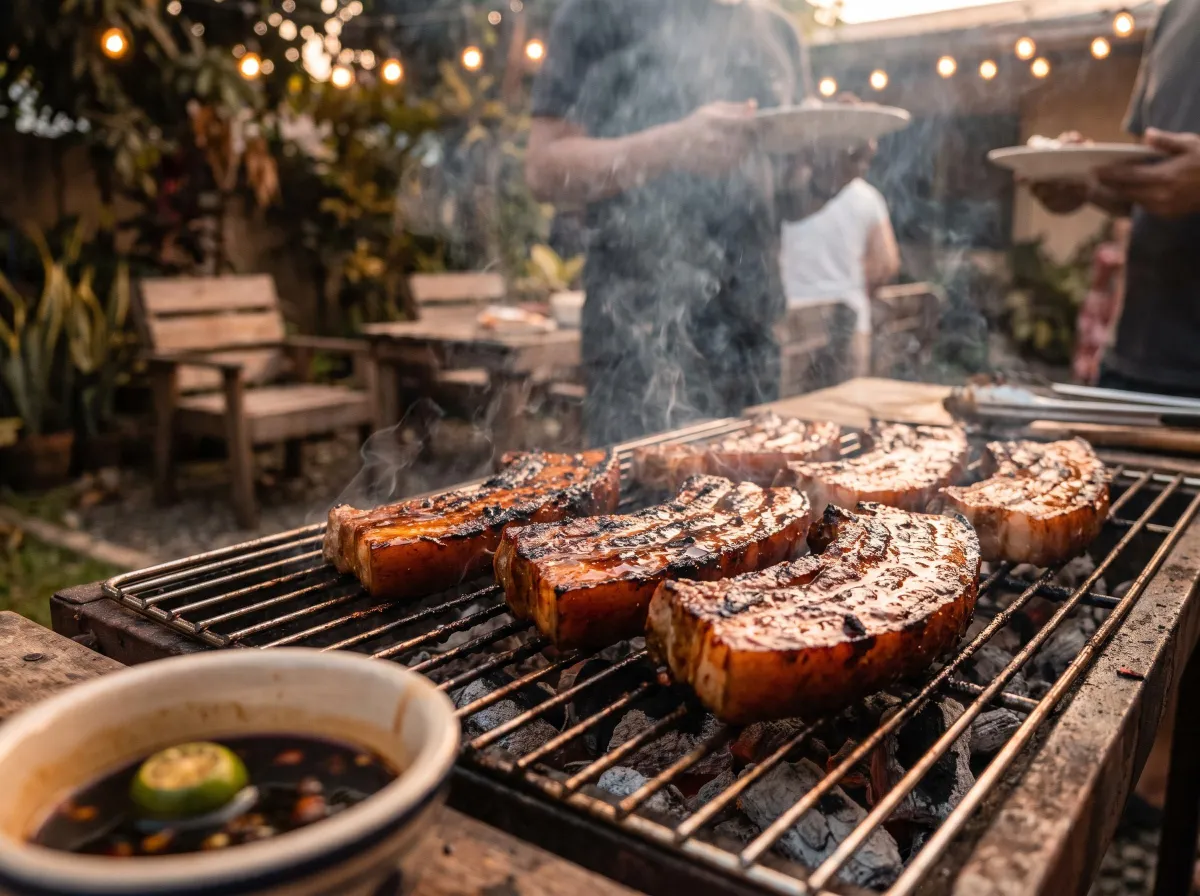
There is a very specific sound that means a Filipino party has officially started, and it is not music and it is not laughter, although both of those are usually happening at the same time. It is the sound of pork belly hitting a hot charcoal grill — that sharp, fatty hiss, followed by smoke, followed by someone's uncle grabbing a pair of tongs he did not technically ask to use but is now fully in charge of. Somewhere nearby, a bottle of soy sauce and calamansi is waiting for its second act as a dipping sauce. Rice is already steaming. Someone is setting the table, or, depending on the occasion, someone is laying down banana leaves instead, because tonight might not involve a table at all.
🍖 Before we go any further — we made something for you.
Find out which Filipino comfort food matches your personality. Takes about a minute.
That smoky, sticky, slightly sweet smell belongs to one dish more than any other: inihaw na liempo, Filipino grilled pork belly. It is not the fanciest dish in Filipino cuisine. It does not require a whole roasted pig or hours of careful basting over a spit. What it requires is pork belly, a marinade you can put together in ten minutes, a hot grill, and people who are hungry and ready to eat with their hands. That combination has made liempo one of the most beloved dishes in the Philippines, and increasingly, one of the most searched-for Filipino foods anywhere in the world.
Liempo is the Tagalog word for pork belly. Inihaw na liempo — "grilled pork belly" — is the dish made from marinating that pork belly in a mix of soy sauce, calamansi, garlic, and, in its most distinctly Filipino version, banana ketchup, then grilling it over charcoal until the edges char and the fat renders into something unbelievably good. It shows up at backyard cookouts, beach outings, parties, birthdays, and the kind of Sunday where nobody has anywhere else to be. It is also the foundation for a handful of other beloved dishes, which we will get into.
At Studio Tributes, we tell the stories behind Filipino food because every dish carries a piece of Filipino life inside it. Liempo carries the backyard-party version of that life — the smoke, the shared plate, the argument about whose marinade is better, the moment when someone says "isa pa" and reaches for another piece before the platter even makes it all the way around the table. Let's get into it: what liempo actually is, where it came from, how it differs from its equally famous cousin lechon kawali, and why this cut of pork has become one of the most talked-about ingredients in food circles well beyond the Philippines.
🔥 What Is Liempo?
Let's start with the basics, because "liempo" gets used two ways in everyday Filipino conversation, and both are correct.
Liempo, the cut. Liempo is the Filipino word for pork belly — the same primal cut used internationally for bacon. It comes from the underside of the pig, and it is prized specifically because it is not a single-texture cut. A good slice of liempo has layers: meat, fat, sometimes skin, all stacked together, which is exactly what makes it forgiving and flavorful on a hot grill. Too lean a cut dries out over charcoal. Liempo does not have that problem, because the fat bastes the meat from the inside as it cooks.
Liempo, the dish. In everyday use, "liempo" often refers to the finished grilled dish itself — inihaw na liempo. Ask a Filipino family what's for dinner and hear "liempo" as the answer, and you already know: someone bought pork belly, someone mixed a marinade, and there is a grill involved.
The full liempo setup usually looks like this:
🥩 The pork belly — sliced into thick strips or slabs, sometimes butterflied, always chosen with a good ratio of meat to fat
🧄 The marinade — soy sauce, calamansi (or lemon or lime as a substitute), garlic, and black pepper form the base; many versions add brown sugar, oyster sauce, or a splash of lemon-lime soda for tenderness
🍌 Banana ketchup — the ingredient that makes it distinctly Filipino, used either in the marinade or brushed on as a basting sauce while it grills, where it caramelizes into a sticky, faintly sweet glaze
🥃 Toyomansi — a dipping sauce of soy sauce and calamansi, sometimes with sliced chili, served alongside the finished liempo
🍚 Garlic rice or plain steamed rice — the non-negotiable companion, there to soak up every bit of the drippings
You eat liempo hot off the grill, ideally within minutes, while the char is still audible when you bite into it. It gets sliced into pieces, piled onto a plate or straight onto rice, and passed around a table — or, just as often, arranged along a strip of banana leaf for a full boodle fight, which we'll come back to.
📜 The Story Behind It
Liempo's story is really two stories stacked on top of each other: a very old one about pork in the Philippines, and a much newer one about a particular marinade that turned pork belly into a national obsession.
The old story starts with the pig itself. Pork has deep roots in Filipino food culture — deeper than most people realize. The Tagalog word for pig, baboy , is believed to trace back to the Indo-Malay word babi , suggesting that pigs and pork cookery arrived in the Philippine archipelago alongside some of its earliest inhabitants, long before any colonial period. Long before Spanish contact, communities across the islands were already raising and cooking pigs, often over open fire — the direct ancestor of the charcoal grilling method still used for today. Grilling meat over fire is one of the oldest cooking methods in the Philippines, and pork has been central to Filipino feasting for a very long time.
The newer story is about a marinade ingredient invented out of necessity. During World War II, tomatoes became difficult to source in the Philippines, and Filipino food scientists — most famously credited to Maria Orosa — developed a ketchup substitute using local bananas, colored red to resemble the tomato ketchup people were used to. Banana ketchup was a wartime workaround. But it did not disappear once tomatoes became available again. Its sweet, slightly tangy, fruity flavor turned out to complement grilled and fried Filipino dishes so well that it became a permanent fixture in Filipino pantries — and a defining ingredient in the modern liempo marinade. That sticky, caramelized glaze you see on a well-grilled piece of liempo is very often banana ketchup at work, doing something a plain tomato-based sauce cannot quite replicate.
By the time you got to the second half of the twentieth century, Liempo had settled into its now-familiar role: the pork dish you grill at home, at the beach, at a roadside ihawan, or at a full-blown backyard party. It never needed a special occasion. That was always part of the appeal — liempo could be a Tuesday dinner or the centerpiece of a fiesta, with no real change to the recipe.
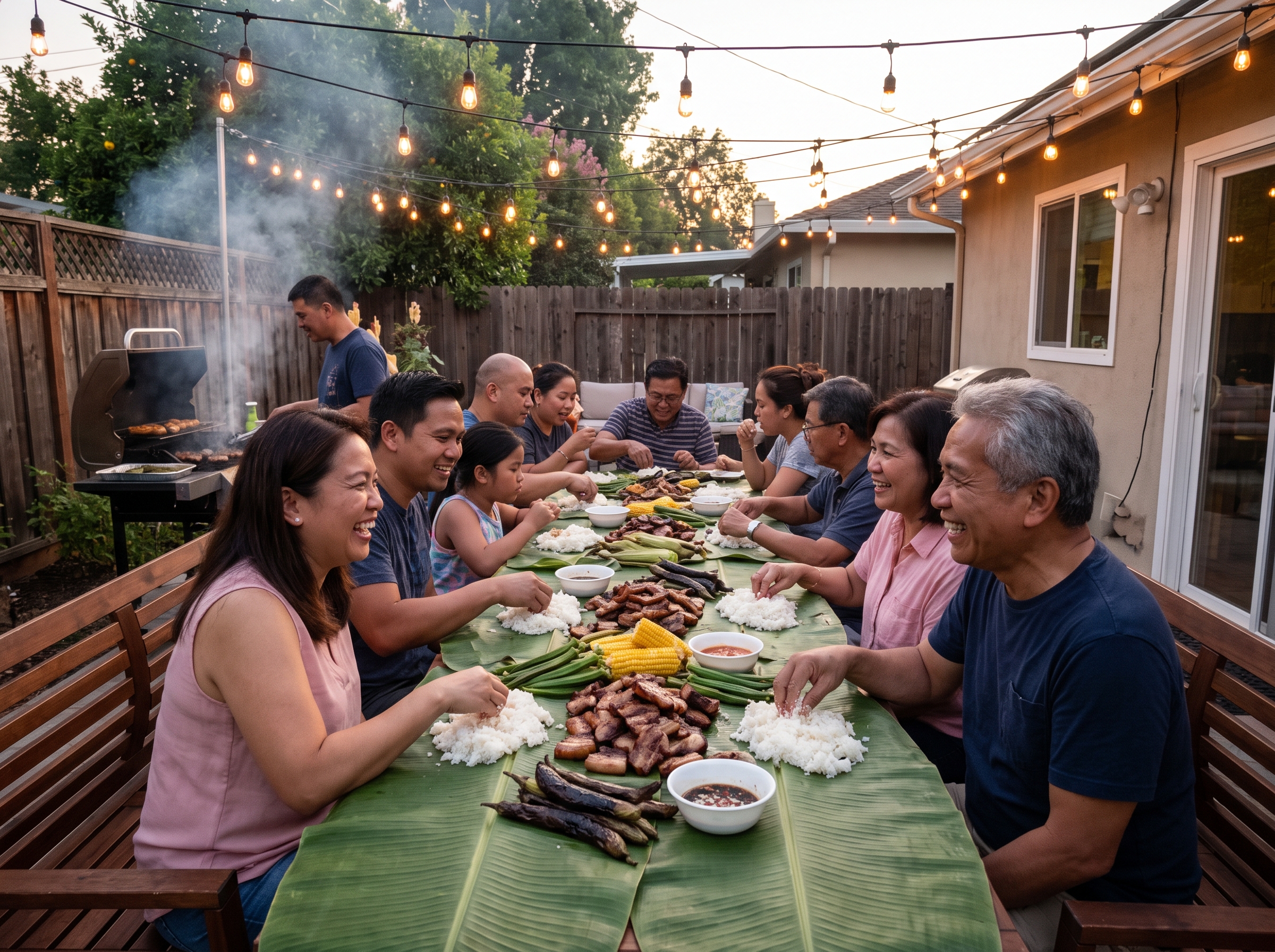
And then there is the boodle fight. No conversation about liempo and backyard gatherings is complete without it. A boodle fight is a Filipino communal dining tradition with roots in the Philippine military — specifically the Philippine Military Academy, with an assist from a similar custom at the United States Military Academy at West Point. "Boodle" was old cadet slang for snacks and treats; over time, in the Philippine military context, it came to describe a shared meal where food was piled onto a long table lined with banana leaves and soldiers tied with their hands, standing shoulder to shoulder, regardless of rank. The point was equality and camaraderie: everyone eats the same food, the same way, at the same table. Grilled meats — liempo chief among them — became a staple of the boodle fight spread precisely because they hold up well piled onto rice and eaten with your fingers. Filipino military veterans carried the tradition into civilian life, and today the boodle fight (sometimes called a kamayan feast) is a fixture of Filipino birthdays, reunions, and backyard parties everywhere Filipinos have settled, with liempo almost always claiming the center of the table.
👅 What Does Liempo Taste Like?
If you have never had it, here is the honest answer: liempo tastes like the best parts of a backyard cookout distilled into one dish.
The exterior is where the drama happens. Because of the sugar in the marinade — whether it comes from banana ketchup, brown sugar, or both — liempo caramelizes hard on a hot grill. The edges go dark, slightly charred, and faintly crackly, with pockets where the fat has rendered and crisped. That char carries real bitterness in a good way, the kind that balances out the sweetness underneath it.
Underneath that char is the payoff: tender, juicy pork with layers of rendered fat running through it, carrying the savory depth of soy sauce and the bright acidity of calamansi from the marinade. The fat is not a flaw here — it is the reason liempo stays moist over direct heat when leaner cuts would dry out and toughen. A well-marinated, well-grilled piece of liempo should give slightly at the first bite, then yield into something rich and almost sticky-sweet at the center.
Then there's the toyomansi. Dipping grilled liempo into a simple soy sauce and calamansi mixture cuts straight through the richness, the same way vinegar does for other Filipino grilled dishes. The sharp citrus notes reset your palate for the next bite, which is exactly why the plate empties so fast.
In short: liempo tastes like smoke, char, sweetness, and salt, all working on the same piece of meat at the same time — and it is very hard to stop at one piece.
⚖️ Liempo vs. Lechon Kawali: What's the Difference?
This is one of the most common questions people ask once they start exploring Filipino pork dishes, and it deserves a clear answer, because the confusion is understandable: both dishes start from the exact same cut of meat.
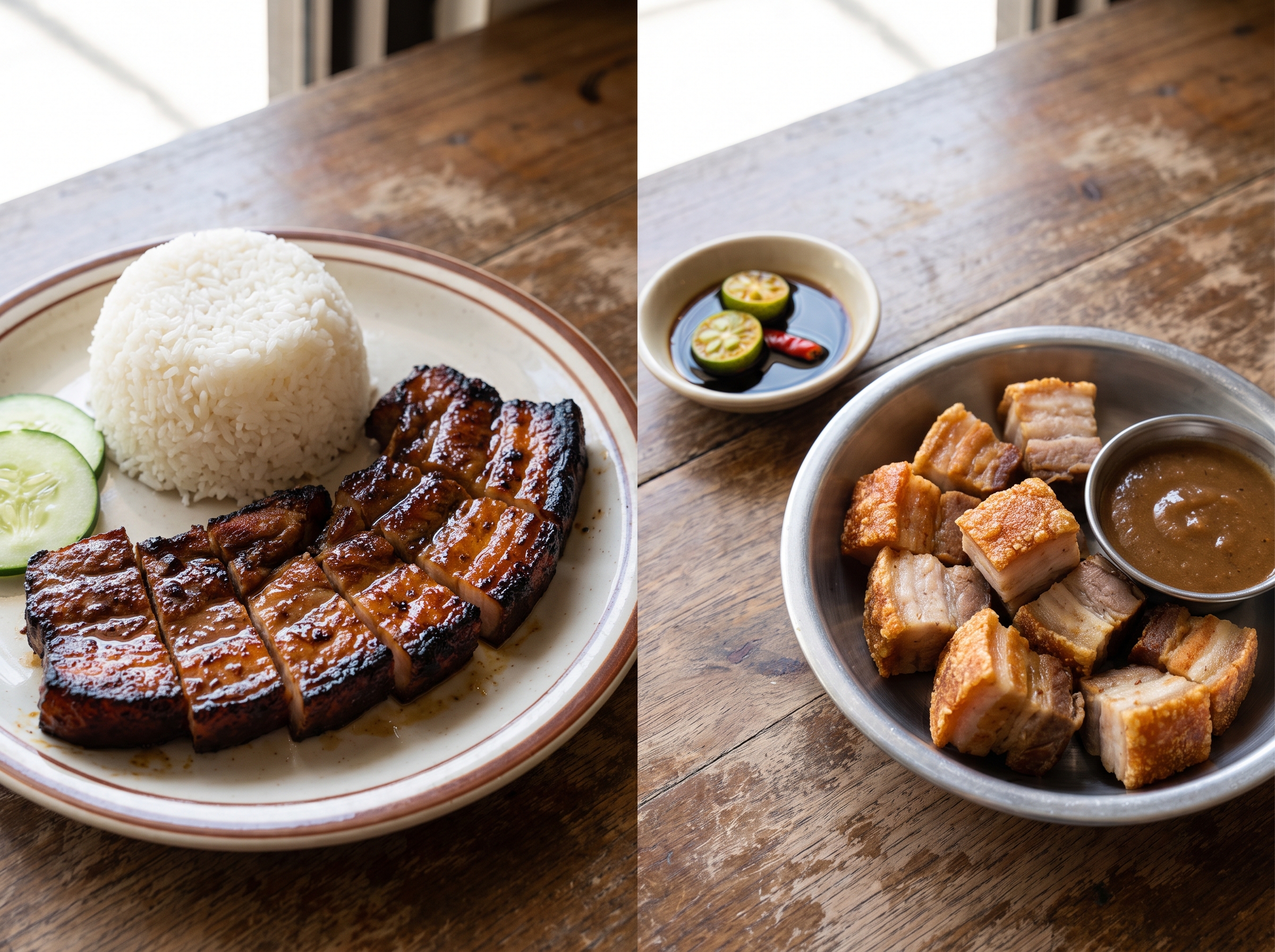
They begin as the same ingredient. Liempo is pork belly. Lechon kawali is also made from pork belly — often literally called "liempo" or "lechon kawali cut" at the Filipino butcher counter. The two dishes diverge entirely in the cooking method, and that divergence is what defines each one.
Inihaw na liempo is marinated raw pork belly, grilled directly over hot charcoal. The technique is quick, direct heat, usually 20 to 30 minutes total, turned and basted along the way. The result is smoky, charred at the edges, tender rather than crisp, and best eaten hot off the grill.
Lechon kawali takes a completely different path. The pork belly is first boiled — often with garlic, peppercorns, bay leaf, and salt — until fully tender, then air-dried, then deep-fried, sometimes twice, until the skin blisters and shatters into a crackling, audibly crunchy crust. The name itself gives away the method: kawali means "wok" or "frying pan" in Tagalog, referencing the deep-frying step. Where liempo is smoky and tender, lechon kawali is crisp and rich, usually served in cubes with a lechon sauce made from liver, or with the same toyomansi used for liempo.
Here's the quickest way to keep them straight:
🔥 Liempo (inihaw na liempo) — marinated, grilled over charcoal, smoky and tender, eaten in slices, cooked once and served hot off the fire
🍳 Lechon kawali — boiled first, then deep-fried, crisp skin and tender interior, served in cubes, involves two full cooking stages
Both dishes are Filipino pork belly at their best, and most Filipino households genuinely love both — they simply serve different purposes. Liempo is the dish for a backyard grill session, a beach trip, or anytime charcoal and a lighter are within reach. Lechon kawali is the dish for when you want that specific, shattering crackle of fried skin, and don't mind the extra step of boiling first. Neither one replaces the other, which is exactly why Filipino menus, food carts, and family recipe boxes tend to keep both recipes in permanent rotation.
✅ Cooking Liempo the Right Way
Liempo is forgiving, but a few details separate a good piece from a great one.
Marinate, but don't over-marinate. Calamansi and other citrus juices are acidic, and while that acid helps tenderize the pork and brightens the flavor, leaving liempo in an overly acidic marinade for too long can start to break down the meat's texture and make it mushy rather than tender. A marinating window of a few hours up to overnight is the general range most Filipino home cooks use, with shorter times for smaller, thinner cuts.
Let the fire do the work, but don't let it burn. Because the marinade typically contains sugar — from banana ketchup, brown sugar, or both — liempo caramelizes fast and can go from perfectly charred to burnt in a short window. Cooking over medium-hot coals rather than the highest possible flame, and basting as you go rather than dumping all the sauce on at once, helps develop that deep caramelized color without scorching the sugar into bitterness.
Cook pork belly through. As with any pork, food safety guidance recommends cooking pork to a safe internal temperature — the USDA recommends pork be cooked to at least 145°F (about 63°C) with a rest time, or well done if preferred, and ground pork to 160°F (71°C). Liempo, sliced thick and grilled directly, typically reaches a safe internal temperature well within a normal grilling time, but a meat thermometer takes the guesswork out of it, especially with thicker cuts.
Rest it briefly before slicing. A short rest off the grill lets the juices settle back into the meat instead of running out the moment you cut into it — a small step that makes a real difference in the final bite.
🗺️ Liempo Across the Philippines — and Beyond
Grilled pork belly shows up everywhere in the Philippines, but the way it's served shifts depending on where you are and what the occasion calls for.
Roadside ihawan stalls are where a lot of people first fall in love with liempo — small charcoal grill setups along highways and street corners, smoke visible from a distance, plastic tables and chairs set up nearby. Order by the kilo, and it arrives sliced, hot, with rice and a small bag of toyomansi.
Beach outings and provincial gatherings treat liempo as the anchor of a full spread — grilled alongside inihaw na isda (grilled fish), fresh seafood, and rice, often piled onto banana leaves for a full boodle fight rather than served on individual plates.
Urban backyard parties , particularly in Metro Manila and other cities, treat liempo as party food in the most literal sense: the dish that goes on the grill the moment guests arrive, cooked in batches throughout the so there's always a fresh, hot plate coming off the afternoon fire.
In the Filipino diaspora , liempo has become one of the most recognizable Filipino dishes at community gatherings — church potlucks, Filipino-American backyard parties, Filipino food festivals from California to Toronto to the Middle East. It travels well conceptually even when the exact ingredients require a trip to an Asian grocery store: pork belly is widely available internationally, and banana ketchup has become easier to find outside the Philippines as Filipino food has gained global visibility.
That global visibility is worth pausing on. Pork belly as an ingredient has been trending well beyond Filipino cuisines in recent years, driven in large part by the international rise of Korean barbecue, ramen, and other Asian cuisines that showcase the cut. Industry reports tracking the global pork belly market point to steady growth driven by demand for the cut across Asian-inspired menus, premium dining, and home cooking alike. Liempo sits at an interesting intersection of that trend: it is one of the original grilled pork belly preparations, with a marinade tradition — soy, citrus, banana ketchup — that is distinct from Korean, Chinese, or Japanese versions of the same cut, and increasingly, it's the version curious eaters are seeking out once they've tried the others.
🗣️ Learn the Tagalog
Liempo comes with its own vocabulary — the language of the grill, the marinade, and the backyard party built around it.
The dish and the cut:
Liempo (lee-EM-poh) — pork belly; also used to refer to the grilled dish itself
Inihaw (ee-nee-HAW) — grilled; the cooking method that defines the dish
Inihaw na liempo (ee-nee-HAW nah lee-EM-poh) — grilled pork belly, the full name of the dish
Baboy (BAH-boy) — pig or pork, the source ingredient
Lechon kawali (leh-CHON kah-WAH-lee) — deep-fried pork belly, liempo's crispy cousin
Litson (LIT-son) — an alternate spelling of lechon, used interchangeably in some regions
The marinade and the sauce:
Toyo (TOH-yoh) — soy sauce, the marinade's savory backbone
Kalamansi (kah-lah-MAHN-see) — calamansi, the small citrus fruit that gives liempo its brightness
Toyomansi (toh-yoh-MAHN-see) — the classic dipping sauce, soy sauce mixed with calamansi juice
Bawang (bah-WAHNG) — garlic, present in nearly every liempo marinade
Suka (SOO-kah) — vinegar, sometimes used in the marinade or as part of the dipping sauce
Uling (OO-ling) — charcoal, the traditional and preferred fuel source for grilling liempo
At the party:
Ihawan (ee-HAH-wahn) — a grilling station or roadside grill stall
Boodle fight — a communal, hands-only feast served on banana leaves, liempo's favorite occasion
Kamayan (kah-MAH-yahn) — eating with your hands, the style used at a boodle fight
Sawsawan (saw-sah-WAHN) — dipping sauce, the general term covering toyomansi and other condiments
Isa pa! (EE-sah PAH) — one more, please! The most common phrase heard once the platter starts making the rounds
Ang sarap! (ahng sah-RAHP) — so delicious! The natural response to the first bite
Kain na tayo! (KAH-in nah TAH-yoh) — let's eat! The signal that the liempo is finally off the grill
🎨 Color It!
Bring Filipino food to life in a whole new way — through art.
Our Filipino Food Coloring Book on Amazon was built from questions exactly like this one. Every page is a dish with a story. Every coloring session is an invitation to remember.
That makes it especially meaningful for:
🌼 Families who want a creative activity that naturally opens a conversation about Filipino food heritage
🌼 Filipino parents and grandparents sharing their regional food traditions with the next generation
🌼 Adults and seniors who find nostalgia, mindful creativity deeply satisfying
🌼 Anyone in the Filipino diaspora who wants a quiet, beautiful way to hold onto what home tastes like
🌼 Teachers, homeschoolers, and community groups exploring Filipino food and culture through art
👉 Get your FREE Filipino Coloring pages here.
👉 What Filipino Food Are You? Take the quiz →
🤩 Fun Facts About Time
1. Banana ketchup was a wartime invention. During World War II, when tomatoes were scarce in the Philippines, banana ketchup was developed as a substitute using local bananas, dyed red to resemble the condiment people already knew. It never went away — and today it's one of the ingredients that makes liempo marinade taste unmistakeably Filipino.
2. Liempo and lechon kawali come from the exact same cut. The only difference between the two beloved dishes is the cooking method: grilling versus boiling-then-frying. Same pork belly, two completely different textures.
3. The word "baboy" may predate Spanish colonization. The Tagalog word for pig is believed to trace back to the Indo-Malay word babi , suggesting pork has been part of Filipino food culture since some of the archipelago's earliest inhabitants.
4. Liempo is the anchor dish of the modern boodle fight. Although the boodle fight tradition began in the Philippine military, grilled pork belly became one of its most consistent centerpiece dishes once the custom spread into civilian celebrations — largely because it holds up so well piled onto rice and eaten by hand.
5. Liempo doubles as the base for other dishes. Chopped grilled liempo shows up in Sinuglaw, a Visayan dish that combines it with fish ceviche, and in "special" versions of tokwa't baboy, which normally uses boiled pork but gets a smokier upgrade with grilled liempo instead.
6. Bacon comes from the same cut as liempo. Pork belly is the international cut used to make bacon in most Western countries — meaning liempo and your breakfast bacon starts from the same part of the pig, just prepared in completely different directions.
7. The marinating time matters more than people think. Because calamansi and other citrus juices are acidic, marinating too long can actually make the texture mushy rather than tender. A few hours to overnight is the general sweet spot most Filipino home cooks aim for.
8. Liempo has no single "correct" marinade. Every family seems to have its own version — some lean on banana ketchup, some skip it entirely in favor of a saltier soy-and-calamansi base, some add a splash of lemon-lime soda for extra tenderness. Ask five Filipino households for their liempo marinade and expect five different answers, each passionately defended.
9. Pork belly is currently one of the most in-demand cuts globally. Industry market research consistently points to pork belly as a rising cut internationally, driven by its role in Korean barbecue, ramen, and fusion cuisine — placing liempo in good company as global interest in the cut continues to climb.
10. The char is not a mistake — it's the point. Because the marinade almost always contains sugar, it caramelizes and chars at the edges by design. That slightly bitter, deeply savory char is considered essential to the dish, not a sign it went wrong on the grill.
11. Liempo shows up at nearly every kind of Filipino gathering. Birthdays, parties, funerals, graduations, beach trips, Sunday lunches — there is almost no Filipino occasion where grilled pork belly would feel out of place on the table.
🌍 How Liempo Connects Filipinos Everywhere
Ask a Filipino what their family grills for a party, and liempo comes up almost every time — not because it's the most elaborate dish on the table, but because it's the one that turns a gathering into an event. The smell of pork belly hitting hot charcoal is one of those sensory triggers that pulls people toward the backyard before anyone even announces the food is ready.
That's part of why liempo travels so well emotionally, even when it can't always travel physically. For Filipinos abroad, recreating a backyard liempo grill-out — complete with a makeshift charcoal setup, a marinade mixed from memory, and banana leaves laid out for a boodle fight — is one of the most direct ways to bring a piece of home into a new country. It doesn't require a special occasion, and it doesn't require perfect execution. It requires pork belly, a hot grill, and people willing to gather around it.
This is also why liempo sits so comfortably inside the broader Filipino barbecue tradition, alongside dishes like pork barbecue skewers, chicken inasal, and isaw. They all share the same DNA: charcoal, a marinade built on soy sauce and citrus, and food meant to be eaten standing up, plate in one hand, with people you like standing close by. Liempo just happens to be the one most likely to anchor the whole spread — the dish that goes on the grill first and disappears from the platter fastest.
For newcomers to Filipino food, liempo is also one of the easiest entry points. It doesn't ask you to try something unfamiliar in concept — it's pork belly, grilled, which most cuisines have some version of. What makes it distinctly Filipino is everything wrapped around it: the banana ketchup, the toyomansi, the calamansi, and the whole social ritual of the boodle fight or the backyard cookout that so often surrounds it.
❓ FAQ — Everything You Need to Know About Liempo
What is liempo? Liempo is the Filipino word for pork belly, and it's also the everyday name for inihaw na liempo — pork belly marinated in soy sauce, calamansi, garlic, and often banana ketchup, then grilled over charcoal until charred and caramelized. It's one of the most popular grilled dishes in Filipino cuisine.
What is the difference between liempo and lechon kawali? Both come from the same cut of pork belly. Inihaw na liempo is marinated and grilled directly over charcoal, giving it a smoky, tender bite. Lechon kawali is boiled first, then deep-fried, giving it a crisp, crackling skin and a completely different texture. They are two different dishes made from the same starting ingredient.
What does liempo taste like? Smoky, savory, and slightly sweet, with a caramelized char on the outside from the banana ketchup and sugar in the marinade, and a juicy, tender interior from the marbled fat in the pork belly. It's typically served with a soy-calamansi dipping sauce called toyomansi.
What cut of pork is liempo? Liempo is pork belly — the same primal cut used internationally for bacon — typically sliced into thick strips or slabs with a balanced mix of meat, fat, and sometimes skin, which is what makes it well-suited to grilling.
Where does banana ketchup come from? Banana ketchup was developed in the Philippines during World War II, when tomatoes were hard to find and Filipino food technologists created a substitute using local bananas, dyed red to resemble tomato ketchup. It became a permanent fixture in Filipino cooking and remains a defining ingredient in many liempo marinades today.
Is liempo the same as pork belly? Yes — liempo is the general Tagalog word for pork belly as an ingredient, while inihaw na liempo refers to the specific grilled dish made from it. In casual conversation, "liempo" often refers to the finished grilled dish.
What is a boodle fight, and how does it relate to time? A boodle fight is a Filipino communal dining tradition, rooted in Philippine military practice, where food is piled onto banana leaves along a long table and eaten by hand, standing shoulder to shoulder. Grilled pork belly is one of the most common centerpiece dishes at a boodle fight because it holds up well when piled directly onto rice.
Can you cook liempo without a charcoal grill? Yes — many home cooks use a stovetop grill pan or oven broiler when charcoal isn't available, although the flavor won't be quite as smoky. Charcoal remains the traditional and preferred method because of the char and smokiness it imparts, which most Filipino cooks consider essential to the dish.
💛 Closing
Liempo doesn't need an introduction in most Filipino households, and it doesn't ask for much in return, either. A good marinade, a hot fire, and a little patience while it grills — that's the whole ask. What it gives back is disproportionate: the smell that pulls everyone toward the backyard, the char that means it's almost ready, the first slice that someone inevitably eats standing over the grill before it even reaches the table.
That's the real reason liempo shows up at nearly every kind of Filipino gathering, from a quiet Sunday lunch to a full backyard fiesta with banana leaves down the length of the table. It scales up or down without changing its character. It's just as much as it is feeding four people at a weeknight dinner as it is feeding forty at a boodle fight.
At Studio Tributes, we tell the stories of Filipino food because Filipino food is worth knowing deeply — not just the recipe, but the history behind the banana ketchup, the military roots of the feast it so often anchors, and the reason pork belly has been part of Filipino cooking since long before it became a global trend.
The next time the charcoal starts smoking and someone hands you tongs you didn't ask for, you'll know exactly what's about to happen, and exactly why it's worth the wait.
Get the grill going. Enough it one more time. Isa pa.
Keep exploring Filipino food and culture with us:
🎨 Get our Filipino Food Activity Book on Amazon 📚 Read more Filipino food stories on our blog
💭 A Memory to Hold Onto
Did liempo bring a backyard back to you?
Maybe it's the uncle who always claimed the grill and the tongs, no vote required.
Maybe it's the specific marinade your family swears by — banana ketchup or none, and why the debate never really ends.
Maybe it's a boodle fight, banana leaves down the whole table, everyone reaching in at once.
Maybe it's the smell of charcoal smoke drifting through a backyard on the other side of the world from where you grew up, and how it stopped you mid-step the first time you caught it again.
Banana ketchup marinade or straight soy and calamansi — which side are you on? Liempo or lechon kawali, if you could only pick one for the rest of your life? Who ran the grill at your family's parties — and are they still in charge?
If a memory came to mind, share your liempo story on Facebook or Instagram and tag @StudioTributes — we would love to hear it.
Read Next
📚 References & Further Reading
Wikipedia — Lechon Kawali — Reference for the dish classification, alternate names, and the boil-then-fry preparation method that distinguishes it from grilled liempo.
Kawaling Pinoy — Inihaw na Liempo — Reference for the standard marinade ingredients and food-safety guidance around marinating time.
The Domestic Man — Inihaw na Liempo — Reference for the etymology of "baboy" and the pre-colonial roots of pork in Filipino cuisine, and the wartime origin of banana ketchup.
Panlasang Pinoy — Inihaw na Liempo — Reference for the role of banana ketchup in the modern liempo basting sauce and its use across backyard cookouts and parties.
SBS Food — What Is a Boodle Fight? — Reference for the military origins of the boodle fight tradition and its spread into Filipino community gatherings worldwide.
Panlasang Pinoy — Boodle Fight Kamayan Feast — Reference for the Philippine Military Academy origins of the boodle fight and its evolution into a civilian family tradition.
US Foods — Top Food Trends for 2026 — Reference for the rising visibility of Filipino pork belly dishes on menus outside the Philippines.
Studio Tributes is a heritage-centered publishing brand creating premium bilingual books, creative activities, and storytelling experiences that help children, families, and communities celebrate culture, memory, and connection through art, food, and shared traditions.
© 2026 Studio Tributes. Made with warmth and care for children, adults, seniors, families, educators, libraries, retailers and community spaces.