
What Is Noche Buena? The Filipino Christmas Eve Feast Explained
What Is Noche Buena? The Filipino Christmas Eve Feast Explained
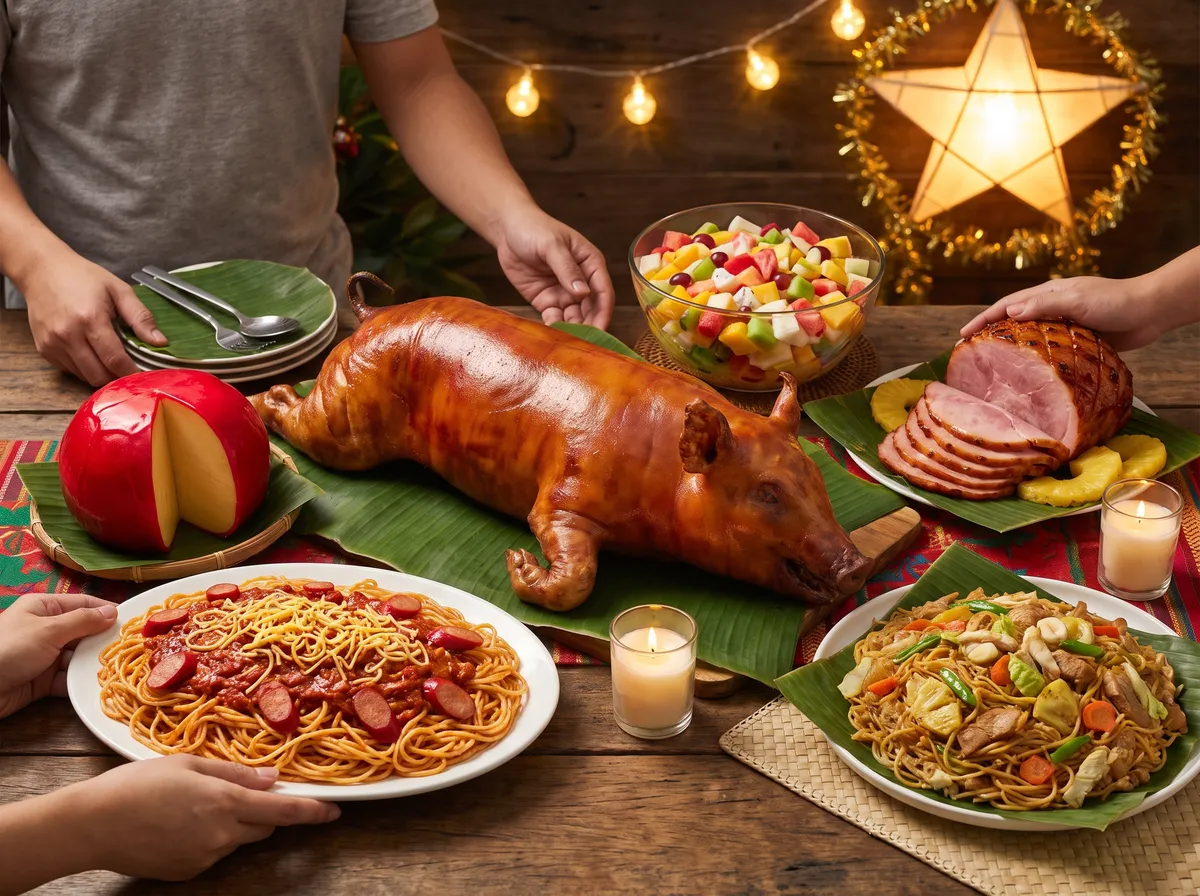
It's 11:45 PM on December 24th somewhere in the Philippines, and a household that's been quiet most of the evening suddenly bursts into motion. The lechon arrives, carried in by two people because a whole roasted pig is heavier than it looks. Someone's uncovering the fruit salad from the refrigerator. The spaghetti—sweet, orange-red, utterly unlike anything you'd find in Italy—gets its final toss. Queso de bola sits wrapped in its distinctive red wax, waiting to be unveiled. Family members start drifting in from Midnight Mass, or gathering around the TV to watch it livestreamed, counting down to the stroke of midnight.
Then midnight hits, hugs and greetings of "Maligayang Pasko" circulate the room, and the feast begins.
This is Noche Buena, and if you've never experienced it, you're missing one of the most food-centric, family-centered, genuinely joyful traditions in Filipino culture. But here's something worth knowing before we go further: much of what sits on that table—the spaghetti, the fruit salad, the queso de bola, even the ham—has a history far more tangled and far less "purely Filipino" than most casual descriptions let on. And that complicated history is actually worth talking about honestly, rather than smoothing over.
Let's dig into what Noche Buena actually is, where it comes from, what's really on the table, and why the question of how "Filipino" this feast truly is deserves a more honest answer than most food articles give it.
The Basics: What Exactly Is Noche Buena?
Noche Buena is the traditional Filipino Christmas Eve feast and family gathering, held late on December 24th, typically centered around midnight, either immediately following Midnight Mass (Misa de Gallo) or timed to coincide with the stroke of twelve.
The term itself is Spanish: "Noche Buena" literally translates to "Good Night," referring specifically to Christmas Eve night in the broader Hispanic Catholic world—the term and the underlying concept of a special Christmas Eve meal exist across Spain and Latin America, not just the Philippines.
The Core Elements
A traditional Filipino Noche Buena involves:
The Timing:
A meal held late at night, typically beginning around midnight
Often preceded by attendance at Midnight Mass (Misa de Gallo), the final and most significant of the Simbang Gabi dawn Masses
Sometimes starting slightly earlier for families with young children, with the formal "feast moment" still centered on midnight
The Gathering:
Extended family convening, often multiple generations under one roof
A sense of occasion distinct from ordinary family dinners
Exchange of greetings, sometimes gift-giving, and significant social and emotional weight
The Food:
A specific, fairly recognizable menu of dishes that has become culturally "expected" for this particular meal
Abundance as a core value—the table should feel generous, even excessive, reflecting both celebration and, historically, gratitude for the year's blessings
The Spirit:
A blend of religious observance (marking Christ's birth) and secular family celebration
Often the single most anticipated meal of the entire Filipino calendar year
The Religious Roots: Noche Buena's Connection to Midnight Mass
To understand Noche Buena properly, you have to understand its connection to Filipino Catholic practice, particularly the culmination of Simbang Gabi.
From Simbang Gabi to Misa de Gallo
As covered in our previous explorations of Bibingka and Puto Bumbong, Simbang Gabi refers to the nine consecutive dawn Masses held December 16-24. The final Mass in this sequence, however, is distinct: rather than occurring at dawn, it's held at midnight on December 24th, transitioning into December 25th, and is specifically called Misa de Gallo (Mass of the Rooster) in some traditions, marking the actual celebration of Christ's birth.
Noche Buena, traditionally, is the meal that follows this midnight Mass—families would attend the service together, then return home (or to a relative's house) to share the feast that had been prepared in advance, breaking what was historically a day of relative restraint or anticipation with a genuinely abundant meal.
The Historical Catholic Framework
This pattern—a period of restraint or fasting followed by a significant feast marking a major religious milestone—reflects broader Catholic liturgical tradition. Christmas Eve, in traditional Catholic practice across many cultures, often involved meatless or simpler eating during the day, with the "Noche Buena" feast specifically marking the transition into the celebratory period of Christmas itself.
In the Philippines, this Spanish Catholic framework merged with local family and social customs to produce the specific version of Noche Buena now considered a core Filipino Christmas tradition.
What's Actually on the Table: The Noche Buena Menu
While individual families have their own specific traditions, certain dishes have become so closely associated with Noche Buena that their absence would seem notable to most Filipino families.
The Centerpiece: Lechon
Lechon (whole roasted pig) frequently serves as the aspirational centerpiece of a Filipino Noche Buena table, particularly for larger family gatherings or households with the budget and logistics to manage it. The crispy skin, tender meat, and sheer visual impact of a whole roasted pig signal genuine celebration and abundance.
The Sweet Spaghetti
Filipino-style spaghetti—notably sweet, often orange-red in color due to the use of banana ketchup, loaded with hot dog slices and sometimes ground meat—is a Noche Buena staple that regularly surprises non-Filipino observers. This dish bears little resemblance to Italian spaghetti and represents a thoroughly localized adaptation that has become inseparable from Filipino celebratory eating, Christmas specifically included.
Queso de Bola
Queso de bola (literally "ball of cheese," referring to Edam cheese wrapped in its distinctive red wax coating) is a near-ubiquitous Noche Buena presence. Its appearance on the table, often as an actual gift item as much as a food to be eaten, carries specific nostalgic and celebratory weight for many Filipino families.
Ham
Christmas ham, often glazed and sometimes a specific imported or locally-produced brand carrying particular cachet (certain ham brands have achieved near-iconic status in Filipino Christmas culture), rounds out the protein offerings alongside or instead of lechon.
Fruit Salad
Filipino fruit salad—a mixture of canned fruit cocktail, cream, condensed milk, and often nata de coco or kaong (sweetened palm fruit strings)—provides a distinctively sweet, creamy dessert-adjacent dish that frequently appears on the Noche Buena table.
Other Common Additions
Pancit (noodles, symbolizing long life, common at celebrations generally)
Embutido (Filipino-style meatloaf, often steamed and sliced)
Morcon (a stuffed, rolled beef dish)
Lumpia (spring rolls)
Various rice cakes and desserts, including Bibingka and Puto Bumbong if the family attended Misa de Gallo and picked some up afterward
The Real Debate: How "Filipino" Is the Modern Noche Buena Menu, Really?
Here's where we need to have an honest, substantive conversation rather than simply presenting this menu as straightforward, timeless Filipino tradition.
The Case That Much of This Menu Is Recent and Colonial/American-Influenced
A closer look at the actual Noche Buena menu reveals something worth sitting with: several of its most iconic, "essential" components are not indigenous Filipino foods at all, but rather reflect fairly recent Spanish and, even more significantly, American colonial influence, some dating back less than a century.
The spaghetti is a 20th-century American-era adaptation: Pasta itself arrived in the Philippines through various trade and colonial channels, but the specific sweet, banana-ketchup-based Filipino spaghetti commonly associated with Noche Buena developed during and after the American colonial period (1898-1946) and gained significant popularity in the mid-20th century, heavily shaped by American food products, canned goods, and processed ingredients becoming available and fashionable.
Queso de bola represents imported Dutch cheese culture: Edam cheese isn't Filipino in origin at all—it's Dutch, and its specific association with Filipino Christmas developed through colonial-era trade and later through its positioning as an imported luxury good, something special precisely because it wasn't locally produced. Its "traditional" status in Filipino Christmas culture is a case of an imported luxury item becoming naturalized as an essential tradition.
Canned fruit cocktail-based fruit salad is distinctly a product of American grocery and canning culture: This dish simply could not exist in its familiar form without American-style canned fruit products becoming widely available in the Philippines, a direct legacy of American colonial-era commercial influence and the subsequent entrenchment of American brands and products in Filipino households.
Christmas ham, particularly specific favored brands, reflects American and Western Christmas food culture transplanted and adapted, rather than any pre-colonial Filipino practice.
Even lechon, while genuinely rooted in longer pre-colonial and early colonial Filipino roasting traditions, became specifically associated with elaborate celebration partly through Spanish colonial-era feast culture, where whole roasted animals marked significant occasions in ways that merged with existing local practices.
The Case for Calling This "Authentically Filipino" Anyway
At the same time, dismissing this menu as merely "colonial leftovers" or "not really Filipino" misses something important and arguably more accurate: food traditions become authentically theirs through sustained practice, adaptation, and cultural meaning-making, not through ingredient or technique purity.
This is a position we've taken consistently when examining Ensaymada (Spanish Mallorcan origins, genuinely transformed into Filipino tradition) and other dishes with complicated colonial histories: the fact that an ingredient, dish, or practice originated elsewhere doesn't disqualify it from legitimate Filipino cultural ownership once it has been thoroughly localized, adapted, and woven into genuine lived tradition across generations.
Filipino-style sweet spaghetti isn't Italian food awkwardly imitated—it's a genuinely distinct dish, with its own specific flavor profile, ingredient logic, and cultural meaning that has nothing to do with how Italians think about pasta. Queso de bola's specific ritual role—unwrapped at the table, often grated or sliced with ceremony, carrying genuine nostalgic weight tied to specific family memories—represents real cultural meaning-making regardless of the cheese's Dutch origin. The fruit salad, in its specific Filipino formulation with condensed milk and nata de coco, doesn't taste like or function like any American fruit salad; it's been thoroughly transformed into something locally specific.
The Stance Worth Taking
The historically honest and culturally productive position holds two truths simultaneously: the modern Noche Buena menu reflects substantial, documented Spanish and especially American colonial influence, often more recent than most celebratory tradition-focused articles acknowledge—AND this menu has become genuinely, authentically Filipino through generations of practice, adaptation, and the accumulation of real cultural and familial meaning.
What's actually worth resisting is the tendency in some food writing and tourism-oriented content to present this specific menu as ancient, unbroken Filipino tradition stretching back centuries, when the reality is that much of what sits on a contemporary Noche Buena table reflects 20th-century American commercial and cultural influence more than it reflects pre-colonial or even early Spanish-colonial Filipino foodways.
This matters for a few reasons beyond simple historical accuracy:
It affects how we think about "authenticity" demands placed on Filipino cuisine broadly. If the most iconic, beloved version of a core Filipino celebration is substantially shaped by 20th-century American commercial culture, this should inform more generous, less purist thinking about what counts as "real" Filipino food in general—tradition is often younger and more constructed than nostalgia suggests, and that's true across virtually all cuisines, not uniquely a Filipino phenomenon.
It acknowledges the complicated reality of Filipino food history without diminishing the holiday's genuine meaning. Recognizing that queso de bola is Dutch cheese and the fruit salad depends on American canning technology doesn't make the Noche Buena table less meaningful to the Filipino families who gather around it—it simply tells a more complete, more interesting story about how Filipino culture absorbs, transforms, and claims ownership over influences from multiple colonial and commercial sources.
It invites more honest conversation about class and the "aspirational" quality of certain Noche Buena staples. Items like queso de bola, imported ham, and lechon have historically carried (and in many cases continue to carry) connotations of relative prosperity and special-occasion spending specifically because of their imported or resource-intensive nature—worth acknowledging rather than presenting the full "traditional" spread as equally accessible to all Filipino households regardless of economic circumstance.
The Lechon Question: Centerpiece or Inaccessible Status Symbol?
Related to the broader authenticity conversation is a more pointed, practical debate about lechon's role specifically.
The Case for Lechon as Essential
Many Filipino families and cultural commentators consider a whole roasted lechon the defining marker of a truly complete, celebratory Noche Buena. Its presence signals:
Genuine effort and investment in the celebration
Sufficient household resources to gather and feed an extended family generously
Continuity with longstanding Filipino feast traditions
The Case for Reconsidering Lechon's Centrality
However, a legitimate, increasingly voiced counter-perspective raises real concerns:
Cost accessibility: A whole lechon represents significant expense, often requiring advance ordering, deposit payments, and costs that can represent a substantial portion of a working-class or lower-middle-class family's monthly budget—creating pressure to spend beyond comfortable means in order to meet a perceived social or cultural expectation.
Debt and financial strain: Social and cultural pressure to produce an "impressive" Noche Buena spread, with lechon as the visible marker of success, can contribute to Filipino families taking on holiday debt or financial strain specifically to meet these expectations—a pattern recognized and discussed within Filipino personal finance and cultural commentary circles.
The equation of abundance with lechon specifically: Critics of this framing argue that conflating "proper" or "complete" Noche Buena specifically with lechon's presence unfairly diminishes families who celebrate meaningfully and abundantly through other means—emphasizing togetherness, other dishes, and genuine family connection without a whole roasted pig as the centerpiece.
A Reasonable Position
The more balanced, reasonable take acknowledges that lechon's cultural significance as a celebratory centerpiece is real and legitimate, but shouldn't be treated as a mandatory marker of a "proper" or "complete" Noche Buena. Families who celebrate with ham, fried chicken, or other more budget-accessible proteins as their centerpiece are participating just as authentically in the Noche Buena tradition as those serving lechon. The core elements that actually define Noche Buena—family gathering, marking Christ's birth, shared abundance relative to one's own means, and genuine togetherness—don't require any single specific dish to be present.
The Timing Debate: Strictly Midnight, or Whenever Works?
A smaller, more practical debate concerns Noche Buena's timing itself.
The Traditional Midnight Framework
Historically and ideally, Noche Buena is timed around midnight, following Midnight Mass, with the meal beginning right as December 25th technically arrives—creating a meaningful transition from Christmas Eve anticipation into Christmas Day celebration.
The Practical Modern Adaptation
In contemporary practice, particularly among families with young children, elderly members, or simply practical scheduling constraints, many Filipino households have shifted Noche Buena earlier—sometimes beginning the feast at 9 or 10 PM, or occasionally even earlier, without necessarily attending Midnight Mass immediately beforehand (some families attend an earlier evening Mass option instead, where available, or skip Mass attendance that specific night while still honoring the broader holiday).
Why This Shift Is Reasonable Rather Than a Loss of Tradition
Rather than treating this timing flexibility as tradition eroding, it's more productive to view it as sensible adaptation that preserves the core meaning (family gathering, marking Christmas, shared abundant meal) while accommodating contemporary family logistics—small children who cannot reasonably stay awake until midnight, elderly family members for whom very late hours pose genuine difficulty, or simply the practical reality of coordinating a large extended family's schedules.
Noche Buena in the Filipino Diaspora
For Filipinos living abroad, Noche Buena carries particular emotional weight and practical challenges.
Recreating the Feast Away From Home
Overseas Filipino communities frequently organize their own Noche Buena celebrations, often involving:
Filipino community organizations or churches hosting collective gatherings
Families sourcing specific ingredients (queso de bola, Filipino-style hot dogs for the spaghetti, banana ketchup) through Filipino or Asian grocery stores
Adapting the midnight timing to accommodate different time zones relative to the Philippines, or maintaining local midnight timing regardless
The Emotional Significance
For OFWs specifically, Noche Buena often represents one of the most acutely felt moments of homesickness during the holiday season—video calling family back home during the feast, or recreating as much of the traditional spread as possible specifically to feel connected to home despite physical distance.
The Imported Ingredient Challenge
Sourcing specific "essential" Noche Buena ingredients abroad—particular ham brands, queso de bola, Filipino hot dogs, banana ketchup for the spaghetti—can require deliberate effort, often involving Filipino specialty grocers, and sometimes substituting with reasonably close alternatives when exact products aren't available.
Regional and Family Variations
While certain dishes have become broadly iconic, Noche Buena shows meaningful variation across different Filipino regions and individual family traditions.
Regional Differences
Different regions may emphasize different proteins, incorporate more regionally specific dishes alongside (or instead of) the "standard" Manila-centric menu, or adjust sweetness and flavor profiles according to local palates.
Family-Specific Traditions
Many Filipino families maintain their own specific Noche Buena traditions passed down through generations—a particular recipe for morcon, a specific way of preparing the fruit salad, particular gift-giving customs that accompany the meal, or specific seating and serving rituals that hold meaning for that particular family, regardless of how closely they align with any "standard" menu.
The Health Question: A Once-a-Year Reality Check
Given the sheer abundance and richness typically on display, it's worth briefly addressing the nutritional reality of a traditional Noche Buena spread.
The Nutritional Reality
A typical Noche Buena table, featuring lechon or ham, sweet spaghetti, queso de bola, and cream-based fruit salad, represents a meal high in:
Saturated fat (from pork, cheese, cream)
Refined carbohydrates (spaghetti, bread)
Sugar (sweet spaghetti sauce, fruit salad, various desserts)
Sodium (cured meats, cheese)
The Appropriate Context
Noche Buena was never intended as a template for regular eating—it's explicitly a once-a-year, deliberately abundant and indulgent celebration meal. Approaching it with the same health-conscious restraint one might apply to everyday eating somewhat misses the point of the occasion; this is one of the few meals in Filipino culinary culture explicitly designed around abundance and indulgence as core values, tied to genuine celebration rather than everyday sustenance.
Reasonable moderation remains sensible for those managing specific health conditions, but understanding Noche Buena's cultural role as an intentional, occasional exception to everyday eating patterns provides useful context for how to think about it.
Why Noche Buena Matters Beyond Being a Meal
This feast carries significance well beyond the food itself.
A Culmination of Weeks of Anticipation
Noche Buena represents the culmination of the entire Simbang Gabi season—nine days of dawn Masses, weeks of Christmas preparation, and building anticipation that reaches its peak at this specific midnight moment. This structural buildup gives the feast emotional weight beyond what the food alone could provide.
Family Reunion and Reconnection
For many Filipino families, Noche Buena represents one of the few occasions in the year when extended family members—including those working abroad who manage to come home for the holidays, or relatives scattered across different provinces or cities—gather together under one roof. The meal becomes a vehicle for reconnection, catching up, and reaffirming family bonds.
A Living, Evolving Tradition
As explored through the authenticity debate, Noche Buena demonstrates how Filipino traditions continue evolving, absorbing new influences, and generating genuine cultural meaning regardless of the complicated, sometimes recent and colonially-influenced origins of specific menu components. This isn't a weakness in the tradition—it's evidence of a living culture actively making meaning rather than simply preserving an unchanging museum piece.
Economic Activity and Seasonal Significance
The Noche Buena season drives significant economic activity throughout the Philippines—grocery sales, meat and lechon vendors, ham and cheese imports, and various food businesses all experience meaningful seasonal spikes tied directly to this specific celebration, supporting livelihoods throughout the food supply chain.
Ready to Experience Noche Buena? Here's Your Action Plan
Whether you're Filipino or simply curious about this tradition, here's how to engage with it meaningfully.
For Those in the Philippines
Attend Misa de Gallo if possible: Experiencing the full tradition, including the Midnight Mass that precedes the feast, provides richer context for Noche Buena's significance.
Contribute to the family effort: If gathering with extended family, consider what dish or contribution you might bring, participating actively in the collective preparation rather than simply arriving to eat.
Reflect on what belongs on your table: Whether you include lechon, ham, or other proteins, recognize that the specific menu matters less than the gathering and intention behind it.
For Those Abroad
Seek out Filipino community celebrations: Many cities with significant Filipino populations host community Noche Buena gatherings, particularly through churches or cultural organizations.
Source what ingredients you can: Filipino or Asian grocery stores often carry key Noche Buena ingredients—queso de bola, banana ketchup, Filipino-style hot dogs—allowing reasonably authentic recreation.
Connect with family virtually if physical gathering isn't possible: Video calls during the feast itself, even across significant time zone differences, help maintain the emotional connection central to the tradition.
For the Truly Curious
Approach the menu's history honestly: Appreciate both the genuine colonial and American commercial influence on specific dishes and the authentic Filipino cultural meaning those dishes have accumulated over generations.
Consider the economic dimension: Reflect on how expectations around specific "impressive" dishes like lechon can create financial pressure, and consider how genuine celebration doesn't require meeting every traditional marker.
Share thoughtfully: If discussing Noche Buena with others unfamiliar with the tradition, consider presenting its complicated, layered history rather than a simplified, purely "ancient tradition" narrative.
The Last Toast
Noche Buena represents something genuinely beautiful about how Filipino culture works: taking influences from Spanish Catholic practice, American commercial culture, Dutch imported cheese, and homegrown Filipino feast traditions, and weaving them into something that, despite its layered and sometimes surprisingly recent origins, carries deep, authentic meaning for millions of Filipino families every December 24th.
The sweet spaghetti isn't less meaningful for being a 20th-century American-influenced invention. The queso de bola isn't less special for being Dutch cheese reimagined through Filipino Christmas ritual. And the whole tradition isn't less authentically Filipino for being younger and more constructed than nostalgic descriptions often suggest.
What matters is what happens around that table at midnight—the greetings exchanged, the family members embraced, the collective acknowledgment that another year has passed and another Christmas has arrived, shared with the people who matter most.
The next time you find yourself at a Noche Buena table, whether in the Philippines or thousands of miles away, take a moment to appreciate the layered, complicated, genuinely fascinating history sitting right there on your plate alongside the lechon and the sweet spaghetti. It's a more interesting story than "ancient unbroken tradition," and arguably a more honest tribute to how Filipino culture actually works: not through purity, but through the confident, ongoing act of making something truly their own.
Maligayang Pasko, and enjoy the feast.
Keep the Filipino Food Journey Going
Want to share the joy of Filipino food culture with the little ones in your life?
Our Filipino Food Coloring Book brings beloved traditions like Noche Buena, Bibingka, Puto Bumbong, and more to life through beautiful illustrations that kids (and kids at heart) can color and learn from. It's a fun, creative way to introduce Filipino culinary heritage and Christmas traditions to the next generation while celebrating the foods and gatherings that connect us to our roots.
Each page features a different iconic Filipino dish or tradition with educational tidbits that make learning about culture delicious and engaging. Perfect for Filipino families wanting to pass down holiday traditions, educators teaching about diverse cultures, or anyone who loves Filipino food and wants to celebrate it in a creative way.
Get your Filipino Food Coloring Book here and start a colorful conversation about the foods and traditions that make Filipino Christmas celebrations so special.
What's non-negotiable on your family's Noche Buena table? Is lechon essential, or does your family celebrate just as fully without it? And does learning about the American and Dutch influences on "traditional" dishes change how you think about the meal? Share your Noche Buena traditions and thoughts in the comments below!
For more deep dives into Filipino food culture, check out our explorations of Bibingka, Puto Bumbong, Ensaymada, and Silvanas, and subscribe to stay updated on future posts celebrating the foods that connect us to home, history, and each other.
References and Further Reading
To ensure accuracy and depth in exploring Noche Buena and the historical origins of its traditional menu, this article drew from various sources on Filipino Christmas traditions, colonial food history, and Catholic liturgical practice:
On Noche Buena and Filipino Christmas Traditions:
Fernandez, Doreen G. Tikim: Essays on Philippine Food and Culture. Anvil Publishing, 1994.
"Christmas in the Philippines: Food Traditions and Celebrations." Positively Filipino, cultural essays.
Javellana, Rene B. Fiesta: Ang Kasaysayan at Kultura ng Pista sa Pilipinas. Ateneo de Manila University Press, 2019.
On Simbang Gabi and Misa de Gallo:
"Simbang Gabi: History and Significance of the Philippine Christmas Tradition." Catholic Bishops' Conference of the Philippines.
"Misa de Gallo and the Religious Roots of Filipino Christmas Eve." Philippine Star, cultural and religious features.
On American Colonial Influence on Filipino Food:
Matejowsky, Ty. Fast Food Globalization in the Provincial Philippines. Lexington Books, 2018.
Civar, Felice Prudente Sta. Maria. The Governor-General's Kitchen: Philippine Culinary Vignettes and Period Recipes 1521-1935. Anvil Publishing, 2006.
"How American Colonization Shaped Filipino Food Culture." Esquire Philippines, culinary history features.
On Filipino-Style Spaghetti and Processed Food Adaptation:
"The History Behind Filipino Spaghetti." Kawaling Pinoy, dish history and recipes.
"Why Filipino Spaghetti Is Sweet: A Culinary History." Atlas Obscura, food history features.
On Queso de Bola and Imported Food Traditions:
"Queso de Bola: The Story Behind the Philippines' Christmas Cheese." Spot.ph, food culture articles.
"Edam Cheese's Journey from the Netherlands to Filipino Christmas Tables." Rappler, cultural food reporting.
On Lechon and Filipino Feast Culture:
Alejandro, Reynaldo. The Philippine Cookbook. Penguin Books, 1985.
"Lechon: The Centerpiece of Filipino Celebration." Business Mirror, culinary feature articles.
"The Cost of Christmas: Examining Holiday Spending Pressure in Filipino Households." Rappler, personal finance and cultural reporting.
On Catholic Christmas Eve Traditions Broadly:
"Noche Buena Across the Hispanic Catholic World." Encyclopedia Britannica, comparative religious and cultural entries.
"The Liturgical Significance of Christmas Eve in Catholic Tradition." United States Conference of Catholic Bishops.
On Filipino Diaspora Christmas Traditions:
Manalansan, Martin F. "Beyond Authenticity: Rerouting the Filipino Culinary Diaspora." Eating Asian America: A Food Studies Reader, NYU Press, 2013.
"How Overseas Filipinos Maintain Christmas Food Traditions." Rappler, diaspora culture reporting.
On Filipino Celebratory Food and Economic Class:
"Christmas Spending and Economic Pressure in the Philippines." Philippine Star, economic and cultural analysis.
Parreñas, Rhacel Salazar. Servants of Globalization: Migration and Domestic Work. Stanford University Press, 2015.
Nutritional Information:
United States Department of Agriculture (USDA) FoodData Central. Nutritional profiles for roasted pork, processed meats, and cream-based dishes.
Cultural and Contemporary Sources:
Field observations and documentation of contemporary Filipino Noche Buena celebrations across different regions and economic contexts
Contemporary Filipino food blogs and holiday tradition documentation
Filipino diaspora community discussions on recreating Noche Buena abroad
Culinary historical research on colonial-era food product introduction and adoption in the Philippines
This article represents a synthesis of published research, documented colonial and religious history, and ongoing conversations within Filipino food and cultural communities both in the Philippines and globally. The historical origin claims regarding specific menu items reflect documented food history research, and the editorial perspective on authenticity and tradition presented here is offered as one informed viewpoint within an ongoing, legitimate cultural conversation rather than a final or universally agreed-upon conclusion.