
What Is Bibingka? The Filipino Christmas Rice Cake Guide
What Is Bibingka? The Filipino Christmas Rice Cake Guide
Here's a sound that means Christmas has officially arrived in the Philippines: the early morning church bells calling the faithful to Simbang Gabi, followed almost immediately by another sound—the sizzle of banana leaves hitting hot clay pots, and the unmistakable aroma of coconut milk and rice flour cooking over glowing charcoal.
That smell, wafting through church courtyards and street corners at 4 AM in December, belongs to one food: Bibingka.
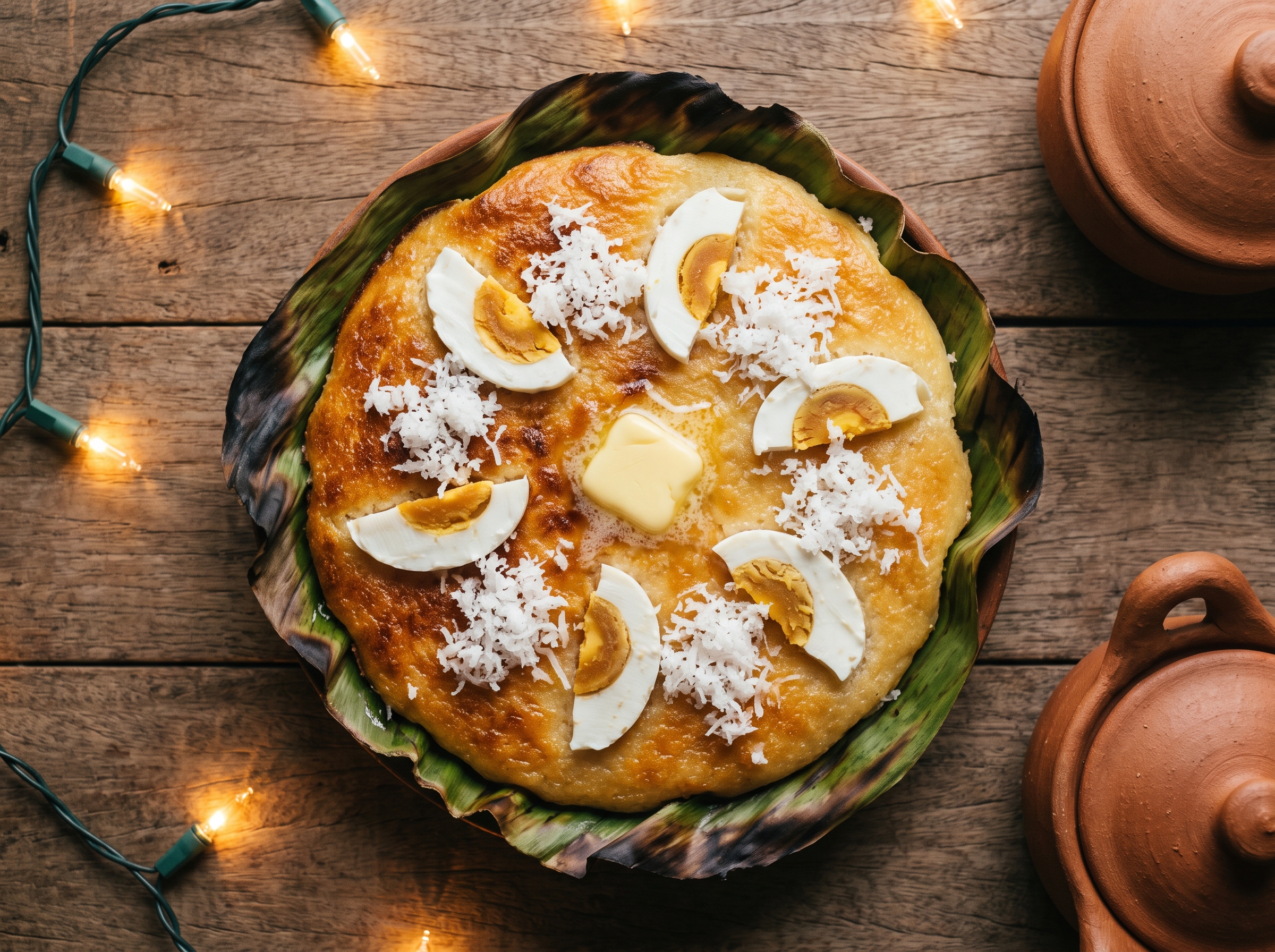
If you've never experienced it, imagine this: You've just come out of a pre-dawn Mass, the air still cool (by Philippine standards), string lights twinkling from nearby stalls, and there—steaming, golden, and impossibly fragrant—sits a rice cake unlike anything you've tasted before. Someone hands you a slice wrapped in banana leaf, topped with a pat of melting butter, a slice of salted egg, and a sprinkle of fresh grated coconut. You take a bite, and suddenly you understand why Filipinos will brave the early morning cold for weeks straight just to have this experience.
This is Bibingka, and it's about to become essential knowledge for your Filipino food education.
The Basics: What Exactly Is Bibingka?
Bibingka is a traditional Filipino rice cake made from galapong (fermented rice flour), coconut milk, and eggs, traditionally cooked in clay pots lined with banana leaves, with heat applied from both above and below using charcoal.
The name "Bibingka" likely derives from old Tagalog, though its exact etymology remains debated among linguists. What's not debated is its cultural significance: Bibingka is inextricably linked to Simbang Gabi (Night Mass), the nine-day series of dawn Masses leading up to Christmas that represents one of the most beloved Filipino Catholic traditions.
The Essential Elements
A traditional Bibingka includes:
The Batter Base:
Galapong (fermented rice flour, traditionally made from soaked and ground rice)
Coconut milk (gata)
Eggs
Sugar
Baking powder (in modern versions) or reliance on natural fermentation (traditional versions)
The Toppings:
Salted egg (itlog na maalat), sliced
Fresh grated coconut (niyog)
Butter or margarine
Sometimes cheese (a modern addition causing its own debates, which we'll get to)
The Cooking Vessel:
Traditional clay pot (lined with banana leaves)
Charcoal placed both underneath AND on top of the lid, creating even heat from both directions
This dual-heat cooking method is crucial to authentic Bibingka—it's essentially an ancient version of a convection oven, creating that distinctive caramelized top while keeping the inside moist and tender.
The Linguistic and Cultural Origins
Bibingka's history connects to broader Southeast Asian rice cake traditions, though it has evolved into something distinctly Filipino.
Pre-Colonial and Colonial Roots
Rice cakes cooked in clay vessels existed in the Philippines before Spanish colonization, as rice has been a staple crop for thousands of years. The technique of using banana leaves as a natural non-stick liner and flavor enhancer predates colonial influence significantly.
What likely evolved over time:
Spanish colonial period: Introduction of certain ingredients and possibly refinement of techniques
Chinese trading influence: Some food historians note similarities to Chinese rice cake traditions, particularly in the use of rice flour and steaming/baking techniques
Indigenous innovation: The specific combination of galapong, coconut milk, and the clay pot cooking method represents genuine Filipino culinary innovation
Why Christmas? The Simbang Gabi Connection
The association between Bibingka and Christmas, specifically Simbang Gabi, developed through practical and cultural factors:
Practical reasons:
Rice harvest season in many parts of the Philippines aligns with the lead-up to Christmas
The warming qualities of Bibingka suit the (relatively) cooler December mornings
Street vendors historically set up near churches to catch the crowds attending dawn Masses
Cultural reasons:
Simbang Gabi represents communal faith practice, and sharing Bibingka afterward became a communal food practice
The ritual of completing all nine dawn Masses (traditionally believed to grant a special wish if completed) created a nine-day period where this specific food tradition could flourish
Food vendors became part of the Simbang Gabi experience, creating an entire ecosystem around the pre-dawn Mass tradition
This isn't fabricated nostalgia—it's documented cultural practice that has persisted for generations, making Bibingka one of the most reliably seasonal foods in Filipino cuisine. You simply don't see much Bibingka in July; it's a December phenomenon almost exclusively.
The Authenticity Debate: Clay Pot vs. Modern Oven
Here's where we need to address a genuine, ongoing debate within Filipino culinary circles—one that matters for understanding what "authentic" Bibingka really means.
The Traditional Method: Clay Pots and Charcoal
Traditional Bibingka preparation requires:
Lusong or clay pots specifically designed for Bibingka
Banana leaves lining the pot (providing both non-stick properties and subtle flavor)
Charcoal placed both below the pot AND on the lid, creating the signature dual-heat cooking
Active management of charcoal heat throughout cooking
Skill developed over years to judge heat levels without thermometers
This method produces:
A distinctive slightly smoky flavor from the charcoal
A specific caramelized, slightly crusty top from the direct heat above
Subtle banana leaf flavor infused into the cake
Textural variation between the crusty top and moist interior
The Modern Method: Conventional Ovens
Contemporary Bibingka production, especially for commercial purposes or convenience, often uses:
Conventional ovens set to appropriate temperatures
Metal or ceramic baking pans (sometimes still lined with banana leaves for flavor)
Consistent, controlled heat rather than charcoal management
Faster, more standardized production
The Actual Debate Worth Having
Food writers, home cooks, and Filipino culinary historians genuinely disagree about whether oven-baked Bibingka can rightfully claim the same name as traditionally-prepared versions.
The purist position argues:
The charcoal flavor is essential to authentic Bibingka—its absence creates a fundamentally different product
The dual-heat cooking method produces textural qualities impossible to replicate in conventional ovens
Something is lost culturally when we abandon traditional techniques for convenience
Commercial oven-baked versions, however tasty, represent a different category of food that shouldn't claim the same cultural weight
The pragmatist position argues:
Food traditions have always evolved with available technology
Oven-baked Bibingka still uses the same core ingredients (galapong, coconut milk, banana leaves) and serves the same cultural function
Insisting on charcoal-only "authenticity" creates unnecessary gatekeeping that excludes people without access to traditional equipment
The dish's cultural significance lies in its association with Christmas and community, not exclusively in cooking method
Many beloved Filipino dishes have modernized cooking methods without losing cultural relevance
The stance worth taking: Both versions have legitimate claims to the Bibingka name, but they represent different points on an authenticity spectrum, and that distinction matters for several reasons.
Traditional clay-pot-and-charcoal Bibingka deserves recognition as the technique that created and defined this dish's cultural significance. When Filipino families specifically seek out street vendors during Simbang Gabi season, they're often seeking that traditional preparation method and its distinctive flavor profile—not just any rice cake that happens to be called Bibingka.
At the same time, oven-baked Bibingka isn't "fake" or illegitimate. It represents practical adaptation that allows the tradition to continue in contexts where traditional clay pots and constant charcoal management aren't feasible—apartments, overseas Filipino kitchens, commercial bakeries needing consistent output, or simply home cooks without specialized equipment.
The disservice happens when oven-baked versions are marketed or discussed as identical to traditional preparation without acknowledging the difference. Transparency about method matters. A bakery selling "Bibingka" made in a conventional oven isn't wrong to use the name, but claiming it tastes exactly like traditionally-prepared versions misrepresents the product.
This mirrors broader debates in traditional foods worldwide—think Neapolitan pizza and wood-fired ovens, or Texas barbecue and specific wood-smoking techniques. Technique matters to flavor and cultural authenticity, even as adaptation allows traditions to survive and spread.
The Galapong Question: Fresh-Milled vs. Rice Flour Shortcuts
A second, related debate concerns the base ingredient itself: traditional galapong versus convenient rice flour substitutes.
Traditional Galapong Process
Authentic galapong involves:
Soaking rice (usually a combination of regular and glutinous rice) for several hours or overnight
Grinding the soaked rice into a wet, slightly fermented paste (traditionally using a stone mill, now often a blender or food processor)
Allowing natural fermentation to develop slightly, creating subtle tanginess and improved texture
Using this fresh, wet mixture as the base for the batter
This process creates a specific texture and slight fermented tang that defines traditional Bibingka's flavor profile.
The Modern Shortcut: Rice Flour
Many contemporary recipes, especially those designed for home cooks or international audiences, substitute:
Pre-packaged rice flour (dry, no fermentation)
Sometimes combined with a bit of baking soda or yogurt to mimic the tangy fermented quality
Much faster preparation (no soaking or grinding required)
Why This Matters
The fermentation process in traditional galapong does more than save time—it:
Develops flavor complexity impossible to replicate quickly
Creates specific textural qualities (slightly springy, tender crumb)
Represents traditional food preservation and preparation knowledge
Using straight rice flour without any fermentation process produces a noticeably different, often blander result. This explains why some oven-baked, rice-flour-shortcut versions of Bibingka taste good but somehow "not quite right" to people who grew up with traditional preparation.
This isn't to say rice flour shortcuts are illegitimate—they make Bibingka accessible to far more home cooks, especially outside the Philippines where fresh galapong preparation is impractical. But understanding this distinction helps explain flavor variations between different Bibingka experiences.
How to Eat Bibingka: The Full Experience
Bibingka isn't just about the cake itself—it's about the entire sensory and social experience surrounding it.
The Proper Serving Method
Step 1: Fresh from the pot
Traditional Bibingka is served immediately after cooking, while still warm. This isn't a make-ahead dessert meant to sit around—freshness matters enormously to the experience.
Step 2: The toppings go on hot
A pat of butter or margarine placed on top, allowed to melt into the warm cake
Slices of salted egg arranged across the surface
Fresh grated coconut sprinkled generously on top
Sometimes a dusting of sugar
Step 3: The banana leaf wrapper
Traditional Bibingka is served still sitting in its banana leaf, which continues imparting flavor and also makes for practical, biodegradable serving "packaging."
Step 4: Eating approach
Most people eat Bibingka with their hands or a simple fork, taking bites that combine the cake with its toppings. The contrast between the slightly sweet cake, the salty egg, the rich butter, and the fresh coconut creates a complex flavor experience in each bite.
The Temperature Experience
Part of Bibingka's appeal is temperature contrast:
The cake itself: warm, almost hot from recent cooking
The butter: melting into warm pools
The fresh coconut: cool and slightly crisp
The salted egg: room temperature, adding textural variety
This temperature interplay is part of what makes fresh Bibingka so much more satisfying than versions that have cooled and been reheated.
The Social Context
Bibingka eating is rarely a solitary activity. It typically happens:
Immediately after Simbang Gabi, with fellow churchgoers
Shared among family members who attended Mass together
Purchased for multiple people from street vendors, meant for sharing
As a social gathering point where people linger, chat, and enjoy the early morning atmosphere before heading to work or school
The experience extends beyond just eating—it's wrapped up in the pre-dawn darkness, the string lights of vendor stalls, the chatter of fellow Mass-goers, and that distinctive December chill (however mild by global standards).
Bibingka vs. Puto Bumbong: The Great Simbang Gabi Debate
No discussion of Bibingka is complete without addressing its constant companion and sometimes rival: Puto Bumbong.
Understanding Puto Bumbong
Puto Bumbong is:
Made from pirurutong (purple glutinous rice), giving it a distinctive violet color
Steamed in bamboo tubes (bumbong), creating a cylindrical shape
Topped with butter, sugar, and fresh grated coconut
Equally associated with Simbang Gabi season
The Rivalry (That's Not Really a Rivalry)
Some food writers frame Bibingka and Puto Bumbong as rivals or alternatives, asking "which is better?" This framing misses the actual cultural reality: these are companion foods, not competitors.
Most Simbang Gabi food stalls sell both items side by side, and most Filipinos don't choose one over the other—they enjoy both as part of the complete post-Mass food experience. Asking "Bibingka or Puto Bumbong?" is a bit like asking whether you prefer bread or butter; they're meant to coexist, often purchased and eaten together or in succession.
The real distinguishing factors are:
Flavor profile: Bibingka has more savory-sweet balance (from the salted egg) while Puto Bumbong leans sweeter and has unique nutty, glutinous rice flavor
Texture: Bibingka has that distinctive crusty top and tender interior; Puto Bumbong has a denser, chewier, more uniform texture throughout
Visual appeal: Bibingka's golden-brown color with white egg and coconut contrasts with Puto Bumbong's striking purple hue
Cooking method: Different vessels entirely—clay pot versus bamboo tube
Rather than debating superiority, the more productive conversation acknowledges these as complementary parts of the same beloved food tradition, each deserving appreciation on its own terms.
Regional Variations: How Bibingka Changes Across the Philippines
While the Christmas association remains fairly consistent nationwide, Bibingka itself has regional variations worth understanding.
Bibingkang Malagkit (Glutinous Rice Version)
Some regions prepare a denser, stickier version using glutinous rice flour instead of or combined with regular rice flour, creating a chewier texture closer to other Filipino rice cakes.
Bibingkang Cassava
Particularly in regions where cassava is abundant, some cooks create variations using cassava (kamoteng kahoy) instead of or alongside rice flour, creating a different texture and flavor profile while maintaining the coconut milk and traditional toppings.
Pampanga and Bulacan Styles
These regions, known for their culinary traditions, often have specific local variations with particular reputations for quality, sometimes featuring:
Extra-rich coconut milk ratios
Specific salted egg preparation methods
Particular banana leaf varieties believed to impart better flavor
Visayan Variations
Some Visayan regions incorporate local ingredients or slightly different preparation timing, though the core elements remain recognizable.
Modern Fusion Versions
Contemporary bakeries and restaurants have introduced numerous variations:
Cheese Bibingka: Adding cheese on top (itself a source of some purist objection, similar to pineapple-on-pizza debates)
Ube Bibingka: Incorporating purple yam flavor and color
Chocolate Bibingka: A more dramatic departure incorporating cocoa
Mini Bibingka: Smaller, more portable versions for modern consumption patterns
These innovations spark their own mini-debates about tradition versus innovation, mirroring the larger authenticity conversations happening throughout Filipino cuisine.
The Health Question: Nutritional Reality of Bibingka
Let's address what's actually in this beloved treat nutritionally.
The Nutritional Profile
From the rice flour/galapong:
Primarily carbohydrates, providing energy
Some protein content
Minimal fiber (refined rice flour)
From coconut milk:
Medium-chain triglycerides (MCTs)
Some saturated fat
Small amounts of minerals like manganese and iron
From eggs:
Protein
Various vitamins and minerals
Some fat content
From salted egg topping:
Additional protein
Significant sodium content
Rich, distinctive flavor
From butter/margarine:
Additional fat content
Flavor enhancement
Overall characteristics:
Moderate to high calorie content per serving
Significant sugar content (inherent sweetness)
Notable sodium from salted egg
Not particularly high in fiber or micronutrients relative to calories
The Contextual Perspective
Bibingka was never intended as a daily health food—it's explicitly a seasonal treat, traditionally consumed:
Once daily at most, during the nine-day Simbang Gabi period
In reasonable portions (a slice, not an entire cake)
As part of celebratory, communal eating rather than regular sustenance
Understanding this context matters. Criticizing Bibingka for not being "healthy" misunderstands its cultural role. It's meant to be a special, anticipated treat tied to a specific spiritual and cultural practice—not an everyday dietary staple.
For those monitoring sugar or sodium intake, moderate consumption during the actual Christmas season, rather than daily year-round eating, aligns with both traditional practice and reasonable health considerations.
Making Bibingka at Home: Realistic Expectations
Can you make authentic Bibingka without a traditional clay pot and charcoal setup? Yes, with some understanding of what you're trading off.
The Home Cook's Approach
For those without traditional equipment:
Oven method: Use a conventional oven at high heat (around 375-400°F), ideally with a baking stone or cast iron pan preheated to create bottom heat, and consider using your oven's broiler briefly at the end to achieve some top caramelization
Banana leaves: Still use these if available (found in the frozen section of most Asian grocery stores)—they contribute meaningfully to flavor even in oven preparation
Accept the trade-off: Understand you're making a delicious rice cake inspired by Bibingka, even if it won't perfectly replicate the charcoal-cooked version
For those wanting closer authenticity:
Some adventurous home cooks attempt stovetop methods using cast iron pans with lids, placing some heat source (even a kitchen torch briefly) on top to mimic the dual-heat approach, though this requires more skill and attention than conventional baking.
Sourcing Ingredients
Readily available:
Coconut milk (most grocery stores)
Eggs
Rice flour (though not true galapong)
Sugar, butter
Requiring Asian grocery stores:
Banana leaves (usually frozen)
Salted eggs (itlog na maalat)
Proper rice flour varieties
Sometimes fresh coconut for grating
Nearly impossible outside the Philippines:
True clay Bibingka pots
Fresh-ground galapong (though you can make a reasonable approximation by soaking and blending rice yourself)
The Honest Assessment
Home-made Bibingka, especially using oven methods and rice flour shortcuts, will taste good and satisfy cravings, but experienced Bibingka eaters will likely notice it's not quite identical to traditional versions. This isn't failure—it's realistic adaptation that still honors the tradition while acknowledging practical limitations.
Why Bibingka Matters Beyond Being Delicious
Food is never just food, and Bibingka exemplifies this truth particularly well.
A Marker of Time and Season
In a tropical country without dramatic seasonal changes, Bibingka serves an important psychological and cultural function: it marks time. Its appearance signals that Christmas season has truly begun, creating anticipation and marking the passage of the year in ways that weather alone cannot in the Philippines' consistent tropical climate.
Faith and Food Intertwined
The deep connection between Bibingka and Simbang Gabi represents something significant about Filipino culture: the inseparability of faith practice and food tradition. The nine days of dawn Masses aren't just religious observance—they're wrapped in sensory experience, community gathering, and food tradition that makes the spiritual practice more embodied and memorable, especially for children who might not fully grasp theological concepts but absolutely understand "after Mass, we get Bibingka."
Economic Opportunity and Seasonal Livelihood
For many small vendors and families, the Simbang Gabi season and accompanying Bibingka sales represent crucial seasonal income. This creates an entire economic ecosystem around churches during December, supporting vendors who prepare and sell not just Bibingka but various Christmas treats and ingredients needed for holiday cooking.
Diaspora Connection
For Filipinos abroad, recreating or seeking out Bibingka during the Christmas season becomes an act of cultural connection and nostalgia. Filipino communities worldwide organize Simbang Gabi celebrations specifically to maintain this tradition, often featuring Bibingka (even if imperfectly replicated) as an essential component.
The lengths some overseas Filipino communities go to—importing banana leaves, sourcing specific rice flour, organizing group cooking sessions—demonstrate how significant this seemingly simple rice cake is to cultural identity and continuity.
A Living Tradition, Not a Museum Piece
The ongoing debates about authentic preparation methods, regional variations, and modern adaptations demonstrate that Bibingka remains a living food tradition rather than a static, unchanging artifact. This evolution—while sometimes contentious—indicates cultural vitality. Traditions that matter to people generate debate precisely because people care about getting them right while also adapting to changing circumstances.
Ready to Experience Bibingka? Here's Your Action Plan
If you've made it this far, you're ready to seek out this seasonal Filipino treasure.
For Those in the Philippines
Time it right: Seek out Bibingka specifically during the Simbang Gabi season (December 16-24). While some bakeries sell versions year-round, the authentic experience—including fresh, traditionally-prepared versions—concentrates during this specific window.
Attend Simbang Gabi: Experience the full tradition by attending at least one dawn Mass, then seeking out nearby vendors for fresh Bibingka immediately after.
Seek traditional preparation: Look specifically for vendors using visible clay pots and charcoal rather than assuming all Bibingka is prepared identically. The visual cues (charcoal, clay pots, banana leaves) indicate traditional method.
Try regional variations: If traveling during December, sample Bibingka from different regions to understand the subtle variations.
For Those Abroad
Find Filipino community celebrations: Search for Filipino Catholic churches or community organizations hosting Simbang Gabi celebrations, which often feature homemade or specially-prepared Bibingka.
Check Filipino bakeries: During November-December, many Filipino bakeries abroad specifically prepare Bibingka, recognizing the seasonal demand.
Attempt home preparation: With realistic expectations about authenticity limitations, making Bibingka at home can still create meaningful connection to the tradition, especially when done with family or community.
Connect with the deeper tradition: Consider learning about and potentially attending Simbang Gabi itself, understanding that Bibingka's full meaning connects to this spiritual practice, not just the food alone.
For the Truly Curious
Learn the full cultural context: Understanding Simbang Gabi's significance enriches appreciation for why Bibingka carries such cultural weight.
Respect the debates: Engage with the authenticity conversations (clay pot vs. oven, traditional galapong vs. rice flour) as genuine cultural dialogue rather than simply "correct vs. incorrect" preparation.
Document and share: If you experience authentic Bibingka, especially during actual Simbang Gabi season, this represents a meaningful cultural experience worth remembering and sharing with others interested in Filipino culture.
The Last Bite
Bibingka represents something beautiful about food traditions: the way a simple combination of rice, coconut milk, and eggs, prepared with specific technique and timing, becomes inseparable from faith, family, and cultural identity.
Whether you're experiencing traditionally-prepared Bibingka fresh from a clay pot after dawn Mass, or making an oven-baked version in a kitchen far from the Philippines, you're participating in a tradition that marks time, celebrates community, and connects generations.
The debates about authentic preparation—charcoal versus oven, traditional galapong versus rice flour shortcuts—aren't really about declaring winners and losers. They're about understanding what elements matter most to preserving cultural significance while acknowledging that traditions must sometimes adapt to survive and spread.
The next time December arrives, whether you're in the Philippines hearing those early morning church bells or somewhere else entirely, remember what Bibingka represents: anticipation, community, faith, and the particular joy of warm rice cake on a dark December morning, shared with people who matter to you.
That's worth seeking out, worth preserving, and worth sharing with anyone curious about Filipino culture and its rich culinary traditions.
Welcome to the warm, communal world of Bibingka. May your Christmas season include at least one perfect slice.
Keep the Filipino Food Journey Going
Want to share the joy of Filipino food culture with the little ones in your life?
Our Filipino Food Coloring Book brings beloved dishes like Bibingka, Puto Bumbong, Ginataang Kalabasa, Pancit Mami, and more to life through beautiful illustrations that kids (and kids at heart) can color and learn from. It's a fun, creative way to introduce Filipino culinary heritage to the next generation while celebrating the foods that connect us to our roots—especially perfect for teaching little ones about Christmas traditions back home.
Each page features a different iconic Filipino dish with educational tidbits that make learning about culture delicious and engaging. Perfect for Filipino families wanting to pass down food and holiday traditions, educators teaching about diverse cultures, or anyone who loves Filipino food and wants to celebrate it in a creative way.
Get your Filipino Food Coloring Book here and start a colorful conversation about the foods that make Filipino Christmas celebrations so special.
Have you experienced Bibingka during Simbang Gabi? Are you Team Clay Pot or Team Modern Oven? Do you prefer it with Puto Bumbong or on its own? Share your Bibingka memories and holiday food traditions in the comments below!
For more deep dives into Filipino food culture, check out our explorations of Taho, Goto, Pancit Mami, and Ginataang Kalabasa, and subscribe to stay updated on future posts celebrating the foods that connect us to home, history, and each other.
References and Further Reading
To ensure accuracy and depth in exploring Bibingka and its connection to Filipino Christmas traditions, this article drew from various sources on Filipino culinary history, religious practices, and food culture:
On Bibingka History and Preparation:
Fernandez, Doreen G. Tikim: Essays on Philippine Food and Culture. Anvil Publishing, 1994.
Alejandro, Reynaldo. The Philippine Cookbook. Penguin Books, 1985.
"The Art of Traditional Bibingka Making." Panlasang Pinoy, recipe documentation and technique guides.
On Simbang Gabi Traditions:
"Simbang Gabi: History and Significance of the Philippine Christmas Tradition." Catholic Bishops' Conference of the Philippines.
Javellana, Rene B. Fiesta: Ang Kasaysayan at Kultura ng Pista sa Pilipinas. Ateneo de Manila University Press, 2019.
"The Religious and Cultural Significance of Simbang Gabi." Philippine Star, cultural features.
On Filipino Christmas Food Traditions:
"Christmas in the Philippines: Food Traditions and Celebrations." Positively Filipino, cultural essays.
Gelle, Ging. Salo-Salo: Recipes and Stories from the Filipino Kitchen. HarperCollins, 2022.
"Puto Bumbong and Bibingka: The Dynamic Duo of Simbang Gabi." Spot.ph, food culture articles.
On Traditional Cooking Methods:
"Clay Pot Cooking Traditions in the Philippines." Esquire Philippines, culinary technique articles.
Matejowsky, Ty. Fast Food Globalization in the Provincial Philippines. Lexington Books, 2018.
"The Science Behind Traditional Charcoal Cooking Methods." Serious Eats, cooking technique analysis.
On Rice and Rice Flour in Filipino Cuisine:
"Galapong: Understanding Traditional Fermented Rice Flour." Kawaling Pinoy, ingredient guides.
Stuart Jr., Godofredo. "Philippine Rice Varieties and Traditional Uses." StuartXchange.org.
Philippine Rice Research Institute. "Traditional Rice Processing Methods in the Philippines."
On Filipino Diaspora and Food Culture:
Manalansan, Martin F. "Beyond Authenticity: Rerouting the Filipino Culinary Diaspora." Eating Asian America: A Food Studies Reader, NYU Press, 2013.
"How Overseas Filipinos Maintain Christmas Food Traditions." Rappler, diaspora culture reporting.
Nutritional Information:
United States Department of Agriculture (USDA) FoodData Central. Nutritional profiles for rice flour, coconut milk, and eggs.
"Understanding Traditional Filipino Dessert Nutrition." Food and Nutrition Research Institute, Philippines.
Cultural and Contemporary Sources:
Field observations and documentation of Simbang Gabi food vendor practices
Contemporary Filipino food blogs and recipe sharing communities
Filipino Catholic community organizations and their Christmas celebration documentation
Culinary anthropological research on Filipino seasonal food traditions
This article represents a synthesis of published research, documented religious and cultural practices, and ongoing conversations within Filipino food and faith communities both in the Philippines and globally. As with all living food traditions, practices and interpretations continue to evolve, and the debates explored here reflect genuine, ongoing discussions within Filipino culinary culture rather than settled conclusions.