
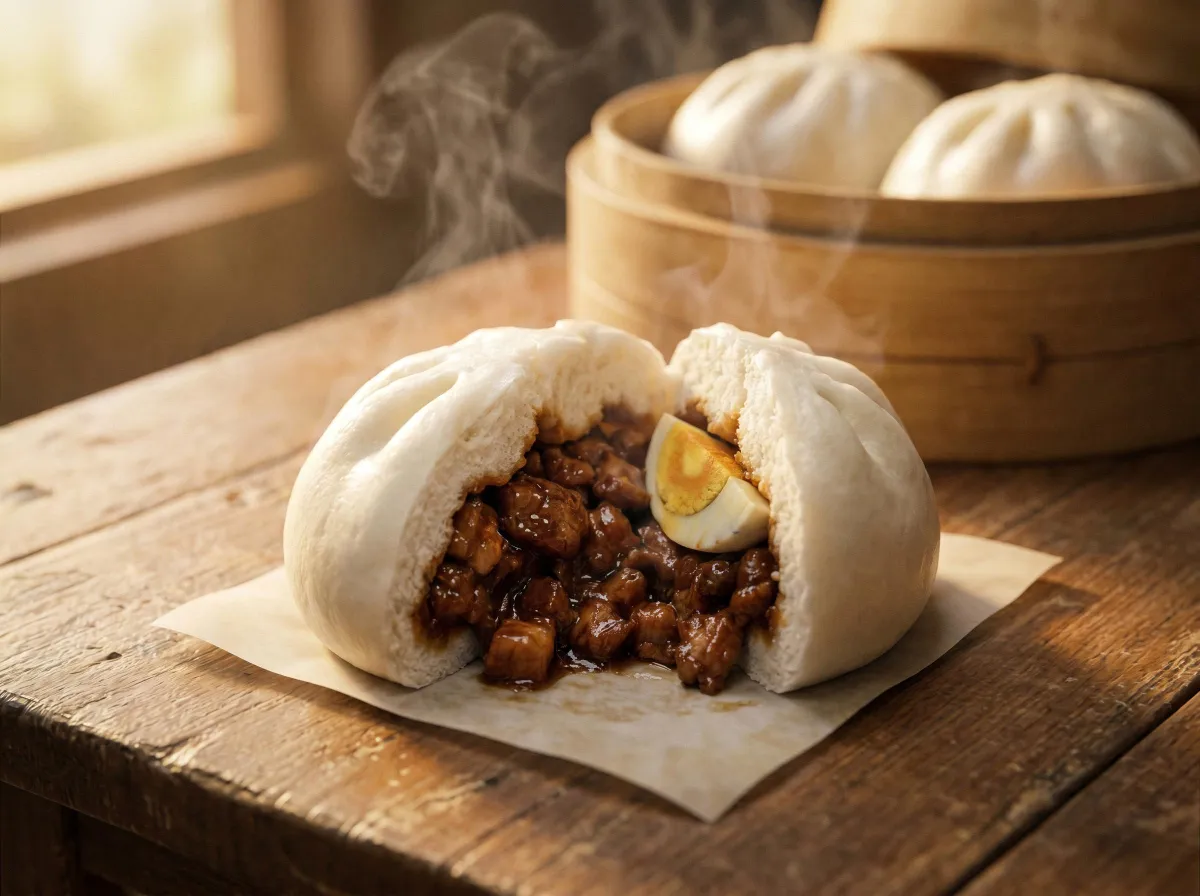
What Is Siopao? The Filipino Steamed Bun That Carries Every Memory Home
Quick Answer: What Is Siopao?
What it is: The Filipino steamed bun — a large, pillowy white bun filled with sweet braised pork (asado) or a savory meatball mixture (bola-bola), steamed until the dough is soft and cloud-like, and eaten held in the hands like a warm, edible hug. One of the most beloved everyday Filipino snacks, found in bakeries, convenience stores, school canteens, bus terminals, and every Filipino kitchen that has ever comforted someone on a long day.
Name meaning: From Philippine Hokkiensio-pau(燒包), literally "hot bun." Introduced to the Philippines by Hokkien-speaking Chinese immigrants during the Spanish colonial period, absorbed into Filipino food culture so deeply that most Filipinos have never experienced it as anything foreign — siopao is simply Filipino, full stop.
How old is it? Chinese traders established communities in the Philippines beginning in the 10th century, and Hokkien immigrants during the Spanish colonial period (1565–1898) brought the baozi tradition that became siopao. The modern Filipino siopao — larger than its Chinese ancestor, with distinctly Filipino fillings and a sweet sauce — solidified in the early 20th century, especially through the legendary Ma Mon Luk, who began selling siopao from his Binondo restaurant in the 1920s.
What's inside: Two classic fillings define siopao. Asado is sweet braised pork — stewed in soy sauce, sugar, oyster sauce, and hoisin until the meat is impossibly tender and the sauce is thick and glossy. Bola-bola is a seasoned meatball filling — ground pork or a combination of pork and chicken, mixed with Chinese sausage, and often cradling a quarter of salted duck egg at the center. Both fillings are enclosed in the same cloud-soft white dough. The difference between them is the first question every Filipino answers when standing in line at the bakery.
When it's served: always. At the bakery counter after school. At the bus terminal before the twelve-hour provincial trip. At the convenience store at two in the morning when nothing else will do. At the merienda table with hot mami noodle soup on a rainy afternoon. At every stage of Filipino life where hunger meets comfort and the two become the same thing.
The golden rule: Siopao is eaten warm. The bun must yield softly when you pull it apart. The filling must glisten. The parchment paper at the bottom must be peeled away first — and the way you peel it says everything about how well you know siopao.
There is a white bun in almost every memory.
It sits in a glass case at the bakery on the corner — the bakery that smells like bread and sugar and years of neighborhood mornings. The case is warm. The buns inside it are lined up in rows, white and round and identical except for the small mark at the top that tells you which filling is inside if you know what to look for. Most people know what to look for. Most people decided a long time ago.
You point. The person behind the counter picks one up with tongs and places it in a small paper bag. It is warm through the bag. You carry it outside and pull the parchment from the bottom and tear the bun open, and the steam rises and the filling is right there—dark and sweet and exactly what you expected, because siopao is never a surprise. Siopao is the opposite of a surprise. Siopao is the thing you already knew you wanted before you walked in.
Siopao is the Filipino steamed bun. That sentence is accurate and entirely incomplete. Siopao is the snack that Filipino children eat after school and Filipino adults eat when they need to feel like children again. It is the food sold at every bakery in the Philippines—the words "panaderia" and "siopao" are almost impossible to separate in the Filipino imagination. It is the bun that a generation of overseas Filipinos seeks out in Asian grocery stores and Filipino bakeries in Los Angeles and Toronto and Dubai and Sydney, not because it is rare but because it is familiar, and familiarity is what you crave when you are far from home.
Siopao is a soft, white, steamed wheat bun filled with either sweet braised pork or a savory meatball, eaten warm, held in two hands, peeled open carefully or torn apart eagerly depending on how hungry you are and how long you have been waiting. That is what it is, technically. But technically it does not reach the bakery counter or the bus terminal or the kitchen table on the rainy afternoon when someone hands you one and says nothing because the bun says everything.
At Studio Tributes, we celebrate Filipino food because it carries more than flavor — it carries the whole story of a people. Today we are going deep on siopao: where it came from, why it has two classic fillings, what the difference between asado and bola-bola actually is, why a Chinese immigrant named Ma Mon Luk turned the steamed bun into a Manila legend, how the Filipino panaderia made siopao the most accessible comfort food in the archipelago, and why the warm white bun is always the first thing Filipinos look for when the day has been long and the heart needs something soft.
What Is Siopao?
Siopao is the Filipino steamed bun — a large, round, white bun made from leavened wheat flour dough, filled with a seasoned meat mixture, and steamed until the exterior is pillow-soft and the filling inside is warm and tender. It is not one dish but a family of dishes, united by the soft white dough and divided by what lives inside it.
The name comes from Philippine Hokkien:sio(燒), meaning hot, pau (包), meaning bun. Siopao literally means "hot bun." The Hokkien-speaking immigrants who brought this food tradition to the Philippines came primarily from China's Fujian province, and their culinary influence on Filipino food runs so deep and so far back in history that most Filipinos experience siopao as purely and completely their own.
Which it now is. That is the nature of cultural absorption performed across centuries.
The basic siopao formula is straightforward: a soft dough made from flour, sugar, yeast, and baking powder is rolled out, filled with a seasoned meat mixture, sealed by hand, and steamed. But the variables within that formula — the filling, the sauce, the size, the occasion — have produced a food that carries an outsized emotional weight for a bun that fits in two hands.
Siopao differs from its Chinese ancestor, the baozi, in several important ways. Filipino siopao is significantly larger — sometimes bigger than a fist — and is eaten held in the hands rather than with chopsticks. The fillings are distinctly Filipino: asado, a sweet braised pork that bears the Spanish-derived name but is thoroughly Chinese-Filipino in execution, and bola-bola, a meatball filling with Chinese sausage and salted duck egg that has no direct equivalent in Chinese baozi traditions. The dough is characteristically sweeter and softer than standard Chinese baozi dough, reflecting the Filipino palate's embrace of sweetness across all categories of food.
The sauce that accompanies siopao is not optional. The special siopao sauce — made from beef stock, cornstarch, soy sauce, star anise, and garlic — is either injected into the bun or spread inside before eating. Some Filipinos use plain ketchup, either tomato or banana ketchup, applied in the same way. This is a distinctly Filipino practice: Chinese baozi is typically eaten dipped in soy sauce or vinegar, not sauced from within. The Filipino approach to siopao sauce is an act of making the bun entirely one's own.
The History: From Hokkien Traders to Every Filipino Bakery on Earth
The history of siopao is the history of the Chinese-Filipino relationship itself — a story of migration, suspicion, intermarriage, cultural exchange, and transformation so deep that the food that emerged from it belongs entirely to neither tradition and completely to both.
The Chinese origin. Chinese traders have been present in the Philippine archipelago since at least the 10th century, importing and exporting commodities like cotton, coconuts, silk, and woven mats. Under Spanish colonial rule beginning in 1565, Chinese immigrants — primarily from the Hokkien-speaking coastal provinces of Fujian, Amoy, and Guangdong — migrated in larger numbers to work as craftsmen, artisans, and merchants. They brought with them the baozi tradition: filled, steamed buns that had been a staple of Chinese cuisine for centuries.
The Spanish colonial government initially placed these immigrants—called sangleys, from the Hokkien "siong lai," meaning "frequent visitors" — in a segregated area of Manila. In 1594, those who converted to Christianity were moved to Binondo, which would become the oldest Chinatown in the world. It was within this dense, layered community of Chinese-Filipino cultural exchange that siopao was born — not as a transplant of Chinese baozi, but as something new, shaped by Filipino tastes, Filipino ingredients, and the Filipino way of eating.
The Filipino transformation. What the Hokkien traders brought and what became Filipino siopao are related but distinct. The Filipino version grew larger, grew sweeter, developed its own unique fillings, and acquired its own cultural identity entirely separate from its Chinese ancestor. As historian Adrian De Leon writes in his 2016 essay "Siopao and Power: The Place of Pork Buns in Manila's Chinese History," the story of siopao is inseparable from the complex history of the Chinese in the Philippines — a history marked by both suspicion and integration, both exclusion and intermarriage, resulting in a food culture that is genuinely mestizo in the deepest sense.
The Spanish chapter. The name asado—the most popular siopao filling — comes from the Spanish word meaning "grilled." But Filipino asado evolved away from grilling entirely, becoming a braised and stewed meat preparation with soy sauce, sugar, and hoisin. This linguistic inheritance from Spain wrapped around a cooking technique influenced by China and served inside a bun that belongs to neither and both — this is siopao in miniature, a food that tells the full colonial story of the Philippines in a single bite.
The Ma Mon Luk legend. No history of siopao is complete without Ma Mon Luk. Born in Guangdong, China, Ma Mon Luk was a grade school teacher who emigrated to the Philippines in 1918 — according to legend, to earn his fortune and win the hand of a girl whose wealthy Cantonese family disapproved of his poverty. Arriving penniless in Manila, he began peddling chicken noodle soup on the streets, carrying two metal containers on a bamboo pole balanced on his shoulders — one vat of noodles and chicken, the other of broth heated by live coals underneath. He called his concoction "gupit," after the Tagalog word for "cut with scissors," because he would snip the noodles with scissors for each serving. His student customers eventually named the noodle soup "Mami"—after Ma Mon Luk himself. He soon opened his first restaurant in Binondo, where he introduced his equally legendary siopao, enhanced by a secret sauce that no competitor could replicate. By the 1950s, Ma Mon Luk was nationally famous, and the pairing of mami and siopao—noodle soup and steamed bun — became one of the most iconic food combinations in Filipino cuisine. Ma Mon Luk died on September 1, 1961, but four generations of the Mamonluk family have kept his restaurants running. His name remains synonymous with siopao in the Filipino collective memory.
The bakery chapter. What Ma Mon Luk did for siopao in the restaurant, the Filipino panaderia did for siopao on every street corner. Filipino bakeries — those glass-case-and-tray establishments that appear in every barangay, every town center, every bus stop — adopted siopao as a standard offering alongside pandesal and ensaymada. The bakery democratized siopao. It was no longer a restaurant specialty or a Binondo delicacy. It was a five-peso bun under warm glass, available at any hour, to anyone, for any reason. This is how siopao became truly universal in the Philippines: not through fine dining but through the neighborhood bakery that never closes.
The diaspora chapter. For Filipinos living abroad, siopao occupies a specific emotional category: the food of return. It is the thing you eat on your first day back in the Philippines, bought from the nearest bakery before you even reach the family house. It is the thing you seek in the frozen aisle of the Asian grocery store in your adopted city — Magnolia brand, six in a box, microwaved with a damp paper towel and eaten standing in the kitchen because you could not wait. The frozen siopao is not the same as the bakery siopao. Every Filipino abroad knows this. They eat it anyway, because the shape is right and the softness is right and the filling is close enough and sometimes close enough is what you need.
Asado vs. Bola-Bola: The Two Fillings That Define Siopao
The first question at the siopao counter is always the same: Asado o bola-bola? This is not a casual question. This is an identity question. Most Filipinos have an answer they have held since childhood, and they are prepared to defend it.
Siopao Asado — The Sweet One
Siopao asado is the siopao of sweetness. The filling is braised pork — shoulder or butt, cut into pieces, seared until golden, then stewed in a mixture of soy sauce, oyster sauce, hoisin sauce, sugar, garlic, and onions until the meat is impossibly tender and the sauce has thickened into a dark, glossy, sweet-savory glaze. The word "asado" comes from the Spanish for "grilled," but there is no grilling here — the Filipino asado is all about the long, slow, patient braise that turns tough pork into something that falls apart at the pressure of a spoon.
When you tear open a siopao asado, the filling glistens. The sauce is thick enough to hold but liquid enough to soak into the dough at the edges, creating a ring of flavor where the bread meets the meat. The overall impression is sweet — sweeter than you might expect from a pork bun, because the Filipino palate has always embraced sweetness, and the asado filling is tuned precisely to that preference.
Siopao asado often includes a quarter slice of hard-boiled egg or salted duck egg nestled into the filling — a small addition that changes the entire experience by introducing a creamy, salty counterpoint to the sweet pork. The presence or absence of this egg is a matter of great personal importance to siopao eaters everywhere.
What makes it Filipino: The sweetness of the braise. The specific combination of soy sauce and hoisin and oyster sauce that produces a flavor profile distinct from Chinese char siu bao. The size — Filipino siopao asado is larger than a typical char siu bao, designed to be a meal rather than a snack. And the siopao sauce, applied inside or alongside, that adds another layer of savory depth. The Filipino asado filling has evolved into something that bears the Spanish name, uses Chinese techniques, and tastes like nothing but the Philippines.
Siopao Bola-Bola — The Savory One
Siopao bola-bola is the siopao of substance."Bola-bola" literally means "meatball" in Filipino, and the filling is exactly that: a seasoned ball of ground pork (or a combination of pork, chicken, and sometimes shrimp), mixed with minced Chinese sausage (chorizo chino), wrapped around a quarter of salted duck egg, and steamed inside the dough. Where asado is sweet and saucy, bola-bola is savory and dense — a meatball that carries the richness of pork fat, the slight sweetness of Chinese sausage, and the briny punch of salted egg in every bite.
The bola-bola filling is less saucy than asado. The meatball holds its shape inside the bun, and the flavor comes from the meat itself rather than from a surrounding glaze. This makes bola-bola a structurally different eating experience: each bite is more uniform, more meaty, more grounded. Where asado is a symphony of sauce, bola-bola is a single chord struck with conviction.
The salted duck egg inside the bola-bola is not optional — it is the defining ingredient. Salted duck eggs have been part of Chinese-Filipino cuisine for centuries, and their presence inside the bola-bola connects this filling directly to the Chinese-Filipino culinary tradition from which siopao emerged. The egg provides a creamy, salty, slightly granular burst against the smooth meat — a contrast of textures that makes the bola-bola filling more complex than it first appears.
What makes it Filipino: The inclusion of Chinese sausage, a pantry staple in Chinese-Filipino households. The salted duck egg at the center — a distinctly Chinese-Filipino ingredient that appears in everything from ensaymada to pancit. The overall savory profile that balances the Filipino love of sweetness with an equally deep love of salt. And the fact that choosing bola-bola over asado is, for many Filipinos, a lifelong commitment made in childhood and never revisited.
So Which One Do You Choose?
The asado-versus-bola-bola question is one of the gentle, permanent debates of Filipino food culture — like choosing between Jollibee and McDonald's, or between vinegar and toyomansi as your sawsawan. There is no correct answer. There is only your answer. And your answer was probably decided at a bakery counter when you were six years old, and nothing has changed since.
Speaking of knowing who you are — have you tried our Filipino food personality quiz?It matches your personality to a beloved Filipino dish, and the results might surprise you (or confirm everything you already knew).Take the "What Filipino Food Are You?" quiz here.
The Siopao Family: Variants and Cousins
Beyond the asado and bola-bola binary, siopao has evolved into a family of related forms, each with its own character and following.
Toasted Siopao (Baked Siopao). A variant where the siopao is baked in an oven rather than steamed, producing a golden-brown exterior with a slightly crisp crust while maintaining the soft interior. Toasted siopao has become increasingly popular in Filipino bakeries, offering a textural alternative for those who prefer a little resistance before the softness.
Fried Siopao. A preparation where a steamed siopao is placed bottom-down in a greased skillet and fried until the base is golden and crunchy. The result is a bun that is soft on top and crispy on the bottom — a contrast that has made fried siopao a beloved merienda item in its own right.
Asado Roll. An evolution of siopao that uses regular bread dough instead of steamed bun dough, filled with the same sweet asado filling, and baked. The asado roll is the siopao's bakery cousin — more portable, more bread-like, and found alongside pandesal and Spanish bread in the panaderia display case.
Chicken Pao. A filling variation that uses barbecued or braised chicken instead of pork, popular in bakeries and fast food chains that serve siopao.
Sweet Siopao. Dessert variants filled with sweetened red bean (monggo), ube (purple yam), or custard. The paowaw from Siargao Island, filled with bukayo (sweetened shredded coconut), is a unique regional dessert siopao that reflects the Philippine love of coconut in all its forms.
Cuapao. A variant that combines meat and vegetables inside the bun, sometimes served open-faced, reflecting the ongoing evolution of siopao in contemporary Filipino food culture.
What Does Siopao Taste Like?
The first thing you notice is the softness. Before any flavor arrives, your hands register the texture of the bun — yielding, warm, almost alive in its softness. Good siopao dough should feel like pressing your thumb into a cloud. The surface is smooth and white and slightly tacky with steam. This is not bread. This is something between bread and air.
The second thing is the moment of opening. You tear the bun — not cut it, never cut it — and the steam escapes carrying the scent of the filling with it. If it is asado, the aroma is sweet and soy-dark, with the depth of a long braise. If it is bola-bola, the aroma is meatier, more savory, with the faint sweetness of Chinese sausage underneath. Both aromas are warm in a way that the word "warm" fails to capture — the warmth of a kitchen, of a bakery, of someone's hands handing you something they knew you wanted.
The third thing is the filling. Asado is slippery and sweet, the pork soft enough to melt against the dough, the sauce soaking into the bread at the borders. Bola-bola is dense and savory, the meatball firm but not tough, the salted egg inside adding a creamy, salty surprise that changes the bite completely. In both cases, the filling-to-dough ratio is crucial — too much dough and the siopao feels heavy and bland; too much filling and the bun cannot hold itself together. The perfect siopao balances both, so that every bite contains exactly enough of each.
The siopao sauce — that sweet, savory, star-anise-scented sauce made from beef stock and thickened with cornstarch — is the final act. Injected into the bun or spread inside after opening, it adds a layer of umami and depth that ties the filling and the dough together. Some Filipinos skip the sauce. They are a minority. They are tolerated.
And then there is the parchment paper. Every siopao sits on a small square of parchment or wax paper that prevents the bun from sticking to the steamer or the container. Peeling this paper away is the ritual that begins every siopao eating experience. The way you peel it — slowly, preserving every bit of dough, or quickly, losing a thin layer of bun to the paper — is said to reveal something about your character. This claim has never been scientifically verified. It is believed anyway.
Siopao and the Filipino Life Calendar
Siopao does not wait for an occasion. It is the food of the ordinary day — and in that ordinariness lies its deepest power.
The After-School Siopao. For millions of Filipino children, the walk home from school includes a stop at the bakery. The siopao in the glass case is warm. The few coins in the pocket are enough. The bun is eaten while walking, the parchment paper stuffed into a pocket, the last bite taken before the front door opens. This is the siopao of childhood — small, daily, and so routine it barely registers as a memory until years later, when you are far away and the memory arrives with unexpected force.
The Merienda Siopao. Filipino culture structures the day around meals and the spaces between them, and the afternoon merienda — the snack between lunch and dinner — is sacred. Siopao is one of the definitive merienda foods: substantial enough to satisfy, soft enough to eat quickly, portable enough to eat anywhere. The merienda siopao is often paired with hot mami noodle soup—the mami-siopao combination that Ma Mon Luk made legendary and that every Filipino canteen, carinderia, and convenience store still offers today.
The Road Trip Siopao. Every long-haul bus trip in the Philippines begins the same way: you buy provisions at the terminal. Siopao is always among them. It survives the first hours of the trip in its paper bag, warm at first and then room temperature but still good, eaten somewhere between the city limits and the provincial mountains while the bus rocks and the radio plays and the world outside the window is getting greener. The road trip siopao is the siopao of transition — between places, between chapters, between the life you left this morning and the life you are driving toward.
The Rainy Day Siopao. In the Philippines, the rainy season is long, and the specific comfort of a warm siopao on a cold, wet afternoon is not metaphorical. It is functional. The warmth of the bun in your hands. The steam when you open it. The hot mami beside it. This combination is one of the Filipino food canon's greatest acts of care — engineered, whether intentionally or not, to make you feel held.
The Homecoming Siopao. For overseas Filipinos returning home, the siopao from the first bakery you pass on the way from the airport is the siopao of arrival. It tastes better than every frozen siopao you ate abroad. It tastes better because you are here, and the bakery is here, and the glass case is here, and the person behind the counter is here, and everything is exactly where you left it.
Learn the Tagalog
The dish and its family:
Siopao (shoh-paw) — steamed bun; from Hokkien, siopao means "hot bun"
Siopao asado (shoh-paw ah-sah-doh) — steamed bun with sweet braised pork filling; "asado" is from the Spanish for "grilled," though the Filipino version is braised
Siopao bola-bola (shoh-paw boh-lah boh-lah) — steamed bun with meatball filling; "bola-bola" means "meatball" in Filipino
Mami (mah-mee)—chicken or beef noodle soup; the classic pairing with siopao, named after Ma Mon Luk himself
Asado roll (ah-sah-doh roll) — a baked bread roll filled with the same sweet asado filling
The kitchen vocabulary:
Bawang (bah-wang) — garlic; present in both the asado braise and the siopao sauce
Sibuyas (see-boo-yahs) — onion; a key ingredient in both filling types
Itlog na maalat (eet-log nah mah-ah-laht) — salted duck egg; the hidden treasure inside both asado and bola-bola
Toyo(toh-yoh) — soy sauce; essential to the asado braise
Chorizo chino (choh-ree-zoh chee-noh) — Chinese sausage; the secret ingredient in bola-bola filling
Pasingawan (pah-seeng-ah-wan) — steamer; the tool that transforms raw dough into cloud-soft siopao
At the table:
Asado o bola-bola? (ah-sah-doh oh boh-lah boh-lah) — asado or bola-bola? — the question at every siopao counter
Mainit pa! (mah-ee-nit pah) — it's still hot! — the warning that accompanies every freshly steamed siopao
Ang lambot! (ahng lahm-boht) — so soft! — the highest praise for siopao dough
Isa pa! (ee-sah pah) — one more! — the inevitable follow-up after the first siopao is finished
Fun Facts About Siopao
1. The word "siopao" is Hokkien, not Tagalog — but the dish is completely Filipino.The name comes from Hokkien "sio" (hot) and "pau" (bun). Hokkien-speaking immigrants from China's Fujian province introduced the baozi tradition to the Philippines during the Spanish colonial period. In the centuries since, Filipinos transformed it so thoroughly—different size, different fillings, different sauce, different cultural meaning — that calling it simply "Chinese" today would be inaccurate. Siopao is Chinese-Filipino in origin and Filipino in identity.
2. Ma Mon Luk turned siopao into a national icon by giving it away for free. After opening his Binondo restaurant, Ma Mon Luk continued to walk the streets of Manila peddling noodle soup — but now he gave away free siopao samples to advertise his restaurant. This guerrilla marketing strategy, employed decades before the term existed, helped make his name synonymous with both mami and siopao across the Philippines. By the 1950s, Ma Mon Luk was nationally known and spawned countless imitators, none of whom could match his secret sauce.
3. The mami-siopao pairing is one of the most iconic food combinations in Filipino cuisine.The noodle soup called mami was named after Ma Mon Luk himself—from his surname, from the Chinese word for noodles. The pairing of mami and siopao — hot soup and steamed bun — became so standard in Filipino food culture that ordering one without the other feels incomplete. Every Filipino canteen, every convenience store, every rainy-day meal plan includes this combination.
4. Siopao has an urban legend about cat meat — and it tells us more about history than about siopao.A persistent urban legend in the Philippines alleges that some siopao contains cat meat. Historians have traced this story to anti-Chinese sentiment during the Spanish and American colonial periods — a form of culinary suspicion directed at the Chinese-Filipino community. The legend says more about the complex, sometimes hostile relationship between Chinese immigrants and the broader Philippine society than it says about what is actually inside any siopao.
5. Filipino siopao is significantly larger than Chinese baozi. A standard Filipino siopao is often bigger than a fist, designed to be eaten held in two hands like a sandwich. Chinese baozi is typically smaller and eaten with chopsticks or in a single hand. The Filipino preference for larger portions—busog culture, the value placed on fullness and generosity — shaped the siopao into something physically different from its ancestor.
6. The parchment paper at the bottom is functional, not decorative. Every siopao sits on a small square of parchment or wax paper to prevent the sticky dough from adhering to the steamer or container. Peeling this paper away without losing any dough is considered a minor skill, and the thin layer of dough that inevitably sticks to the paper is either mourned or scraped off with teeth, depending on the eater's philosophy.
7. Siopao sauce is a Filipino invention with no Chinese equivalent. Chinese baozi is traditionally eaten dipped in soy sauce or vinegar. Filipino siopao is accompanied by a special sweet-savory sauce — made from beef stock, soy sauce, star anise, garlic, and cornstarch — that is injected into the bun or spread inside before eating. Some Filipinos use banana ketchup or tomato ketchup instead. This saucing-from-within approach is uniquely Filipino and has no counterpart in the Chinese baozi tradition.
8. Frozen siopao is a product of American colonial influence on Filipino food culture. The commercialization of siopao into frozen, mass-produced packs of six sold in plastic containers is a direct descendant of the American advertising culture that took hold in the Philippines in the 1920s and '30s. American canned goods marketing taught Filipino consumers to value "cheap, easy, healthy" packaged foods, and this mindset eventually extended to Filipino dishes like siopao. The Magnolia brand frozen siopao — available in Filipino grocery stores worldwide — is the contemporary expression of this history.
9. There are siopao relatives across the Pacific. The Filipino siopao traveled to Guam (which was historically part of the Philippine colonial territory) and from there to the Marshall Islands, where it is known assiu pao. Similar buns exist in Thailand (salapao), Hawaii (manapua), and Samoa (keke pua'a). Each version reflects local tastes and ingredients, but all trace back to the same Chinese baozi ancestor that Filipino siopao also descends from.
10. The top marking on a siopao tells you the filling — if you know the code. In Filipino bakeries and dim sum shops, different markings on the top of the siopao — a dot, a swirl, a pinch pattern, or a colored mark — indicate which filling is inside. The code varies by bakery. Regulars know their bakery's system by heart. Newcomers learn by asking, or by the more exciting method of biting into the wrong one.
How Siopao Connects Filipinos Everywhere
Siopao is portable. This is the single most important practical fact about it, and it is part of why siopao became one of the most universally consumed Filipino foods both at home and abroad.
Lechon requires an event. Kare-kare requires a careful hand and specific ingredients. Sinigang requires a pot, a stove, and time. Siopao requires a microwave and forty-five seconds. This accessibility is not incidental. It is why siopao survives everywhere Filipinos go.
As food writer Christina Gonzales observed, the siopao tells the full story of Filipino history through its exact parts: the bun from Chinese ties, the filling named by Spanish conquistadors, the means of eating it shaped by American consumer culture. One bun carries five centuries of contact, conflict, and transformation. One bun, held in two hands, contains more cultural history than most textbooks.
For Filipinos living far from the archipelago, eating siopao is an act of cultural maintenance. The bun in the microwave at midnight—pulled from the freezer, wrapped in a damp paper towel, and rotated on the plate for ninety seconds—is not the same as the siopao from the bakery in the Philippines. Every Filipino abroad knows this. But the shape is right. The softness is close. The filling, though frozen and reheated, still tastes like the general direction of home. And sometimes the general direction is enough.
The frozen siopao in the Filipino grocery store in Toronto or Los Angeles or Dubai is never just a snack. It is a compass point. It says: there is a kitchen somewhere that smells like this. There are hands somewhere that made this. You came from there. You can carry it with you.
FAQ: Everything You Need to Know About Siopao
What is siopao?
Siopao is the Filipino steamed bun — a large, soft, white bun made from leavened wheat flour dough, filled with either sweet braised pork (asado) or a savory meatball mixture (bola-bola), and steamed until the dough is pillow-soft. The name comes from Hokkiensio-pau, meaning "hot bun." Introduced to the Philippines by Hokkien-speaking Chinese immigrants during the Spanish colonial period, siopao has been transformed into a distinctly Filipino food over centuries and is now one of the most beloved everyday snacks in the Philippines, found in bakeries, convenience stores, and Filipino homes worldwide.
What is the difference between siopao asado and siopao bola-bola?
Siopao asado is filled with sweet braised pork — shoulder or butt stewed in soy sauce, oyster sauce, hoisin, and sugar until tender and glossy. Siopao bola-bola is filled with a seasoned ground pork meatball mixed with Chinese sausage, often wrapped around a quarter of salted duck egg. Asado is sweeter and saucier; bola-bola is saltier and denser. Both are enclosed in the same soft white steamed bun. Choosing between them is one of the gentle, permanent identity questions of Filipino food culture.
What is the difference between siopao and char siu bao?
Siopao and char siu bao are related but distinct. Both are white steamed buns with pork filling, but siopao is typically much larger than char siu bao. The fillings differ: char siu bao uses roasted pork in a red five-spice sauce, while siopao asado uses braised pork in a soy-hoisin-oyster sauce glaze that is slightly sweeter. Siopao is also accompanied by a special siopao sauce, which has no equivalent in the Chinese char siu bao tradition.
Who is Ma Mon Luk and why is he important to siopao history?
Ma Mon Luk was a Chinese immigrant from Guangdong who arrived in Manila in 1918 and became the most famous name in Filipino noodle soup (mami) and siopao history. He began as a street vendor, opened a restaurant in Binondo (the world's oldest Chinatown), and popularized the mami-siopao combination that remains iconic in Filipino food culture. His secret siopao sauce was never successfully replicated by competitors, and the Ma Mon Luk restaurant continues to operate under his descendants today.
What is siopao sauce?
Siopao sauce is a sweet, savory condiment made from beef stock, soy sauce, star anise, garlic, onions, and cornstarch. It is either injected into the siopao or spread inside the bun before eating. Some Filipinos use tomato ketchup or banana ketchup instead. The practice of saucing siopao from within — rather than dipping — is distinctly Filipino and has no direct equivalent in the Chinese baozi tradition.
Can siopao be frozen and reheated?
Yes. Siopao freezes exceptionally well and can be stored in an airtight container for up to two months. To reheat, wrap the frozen siopao in a damp paper towel or cloth and microwave on high for one to two minutes. The damp towel is essential — it prevents the bun from drying out and restores the steamed softness. This freezer-readiness is a significant reason why siopao is one of the most reliable comfort foods in the Filipino diaspora pantry.
Where can I find siopao?
In the Philippines, siopao is available in bakeries, convenience stores (7-Eleven and Ministop both carry them), Chinese restaurants, dim sum houses, fast food chains (Chowking is the most well-known), school canteens, bus terminals, and street vendors. Outside the Philippines, frozen siopao is available at Filipino grocery stores and many Asian supermarkets. In cities with large Filipino communities — Los Angeles, Toronto, New York, Dubai, Sydney, London — Filipino bakeries often carry freshly steamed siopao as well.
Closing
Did siopao bring back a memory?
Maybe it is the bakery on the corner — the glass case, the warm buns, the tongs, the small paper bag. Maybe it is the merienda table on a rainy afternoon, the bowl of mami steaming beside the torn-open bun. Maybe it is the bus terminal before the long trip home to the province, the siopao in its bag on your lap, warm through the paper.
Maybe you are somewhere far from the Philippines now. There is no bakery on the corner. There is no glass case. There is a freezer in a kitchen in a city that is not Manila, and inside that freezer is a box of six, and you pull one out and wrap it in a damp paper towel and put it in the microwave and wait, and when you pull it out and peel the paper from the bottom and tear it open, the steam rises and for one breath you are standing at a counter in the Philippines, six years old, pointing at the glass case, and someone is placing a warm white bun in your hands.
Which siopao carries the clearest memory for you? The asado from the bakery after school? The bola-bola your lola always chose? The first one you ate with mami on a rainy afternoon? The frozen one you heated at midnight in a city far from home?
Tag@StudioTributeson Facebook or Instagram with your siopao memory and the hashtags #SiopaoMemory and #FilipinoFoodMemories.
We read every single one.
A Final Thought
Siopao survived everything.
It survived the Spanish colonial period, emerging from the intersection of Hokkien culinary tradition and Spanish-named cooking techniques. It survived the American occupation, which industrialized Filipino food and turned the handmade bun into a frozen product — but could not erase the handmade version from the bakery counter. It survived the complex, sometimes hostile history of Chinese-Filipinos in the Philippines, a community that faced suspicion and segregation but whose food became inseparable from the national cuisine. It survived the mass migration of Filipinos to every corner of the earth, traveling in freezer bags and in memory and in the hands of people who learned to eat it before they learned to explain it.
Siopao survived because it is too good to let go of. Because the combination of a soft, warm bun and a sweet or savory filling and a patient, generous sauce is, at some fundamental level, a correct combination — one that humans across cultures recognize immediately as nourishment in its most primal form. Because it is easy to carry, easy to eat, easy to share, easy to love at first bite.
But siopao also survived because Filipino bakeries kept making it. Because the glass case on every corner kept it warm. Because the bus terminal vendor kept it available. Because Ma Mon Luk walked the streets of Manila giving it away. Because someone, in every generation, decided that the bun was worth making, the filling was worth braising, the dough was worth kneading.
At Studio Tributes, we believe Filipino food carries more than flavor. Siopao carries centuries of Chinese-Filipino exchange, Spanish colonial language wrapped around Chinese cooking techniques, American commercialization laid over handmade tradition. It carries the warmth of a bakery counter on an ordinary afternoon. It carries the specific softness of a bun in your hands when your hands needed something soft.
Every siopao is all of that. And it is eaten in minutes. And that is exactly right.
Keep exploring Filipino food and culture with us:
Get your FREE Filipino coloring pages here.
Get our Filipino Food Activity Book on Amazon
Read more Filipino food stories on our blog
A Memory to Hold Onto
Did siopao bring back a counter, a kitchen, a paper bag warm in your hands?
Maybe the bakery after school. Maybe the glass case and the tongs. Maybe the mami steaming beside it on a rainy afternoon. Maybe the frozen one at midnight, far from home.
Which siopao is yours? Was it asado or bola-bola? Was it from a bakery or a bus terminal or a kitchen?What do you see, smell, or feel when the word siopao arrives?
If a memory came to mind, share it on Facebook or Instagram and tag @StudioTributes—we celebrate every single one.
Read Next
Together, these foods tell the story of Filipino life — from the everyday merienda to the biggest celebration of the year.
References & Further Reading
This article blends Studio Tributes storytelling with cultural and culinary research to create a warm, family-friendly learning experience.
#SiopaoMemory #FilipinoFoodMemories #StudioTributes #FilipinoFood #WhatIsSiopao #SiopaoAsado #SiopaoBolaBola #FilipinoSteamedBuns