
What Is Tapsilog? The Filipino Cured Beef Breakfast That Started It All
Studio Tributes / Filipino Food / What Is Tapsilog?
The garlic hits the pan before the sun even fully comes up.
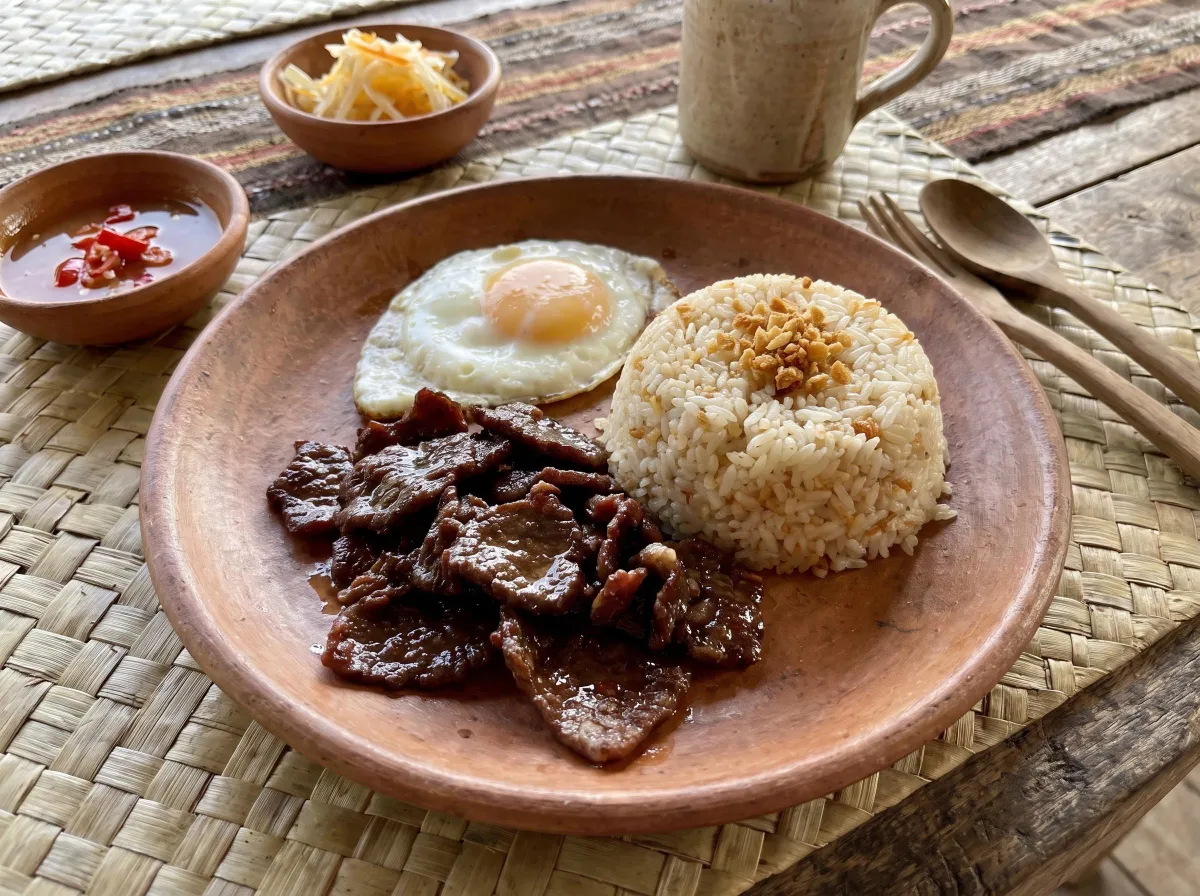
That sharp, fast sizzle is the sound of a Filipino morning starting — garlic fried rice going gold in a hot pan, a slab of dark, glossy cured beef already resting on a plate, and an egg cracking into the same pan a few seconds later, yolk still loose, edges just starting to crisp and lace at the corners. By the time you sit down, the whole plate is steam and smell: sweet-savory beef, sharp garlic rice, and a runny yolk waiting to get broken into everything else. Somewhere on the table, there's a small dish of vinegar with a chili floating in it, because no one at this table is eating tapsilog without it.
🍳 Before we go any further — we made something for you.
Find out which Filipino "silog" breakfast matches your personality. Takes about a minute.
If you've ever eaten at a Filipino diner, a roadside eatery, or a family kitchen before 9am, there's a very good chance tapsilog was on the table — or at least on the menu, hiding behind a name that sounds a little like an acronym because, well, it basically is one.
Tapsilog is a Filipino breakfast built from three parts: tapa (cured, pan-fried beef), sinangag (garlic fried rice), and itlog (a fried egg, usually sunny-side up). The name itself is a portmanteau of those three words — tap-si-log — and according to Wikipedia, it's widely credited as the very first "silog" dish, the meal that started an entire naming convention for Filipino breakfast food that's still expanding today. Every "-silog" you've ever seen on a menu — longsilog, tosilog, spamsilog, bangsilog, chicksilog — exists because tapsilog came first.
At Studio Tributes, we tell the stories behind Filipino food because so much of it carries a real, traceable history that most people eating it every day have never actually heard. Tapsilog's story is a great one: a specific woman, a specific parking-lot food stall, a specific year in Philippine history, and a naming idea so good it became a permanent fixture of the Filipino language. Today we're getting into all of it — what tapsilog actually is, who invented the name and when, why "silog" became the most productive suffix in Filipino food culture, and why this unassuming breakfast plate might be the single most influential Filipino dish of the last forty years.
🥩 What Is Tapsilog?
Let's start simple, because tapsilog is a genuinely simple dish — it's the idea behind it that made it big.
Tapsilog is a Filipino breakfast plate made of three components served together: tapa, cured and pan-fried beef (or sometimes pork, chicken, or another meat); sinangag, garlic fried rice, usually made from day-old leftover rice; and itlog, a fried egg, most commonly sunny-side up with a runny yolk. According to Wikipedia, silog is a whole class of Filipino breakfast dishes built around sinangag and itlog, paired with a rotating cast of savory proteins — and tapsilog, built specifically around tapa, was the original member of that class and the one the entire naming pattern is named after.
Here's the lineup that makes a tapsilog a tapsilog:
🥩 Tapa — thin slices of beef (traditionally), marinated in a mix that usually includes garlic, salt, soy sauce, vinegar, sugar, and black pepper, then pan-fried or grilled until deeply browned
🍚 Sinangag — garlic fried rice, classically made from leftover rice from the night before, fried with garlic until each grain is separate and slightly crisp
🍳 Itlog — a fried egg, almost always sunny-side up, yolk left runny so it can be broken and mixed into the rice
🥒 Atchara — pickled green papaya, a tangy, slightly sweet side that isn't in the name but shows up on almost every tapsilog plate anyway
🌶️ Sawsawan — a dipping sauce, most often spiced vinegar with sliced chili, sometimes banana ketchup for those who want it sweeter
The genius of the dish isn't really any single component — tapa existed long before tapsilog, and so did garlic fried rice and fried eggs. The genius was putting all three together, giving the combination a catchy compressed name, and turning it into a single, orderable, repeatable meal. That's the part of the story most people don't know, and it's a much more specific, much more recent history than most Filipino heritage dishes get to claim.
📜 The Story Behind It
Most Filipino comfort food stretches back centuries, shaped slowly by trade routes, colonization, and generations of home cooks nobody can individually name. Tapsilog's story is different. It has an actual founder, an actual year, and an actual origin story you can trace to one small stall in one specific Philippine city.
The individual pieces of tapsilog are old. Tapa — cured, dried, or smoked meat — has roots that some food historians trace back to pre-colonial curing methods, where meat was thinly sliced and dried in the sun long before Spanish colonization introduced domesticated cattle to the islands. The word "tapa" itself is widely believed to come from the Spanish verb tapar, meaning "to cover" or "to seal," the same root that gives Spain's tapas bar snacks their name. Sinangag, garlic fried rice made from leftover rice, has been a practical, waste-reducing Filipino kitchen habit for generations. None of these three foods needed to be invented in the 1980s. They already existed, separately, all over the Philippines.
What didn't exist yet was the idea of plating them together under one catchy name and selling that combination as a single dish. That happened in 1986, in a small stall in Marikina City called Tapsi ni Vivian, run by a woman named Vivian del Rosario. According to Esquire Philippines, del Rosario opened her humble tapa store in a small corner of a parking lot with a starting daily capital of only ₱1,000, not knowing she was about to start what would become a nationwide food trend. She sold tapa with sinangag and a fried egg as a quick, affordable, filling meal, and — by her own account — she was the one who first shortened "tapa, sinangag, itlog" into the compressed name "tapsilog." The meal became one of her bestsellers almost immediately, popular specifically because it was fast to prepare, cheap, and satisfying for customers who didn't have time to sit through a long breakfast.
According to Wikipedia, tapsilog developed out of an earlier, looser tradition called "tapsi" — meals of beef tapa and sinangag without a fried egg explicitly named as part of the deal — served at small eateries known as tapahan or tapsihan. Del Rosario's version added the egg to the name explicitly and gave the whole combination a single, marketable word. That word caught on fast, and it caught on specifically because it was useful: once "tapsilog" existed as a naming template, anyone could build a new dish just by swapping out the protein and keeping the "-silog" ending.
And that's exactly what happened. Longganisa plus sinangag plus itlog became longsilog. Tocino plus sinangag plus itlog became tosilog. The pattern kept going — hotdog became hotsilog, corned beef became cornsilog, Spam became spamsilog, bangus (milkfish) became bangsilog, fried chicken became chicksilog — until "-silog" stopped being a specific product name and became a genuine, productive suffix in everyday Filipino food vocabulary, the same way "-gate" became shorthand for "scandal" in English. Tapsilog wasn't just a popular breakfast. It accidentally created a whole naming system that Filipino food culture still uses to invent new dishes today.
Del Rosario's stall grew into a full restaurant — reportedly known in fuller form as "Tapsi ni Vivian at Bulaluhan," pairing her tapsilog with bulalo, a beef bone marrow soup — and the tapsilog concept spread out from Marikina into eateries, "silogans," and home kitchens across the entire country. Within a decade of its invention, tapsilog had gone from one woman's parking-lot food stall to a national breakfast standard, served everywhere from roadside carinderias to hotel breakfast buffets.
👅 What Does Tapsilog Taste Like?
If you've never had tapsilog, here's the short version: it's the taste of savory, garlicky, and a little sweet, working in three separate textures on the same plate.
The tapa itself carries the boldest flavor — deeply savory from soy sauce, sharp from garlic, a little tangy from vinegar, and often slightly sweet from sugar in the marinade, all concentrated by the pan-frying or grilling that browns and slightly caramelizes the edges. Depending on the household, tapa can lean drier and more jerky-like, or stay a little more tender and juicy — a difference that comes down to how long it's marinated and how it's cooked.
The sinangag is where the garlic really lands. Fried in oil (or butter, in some households) until each grain of rice separates and turns lightly golden, sinangag carries a savory, aromatic punch that's strong enough to stand on its own but built specifically to soak up whatever sauce or yolk ends up mixed into it.
Then there's the itlog — usually sunny-side up, with a yolk left deliberately runny. Once you break it, that yolk becomes a sauce of its own, coating the rice and the meat in something rich and silky that ties the whole plate together.
Add the tang of pickled atchara and the sharp bite of chili vinegar on the side, and the whole plate becomes a genuine flavor rotation: savory beef, garlicky rice, rich egg, tangy pickle, sharp dip, bite after bite.
Tapsilog tastes like Filipino mornings — savory, garlicky, a little sweet, and built to wake you all the way up.
🍳 How Tapsilog Comes Together
Tapsilog is, by design, a fast meal — most of the effort actually happens ahead of time, in the marinade.
Step 1 — Marinate the tapa. Thin beef slices are marinated, often overnight, in a mix of garlic, soy sauce, vinegar, sugar, and black pepper — sometimes with pineapple juice added for extra tenderness and sweetness.
Step 2 — Cook the tapa. The marinated beef is pan-fried or grilled until deeply browned, with the sugar in the marinade helping the edges caramelize slightly.
Step 3 — Fry the rice. Day-old rice (freshly cooked rice is too soft and clumps together) is fried in oil with minced garlic until every grain separates and turns a light golden color.
Step 4 — Fry the egg. A single egg goes into a hot pan, typically left sunny-side up so the yolk stays runny and the edges get slightly crisp and lacy.
Step 5 — Plate it all together. Tapa, sinangag, and itlog go on the same plate, usually with a side of atchara and a small dish of spiced vinegar for dipping.
Step 6 — Break the yolk. This step isn't official, but it might as well be — most people break the yolk directly into the rice, letting it coat everything before the first bite.
The entire process, minus marinating time, can genuinely be done in fifteen to twenty minutes, which is part of exactly why the dish took off the way it did: real flavor, almost no active cooking time.
🍽️ Tapsilog and the Rest of the "Silog" Family
This is where tapsilog's story gets genuinely interesting from a language standpoint, not just a food one — because tapsilog didn't just become popular. It became a template.
According to Wikipedia, silog is now used as a general class name for any Filipino breakfast built on sinangag and itlog, paired with a savory main. The name of the protein determines the name of the silog: the first syllable (or a recognizable chunk) of the protein gets fused onto "-silog." Tapsilog started it, and everything after followed the same formula:
🍳 Tapsilog — tapa (cured beef) + sinangag + itlog — the original
🌭 Longsilog — longganisa (Filipino sausage) + sinangag + itlog
🥓 Tosilog — tocino (sweet cured pork) + sinangag + itlog
🌭 Hotsilog — hotdog + sinangag + itlog
🥫 Spamsilog — Spam (fried luncheon meat) + sinangag + itlog
🐟 Bangsilog — bangus (fried milkfish) + sinangag + itlog
🍗 Chicksilog — fried chicken + sinangag + itlog
🥩 Cornsilog — corned beef + sinangag + itlog
The pattern is genuinely open-ended. Almost any savory protein can, in theory, become a "-silog" simply by pairing it with garlic rice and a fried egg and giving it a compressed name — which is exactly why new "-silog" combinations keep showing up on Filipino eatery menus decades after the original was invented. Tapsilog isn't just a dish anymore. It's a whole grammar for building breakfast.
🗺️ Tapsilog Across the Philippines
Because tapsilog is a relatively recent invention with a known point of origin, its geography is a little different from older heritage dishes — it spread outward from a specific starting point rather than developing independently in multiple regions.
Marikina City, where Tapsi ni Vivian first opened, holds the strongest historical claim to tapsilog as its point of origin, and the dish remains closely associated with the city's food culture.
Metro Manila more broadly became the dish's fastest-growing home in the years after its invention, with tapsihan and later full "silogan" restaurants — casual eateries built specifically around silog combinations — opening across the metro through the late 1980s and 1990s.
Regional variations of tapa exist all over the Philippines even outside the tapsilog context — in Ilocos, tapa is often cured with the region's distinctively sharp, dark sukang Iloko vinegar; in the Visayas, some households marinate the meat adobo-style before drying it. These regional tapa traditions predate tapsilog itself, but many of them now get folded into a tapsilog plate regardless of where in the country you order it.
Filipino diaspora communities have carried tapsilog (and the wider silog format) to virtually every country with a significant Filipino population — it's a fixture on the menu of Filipino restaurants in the United States, Canada, the Middle East, and beyond, often served as an all-day breakfast rather than a strictly morning meal, since diaspora work schedules don't always line up with a traditional Philippine breakfast hour.
🗣️ Learn the Tagalog
Tapsilog comes with its own compact vocabulary — some of it food-specific, some of it just useful at any Filipino breakfast table.
The dish and its family:
Tapsilog (tap-see-LOG) — the dish itself; a portmanteau of tapa, sinangag, and itlog
Silog (SEE-log) — the general category of Filipino breakfast dishes built on garlic fried rice and a fried egg, paired with any savory protein
Tapa (TAH-pah) — cured, marinated, pan-fried or grilled meat, traditionally beef
Sinangag (see-NAH-ngag) — garlic fried rice, classically made from day-old leftover rice
Itlog (EET-log) — egg
Tapsihan (tap-SEE-hahn) — a small eatery that specializes in tapa-based meals
Silogan (see-LOH-gahn) — a casual restaurant built around the full range of silog combinations
The ingredients and technique:
Bawang (bah-WAHNG) — garlic, the ingredient doing the heaviest lifting in both the tapa marinade and the fried rice
Suka (SOO-kah) — vinegar, used both in the tapa marinade and in the dipping sauce served on the side
Toyo (TOH-yoh) — soy sauce, part of the classic tapa marinade
Kanin (kah-NEEN) — cooked rice, the base that becomes sinangag once it's fried with garlic
Bilao (bee-LAH-oh) — a round, flat woven basket traditionally used for sun-drying meat like tapa
Sawsawan (sow-sah-WAHN) — dipping sauce; usually spiced vinegar for tapsilog, sometimes banana ketchup
Atchara (at-CHAH-rah) — pickled green papaya, the tangy side dish that rounds out most tapsilog plates
At the table:
Kain na! (kah-IN nah) — Let's eat!
Sarap! (sah-RAHP) — Delicious!
Maalat (mah-AH-laht) — Salty — often said fondly about a properly seasoned tapa
Todo sabaw ng itlog (TOH-doh sah-BAO nang EET-log) — roughly "all the egg's juice," referring to that first satisfying break of a runny yolk over the rice
Extra rice, please — a phrase that needs no translation at any tapsilog table, ever
🎨 Color It!
Bring Filipino food to life in a whole new way — through art.
Our Filipino Food Coloring Book on Amazon was built from exactly that kind of question. Every page is a dish with a story. Every coloring session is an invitation to remember.
That makes it especially meaningful for:
🌼 Families who want a creative activity that naturally opens a conversation about Filipino food heritage
🌼 Filipino parents and grandparents sharing their regional food traditions with the next generation
🌼 Adults and seniors who find nostalgic, mindful creativity deeply satisfying
🌼 Anyone in the Filipino diaspora who wants a quiet, beautiful way to hold onto what home tastes like
🌼 Teachers, homeschoolers, and community groups exploring Filipino food and culture through art
👉 Get your FREE Filipino coloring pages here.
👉 Which Filipino "Silog" Breakfast Are You? Take the quiz. →
🤩 Fun Facts About Tapsilog
1. Tapsilog has a named inventor and a known invention date. According to multiple sources, tapsilog was first sold under that name in 1986 by Vivian del Rosario at her stall, Tapsi ni Vivian, in Marikina City — making it one of the few Filipino dishes with a documented, individual origin story rather than an untraceable folk history.
2. The name is genuinely just an acronym-style shortening. Tap-si-log is built directly from "tapa, sinangag, itlog" — del Rosario has said in interviews that she specifically decided to shorten the phrase into a catchier, more compact word.
3. Tapsilog kicked off an entire naming convention. Once "-silog" caught on as a suffix, it became genuinely productive in Filipino food language — longsilog, tosilog, hotsilog, spamsilog, bangsilog, chicksilog, and cornsilog all followed the exact same "protein + silog" formula tapsilog established first.
4. Tapa itself is much older than tapsilog. While tapsilog as a combo dish dates to the 1980s, tapa — cured, dried, or smoked meat — has roots that some food historians trace to pre-colonial Filipino meat-curing methods, long before the dish that made it famous existed.
5. The word "tapa" may come from a Spanish word meaning "to cover." Several food historians connect "tapa" to the Spanish verb tapar (to cover or seal) — the same linguistic root behind Spain's tapas bar snacks, even though the Filipino and Spanish dishes ended up looking nothing alike.
6. Sinangag exists specifically to use up leftover rice. Garlic fried rice works best with rice that's a day old and slightly dried out — fresh rice is too soft and tends to clump — which makes sinangag a practical, waste-reducing Filipino kitchen habit as much as a flavor choice.
7. Tapsilog was originally hangover food as much as breakfast food. According to Wikipedia, silog dishes, tapsilog included, were originally intended as quick breakfast fare or late-night food for people recovering from a night out — filling, salty, and fast to make.
8. Del Rosario's stall eventually grew into a full restaurant. What started as a humble tapa stall in a parking lot corner reportedly grew into "Tapsi ni Vivian at Bulaluhan," pairing her famous tapsilog with bulalo, a beef bone marrow soup, as the business expanded.
9. "Silogan" restaurants are now their own category of Filipino eatery. Because the silog format is so flexible, entire restaurants — often casual, budget-friendly spots — now build their whole menu around different silog combinations, letting customers pick their protein and get sinangag and itlog automatically.
10. Tapsilog remains one of the most-ordered breakfasts in the Philippines, decades after its invention. Despite being a relatively recent creation compared to centuries-old Filipino dishes, tapsilog has become such a fixture of daily Filipino life that many people assume it's always existed — a sign of just how completely it took over the national breakfast table.
🌍 How Tapsilog Connects Filipinos Everywhere
Unlike dishes tied to a specific festival or a specific region, tapsilog is an everyday dish — which is exactly what makes it such a strong connector for Filipinos far from home.
For Filipinos abroad, tapsilog is often one of the first dishes they seek out at a Filipino restaurant in a new country, precisely because it represents something so ordinary and so routine back home. It isn't a special-occasion dish. It's a Tuesday morning dish, a "I need something filling before work" dish, and that everydayness is exactly what makes it feel like home when it shows up on a menu somewhere unfamiliar.
For Filipino families overseas, cooking tapsilog at home doesn't require a special trip to a specialty grocer — beef, garlic, rice, and eggs are available almost everywhere in the world, which means tapsilog travels easily in a way that some more ingredient-specific Filipino dishes don't. It's frequently one of the first "real" Filipino meals a home cook teaches a child or a partner to make, because the technique is forgiving and the ingredient list is short.
For non-Filipinos, tapsilog tends to be a genuinely approachable entry point into Filipino food — cured beef, fried rice, and a fried egg is a combination that reads as familiar in structure to a lot of cultures' own breakfast traditions, even while the specific flavors (the garlic, the vinegar-forward tapa marinade, the atchara on the side) are distinctly Filipino. It's often the dish that convinces a first-time visitor to a Filipino restaurant that they should come back and try something else on the menu next time.
❓ FAQ — Everything You Need to Know About Tapsilog
What is tapsilog? Tapsilog is a Filipino breakfast dish made of three parts: tapa (cured, pan-fried beef), sinangag (garlic fried rice), and itlog (a fried egg, usually sunny-side up). The name is a portmanteau of those three words, and it's widely credited as the original "silog" dish that gave rise to an entire category of Filipino breakfast food.
What does tapsilog mean? Tapsilog is short for "tapa, sinangag, itlog" — the three Filipino words for the dish's beef, garlic rice, and egg components, compressed into a single catchy name.
What are the types of Filipino silog? The most common types include tapsilog (cured beef), longsilog (Filipino sausage), tosilog (sweet cured pork), hotsilog (hotdog), spamsilog (Spam), bangsilog (fried milkfish), chicksilog (fried chicken), and cornsilog (corned beef) — all built on the same garlic-rice-and-fried-egg formula, with the protein name fused onto "-silog."
Who invented tapsilog? Tapsilog is widely credited to Vivian del Rosario, who first sold the dish under that name in 1986 at her stall, Tapsi ni Vivian, in Marikina City. She has said in interviews that she was the first to shorten "tapa, sinangag, itlog" into the compressed name "tapsilog."
Is tapsilog only eaten for breakfast? Traditionally yes, but not exclusively — many Filipino "silogan" restaurants serve silog dishes all day, and the format has become popular as a quick, filling meal at any hour, not just in the morning.
What is tapa made of? Tapa is traditionally thin slices of beef, marinated in a mix of garlic, soy sauce, vinegar, sugar, and black pepper, then pan-fried or grilled until deeply browned. Pork, chicken, and other meats are also used as substitutes.
Why is the rice fried with garlic? Sinangag, garlic fried rice, uses day-old leftover rice fried with garlic until each grain separates — a practical way to use up rice from the night before while adding a strong savory, aromatic flavor to the plate.
What's the difference between tapsilog and other silog dishes? The core format — sinangag and a fried egg — stays the same across all silog dishes. The only difference is the protein: tapsilog uses cured beef tapa, while longsilog uses longganisa sausage, tosilog uses sweet cured tocino, and so on.
💛 Closing
Tapsilog is proof that you don't need centuries of history to build something that feels timeless. Forty years ago, this dish didn't exist under this name. Now it's hard to imagine a Filipino breakfast menu without it — three ordinary ingredients, put together by one resourceful woman with a good instinct for a catchy name, turned into a national institution.
There's something genuinely satisfying about a dish with a traceable origin story. Most Filipino heritage food asks you to imagine a slow, anonymous evolution across generations and regions. Tapsilog asks you to imagine one specific morning, one specific parking-lot stall in Marikina, and one specific woman deciding that "tapa, sinangag, itlog" was a mouthful — and that "tapsilog" said the same thing faster, catchier, and a lot more memorably.
At Studio Tributes, we tell the stories of Filipino food because every dish, whether it's three hundred years old or forty, deserves to be known for more than just its taste. Tapsilog deserves that recognition twice over — once for the meal itself, and once for the naming idea that quietly reshaped how an entire country talks about breakfast.
The next time you order a tapsilog — or a tosilog, or a longsilog, or whatever silog happens to be on the menu that day — you'll know exactly which dish started it all, and exactly whose idea made the whole naming system possible.
Break that yolk. Mix it into the rice. Don't skip the vinegar.
Keep exploring Filipino food and culture with us:
🎨 Get our Filipino Food Activity Book on Amazon. 📚 Read more Filipino food stories on our blog
💭 A Memory to Hold Onto
Did tapsilog bring a morning back?
Maybe it's a specific carinderia near your old school or office, the one whose tapa you still measure every other tapa against.
Maybe it's the ongoing argument in your house about whether the egg should be sunny-side up or scrambled, and which side of that argument you refuse to budge from.
Maybe it's a parent or grandparent's specific tapa marinade — a little more sugar, a little more garlic — that you've tried to recreate and never quite matched.
Maybe it's the smell of garlic rice on a weekend morning, a plate set down in front of you before you'd even fully woken up.
Which silog is your silog — tapsilog, tosilog, longsilog, or something more creative? Sunny-side up or scrambled — where do you stand? Whose tapa recipe are you still chasing?
If a memory came to mind, share your tapsilog story on Facebook or Instagram and tag @StudioTributes — we would love to hear it.
Read Next
📚 References & Further Reading
Wikipedia — Silog — Primary reference for the silog category, the naming pattern, and tapsilog's status as the original silog dish credited to Vivian del Rosario at Tapsi ni Vivian.
Esquire Philippines — The History of Tapsilog and Where It All Began — Reference for the 1986 origin story, Vivian del Rosario's account of naming the dish, and the founding of her stall in Marikina.
Wikipedia — Tapa (Filipino cuisine) — Reference for tapa's history, ingredients, and its connection to the tapsilog dish.
Eat Your World — Tapsilog in Manila — Reference for the pre-Hispanic curing origins of tapa and the meaning of sinangag.